Archive for June, 2025
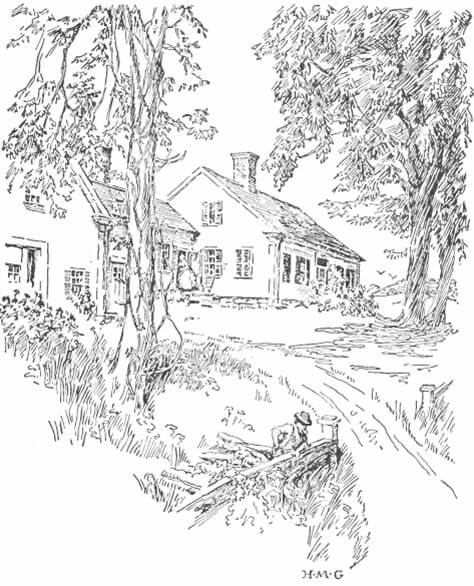 Uncle Jerry’s House
CHAPTER VII. HOW A BOY BROUGHT THE ADMIRAL TO GRIEF.
Columbus kept sailing on from one island to another. Each new island he found would, he hoped, bring him nearer to Cathay and to the marble temples and golden palaces and splendid cities he was looking for. But the temples and palaces and cities did not appear. When the Admiral came to the coast of Cuba he said: This, I know, is the mainland of Asia. So he sent off Louis, the interpreter, with a letter to the “great Emperor of Cathay.” Louis was gone several days; but he found no emperor, no palace, no city, no gold, no jewels, no spices, no Cathay—only frail houses of bark and reeds, fields of corn and grain, with simple people who could tell him nothing about Cathay or Cipango or the Indies.
So day after day Columbus kept on his search, sailing from island to island, getting a little gold here and there, or some pearls and silver and a lot of beautiful bird skins, feathers and trinkets.
Then Captain Alonso Pinzon, who was sailing in the Pinta, believed he could do better than follow the Admiral’s lead. I know, he said, if I could go off on my own hook I could find plenty of gold and pearls, and perhaps I could find Cathay. So one day he sailed away and Columbus did not know what had become of him.
At last Columbus, sailing on and troubled at the way Captain Alonso Pinzon had acted, came one day to the island of Hayti. If Cuba was Cathay (or China), Hayti, he felt sure, must be Cipango (or Japan). So he decided to sail into one of its harbors to spend Christmas Day. But just before Christmas morning dawned, the helmsman of the Santa Maria, thinking that everything was safe, gave the tiller into the hands of a boy—perhaps it was little Pedro the cabin boy—and went to sleep. The rest of the crew also were asleep. And the boy who, I suppose, felt quite big to think that he was really steering the Admiral’s flagship, was a little too smart; for, before he knew it, he had driven the Santa Maria plump upon a hidden reef. And there she was wrecked. They worked hard to get her off but it was no use. She keeled over on her side, her seams opened, the water leaked in, the waves broke over her, the masts fell out and the Santa Maria had made her last voyage.
Then Columbus was in distress. The Pinta had deserted him, the Santa Maria was a wreck, the Nina was not nearly large enough to carry all his men back to Spain. And to Spain he must return at once. What should he do?
Columbus was quick at getting out of a fix. So in this case he speedily decided what to do. He set his men at work tearing the wreck of the Santa Maria to pieces. Out of her timbers and woodwork, helped out with trees from the woods and a few stones from the shore, he made quite a fort. It had a ditch and a watch-tower and a drawbridge. It proudly floated the flag of Spain. It was the first European fort in the new world. On its ramparts Columbus mounted the cannons he had saved from the wreck and named the fort La Navidad—that is, Fort Nativity, because it was made out of the ship that was wrecked on Christmas Day-the day of Christ’s nativity, his birthday.
He selected forty of his men to stay in the fort until he should return from Spain. The most of them were quite willing to do this as they thought the place was a beautiful one and they would be kept very busy filling the fort with gold. Columbus told them they must have at least a ton of gold before he came back. He left them provisions and powder for a year, he told them to be careful and watchful, to be kind to the Indians and to make the year such a good one that the king and queen of Spain would be glad to reward them. And then he said good-by and sailed away for Spain.
It was on the fourth of January, 1493, that Columbus turned the little Nina homeward. He had not sailed very far when what should he come across but the lost Pinta. Captain Alonso Pinzon seemed very much ashamed when he saw the Admiral, and tried to explain his absence. Columbus knew well enough that Captain Pinzon had gone off gold hunting and had not found any gold. But he did not scold him, and both the vessels sailed toward Spain.
The homeward voyage was a stormy and seasick one. Once it was so rough that Columbus thought surely the Nina would be wrecked. So he copied off the story of what he had seen and done, addressed it to the king and queen of Spain, put it into a barrel and threw the barrel overboard.
But the Nina was not shipwrecked, and on the eighteenth of February Columbus reached the Azores. The Portuguese governor was so surprised when he heard this crazy Italian really had returned, and was so angry to think it was Spain and not Portugal that was to profit by his voyage that he tried to make Columbus a prisoner. But the Admiral gave this inhospitable welcomer the slip and was soon off the coast of Portugal.
Here he was obliged to land and meet the king of Portugal—that same King John who had once acted so meanly toward him. King John would have done so again had he dared. But things were quite different now. Columbus was a great man. He had made a successful voyage, and the king and queen of Spain would have made it go hard with the king of Portugal if he dared trouble their admiral. So King John had to give a royal reception to Columbus, and permit him to send a messenger to the king and queen of Spain with the news of his return from Cathay.
Then Columbus went on board the Nina again and sailed for Palos. But his old friend Captain Alonso Pinzon had again acted badly. For he had left the Admiral in one of the storms at sea and had hurried homeward. Then he sailed into one of the northern ports of Spain, and hoping to get all the credit for his voyage, sent a messenger post-haste to the king and queen with the word that he had returned from Cathay and had much to tell them. And then he, too, sailed for Palos.
On the fifteenth of March, 1493, just seven months after he had sailed away to the West, Columbus in the Nina sailed into Palos Harbor. The people knew the little vessel at once. And then what a time they made! Columbus has come back, they cried. He has found Cathay. Hurrah! hurrah! And the bells rang and the cannons boomed and the streets were full of people. The sailors were welcomed with shouts of joy, and the big stories they told were listened to with open mouths and many exclamations of surprise. So Columbus came back to Palos. And everybody pointed him out and cheered him and he was no longer spoken of as “that crazy Italian who dragged away the men of Palos to the Jumping-off place.”
And in the midst of all this rejoicing what should sail into the harbor of Palos but the Pinta, just a few hours late! And when Captain Alonso Pinzon heard the sounds of rejoicing, and knew that his plans to take away from Columbus all the glory of what had been done had all gone wrong, he did not even go to see his old friend and ask his pardon. He went away to his own house without seeing any one. And there he found a stern letter from the king and queen of Spain scolding him for trying to get the best of Columbus, and refusing to hear or see him. The way things had turned out made Captain Alonso Pinzon feel so badly that he fell sick; and in a few days he died.
But Columbus, after he had seen his good friend Juan Perez, the friar at Rabida, and told him all his adventures, went on to Barcelona where King Ferdinand and Queen Isabella were waiting for him. They had already sent him letters telling him how pleased they were that he had found Cathay, and ordering him to get ready for a second expedition at once. Columbus gave his directions for this, and then, in a grand procession that called everybody to the street or window or housetop, he set off for Barcelona. He reached the court on a fine April day and was at once received with much pleasure by the king and queen of Spain.
Columbus told them where he had been and what he had seen; he showed them the gold and the pearls and the birds and curiosities he had brought to Spain as specimens, of what was to be found in Cathay; he showed them the ten painted and “fixed-up” Indians he had stolen and brought back with him.
And the king and queen of Spain said he had done well. They had him sit beside them while he told his story, and treated this poor Italian wool-weaver as they would one of their great princes or mighty lords. They told him he could put the royal arms alongside his own on his shield or crest, and they bade him get together at once ships and sailors for a second expedition to Cathay—ships and sailors enough, they said, to get away up to the great cities of Cathay, where the marble temples and the golden palaces must be. It was their wish, they said, to gain the friendship of the great Emperor of Cathay, to trade with him and get a good share of his gold and jewels and spices. For, you see, no one as yet imagined that Columbus had discovered America. They did not even know that there was such a continent. They thought he had sailed to Asia and found the rich countries that Marco Polo had told such big stories about.
Columbus, you may be sure, was “all the rage” now. Wherever he went the people followed him, cheering and shouting, and begging him to take them with him on his next voyage to Cathay.
He was as anxious as any one to get back to those beautiful islands and hunt for gold and jewels. He set to work at once, and on the twenty-fifth of September, 1493, with a fleet of seventeen ships and a company of fifteen hundred men, Columbus the Admiral set sail from Cadiz on his second voyage to Cathay and Cipango and the Indies. And this time he was certain he should find all these wonderful places, and bring back from the splendid cities unbounded wealth for the king and queen of Spain.
Rebecca of Sunnybrook Farm Chapter 8: Color Of Rose
On the very next Friday after this “dreadfullest fight that ever was seen,” as Bunyan says in Pilgrim’s Progress, there were great doings in the little schoolhouse on the hill. Friday afternoon was always the time chosen for dialogues, songs, and recitations, but it cannot be stated that it was a gala day in any true sense of the word. Most of the children hated “speaking pieces;” hated the burden of learning them, dreaded the danger of breaking down in them.
Miss Dearborn commonly went home with a headache and never left her bed during the rest of the afternoon or evening; and the casual female parent who attended the exercises sat on a front bench with beads of cold sweat on her forehead, listening to the all-too-familiar halts and stammers. Sometimes a bellowing infant who had clean forgotten his verse would cast himself bodily on the maternal bosom and be borne out into the open air, where he was sometimes kissed and occasionally spanked; but in any case the failure added an extra dash of gloom and dread to the occasion.
The advent of Rebecca had somehow infused a new spirit into these hitherto terrible afternoons. She had taught Elijah and Elisha Simpson so that they recited three verses of something with such comical effect that they delighted themselves, the teacher, and the school; while Susan, who lisped, had been provided with a humorous poem in which she impersonated a lisping child. Emma Jane and Rebecca had a dialogue, and the sense of companionship buoyed up Emma Jane and gave her self-reliance.
In fact, Miss Dearborn announced on this particular Friday morning that the exercises promised to be so interesting that she had invited the doctor’s wife, the minister’s wife, two members of the school committee, and a few mothers. Living Perkins was asked to decorate one of the blackboards and Rebecca the other. Living, who was the star artist of the school, chose the map of North America. Rebecca liked better to draw things less realistic, and speedily, before the eyes of the enchanted multitude, there grew under her skillful fingers an American flag done in red, white, and blue chalk, every star in its right place, every stripe fluttering in the breeze. Beside this appeared a figure of Columbia, copied from the top of the cigar box that held the crayons.
Miss Dearborn was delighted. “I propose we give Rebecca a good hand-clapping for such a beautiful picture—one that the whole school may well be proud of!”
The scholars clapped heartily, and Dick Carter, waving his hand, gave a rousing cheer.
Rebecca’s heart leaped for joy, and to her confusion she felt the tears rising in her eyes. She could hardly see the way back to her seat, for in her ignorant lonely little life she had never been singled out for applause, never lauded, nor crowned, as in this wonderful, dazzling moment. If “nobleness enkindleth nobleness,” so does enthusiasm beget enthusiasm, and so do wit and talent enkindle wit and talent.
Alice Robinson proposed that the school should sing ‘Three Cheers for the Red, White, and Blue!’ and when they came to the chorus, all point to Rebecca’s flag. Dick Carter suggested that Living Perkins and Rebecca Randall should sign their names to their pictures, so that the visitors would know who drew them.
Huldah Meserve asked permission to cover the largest holes in the plastered walls with boughs and fill the water pail with wild flowers. Rebecca’s mood was above and beyond all practical details. She sat silent, her heart so full of grateful joy that she could hardly remember the words of her dialogue. At recess she bore herself modestly, notwithstanding her great triumph, while in the general atmosphere of good will the Smellie-Randall hatchet was buried and Minnie gathered maple boughs and covered the ugly stove with them, under Rebecca’s direction.
Miss Dearborn dismissed the morning session at quarter to twelve, so that those who lived near enough could go home for a change of dress. Emma Jane and Rebecca ran nearly every step of the way, from sheer excitement, only stopping to breathe at the stiles.
“Will your aunt Mirandy let you wear your best, or only your buff calico?” asked Emma Jane.
“I think I’ll ask aunt Jane,” Rebecca replied. “Oh! if my pink was only finished! I left aunt Jane making the buttonholes!”
“I’m going to ask my mother to let me wear her garnet ring,” said Emma Jane. “It would look perfectly elegant flashing in the sun when I point to the flag. Goodbye; don’t wait for me going back; I may get a ride.”
Rebecca found the side door locked, but she knew that the key was under the step, and so of course did everybody else in Riverboro, for they all did about the same thing with it. She unlocked the door and went into the dining room to find her lunch laid on the table and a note from aunt Jane saying that they had gone to Moderation with Mrs. Robinson in her carryall. Rebecca swallowed a piece of bread and butter, and flew up the front stairs to her bedroom. On the bed lay the pink gingham dress finished by aunt Jane’s kind hands. Could she, dare she, wear it without asking? Did the occasion justify a new costume, or would her aunts think she ought to keep it for the concert?
“I’ll wear it,” thought Rebecca. “They’re not here to ask, and maybe they wouldn’t mind a bit; it’s only gingham after all, and wouldn’t be so grand if it wasn’t new, and hadn’t tape trimming on it, and wasn’t pink.”
She unbraided her two pigtails, combed out the waves of her hair and tied them back with a ribbon, changed her shoes, and then slipped on the pretty frock, managing to fasten all but the three middle buttons, which she reserved for Emma Jane.
Then her eye fell on her cherished pink sunshade, the exact match, and the girls had never seen it. It wasn’t quite appropriate for school, but she needn’t take it into the room; she would wrap it in a piece of paper, just show it, and carry it coming home. She glanced in the parlor looking-glass downstairs and was electrified at the vision. It seemed almost as if beauty of apparel could go no further than that heavenly pink gingham dress! The sparkle of her eyes, glow of her cheeks, sheen of her falling hair, passed unnoticed in the all-conquering charm of the rose-colored garment. Goodness! it was twenty minutes to one and she would be late. She danced out the side door, pulled a pink rose from a bush at the gate, and covered the mile between the brick house and the seat of learning in an incredibly short time, meeting Emma Jane, also breathless and resplendent, at the entrance.
“Rebecca Randall!” exclaimed Emma Jane, “you’re handsome as a picture!”
“I?” laughed Rebecca “Nonsense! it’s only the pink gingham.”
“You’re not good looking every day,” insisted Emma Jane; “but you’re different somehow. See my garnet ring; mother scrubbed it in soap and water. How on earth did your aunt Mirandy let you put on your brand new dress?”
“They were both away and I didn’t ask,” Rebecca responded anxiously. “Why? Do you think they’d have said no?”
“Miss Mirandy always says no, doesn’t she?” asked Emma Jane.
“Ye—es; but this afternoon is very special—almost like a Sunday school concert.”
“Yes,” assented Emma Jane, “it is, of course; with your name on the board, and our pointing to your flag, and our elegant dialogue, and all that.”
The afternoon was one succession of solid triumphs for everybody concerned. There were no real failures at all, no tears, no parents ashamed of their offspring. Miss Dearborn heard many admiring remarks passed upon her ability, and wondered whether they belonged to her or partly, at least, to Rebecca. The child had no more to do than several others, but she was somehow in the foreground.
It transpired afterwards at various village entertainments that Rebecca couldn’t be kept in the background; it positively refused to hold her. Her worst enemy could not have called her pushing. She was ready and willing and never shy; but she sought for no chances of display and was, indeed, remarkably lacking in self-consciousness, as well as eager to bring others into whatever fun or entertainment there was.
If wherever the MacGregor sat was the head of the table, so in the same way wherever Rebecca stood was the center of the stage. Her clear high treble soared above all the rest in the choruses, and somehow everybody watched her, took note of her gestures, her whole-souled singing, her irrepressible enthusiasm.
Finally it was all over, and it seemed to Rebecca as if she should never be cool and calm again, as she loitered on the homeward path. There would be no lessons to learn tonight, and the vision of helping with the preserves on the morrow had no terrors for her—fears could not draw breath in the radiance that flooded her soul. There were thick gathering clouds in the sky, but she took no note of them save to be glad that she could raise her sunshade. She did not tread the solid ground at all, or have any sense of belonging to the common human family, until she entered the side yard of the brick house and saw her aunt Miranda standing in the open doorway. Then with a rush she came back to earth.
Peter and Polly Series Lesson 6: In the Woods
Let us go after those beechnuts today,” said Tim to Peter. “My mother says that I may.”

“The squirrels take all the nuts,” said Peter. “We cannot find any.”
“Yes, we can,” said Tim. “We can get the beechnuts before the squirrels do. Only we must hurry. See if you may go.”
Mother said, “Yes.” Then the boys went through the field back of Tim’s house. They passed the sandbank. Soon they came to the edge of the woods.
The woods were not green any longer. The trees were bright with colors. There were many red and yellow sugar maples. Tim’s father always tapped these in the spring.
A few of the trees in the woods were evergreens. Their needles were a dark green.
And there were many beech trees. Their leaves had turned brown and yellow.
“See, Peter,” said Tim. “Some of the leaves have come down. I am glad. We can play in them.”
“No,” said Peter. “We must hunt for beechnuts. Let us find a beech tree. Then we will look on the ground for nuts.”
“All right,” said Tim. And he began to hunt for beechnuts under a maple tree.
He looked on top of the leaves. He scraped up the leaves. But not one single nut did he find.
“There are no nuts,” he said. “This is not a beechnut year. I shall not hunt anymore.”
Just then Peter shouted, “Oh, come here, come here! I have found some! See, see! The squirrels have not taken them all.”
He held out his hand. In it were some small, brown nuts. They were three-cornered nuts. Two were in a prickly burr.
“There are more on the ground,” he said. “And, Oh Tim! Look up into the tree! I can see burrs all over it. I wish that we could climb up and knock them off.”
“I wish so, too,” said Tim. “I am going back to look up into my tree. Maybe they have not come down from my tree.”
When Peter saw Tim looking up into a maple, he laughed.
“Oh Tim!” he said. “Of course, you cannot find any beechnuts there. Beechnuts do not grow on maples. Find a beech.”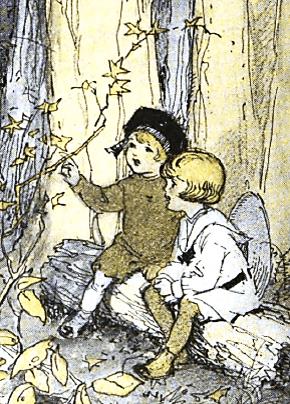
Soon Tim found a tree like Peter’s. The leaves were not the shape of maple leaves. The bark was smoother than maple bark. It had gray spots on it.
Tim began to find nuts, too. He put them into his pocket. That is where Peter put his.
It was not easy work to find such little nuts. Sometimes they were lying on the leaves. Sometimes the leaves hid them.
“It is easier to pick up butternuts,” said Peter. “I could fill my pockets with them very quickly. I shall never get my pockets filled with beechnuts. I have enough any way. Let’s go home.”
“In a minute,” said Tim. “Let’s sit here a little while. See the leaves come down. I can hear them, too. Can you?”
“Yes,” said Peter. “And I shall be glad when they are all down. I am wishing for winter all the time. My mother says that it will come soon.”
The woods were very still. The boys heard no birds singing. Some of them had gone south. Those that were left did not sing.
There was no noise but the sound of the leaves as they fell down from the trees.
Peter got up and scuffed in the fallen leaves.
“I like the smell of them,” he said. “Now I am going home. Come on.”
So home through the field they went. Collie met them. He jumped around them and barked. Perhaps he said, “Why didn’t you take me with you?”
Tim put his hand into his pocket to show Collie his beechnuts. But he could not find them.
He turned his pocket inside out. Still he found no nuts. Instead, he found a large hole.
He said to Peter, “The squirrels take most of the nuts, and the hole takes the rest. I think that is a good joke. Let us go for more, tomorrow.”

Great Stories for Little Americans: FRANKLIN ASKS THE SUNSHINE SOMETHING.
One day Franklin was eating dinner at the house of a friend. The lady of the house, when she poured out the coffee, found that it was not hot.
She said, “I am sorry that the coffee is cold. It is because the servant forgot to scour the coffee-pot. Coffee gets cold more quickly when the coffee-pot is not bright.”
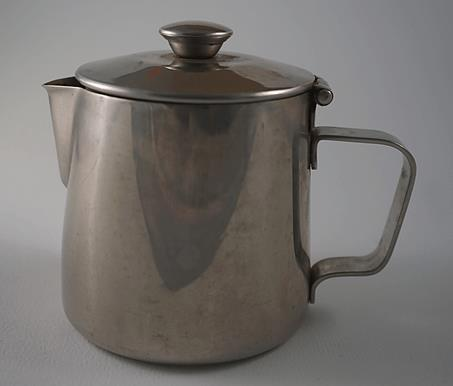
This set Franklin to thinking. He thought that a black or dull thing would cool more quickly than a white or bright one. That made him think that a black thing would take in heat more quickly than a white one.
He wanted to find out if this were true or not. There was no-body who knew, so there was no-body to ask. But Franklin thought that he would ask the sunshine. Maybe the sunshine would tell him whether a black thing would heat more quickly than a white thing.
But how could he ask the sunshine?
There was snow on the ground. Franklin spread a white cloth on the snow. Then he spread a black cloth on the snow near the white one. When he came to look at them, he saw that the snow under the black cloth melted away much sooner than that under the white cloth.
That is the way that the sunshine told him that black would take in heat more quickly than white. After he had found this out, many people got white hats to wear in the summer time. A white hat is cooler than a black one.
Some time when there is snow on the ground, you can take a white and a black cloth and ask the sunshine the same question.
Songs That Teach: Reflections on Life and Faith
Songs have the power to make us reflect on various things, some positive and some not so much. They can teach us valuable lessons, and it’s often easier to remember a song than random facts. Below are a few articles I’ve written that feature a song, sharing some of my personal thoughts. More will be added as time goes by.
- The Power of Hearing: Shaping Faith and Life Choices (Be careful Little Eyes what you see)
- Stand for Your Beliefs: Lessons from the 90’s Song (You’ve Got to Stand for Something)
- Nostalgic Hymns and Childlike Faith (various hymns)
- Songs about prayer: Remembering the Importance of Prayer in Busy Lives
- Spiritual Warfare: Obeying God for Victory (Look What the Lord has Done)
- Understanding Divine Love through “Love Without End, Amen”
- Faith and Perseverance: Running Life’s Race (The River)
- Lust and Its Role in Conflict According to the Bible: War originates from human lust and strife, countered by Jesus’ command to love one another, promoting peace over conflict. (War: What is it good for)
Peter and Polly Series: Peter’s Fifth Birthday
Mother, when is my birthday?” asked Peter. “I wish I could be five years old soon.”
“You will be five years old soon, Peter. Your birthday is the very last day of this month. It comes on Halloween. Do you know about that?”
“Yes, mother, I know. The big boys and the big girls go out with Jack-o’-lanterns and scare people.”
“Sometimes they do,” said mother. “I am going to let you have a birthday party this year. Are you glad?”
“Oh, goody, goody, mother! May Tim come?”
“Yes, Peter, and you may ask three other boys to your party. Which shall you choose?”
“I shall choose Ned and Jack and Will. When may I ask them?”
“Any time you wish, Peter. Ask them to come to your party on the last day of October. I will speak to their mothers about it.”
Peter awoke early on the morning of his birthday. He called to Polly. Mother heard him.
She said, “Turn on the light, Peter. You may begin to dress, if you wish. There are some presents for you downstairs.”
“Did Santa Claus leave them?” asked Peter. “I must hurry and look. May I go down before I dress?”
“If you wish,” said mother.
When he ran downstairs, he found a sled, a pair of mittens, a book, and a new fur cap. He liked these very much.
All that day Peter was quite busy. First, he had to help father. Father was working in the barn. He was making Jack-o’-lanterns.
He made big ones and middle-sized ones and little ones. All had funny faces. All were smiling at something. Peter helped to scrape out the insides of the pumpkins.
He said, “I never before saw so many Jack-o’-lanterns. I am glad that you planted lots of pumpkin seeds. What shall we do with so many?”
“Mother will show you by and by,” said father.
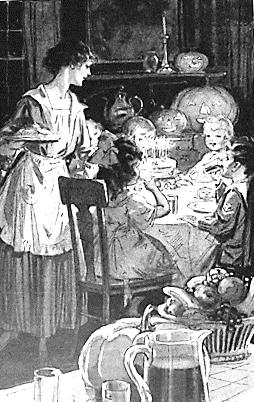
When the lanterns were done, Peter helped mother. They put the lanterns in the dining room. Some were on a table. Some were on a shelf. Some were on the sideboard. The room was full of smiling lanterns.
Next Peter helped mother wash and polish five apples. These were for an apple game. They hung by strings from the top of the room. They hung down into the middle of the room.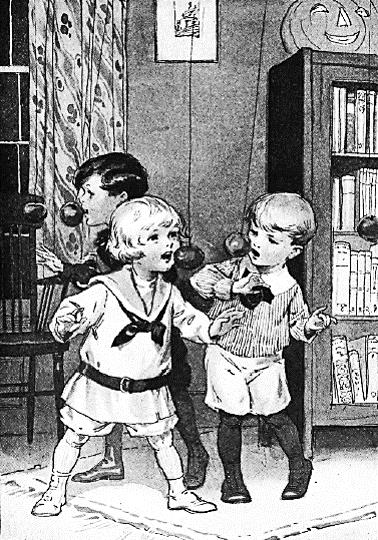
The boys would try to take a bite of these apples without touching them with their hands. This would be fun.
At last it was time for the party to begin. Tim came first. He wished to start playing at once. But just then the three other boys came. Then the fun began.
Tim tried to take a bite out of one swinging apple. But he got only some hard knocks on his nose. The apple was so slippery that he could not get a piece without using his hands.
“I do not wish a bite anyway,” said Tim. “You play that game, Ned. I will do something else.”
“Here is my train of cars,” said Peter. “Let us play with that.”
“I shall be the engineer,” said Tim. But he ran the engine so fast that the train went off the track.
Then they all played tag. This was fun until Jack tumbled over a chair. He bumped his nose, but he did not care much.
Mrs. Howe said, “You must play a quieter game now. Try puss in the corner. There are four corners in this room and there are five boys.”
“Peter, you must be the first one without a corner.”
What fun it was changing corners! At last Tim was in the middle. He could not get a corner. He grew tired of trying.
He said, “May we play leapfrog? I will be the first frog.”
All the boys but Peter could jump quite well. Peter got stuck. He had to be the next frog.
Then Ned tumbled over his back. So Ned had to be the frog.
At last Mrs. Howe said, “You boys must be hungry. You; nave worked hard. Supper is almost ready. There is time for one game of hide and seek. You may all hide. I will hunt for you. Hurry, while I count five hundred.”
Off they ran. After a minute, they heard her call, “One, two, three; look out for me, for I am coming; one, two, three.”
She uncovered her eyes and turned around. She saw Peter behind a chair. Then she said, “I spy Peter, and touch the goal before him.”
Behind the door she found Will. So she said, “I spy Will, and touch the goal before him.”
Just at that minute somebody under the couch sneezed and then somebody laughed. Mother found Jack and Ned there.
She said, “I spy Jack and Ned, and touch the goal before them.”
Only Tim was left. He could not be found. Mother hunted everywhere for him. At last she called, “I give up, Tim. You are safe. Come out now.”
Tim walked in from the hall. He had been hiding under Mr. Howe’s long coat. It hung from a hook nearly to the floor.
“I beat, didn’t I?” asked Tim.
“Yes, indeed,” said Mrs. Howe. “Now come to the dining room. I hear grandmother. She and Polly have just come in. We were waiting supper for Polly.”
She opened the door and the children looked in.
“Oh, oh, oh!” they cried. Then they began to laugh. You see, every Jack-o’-lantern was lighted. Everyone was grinning at them.
And besides, there, on the table, was Peter’s birthday cake. That looked very good.
What fun those children had at supper! And the Jack-o’-lanterns must have had fun, too. Anyway, they smiled a great deal.
When the boys went home, each carried a large piece of Peter’s cake and a box of candy with him.
The Jack-o’-lanterns stayed all night. They had never before been to a party. Perhaps they talked about it, when everyone had gone to bed.
Biblical Perspectives on the Baptism of the Holy Ghost
The Holy Spirit
JESUS SPOKE OF THIS EXPERIENCE
Jesus spoke of this experience when He said
- John 3:5 Jesus answered, Verily, verily, I say unto thee, Except a man be born of water and of the Spirit, he cannot enter into the kingdom of God.
PAUL PREACHED IT
- Paul emphasized it with the words
- Romans 8:9 But ye are not in the flesh, but in the Spirit, if so be that the Spirit of God dwell in you. Now if any man have not the Spirit of Christ, he is none of his.
- Christ actually comes and takes up His abode in a human body (temple).
- 1 Corinthians 6:19 What? know ye not that your body is the temple of the Holy Ghost which is in you, which ye have of God, and ye are not your own?
- The baptism of the Holy Ghost is promised to all who obey God’s command to repent and who exercise faith in Jesus Christ.
- Paul described it as: Joy unspeakable.
- Romans 14:17 For the kingdom of God is not meat and drink; but righteousness, and
peace, and joy in the Holy Ghost
- Romans 14:17 For the kingdom of God is not meat and drink; but righteousness, and
PETER TOLD OF IT
- Peter spoke in Acts about the experience of the Holy Ghost. Later he described the feeling
when the Creator dwells within his creation through the baptism of the Holy Ghost.- 1 Peter 1:8 Whom having not seen, ye love; in whom, though now ye see him not, yet believing, ye rejoice with joy unspeakable and full of glory:
The Evidence of the Holy Ghost
- Acts 2:1-3 records the initial outpouring of the Holy Hust, when the believe the upper
room spoke with other tongues.- And when the day of Pentecost was fully come, they were all with one accord in one place. And suddenly there came a sound from heaven as of a rushing mighty wind, and it filled all the house where they were sitting. And there appeared unto them cloven tongues like as of fire, and it sat upon each of them.
Who spoke in tongues in the Scriptures?
- EVERYONE IN THE UPPER ROOM
- On the Day of Pentecost all 120 were filled;
- Acts 2:4 And they were all filled with the Holy Ghost, and began to speak with other tongues, as the Spirit gave them utterance.
- Among them were Mary, mother of Jesus, Jesus’ four half-brothers, and all the disciples.
- On the Day of Pentecost all 120 were filled;
- SAMARITANS RECEIVED THE HOLY GHOST
- The Samaritans received the same experience and an outward sign to tell everyone when people received the Holy Ghost.
- Even Simon the sorcerer knew they had received a heavenly gift and sought to buy the power
- Acts 8:9-13 But there was a certain man, called Simon, which beforetime in the same city used sorcery, and bewitched the people of Samaria, giving out that himself was some great one: To whom they all gave heed, from the least to the greatest, saying, This man is the great power of God. And to him they had regard, because that of long time he had bewitched them with sorceries. But when they believed Philip preaching the things concerning the kingdom of God, and the name of Jesus Christ, they were baptized, both men and women. Then Simon himself believed also: and when he was baptized, he continued with Philip, and wondered, beholding the miracles and signs which were done.
- GENTILES RECEIVED THE HOLY GHOST
- The Holy Ghost fell on Cornelius and other Gentiles, and they spoke with other tongues
- This sign convinced the skeptical Jewish Christians that the Gentiles had received the Holy Ghost, and this sign alone was sufficient for Peter to proclaim that the Gentles had received the same Holy Ghost experience
- Acts 10:44-48 While Peter yet spake these words, the Holy Ghost fell on all them which heard the word. And they of the circumcision which believed were astonished, as many as came with Peter, because that on the Gentiles also was poured out the gift of the Holy Ghost. For they heard them speak with tongues, and magnify God. Then answered Peter, Can any man forbid water, that these should not be baptized, which have received the Holy Ghost as well as we? And he commanded them to be baptized in the name of the Lord. Then prayed they him to tarry certain days.
- Acts 11:15-17 And as I began to speak, the Holy Ghost fell on them, as on us at the beginning. Then remembered I the word of the Lord, how that he said, John indeed baptized with water; but ye shall be baptized with the Holy Ghost. Forasmuch then as God gave them the like gift as he did unto us, who believed on the Lord Jesus Christ; what was I, that I could withstand God?
- DISCIPLES OF JOHN THE BAPTIST RECEIVED THE HOLY GHOST
- In Acts 19, a group of John the Baptist’s disciples were rebaptized in Jesus’ name by the apostle Paul, and they were filled with the Holy Ghost.
- Acts 19:1-6 And it came to pass, that, while Apollos was at Corinth, Paul having passed through the upper coasts came to Ephesus: and finding certain disciples, He said unto them, Have ye received the Holy Ghost since ye believed? And they said unto him, We have not so much as heard whether there be any Holy Ghost. And he said unto them, Unto what then were ye baptized? And they said, Unto John’s baptism. Then said Paul, John verily baptized with the baptism of repentance, saying unto the people, that they should believe on him which should come after him, that is, on Christ Jesus. When they heard this, they were baptized in the name of the Lord Jesus. And when Paul had laid his hands upon them, the Holy Ghost came on them; and they spake with tongues, and prophesied.
- In Acts 19, a group of John the Baptist’s disciples were rebaptized in Jesus’ name by the apostle Paul, and they were filled with the Holy Ghost.
Mother Goose: Three Wise Men of Gotham
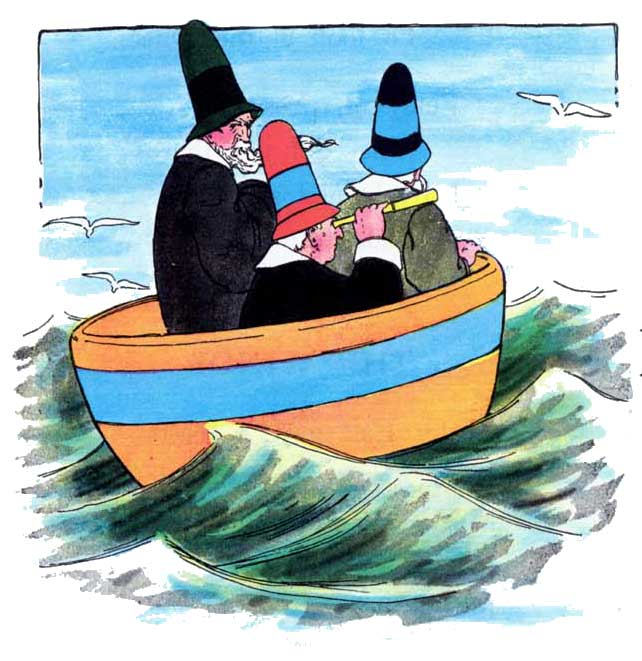
THREE WISE MEN OF GOTHAM
Three wise men of Gotham
Went to sea in a bowl;
If the bowl had been stronger
My song had been longer.
By Mother Goose


 articlesforchristians