Archive for June, 2025
“We cannot be far from the road of yellow brick, now,” remarked the Scarecrow, as he stood beside the girl, “for we have come nearly as far as the river carried us.”


The Story of Mankind: Mesopotamia
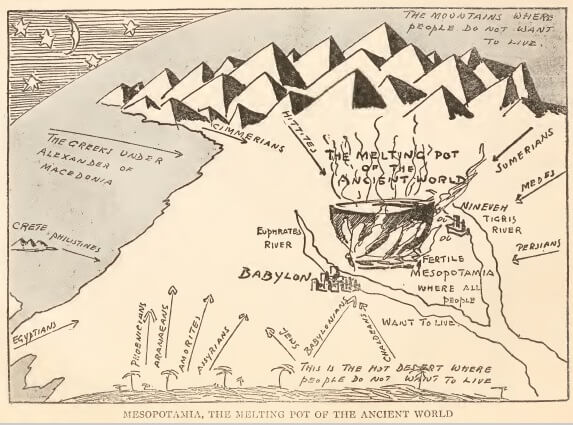
I am going to take you to the top of the highest pyramid and I am going to ask that you imagine yourself possessed of the eyes of a hawk. Way, way off, in the distance, far beyond the yellow sands of the desert, you will see something green and shimmering. It is a valley situated between two rivers. It is the Paradise of the Old Testament. It is the land of mystery and wonder which the Greeks called Mesopotamia—the “country between the rivers.”
The names of the two rivers are the Euphrates (which the Babylonians called the Purattu) and the Tigris (which was known as the Diklat). They begin their course amidst the snows of the mountains of Armenia where Noah’s Ark found a resting place and slowly they flow through the southern plain until they reach the muddy banks of the Persian Gulf. They perform a very useful service. They turn the arid regions of western Asia into a fertile garden.
The valley of the Nile had attracted people because it had offered them food upon fairly easy terms. The “land between the rivers” was popular for the same reason. It was a country full of promise and both the inhabitants of the northern mountains and the tribes which roamed through the southern deserts tried to claim this territory as their own and most exclusive possession.
The constant rivalry between the mountaineers and the desert-nomads led to endless warfare. Only the strongest and the bravest could hope to survive and that will explain why Mesopotamia became the home of a very strong race of people who were capable of creating a civilization which was in every respect as important as that of Egypt.
CHAPTER 6: WHAT COLUMBUS DISCOVERED
A little over three hundred years ago there was a Pope of Rome whose name was Gregory XIII. He was greatly interested in learning and science, and when the scholars and wise men of his day showed him that a mistake in reckoning time had long before been made he set about to make it right. At that time the Pope of Rome had great influence with the kings and queens of Europe, and whatever he wished them to do they generally did.
So they all agreed to his plan of renumbering the days of the year, and a new reckoning of time was made upon the rule that most of you know by heart in the old rhyme:
Thirty days hath September, April, June and November; All the rest have thirty-one, Excepting February which alone Hath twenty-eight—and this, in fine, One year in four hath twenty-nine.
And the order of the days of the months and the year is what is called, after Pope Gregory, the Gregorian Calendar.
This change in reckoning time made, of course, all past dates wrong. The old dates, which were called Old Style, had to be made to correspond with the new dates which were called New Style.
Now, according to the Old Style, Columbus discovered the islands he thought to be the Indies (and which have ever since been called the West Indies) on the twelfth of October, 1492. But, according to the New Style, adopted nearly one hundred years after his discovery, the right date would be the twenty-first of October. And this is why, in the Columbian memorial year of 1892, the world celebrated the four hundredth anniversary of the discovery of America on the twenty-first of October; which, as you see, is the same as the twelfth under the Old Style of reckoning time.
But did Columbus discover America? What was this land that greeted his eyes as the daylight came on that Friday morning, and he saw the low green shores that lay ahead of his caravels.
As far as Columbus was concerned he was sure that he had found some one of the outermost islands of Cipango or Japan. So he dropped his anchors, ordered out his rowboat, and prepared to take possession of the land in the name of the queen of Spain, who had helped him in his enterprise.
Just why or by what right a man from one country could sail up to the land belonging to another country and, planting in the ground the flag of his king, could say, “This land belongs to my king!” is a hard question to answer. But there is an old saying that tells us, Might makes right; and the servants of the kings and queens—the adventurers and explorers of old—used to go sailing about the world with this idea in their heads, and as soon as they came to a land they, had never seen before, up would go their flag, and they would say, This land is mine and my king’s! They would not of course do this in any of the well-known or “Christian lands” of Europe; but they believed that all “pagan lands” belonged by right to the first European king whose sailors should discover and claim them.
So Columbus lowered a boat from the Santa Maria, and with two of his chief men and some sailors for rowers he pulled off toward the island.
But before he did so, he had to listen to the cheers and congratulations of the very sailors who, only a few days before, were ready to kill him. But, you see, this man whom they thought crazy had really brought them to the beautiful land, just as he had promised. It does make such a difference, you know, in what people say whether a thing turns out right or not.
Columbus, as I say, got into his rowboat with his chief inspector and his lawyer. He wore a crimson cloak over his armor, and in his hand he held the royal banner of Spain. Following him came Captain Alonso Pinzon in a rowboat from the Pinta, and in a rowboat from the Nina Captain Vincent Pinzon. Each of these captains carried the “banner of the green cross” on which were to be seen the initials of the king and queen of Spain.
As they rowed toward the land they saw some people on the shore. They were not dressed in the splendid clothes the Spaniards expected to find the people of Cathay wearing. In fact, they did not have on much of anything but grease and paint. And the land showed no signs of the marble temples and gold-roofed palaces the sailors expected to find. It was a little, low, flat green island, partly covered with trees and with what looked like a lake in the center.
This land was, in fact, one of the three thousand keys or coral islands that stretch from the capes of Florida to the island of Hayti, and are known as the Bahama Islands. The one upon which Columbus landed was called by the natives Guanahani, and was either the little island now marked on the map as Cat Island or else the one called Watling’s Island. Just which of these it was has been discussed over and over again, but careful scholars have now but little doubt that it was the one known to-day as Watling’s Island. To see no sign of glittering palaces and gayly dressed people was quite a disappointment to Columbus. But then, he said, this, is probably the island farthest out to sea, and the people who live here are not the real Cathay folks. We shall see them very soon.
So with the royal banner and the green-cross standards floating above him, with his captains and chief officers and some of the sailors gathered about him, while all the others watched him from the decks of his fleet, Columbus stepped upon the shore. Then he took off his hat, and holding the royal banner in one hand and his sword in the other he said aloud: I take possession of this island, which I name San Salvador,(*) and of all the islands and lands about it in the name of my patron and sovereign lady, Isabella, and her kingdom of Castile. This, or something like it, he said, for the exact words are not known to us.
     (*) The island of San Salvador means the island of the Holy
     Saviour. Columbus and the Spanish explorers who followed him
     gave Bible or religious names to very much of the land they
     discovered.
And when he had done this the captains and sailors fell at his feet in wonder and admiration, begging him to forgive them for all the hard things they had said about him. For you have found Cathay, they cried. You are our leader. You will make us rich and powerful. Hurrah for the great Admiral!
And when the naked and astonished people of the island saw all this—the canoes with wings, as they called the ships, the richly-dressed men with white and bearded faces, the flags and swords, and the people kneeling about this grand-looking old man in the crimson cloak—they said to one another: These men are gods; they have come from Heaven to see us. And then, they, too, fell on the ground and worshiped these men from Heaven, as they supposed Columbus and his sailors to be.
And when they found that the men from Heaven did not offer to hurt them, they came nearer; and the man in the crimson cloak gave them beads and pieces of bright cloth and other beautiful things they had never seen before. And this made them feel all the more certain that these men who had come to see them in the canoes with wings must really be from Heaven. So they brought them fruits and flowers and feathers and birds as presents; and both parties, the men with clothes and the men without clothes, got on very well together.
But Columbus, as we know, had come across the water for one especial reason. He was to find Cathay, and he was to find it so that he could carry back to Spain the gold and jewels and spices of Cathay. The first thing, therefore, that he tried to find out from the people of the island—whom he called “Indians,” because he thought he had come to a part of the coast of India was where Cathay might be.
Of course they did not understand him. Even Louis, the interpreter, who knew a dozen languages and who tried them all, could not make out what these “Indians” said. But from their signs and actions and from the sound of the words they spoke, Columbus understood that Cathay was off somewhere to the southwest, and that the gold he was bound to find came from there. The “Indians” had little bits of gold hanging in their ears and noses. So Columbus supposed that among the finer people he hoped soon to meet in the southwest, he should find great quantities of the yellow metal. He was delighted. Success, he felt, was not far off. Japan was near, China was near, India was near. Of this he was certain; and even until he died Columbus did not have any idea that he had found a new world—such as America really was. He was sure that he had simply landed upon the eastern coasts of Asia and that he had found what he set out to discover—the nearest route to the Indies.
The next day Columbus pulled up his anchors, and having seized and carried off to his ships some of the poor natives who had welcomed him so gladly, he commenced a cruise among the islands of the group he had discovered.
Day after day he sailed among these beautiful tropic islands, and of them and of the people who lived upon them he wrote to the king and queen of Spain: “This country excels all others as far as the day surpasses the night in splendor. The natives love their neighbors as themselves; their conversation is the sweetest imaginable; their faces smiling; and so gentle and so affectionate are they, that I swear to Your Highness there is not a better people in the world.”
Does it not seem a pity that so great a man should have acted so meanly toward these innocent people who loved and trusted him so? For it was Columbus who first stole them away from their island homes and who first thought of making them slaves to the white men.
The Wonderful Wizard of Oz: Chapter 8: The Deadly Poppy Field
Our little party of travelers awakened the next morning refreshed and full of hope, and Dorothy breakfasted like a princess off peaches and plums from the trees beside the river. Behind them was the dark forest they had passed safely through, although they had suffered many discouragements; but before them was a lovely, sunny country that seemed to beckon them on to the Emerald City.
To be sure, the broad river now cut them off from this beautiful land. But the raft was nearly done, and after the Tin Woodman had cut a few more logs and fastened them together with wooden pins, they were ready to start. Dorothy sat down in the middle of the raft and held Toto in her arms. When the Cowardly Lion stepped upon the raft it tipped badly, for he was big and heavy; but the Scarecrow and the Tin Woodman stood upon the other end to steady it, and they had long poles in their hands to push the raft through the water.
They got along quite well at first, but when they reached the middle of the river the swift current swept the raft downstream, farther and farther away from the road of yellow brick. And the water grew so deep that the long poles would not touch the bottom.
“This is bad,” said the Tin Woodman, “for if we cannot get to the land we shall be carried into the country of the Wicked Witch of the West, and she will enchant us and make us her slaves.”
“And then I should get no brains,” said the Scarecrow.
“And I should get no courage,” said the Cowardly Lion.
“And I should get no heart,” said the Tin Woodman.
“And I should never get back to Kansas,” said Dorothy.

“We must certainly get to the Emerald City if we can,” the Scarecrow continued, and he pushed so hard on his long pole that it stuck fast in the mud at the bottom of the river. Then, before he could pull it out again–or let go–the raft was swept away, and the poor Scarecrow was left clinging to the pole in the middle of the river.
“Goodbye!” he called after them, and they were very sorry to leave him. Indeed, the Tin Woodman began to cry, but fortunately remembered that he might rust, and so dried his tears on Dorothy’s apron.
Of course this was a bad thing for the Scarecrow.
“I am now worse off than when I first met Dorothy,” he thought. “Then, I was stuck on a pole in a cornfield, where I could make-believe scare the crows, at any rate. But surely there is no use for a Scarecrow stuck on a pole in the middle of a river. I am afraid I shall never have any brains, after all!”
Down the stream the raft floated, and the poor Scarecrow was left far behind. Then the Lion said: “Something must be done to save us. I think I can swim to the shore and pull the raft after me, if you will only hold fast to the tip of my tail.”

So he sprang into the water, and the Tin Woodman caught fast hold of his tail. Then the Lion began to swim with all his might toward the shore. It was hard work, although he was so big; but by and by they were drawn out of the current, and then Dorothy took the Tin Woodman’s long pole and helped push the raft to the land.
They were all tired out when they reached the shore at last and stepped off upon the pretty green grass, and they also knew that the stream had carried them a long way past the road of yellow brick that led to the Emerald City.
“What shall we do now?” asked the Tin Woodman, as the Lion lay down on the grass to let the sun dry him.
“We must get back to the road, in some way,” said Dorothy.
“The best plan will be to walk along the riverbank until we come to the road again,” remarked the Lion.
So, when they were rested, Dorothy picked up her basket and they started along the grassy bank, to the road from which the river had carried them. It was a lovely country, with plenty of flowers and fruit trees and sunshine to cheer them, and had they not felt so sorry for the poor Scarecrow, they could have been very happy.

They walked along as fast as they could, Dorothy only stopping once to pick a beautiful flower; and after a time the Tin Woodman cried out: “Look!”
Then they all looked at the river and saw the Scarecrow perched upon his pole in the middle of the water, looking very lonely and sad.
“What can we do to save him?” asked Dorothy.
The Lion and the Woodman both shook their heads, for they did not know. So they sat down upon the bank and gazed wistfully at the Scarecrow until a Stork flew by, who, upon seeing them, stopped to rest at the water’s edge.
“Who are you and where are you going?” asked the Stork.
“I am Dorothy,” answered the girl, “and these are my friends, the Tin Woodman and the Cowardly Lion; and we are going to the Emerald City.”

“This isn’t the road,” said the Stork, as she twisted her long neck and looked sharply at the queer party.
“I know it,” returned Dorothy, “but we have lost the Scarecrow, and are wondering how we shall get him again.”
“Where is he?” asked the Stork.
“Over there in the river,” answered the little girl.
“If he wasn’t so big and heavy I would get him for you,” remarked the Stork.
“He isn’t heavy a bit,” said Dorothy eagerly, “for he is stuffed with straw; and if you will bring him back to us, we shall thank you ever and ever so much.”
“Well, I’ll try,” said the Stork, “but if I find he is too heavy to carry I shall have to drop him in the river again.”
So the big bird flew into the air and over the water till she came to where the Scarecrow was perched upon his pole. Then the Stork with her great claws grabbed the Scarecrow by the arm and carried him up into the air and back to the bank, where Dorothy and the Lion and the Tin Woodman and Toto were sitting.
When the Scarecrow found himself among his friends again, he was so happy that he hugged them all, even the Lion and Toto; and as they walked along he sang “Tol-de-ri-de-oh!” at every step, he felt so gay.
“I was afraid I should have to stay in the river forever,” he said, “but the kind Stork saved me, and if I ever get any brains I shall find the Stork again and do her some kindness in return.”
“That’s all right,” said the Stork, who was flying along beside them. “I always like to help anyone in trouble. But I must go now, for my babies are waiting in the nest for me. I hope you will find the Emerald City and that Oz will help you.”
“Thank you,” replied Dorothy, and then the kind Stork flew into the air and was soon out of sight.
They walked along listening to the singing of the brightly colored birds and looking at the lovely flowers which now became so thick that the ground was carpeted with them. There were big yellow and white and blue and purple blossoms, besides great clusters of scarlet poppies, which were so brilliant in color they almost dazzled Dorothy’s eyes.

“Aren’t they beautiful?” the girl asked, as she breathed in the spicy scent of the bright flowers.
“I suppose so,” answered the Scarecrow. “When I have brains, I shall probably like them better.”
“If I only had a heart, I should love them,” added the Tin Woodman.
“I always did like flowers,” said the Lion. “They seem so helpless and frail. But there are none in the forest so bright as these.”
They now came upon more and more of the big scarlet poppies, and fewer and fewer of the other flowers; and soon they found themselves in the midst of a great meadow of poppies. Now it is well known that when there are many of these flowers together their odor is so powerful that anyone who breathes it falls asleep, and if the sleeper is not carried away from the scent of the flowers, he sleeps on and on forever. But Dorothy did not know this, nor could she get away from the bright red flowers that were everywhere about; so presently her eyes grew heavy and she felt she must sit down to rest and to sleep.
But the Tin Woodman would not let her do this.
“We must hurry and get back to the road of yellow brick before dark,” he said; and the Scarecrow agreed with him. So they kept walking until Dorothy could stand no longer. Her eyes closed in spite of herself and she forgot where she was and fell among the poppies, fast asleep.
“What shall we do?” asked the Tin Woodman.
“If we leave her here she will die,” said the Lion. “The smell of the flowers is killing us all. I myself can scarcely keep my eyes open, and the dog is asleep already.”
It was true; Toto had fallen down beside his little mistress. But the Scarecrow and the Tin Woodman, not being made of flesh, were not troubled by the scent of the flowers.
“Run fast,” said the Scarecrow to the Lion, “and get out of this deadly flower bed as soon as you can. We will bring the little girl with us, but if you should fall asleep you are too big to be carried.”

So the Lion aroused himself and bounded forward as fast as he could go. In a moment he was out of sight.
“Let us make a chair with our hands and carry her,” said the Scarecrow. So they picked up Toto and put the dog in Dorothy’s lap, and then they made a chair with their hands for the seat and their arms for the arms and carried the sleeping girl between them through the flowers.
On and on they walked, and it seemed that the great carpet of deadly flowers that surrounded them would never end. They followed the bend of the river, and at last came upon their friend the Lion, lying fast asleep among the poppies. The flowers had been too strong for the huge beast and he had given up at last, and fallen only a short distance from the end of the poppy bed, where the sweet grass spread in beautiful green fields before them.
“We can do nothing for him,” said the Tin Woodman, sadly; “for he is much too heavy to lift. We must leave him here to sleep on forever, and perhaps he will dream that he has found courage at last.”
“I’m sorry,” said the Scarecrow. “The Lion was a very good comrade for one so cowardly. But let us go on.”
They carried the sleeping girl to a pretty spot beside the river, far enough from the poppy field to prevent her breathing any more of the poison of the flowers, and here they laid her gently on the soft grass and waited for the fresh breeze to waken her.
Rebecca of Sunnybrook Farm: Chapter 7: Riverboro Secrets
Mr. Simpson spent little time with his family, owing to certain awkward methods of horse-trading, or the “swapping” of farm implements and vehicles of various kinds, operations in which his customers were never long suited. After every successful trade he generally passed a longer or shorter term in jail; for when a poor man without goods or chattels has the inveterate habit of swapping, it follows naturally that he must have something to swap; and having nothing of his own, it follows still more naturally that he must swap something belonging to his neighbors.
Mr. Simpson was absent from the home circle for the moment because he had exchanged the Widow Rideout’s sleigh for Joseph Goodwin’s plough. Goodwin had lately moved to North Edgewood and had never before met the urbane and persuasive Mr. Simpson. The Goodwin plough Mr. Simpson speedily bartered with a man “over Wareham way,” and got in exchange for it an old horse which his owner did not need, as he was leaving town to visit his daughter for a year, Simpson fattened the aged animal, keeping him for several weeks (at early morning or after nightfall) in one neighbor’s pasture after another, and then exchanged him with a Milltown man for a top buggy.
It was at this juncture that the Widow Rideout missed her sleigh from the old carriage house. She had not used it for fifteen years and might not sit in it for another fifteen, but it was property, and she did not intend to part with it without a struggle. Such is the suspicious nature of the village mind that the moment she discovered her loss her thought at once reverted to Abner Simpson. So complicated, however, was the nature of this particular business transaction, and so tortuous the paths of its progress (partly owing to the complete disappearance of the owner of the horse, who had gone to the West and left no address), that it took the sheriff many weeks to prove Mr. Simpson’s guilt to the town’s and to the Widow Rideout’s satisfaction.
Abner himself avowed his complete innocence, and told the neighbors how a red-haired man with a harelip and a pepper-and-salt suit of clothes had called him up one morning about daylight and offered to swap him a good sleigh for an old cider press he had layin’ out in the dooryard. The bargain was struck, and he, Abner, had paid the harelipped stranger four dollars and seventy-five cents to boot; whereupon the mysterious one set down the sleigh, took the press on his cart, and vanished up the road, never to be seen or heard from afterwards.
“If I could once ketch that consarned old thief,” exclaimed Abner righteously, “I’d make him dance, workin’ off a stolen sleigh on me an’ takin’ away my good money an’ cider press, to say nothin’ o’ my character!”
“You’ll never ketch him, Ab,” responded the sheriff. “He’s cut off the same piece o’ goods as that there cider press and that there character and that there four-seventy-five o’ yourn; nobody ever see any of ’em but you, and you’ll never see ’em again!”
Mrs. Simpson, who was decidedly Abner’s better half, took in washing and went out to do days’ cleaning, and the town helped in the feeding and clothing of the children. George, a lanky boy of fourteen, did chores on neighboring farms, and the others, Samuel, Clara Belle, Susan, Elijah, and Elisha, went to school, when sufficiently clothed and not otherwise more pleasantly engaged.
There were no secrets in the villages that lay along the banks of Pleasant River. There were many hard-working people among the inhabitants, but life wore away so quietly and slowly that there was a good deal of spare time for conversation, under the trees at noon in the hayfield; hanging over the bridge at nightfall; seated about the stove in the village store of an evening. These meeting places furnished ample ground for the discussion of current events as viewed by the masculine eye, while choir rehearsals, sewing societies, reading circles, church picnics, and the like, gave opportunity for the expression of feminine opinion. All this was taken very much for granted, as a rule, but now and then some supersensitive person made violent objections to it, as a theory of life.
Delia Weeks, for example, was a maiden lady who did dressmaking in a small way; she fell ill, and although attended by all the physicians in the neighborhood, was sinking slowly into a decline when her cousin Cyrus asked her to come and keep house for him in Lewiston. She went, and in a year grew into a robust, hearty, cheerful woman. Returning to Riverboro on a brief visit, she was asked if she meant to end her days away from home.
“I do most certainly, if I can get any other place to stay,” she responded candidly. “I was bein’ worn to a shadder here, tryin’ to keep my little secrets to myself, an’ never succeedin’. First they had it I wanted to marry the minister, and when he took a wife in Standish I was known to be disappointed. Then for five or six years they suspicioned I was tryin’ for a place to teach school, and when I gave up hope, an’ took to dressmakin’, they pitied me and sympathized with me for that. When father died I was bound I’d never let anybody know how I was left, for that spites ’em worse than anything else; but there’s ways o’ findin’ out, an’ they found out, hard as I fought ’em!
Then there was my brother James that went to Arizona when he was sixteen. I gave good news of him for thirty years runnin’, but aunt Achsy Tarbox had a ferretin’ cousin that went out to Tombstone for her health, and she wrote to a postmaster, or to some kind of a town authority, and found Jim and wrote back aunt Achsy all about him and just how unfortunate he’d been. They knew when I had my teeth out and a new set made; they knew when I put on a false front-piece; they knew when the fruit peddler asked me to be his third wife—I never told ’em, an’ you can be sure he never did, but they don’t need to be told in this village; they have nothin’ to do but guess, an’ they’ll guess right every time.
I was all tuckered out tryin’ to mislead ’em and deceive ’em and sidetrack ’em; but the minute I got where I wasn’t put under a microscope by day an’ a telescope by night and had myself to myself without sayin’ ‘By your leave,’ I begun to pick up. Cousin Cyrus is an old man an’ considerable trouble, but he thinks my teeth are handsome an’ says I’ve got a splendid suit of hair. There ain’t a person in Lewiston that knows about the minister, or father’s will, or Jim’s doin’s, or the fruit peddler; an’ if they should find out, they wouldn’t care, an’ they couldn’t remember; for Lewiston ‘s a busy place, thanks be!”
Miss Delia Weeks may have exaggerated matters somewhat, but it is easy to imagine that Rebecca as well as all the other Riverboro children had heard the particulars of the Widow Rideout’s missing sleigh and Abner Simpson’s supposed connection with it.
There is not an excess of delicacy or chivalry in the ordinary country school, and several choice conundrums and bits of verse dealing with the Simpson affair were bandied about among the scholars, uttered always, be it said to their credit, in undertones, and when the Simpson children were not in the group.
Rebecca Randall was of precisely the same stock, and had had much the same associations as her schoolmates, so one can hardly say why she so hated mean gossip and so instinctively held herself aloof from it.
Among the Riverboro girls of her own age was a certain excellently named Minnie Smellie, who was anything but a general favorite. She was a ferret-eyed, blond-haired, spindle-legged little creature whose mind was a cross between that of a parrot and a sheep. She was suspected of copying answers from other girls’ slates, although she had never been caught in the act. Rebecca and Emma Jane always knew when she had brought a tart or a triangle of layer cake with her school luncheon, because on those days she forsook the cheerful society of her mates and sought a safe solitude in the woods, returning after a time with a jocund smile on her smug face.
After one of these private luncheons Rebecca had been tempted beyond her strength, and when Minnie took her seat among them asked, “Is your headache better, Minnie? Let me wipe off that strawberry jam over your mouth.”
There was no jam there as a matter of fact, but the guilty Minnie’s handkerchief went to her crimson face in a flash.
Rebecca confessed to Emma Jane that same afternoon that she felt ashamed of her prank. “I do hate her ways,” she exclaimed, “but I’m sorry I let her know we ‘spected her; and so to make up, I gave her that little piece of broken coral I keep in my bead purse; you know the one?”
“It don’t hardly seem as if she deserved that, and her so greedy,” remarked Emma Jane.
“I know it, but it makes me feel better,” said Rebecca largely; “and then I’ve had it two years, and it’s broken so it wouldn’t ever be any real good, beautiful as it is to look at.”
The coral had partly served its purpose as a reconciling bond, when one afternoon Rebecca, who had stayed after school for her grammar lesson as usual, was returning home by way of the short cut. Far ahead, beyond the bars, she espied the Simpson children just entering the woodsy bit. Seesaw was not with them, so she hastened her steps in order to secure company on her homeward walk. They were speedily lost to view, but when she had almost overtaken them she heard, in the trees beyond, Minnie Smellie’s voice lifted high in song, and the sound of a child’s sobbing. Clara Belle, Susan, and the twins were running along the path, and Minnie was dancing up and down, shrieking:
“‘What made the sleigh love Simpson so?’
The eager children cried;
‘Why Simpson loved the sleigh, you know,’
The teacher quick replied.”
The last glimpse of the routed Simpson tribe, and the last futter of their tattered garments, disappeared in the dim distance. The fall of one small stone cast by the valiant Elijah, known as “the fighting twin,” did break the stillness of the woods for a moment, but it did not come within a hundred yards of Minnie, who shouted “Jail Birds” at the top of her lungs and then turned, with an agreeable feeling of excitement, to meet Rebecca, standing perfectly still in the path, with a day of reckoning plainly set forth in her blazing eyes.
Minnie’s face was not pleasant to see, for a coward detected at the moment of wrongdoing is not an object of delight.
“Minnie Smellie, if ever—I—catch—you—singing—that—to the Simpsons again—do you know what I’ll do?” asked Rebecca in a tone of concentrated rage.
“I don’t know and I don’t care,” said Minnie jauntily, though her looks belied her.
“I’ll take that piece of coral away from you, and I think I shall slap you besides!”
“You wouldn’t darst,” retorted Minnie. “If you do, I’ll tell my mother and the teacher, so there!”
“I don’t care if you tell your mother, my mother, and all your relations, and the president,” said Rebecca, gaining courage as the noble words fell from her lips. “I don’t care if you tell the town, the whole of York county, the state of Maine and—and the nation!” she finished grandiloquently. “Now you run home and remember what I say. If you do it again, and especially if you say ‘Jail Birds,’ if I think it’s right and my duty, I shall punish you somehow.”
The next morning at recess Rebecca observed Minnie telling the tale with variations to Huldah Meserve. “She threatened me,” whispered Minnie, “but I never believe a word she says.”
The latter remark was spoken with the direct intention of being overheard, for Minnie had spasms of bravery, when well surrounded by the machinery of law and order.
As Rebecca went back to her seat she asked Miss Dearborn if she might pass a note to Minnie Smellie and received permission. This was the note:
Of all the girls that are so mean
There’s none like Minnie Smellie.
I’ll take away the gift I gave
And pound her into jelly.
P.S. Now do you believe me?
R. Randall.
The effect of this piece of doggerel was entirely convincing, and for days afterwards whenever Minnie met the Simpsons even a mile from the brick house she shuddered and held her peace.
McGuffey’s Eclectic Primer Lesson 6: The dog has Nat’s cap
Letter Sounds:
- o
- b
- g
Words:
- dog
- Rab
- fat
- Nat’s
Lesson:
Nat’s cap
a fat dog
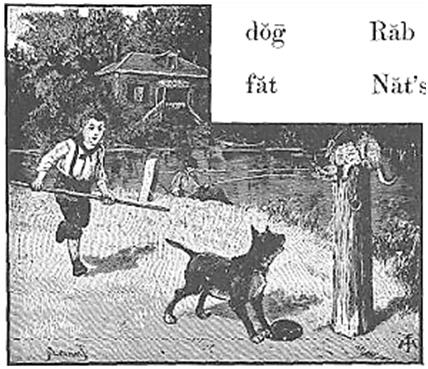
Has the lad a dog?
The lad has a fat dog.
The dog has Nat’s cap.
Nat and Rab ran.
Rab ran at the cat.
Mother Goose: Hush-A-Bye
HUSH-A-BYE
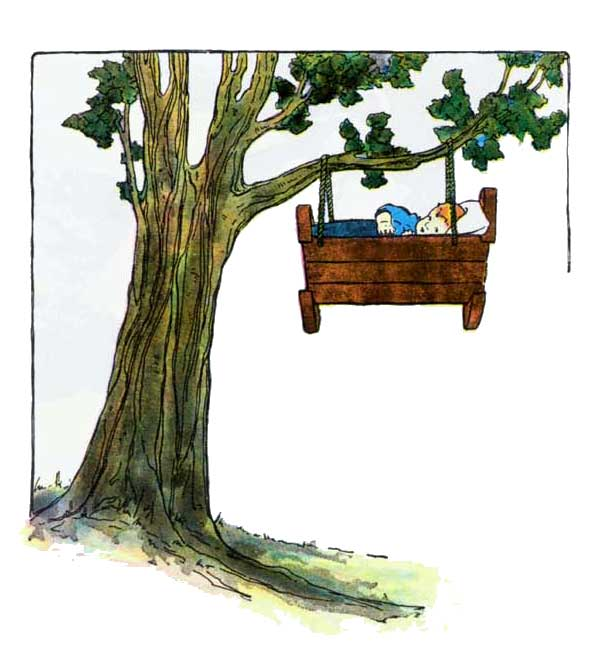
Hush-a-bye, baby, on the tree top!
When the wind blows the cradle will rock;
When the bough breaks the cradle will fall;
Down will come baby, bough, cradle and all.
By Mother Goose
Baptism: A Symbol of Death and New Life
Buried with Him in Baptism
Baptize
- βαπτίζω baptízō, bap-tid’-zo; from a derivative of G911; to immerse, submerge; to make whelmed (i.e. fully wet); used only (in the New Testament) of ceremonial ablution, especially (technically) of the ordinance of Christian baptism:—Baptist, baptize, wash.
- Immersion is important because only this mode preserves the significance of baptism as a
burial. - Repentance in the Bible is symbolic of death to sin and to the ungodly life before the
encounter with Jesus Christ. - Spiritually speaking, when a person repents, he is actually coming to the cross of Calvary.
- The old carnal nature is crucified to Christ.
- After death to sin, a person must be buried with Jesus by baptism.
- But how is a person buried?
- Romans 6:4 Therefore we are buried with him by baptism into death: that like as Christ was raised up from the dead by the glory of the Father, even so we also should walk in newness of life.
Scriptures about being Baptized
- Matthew 28:19 Go ye therefore, and teach all nations, baptizing them in the name of the Father, and of the Son, and of the Holy Ghost:
- Mark 16:16 He that believeth and is baptized shall be saved; but he that believeth not shall be damned.
- John 3:5 Jesus answered, Verily, verily, I say unto thee, Except a man be born of water and of the Spirit, he cannot enter into the kingdom of God.
- Acts 2:38 Then Peter said unto them, Repent, and be baptized every one of you in
- the name of Jesus Christ for the remission of sins, and ye shall receive the gift of the Holy Ghost.
- Acts 8:18 (For as yet he was fallen upon none of them: only they were baptized in the name of the Lord Jesus.)
- Acts 8:38-39 And he commanded the chariot to stand still: and they went down both into the water, both Philip and the eunuch; and he baptized him. And when they were come up out of the water, the Spirit of the Lord caught away Philip, that the eunuch saw him no more: and he went on his way rejoicing.
- Acts 10:48 And he commanded them to be baptized in the name of the Lord. Then prayed they him to tarry certain days.
- Acts 19:5 When they heard this, they were baptized in the name of the Lord Jesus.
- Acts 22:16 And now why tarriest thou? arise, and be baptized, and wash away thy sins, calling on the name of the Lord.
- Romans 6:4 Therefore we are buried with him by baptism into death: that like as Christ was raised up from the dead by the glory of the Father, even so we also should walk in newness of life.
- Galatians 3:27 For as many of you as have been baptized into Christ have put on Christ.
IN THE NAME OF JESUS - Jesus commanded the apostles in Matt 28:19 to baptize “in the name of the Father, and of the Son, and of the Holy Ghost.”
- Father, Son, and Holy Ghost are titles of the one God that reveal aspects of His relationship to humanity. God has revealed Himself as Father incarnation
- God revealed Himself in the Son for our redemption
- He is the Holy Spirit who regenerates and dwells within the believer.
- There is one supreme name of salvation that encompasses these three titles and works they represent. That name is Jesus.
- Acts 4:12 Neither is there salvation in any other: for there is none other name under heaven given among men, whereby we must be saved.
- The Father was revealed in the name of Jesus
- John 5:43 I am come in my Father’s name, and ye receive me not: if another shall come in his own name, him ye will receive.
- The name given to the Son was Jesus
- Matthew 1:21 And she shall bring forth a son, and thou shalt call his name JESUS: for he shall save his people from their sins.
- The Holy Ghost comes in the name of Jesus
- John 14:26 But the Comforter, which is the Holy Ghost, whom the Father will send in my name, he shall teach you all things, and bring all things to your remembrance, whatsoever I have said unto you.
- Jesus opened the disciples’ understanding to this truth of the name of Jesus
- Luke 24:45 Then opened he (Jesus) their understanding, that they might understand the scriptures,
- Zechariah 14:9 And the LORD shall be king over all the earth: in that day shall there be one LORD, and his name one.
Great Stories for Little Americans: Benjamin Franklin – His Own Teacher

 articlesforchristians