Here is this great church building. It is a beautiful structure, is it not? It is so substantial, it has stood here so many years, we take it so for granted that it seems as though it had always been here. But there was a day when the ground upon which this building stands was vacant ground. Then men came with picks and shovels, wagons and plows, and set to work. They laid the foundations, stone upon stone. Then the walls rose, stone upon stone. Then the spire, stone upon stone, until the very peak was reached, for our church is stone from the foundation to the top of the spire. How were these thousands of stones put in place? One by one.
Think also of the roof of our church. It is a tile roof. How in the world did they get all those tiles up on the roof and fitted in place? Did some man who was very strong stand back and throw a handful of tile at the roof? No, it was done one by one.
To-day it is snowing outside. Someone has figured that in a square mile one foot of snow would weigh 65,000 tons. If you should take sleds and horses, and put a ton of snow on each sled, and arrange the horses and sleds in a procession, the sleds carrying the snow from that square mile of territory would reach from Philadelphia to New York, and beyond New York, straight up the Hudson, almost to Albany. That is only one square mile, and there are thousands of square miles every winter covered with snow. How does this snow come? In tiny flakes, one by one.
It is the same with life. God gives us many days, but he sends them one at a time. He also sends us many duties, but they do not come en masse. He is good and sends them one by one.
MEMORY VERSE, Matthew 6:34
“Take therefore no thought for the morrow, for the morrow shall take thought for the things of itself. Sufficient unto the day is the evil thereof.”
All was so still around us, and our pinnace was so completely hidden with its canopy of verdure, that I could not help regretting that I had not accompanied my sons. It was now too late, but my steps involuntarily turned to the road I had seen them take, Ernest remaining on the rocks in search of natural curiosities; but I was suddenly recalled by a cry from Ernest
“Father, a canoe! a canoe!”
“Alas! is it not ours?” I said, rushing to the shore, where, indeed, I saw beyond the reefs a canoe, floating lightly, apparently filled with the islanders, easy to distinguish from their dark complexion. This canoe did not resemble ours; it was longer, narrower, and seemed to be composed of long strips of bark, quite rough, tied together at each end, which gave somewhat of a graceful form to it, though it evidently belonged to the infancy of the art of navigation. It is almost inconceivable how these frail barks resist the slightest storm; but these islanders swim so well, that even if the canoe fills, they jump out, empty it, and take their places again. When landed, one or two men take up the canoe and carry it to their habitation. This, however, appeared to be provided with out-riggers, to preserve the equilibrium, and six natives, with a sort of oars, made it fly like the wind. When it passed the part of the island where we were, we hailed it as loudly as we could; the natives answered by frightful cries, but showed no intention of approaching us or entering the bay; on the contrary, they went on with great rapidity, continuing their cries. I followed them with my eyes as far as I could in speechless emotion; for either my fancy deceived me, or I faintly distinguished a form of fairer complexion than the dark-hued beings who surrounded him features or dress I could not see; on the whole, it was a vague impression, that I trembled alike to believe or to doubt. Ernest, more active than I, had climbed a sand-bank, and, with his telescope, had commanded a better view of the canoe. He watched it round a point of land, and then came down almost as much agitated as myself. I ran to him and said,
“Ernest, was it your mother?”
“No, papa; I am certain it was not my mother,” said he. “Neither was it Francis.”
Here he was silent: a cold shuddering came over me.
“Why are you silent?” said I; “what do you think?”
“Indeed, papa, I could distinguish nothing,” said he, “even with the telescope, they passed so quickly. Would that it were my mother and brother, we should then be sure they were living, and might follow them. We can go quicker than they with the sail; we shall overtake them behind the cape, and then we shall at least be satisfied.”
I hesitated, lest my sons should come back. I would have given worlds to see them arrive before our departure, and to know they were safe. I often left off my work to take a glance into the interior of the island, hoping to see them. Frequently I mistook the trees in the twilight, which was now coming on, for moving objects. At last, I was not deceived, I saw distinctly a figure walking rapidly.
“They are here!” I cried, running forward, followed by Ernest; and we soon saw a dark-coloured figure approaching. I concluded it was a native, and, though disappointed, was not alarmed, as he was alone. I stopped, and begged Ernest to recollect all the words he had met with in his books, of the language of the natives. The black man approached; and conceive my surprise when I heard him cry, in my own language
“Don’t be alarmed, father, it is I, your son Fritz.”
“Is it possible,” said I; “can I believe it? and Jack? What have you done with my Jack? Where is he? Speak….”
Ernest did not ask. Alas! he knew too well; he had seen with his telescope that it was his dear brother Jack that was in the canoe with the natives; but he had not dared to tell me. I was in agony. Fritz, harassed with fatigue, and overwhelmed with grief, sunk down on the ground.
“Oh father!” said he, sobbing, “I dread to appear before you without my brother! I have lost him. Can you ever forgive your unfortunate Fritz?”
“Oh yes, yes; we are all equally unfortunate,” cried I, sinking down beside my son, while Ernest seated himself on the other side to support me. I then besought Fritz to tell me if the natives had murdered my dear boy. He assured me that he was not killed, but carried off by the natives; still he hoped he was safe. Ernest then told me he had seen him seated in the canoe, apparently without clothes, but not stained black as Fritz was.
“I earnestly wish he had been,” said Fritz; “to that I attribute my escape. But I am truly thankful to God that you have seen him, Ernest. Which way have the monsters gone?”
Ernest pointed out the cape, and Fritz was anxious that we should embark without delay, and endeavour to snatch him from them.
“And have you learned nothing of your mother and Francis?” said I.
“Alas! nothing,” said he; “though I think I recognized a handkerchief, belonging to dear mamma, on the head of a native. I will tell you all my adventure as we go. You forgive me, dear father?”
“Yes, my dear son,” said I; “I forgive and pity you.” After recommending ourselves to the protection of God, I desired Fritz to commence his melancholy recital.
“It will be melancholy, indeed,” said the poor boy, weeping; “if we do not find my dear Jack, I shall never forgive myself for not having stained his skin before my own; then he should have been with you now ”
“But I have you, my dear son, to console your father,” said I. “I can do nothing myself, in my sorrow. I depend on you, my two eldest, to restore to me what I have lost. Go on, Fritz.”
“We went on,” continued he, “with courage and hope; and as we proceeded, we felt that you were right in saying we ought not to judge of the island by the borders. You can form no idea of the fertility of the island, or of the beauty of the trees and shrubs we met with at every step, quite unknown to me; some were covered with fragrant flowers, others with tempting fruits; which, however, we did not venture to taste, as we had not Knips to try them.”
“Did you see any monkeys?” asked Ernest.
“Not one,” replied his brother, “to the great vexation of Jack; but we saw parrots, and all sorts of birds of the most splendid plumage. Whilst we were remarking these creatures, I did not neglect to look carefully about for any trace that might aid our search. I saw no hut, no sort of dwelling, nor anything that could indicate that the island was inhabited, and not the slightest appearance of fresh water; and we should have been tormented with thirst if we had not found some cocoa-nuts containing milk. But if we found no dwellings, we often discovered traces of the natives, extinguished fires, remains of kangaroos and of fish, cocoa-nut shells, and even entire nuts, which we secured for ourselves; we remarked, also, footmarks on the sand. We both wished anxiously to meet with a native, that we might endeavour to make him comprehend, by signs, whom we were in search of, hoping that natural affection might have some influence even with these untaught creatures. I was only fearful that my dress and the colour of my skin might terrify them. In the mean time, Jack, with his usual rashness, had climbed to the summit of one of the tallest trees, and suddenly cried out, ’Fritz, prepare your signs, the natives are landing. Oh! what black ugly creatures they are, and nearly naked! you ought to dress yourself like them, to make friends with them. You can stain your skin with these,’ throwing me down branches of a sort of fruit of a dark purple colour, large as a plum, with a skin like the mulberry. ’I have been tasting them, they are very nauseous, and they have stained my fingers black; rub yourself well with the juice of this fruit, and you will be a perfect native,’
“I agreed immediately. He descended from the tree while I undressed, and with his assistance I stained myself from head to foot, as you see me; but don’t be alarmed, a single dip in the sea will make me a European again. The good-natured Jack then helped to dress me in a sort of tunic made of large leaves, and laughed heartily when he looked at me. I then wished to disguise him in the same way, but he would not consent; he declared that, when he met with mamma and Francis, he should fly to embrace them, and that he should alarm and disgust them in such a costume. He said I could protect him if the natives wished to devour him: they were now at hand, and we went forward, Jack following me with my bundle of clothes under his arm. I had slung my kangaroo-skin bag of powder and provision on my shoulders, and I was glad to see that most of the natives wore the skin of that animal, for the most part spread out like a mantle over their shoulders; few of them had other clothes, excepting one, who appeared to be the chief, and had a tunic of green rushes, neatly woven. I tried to recollect all the words of native language I could, but very few occurred to me. But, alas! they did not appear to understand my words. The chief thought I wished to rob him of his handkerchief, and repelled me roughly. I then wished to retire, and I told Jack to follow me; but four islanders seized him, opened his waistcoat and shirt, and cried out together, ‘Alea tea tata.’ In an instant he was stripped, and his clothes and mine were put on in a strange fashion by the natives. Jack, mimicking all their contortions, recovered his shirt from one of them, put it on, and began to dance, calling on me to do the same, and, in a tone as if singing, repeated, ’Make your escape, Fritz, while I am amusing them; I will then run off and join you very soon,’ As if I could for a moment think of leaving him in the hands of these barbarians! However, I recollected at that moment the bag you had given me of toys and trinkets; we had thoughtlessly left it under the great tree where I had undressed. I told Jack, in the same tone, I would fetch it, if he could amuse the natives till I returned, which he might be certain would be very soon. I ran off with all speed, and without opposition arrived at the tree, found my bag well guarded, indeed, father; for what was my surprise to find our two faithful dogs, Turk and Flora, sitting over it.”
“Flora!” cried I, “she accompanied my dear wife and child into their captivity; they must be in this island why have we left it!”
“My dear father,” continued Fritz, “depend on it, they are not there; but I feel convinced that the wretches who have carried off Jack, hold dear mamma and Francis in captivity; therefore we must, at all events, pursue them. The meeting between Flora and me was truly joyful, for I was now convinced that my mother and Francis were not far off, though certainly not on the same island, or their attached friend would not have quitted them. I concluded that the chief who had taken my mamma’s handkerchief had also taken her dog, and brought her on this excursion, and that she had here met with her friend Turk, who had rambled from us.
“After caressing Flora, and taking up my bag, I ran off full speed to the spot where my dear Jack was trying to divert the barbarians. As I approached, I heard cries, not the noisy laughter of the natives, but cries of distress from my beloved brother, cries for help, addressed to me. I did not walk I flew till I reached the spot, and I then saw him bound with a sort of strong cord, made of gut; his hands were fastened behind his back, his legs tied together, and these cruel men were carrying him towards their canoe, while he was crying out, ’Fritz, Fritz, where are you?’ I threw myself desperately on the six men who were bearing him off. In the struggle, my gun, which I held in my hand, caught something, and accidentally went off, and O, father, it was my own dear Jack that I wounded! I cannot tell how I survived his cry of ‘You have killed me!’ And when I saw his blood flow, my senses forsook me, and I fainted. When I recovered, I was alone; they had carried him off. I rose, and following the traces of his blood, arrived fortunately at the shore just as they were embarking. God permitted me to see him again, supported by one of the natives, and even to hear his feeble voice cry, ’Console yourself, Fritz, I am not dead; I am only wounded in the shoulder; it is not your fault; go, my kind brother, as quick as possible to papa, and you will both’ the canoe sailed away so swiftly, that I heard no more; but I understood the rest ’you will both come and rescue me.’ But will there be time? Will they dress his wound? Oh! father, what have I done! Can you forgive me?”
Overwhelmed with grief, I could only hold out my hand to my poor boy, and assure him I could not possibly blame him for this distressing accident.
Ernest, though greatly afflicted, endeavoured to console his brother; he told him a wound in the shoulder was not dangerous, and the natives certainly intended to dress his wound, or they would have left him to die. Fritz, somewhat comforted, begged me to allow him to bathe, to divest himself of the colouring, which was now become odious to him, as being that of these ruthless barbarians. I was reluctant to consent; I thought it might still be useful, in gaining access to the natives; but he was certain they would recognize him in that disguise as the bearer of the thunder, and would distrust him. I now recollected to ask what had become of his gun, and was sorry to learn that they had carried it off whilst he lay insensible; he himself considered that it would be useless to them, as they had fortunately left him the bag of ammunition. Ernest, however, regretted the loss to ourselves, this being the third we had lost the one we had left in the canoe being also in the possession of the natives. The dogs we missed, too, and Fritz could give no account of them; we concluded they had either followed the natives, or were still in the island. This was another severe sorrow; it seemed as if every sort of misfortune was poured out upon us. I rested on the shoulder of Ernest in my anguish. Fritz took advantage of my silence, and leaped out of the pinnace to have a bath. I was alarmed at first; but he was such an excellent swimmer, and the sea was so calm, that I soon abandoned my fears for him.
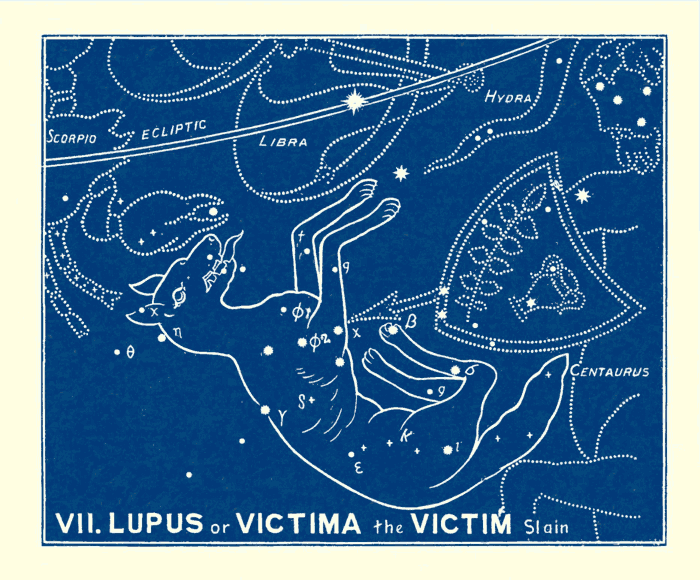
Its modern name is Lupus (a wolf), because it looks like one. It may be any animal. The great point of this ancient constellation is that the animal has been slain, and is in the act of falling down dead.
Plate 7: Lupus or Victima the VICTIM Slain
Its Greek name is Thera, a beast, and Lycos, a wolf. Its Latin name is Victima, or Bestia (Vulg. Gen. viii. 17), which sufficiently indicates the great lesson. This is confirmed by its ancient Hebrew name, Asedah, and Arabic Asedaton, which both mean to be slain.
More than 22 of its stars have been catalogued. None of them are higher than the 4th magnitude; most of them are of the 5th or 6th.
True, He was “by wicked hands crucified and slain,” but He is slain here by the Centaur, i.e. by Himself! To make it perfectly clear that it was His own act (without which His death would lose all merit), He uttered those solemn words: “I lay down my life for the sheep…. No man taketh it from me, but I lay it down of myself. I have power to lay it down, and I have power to take it again” (John x. 15-18). He “offered Himself without spot to God.” “He put away sin by the sacrifice of Himself” (Heb. ix. 11, 26).
In the ancient Zodiac of Denderah He is pictured as a little child with its finger on its lips, and He is called Sura, a lamb! In other pictures He has, besides, the horn of a goat on one side of His head. All this pointed to one and the same great fact, viz., the development and explanation of what was meant by the bruising of His heel! It meant that this Promised Seed of the woman should come as a child, that He should suffer, and die upon the Cross, for
“He was brought as a lamb to the slaughter;
And as a sheep before her shearers is dumb;
SO HE opened not his mouth.”
(Isa. liii. 7.)
Hence, the constellation prefigures a silent, willing sacrifice—Christ Jesus, who, “being found in fashion as a man, humbled Himself, and became obedient unto death, even the death of the Cross” (Phil. ii. 5-8).
Three hundred years ago England was rather poor in people and in money. Spain had become rich and important by her gold mines in the West Indies and the central parts of America. Portugal had been enriched by finding a way around Africa to India, where many things such as silks and spices were bought to be sold in Europe at high prices. Some thoughtful men in England had an idea that as the Portuguese had reached India by sailing around the Eastern Continent on the south, the English might find a way to sail to India around the northern part of Europe and Asia. By this means, the English ships would also be able to get the precious things to be found in the East.
For this purpose, some London merchants founded the Muscovy Company, with old Sebastian Cabot at its head. This Muscovy Company had not succeeded in finding a way to China around the north of Europe, but in trying to do this its ships had opened a valuable trade with Russia, or Muscovy as it was then called, which was a country but little known before.
One of the founders of this Muscovy Company was a rich man named Henry Hudson. It is thought that he was the grandfather of Henry Hudson, the explorer. The merchants who made up this company were in the habit of sending out their sons, while they were boys, in the ships of the company, to learn to sail vessels and to gain a knowledge of the languages and habits of trade in distant countries. Henry was sent to sea while a lad, and was no doubt taught by the ship captains all about sailing vessels. When he grew to be a man, he wished to make himself famous by finding a northern way to China.
In the spring of 1607, almost four months after Captain Smith had left London with the colony bound for Jamestown, his friend Hudson was sent out by the Muscovy Company to try once more for a passage to China. He had only a little ship, which was named Hopewell, and he had but ten men, including his own son John Hudson. He found that there was no way to India by the north pole. But he got farther north than any other man.
Hudson made an important discovery on this voyage. He found whales in the Arctic Seas, and the Muscovy Company now fitted out whaling ships to catch them. The next year the brave Hudson tried to pass between Spitzbergen and Nova Zembla, but he was again bumping against the walls of ice that fence in the frozen pole.
By this time, the Muscovy Company was discouraged and gave up trying to get to India by going around the north of Europe. They thought it better to make money out of the whale-fishery that Hudson had found. But in Holland, there was the Dutch East India Company, which sent ships around Africa to India. They had heard of the voyages of Hudson, who had got the name of “the bold Englishman.” The Dutch Company was afraid that the English, with Hudson’s help, might find a nearer way by the north, and so get the trade away from them. So they sent for “the bold Englishman,” and hired him to find this new route for them.
Hudson left Amsterdam in 1609 in a yacht called “The Half Moon.” He sailed around Norway and found his old enemy the ice as bad as ever about Nova Zembla. Some of the Dutch sailors on Hudson’s ship were used to the heat of the East Indies. The frosty air of these icy seas was very disagreeable to them, and they rebelled against their captain.
Just before leaving home, Hudson had received a letter from his friend Captain John Smith, in Virginia, telling him that there was a strait leading into the Pacific Ocean, to the north of Virginia. Smith had no doubt misunderstood some story of the Indians. But now that the seamen would not go on through the cold seas at the north of Europe, Hudson persuaded them to turn about and sail with him to America to look up the way to India that Smith had written about.
So they turned to the westward and sailed to Newfoundland, and thence down the coast until they were opposite the James River. Then Hudson turned north again and began to look for a gateway through this wild and unknown coast. He sailed into Delaware Bay, as ships do now on their way to Philadelphia. Then he sailed out and followed along the shores till he came to the opening by which thousands of ships nowadays go into New York.
He passed into New York Bay, where no vessel had ever been before. He said it was “a very good land to fall in with, and a pleasant land to see.” The New Jersey Indians swarmed about the ship dressed in fur robes and feather mantles and wearing copper necklaces. Hudson thought some of the many waterways about New York harbor must lead into the Pacific.
He sent men out in a boat to examine the bays and rivers. They declared that the land was “as pleasant with grass and flowers as ever they had seen, and very sweet smells.” But before they got back, some Indians attacked the boat and killed one man by shooting him with an arrow.
When the Indians came around the ship again, Hudson made two of them prisoners and dressed them up in red coats. The rest he drove away. As he sailed farther up from the sea, twenty-eight dug-out canoes filled with men, women, and children, paddled about the ship. The colonists traded with them, giving them trinkets for oysters and beans, but none were allowed to come aboard. As the ship sailed on up the river that we now call the Hudson, the two Indian prisoners saw themselves carried farther and farther from their home. One morning, they jumped out of a porthole and swam ashore. They stood on the shore and mocked the men on the Half Moon as she sailed away up the river.
Hudson’s ship anchored again opposite the Catskill Mountains, and here he found some very friendly Indians, who brought corn, pumpkins, and tobacco to sell to the crew. Still farther up the river, Hudson visited a tribe on shore and wondered at their great heaps of corn and beans. The chief lived in a round bark house. Captain Hudson was made to sit on a mat and eat from a red wooden bowl. The Indians wished him to stay all night. They broke their arrows and threw them into the fire to show their friendliness.
Hudson found the river growing shallower. When he got near where Albany now stands, he sent a rowboat yet higher up. Then he concluded that this was not the way to the Pacific. He turned around and sailed down the river and then across the ocean to England. The Half Moon returned to Holland, and the Dutch sent out other ships to trade in the river which Hudson had found. In the course of time, they planted a colony where New York now stands.
Captain Hudson did not try to go around the north of Europe any more. But the next spring he sailed in an English ship to look for a way around the north side of the American Continent. On this voyage he discovered the great bay that is now called Hudson’s Bay.
In this bay he spent the winter. His men suffered with hunger and sickness. In the summer of 1611, after he had, with tears in his eyes, divided his last bread with his men, these wicked fellows put him into a boat with some sick sailors and cast them all adrift in the great bay.
The men on the ship shot some birds for food, but in a fight with the Indians some of the leaders in the plot against Hudson were killed. The seamen, as they sailed homeward, grew so weak from hunger that they had to sit down to steer the vessel. When at last Juet, the mate, who had put Hudson overboard, had himself died of hunger, and all the rest had lain down in despair to die, they were saved by meeting another ship.
PARALLELS BETWEEN THE FIRST TWO CHAPTERS AND THE LAST TWO CHAPTERS OF THE BIBLE
Genesis Chapters 1 and 2
Revelation Chapter 21 and 22
The Heavens are newly created. Genesis 1:1 In the beginning God created the heaven and the earth.
There will be a new heaven. Revelation 21:1 And I saw a new heaven and a new earth: for the first heaven and the first earth were passed away; and there was no more sea.
The earth is newly created. Genesis 1:1 In the beginning God created the heaven and the earth.
There will be a new earth. Revelation 21:1 And I saw a new heaven and a new earth: for the first heaven and the first earth were passed away; and there was no more sea.
A Tree of Life is in the garden. Genesis 2:9 And out of the ground made the Lord God to grow every tree that is pleasant to the sight, and good for food; the tree of life also in the midst of the garden, and the tree of knowledge of good and evil.
The Tree of Life is the New Jerusalem. Revelation 22:2 In the midst of the street of it, and on either side of the river, was there the tree of life, which bare twelve manner of fruits, and yielded her fruit every month: and the leaves of the tree were for the healing of the nations.
Rivers flow in the garden. Genesis 2:10 And a river went out of Eden to water the garden; and from thence it was parted and became into four heads.
There is a river of life in the New Jerusalem Revelation 22:1 And he shewed me a pure river of water of life, clear as crystal, proceeding out of the throne of God and of the Lamb.
No sin exists. Genesis 1:31 and God saw every thing that he had made, and, behold, it was very good. And the evening and the morning were the sixth day.
No sin will exist on the new earth. Revelation 21:4 And God shall wipe away all tears from their eyes; and there shall be no more death, neither sorrow, nor crying, neither shall there be any more pain: for the former things are passed away.
There is no pain. Everything is good. Genesis 1:31 and God saw every thing that he had made, and, behold, it was very good. And the evening and the morning were the sixth day.
No pain will exist on the new earth. Revelation 21:4 And God shall wipe away all tears from their eyes; and there shall be no more death, neither sorrow, nor crying, neither shall there be any more pain: for the former things are passed away.
There is no sorrow. Everything is good. Genesis 1:31 and God saw every thing that he had made, and, behold, it was very good. And the evening and the morning were the sixth day.
No sorrow will occur on the new earth. Revelation 21:4 And God shall wipe away all tears from their eyes; and there shall be no more death, neither sorrow, nor crying, neither shall there be any more pain: for the former things are passed away.
God walks with man. Genesis 1:15-16 And the Lord God took the man, and put him into the garden of Eden to dress it and to keep it. And the Lord God commanded the man, saying, Of every tree of the garden thou mayest freely eat:
God will be among men. Revelation 21:3 And I heard a great voice out of heaven saying, Behold, the tabernacle of God is with men, and he will dwell with them, and they shall be his people, and God himself shall be with them, and be their God.
No death exists.
No death takes place on the new earth
The is no curse on the earth. Everything is good. Genesis 1:31 and God saw every thing that he had made, and, behold, it was very good. And the evening and the morning were the sixth day.
No curse will exist on the new earth Revelation 22:3 And there shall be no more curse: but the throne of God and of the Lamb shall be in it; and his servants shall serve him:
Esta es una pregunta que Jesús les hizo a sus discípulos.
Mateo 16:15 Él les dijo: «Y vosotros, ¿quién decís que soy yo?».
Una comparación minuciosa de las Escrituras del Antiguo Testamento con las del Nuevo Testamento revela que Él es Dios manifestado en la carne.
1 Timoteo 3:16 E indiscutiblemente, grande es el misterio de la piedad: Dios fue manifestado en la carne, justificado en el Espíritu, visto de los ángeles, predicado a los gentiles, creído en el mundo, recibido arriba en gloria.
Deuteronomio 6:4 Oye, Israel: El Señor nuestro Dios es el único Señor.
Marcos 12:29 Jesús le respondió: «El primero de todos los mandamientos es: Oye, Israel: El Señor nuestro Dios es el único Señor».
Según Juan 4:23-24, el único Dios es Espíritu.
Juan 4:23-24 Pero la hora viene, y ya ha llegado, cuando los verdaderos adoradores adorarán al Padre en espíritu y en verdad; porque el Padre busca a tales que le adoren. Dios es espíritu; y los que le adoran, en espíritu y en verdad deben adorarle.
Él es Dios, Él es Dios con nosotros.
Isaías 7:14 (RV1960) Por tanto, el Señor mismo os dará una señal: He aquí que una virgen concebirá y dará a luz un hijo, y le pondrá por nombre Emanuel.
Él es el Dios Todopoderoso, el Padre Eterno.
Isaías 9:6 Porque un niño nos ha nacido, un hijo nos ha sido dado; y el gobierno estará sobre su hombro; y se llamará su nombre Admirable, Consejero, Dios Todopoderoso, Padre Eterno, Príncipe de Paz.
Él es quien nos creó.
Colosenses 1:15-16 Él es la imagen del Dios invisible, el primogénito de toda la creación. Porque en él fueron creadas todas las cosas, las que hay en los cielos y las que hay en la tierra, visibles e invisibles; sean tronos, sean dominios, sean principados, sean potestades; todo fue creado por medio de él y para él.
Como hombre, tuvo hambre, durmió, se cansó, lloró y oró.
Como Dios, alimentó a cinco mil, sanó a los enfermos, resucitó a los muertos y respondió a las oraciones.
Los fariseos le preguntaron:
Juan 8:19-24 Entonces le dijeron: «¿Dónde está tu Padre?». Jesús les respondió: «Ni me conocéis a mí ni a mi Padre; si me conocieran, también conocerían a mi Padre». Estas palabras las dijo Jesús en el tesoro, mientras enseñaba en el templo; y nadie le puso la mano encima, porque aún no había llegado su hora. Jesús les dijo otra vez: «Yo me voy, y me buscaréis, pero moriréis en vuestros pecados; adonde yo voy, vosotros no podéis venir». Entonces los judíos dijeron: «¿Se va a suicidar? Porque dice: “Adonde yo voy, vosotros no podéis venir”. Y él les dijo: «Vosotros sois de abajo; yo soy de arriba; vosotros sois del mundo; yo no soy del mundo. Por eso os he dicho que moriréis en vuestros pecados; porque si no creéis que yo soy, en vuestros pecados moriréis».
Juan 14:10-11 ¿No crees que yo estoy en el Padre, y el Padre en mí? Las palabras que yo os hablo, no las hablo por mi propia cuenta, sino que el Padre que mora en mí, él hace las obras. Creedme que yo estoy en el Padre, y el Padre en mí; de otra manera, creedme por las obras mismas.
Dios estaba
2 Corintios 5:19 Es decir, que Dios estaba en Cristo reconciliando consigo mismo al mundo, no tomándoles en cuenta sus pecados, y nos encargó a nosotros el mensaje de la reconciliación.
Efesios 4:5-6 Un solo Señor, una sola fe, un solo bautismo, 6 Un solo Dios y Padre de todos, que está sobre todos, actúa por medio de todos y está en todos.
Santiago 2:19 (RV) Tú crees que hay un solo Dios; bien haces. También los demonios creen, y tiemblan.


 articlesforchristians