HERCULES (The Mighty Man)
The Mighty Vanquisher
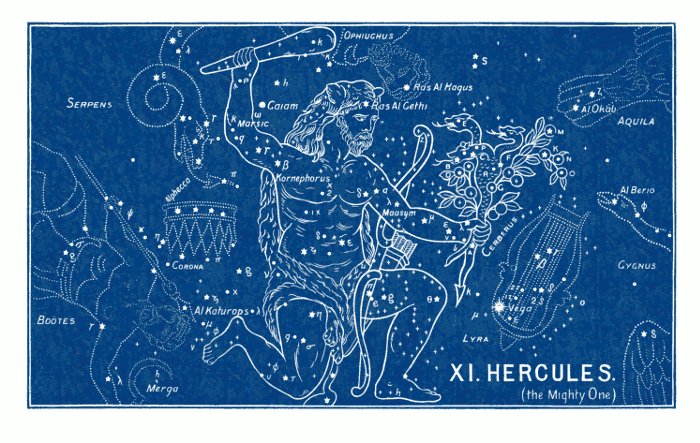
Here the mighty one, who occupies a large portion of the heavens, is seen bending on one knee, with his right heel lifted up as if it had been wounded, while his left foot is set directly over the head of the great dragon. In his right hand he wields a great club, and in his left hand he grasps a triple-headed monster (Cerberus). And he has the skin of a lion, which he has slain, thrown around him.
In the Zodiac of Denderah we have a human figure, likewise with a club. His name is Bau, which means who cometh, and is evidently intended for Him who cometh to crush the serpent’s head, and “destroy the works of the devil.”
In Arabic he is called Al Giscale, the strong one.

There are 113 stars in this constellation. Seven are of the 3rd magnitude, seventeen of the 4th, etc.
The brightest star, α (in his head), is named Ras al Gethi, and means the head of him who bruises.
The next, β (in the right arm-pit), is named Kornephorus, and means the branch, kneeling.
The star κ (in the right elbow) is called Marsic, the wounding.
The star λ (in the upper part of the left arm) is named Ma’asyn, the sin-offering.
While ω (in the lower part of the right arm) is Caiam, or Guiam, punishing; and in Arabic, treading under foot.
Thus does everything in the picture combine to set forth the mighty works of this stronger than the strong man armed!
We can easily see how the perversion of the truth by the Greeks came about, and how, when the true foreshadowings of this Mighty One had been lost, the many fables were invented to supply their place. The wiser sort of Greeks knew this perfectly well. Aristotle (in his Metaphysics, x. 8) admits, with regard to Greek mythology, that religion and philosophy had been lost, and that much had been “added after the mythical style,” while much had come down, and “may have been preserved to our times as the remains of ancient wisdom.” Religion, such as it was (Polybius confesses), was recognised as a “necessary means to political ends.” Neander says that it was “the fragments of a tradition, which transmitted the knowledge of divine things possessed in the earliest times.”
Aratus shews the same uncertainty as to the meaning of this Constellation of Hercules. He says:
“Near this, and like a toiling man, revolves
A form. Of it can no one clearly speak,
Nor what he labours at. They call him simply
‘The man upon his knees’: In desperate struggle
Like one who sinks, he seems. From both his shoulders
His arms are high-uplifted and out-stretched
As far as he can reach; and his right foot
Is planted on the coiléd Dragon’s head.”
Ancient authorities differ as to the personality of Hercules, and they disagree as to the number, nature, and order of what are sometimes called “the twelve labours of Hercules.” But there is no doubt as to the mighty foretold works which the woman’s Seed should perform.
From first to last Hercules is seen engaged in destroying some malignant foe: now it is the Nemean lion; then it is the slaying of the boar of Erymanthus; again, it is the conquest of the bull of Crete; then the killing of the three-headed hydra, by whose venom Hercules afterwards died. In the belly of the sea monster he is said to have remained “three days and three nights.” This was, doubtless, a perversion of the type of Jonah, introduced by Lycophron, who (living at the court of Ptolemy Philadelphus, under whose auspices the Hebrew Scriptures were translated into Greek) would have known of that Divine miracle, and of its application to the Coming One. Bishop Horsley believed that the fables of the Greek mythology could be traced back to the prophecies of the Messiah, of which they were a perversion from ignorance or design. This is specially true of Hercules. In his apparently impossible tasks of overthrowing gigantic enemies and delivering captives, we can see through the shadow, and discern the pure light of the truth. We can understand how the original star-picture must have been a prophetic representation of Him who shall destroy the Old Serpent and open the way again, not to fabled “apples of gold,” but to the “tree of life” itself. He it is who though suffering in the mighty conflict, and brought to His knee, going down even to “the dust of death,” shall yet, in resurrection and advent glory, wield His victorious club, subdue all His enemies, and plant His foot on the Dragon’s head. For of Him it is written:—
“Thou shalt tread upon the lion and adder;
The young lion and the dragon shalt Thou trample under foot.”
(Ps. xci. 13.)
“Come, Lord, and burst the captives’ chains,
And set the prisoners free;
Come, cleanse this earth from all its stains,
And make it meet for Thee!
Oh, come and end Creation’s groans—
Its sighs, its tears, its blood,
And make this blighted world again
The dwelling-place of God.”

3 responses to “Witness of the Stars: HERCULES (The Mighty Man)”
[…] HERCULES (The Mighty Man) […]
[…] The Children’s Six Minutes: HAPPY NEW YEAR […]
[…] HERCULES (The Mighty Man) […]