A place to grow your relationship with God

Posts tagged ‘mexico’

Ancient Mexican Pyramids facts for kids

Similar to the Egyptians, the Maya were famous for their pyramids, which differed in shape based on their location. The Mayan pyramids stand as enduring monuments to the remarkable achievements of the ancient Mayan civilization. With their stepped-pyramid design and precise alignments with celestial events, the Mayan pyramids served as centers of worship, and astronomical observatories. The Maya inhabited the Yucatán Peninsula in Mexico.

The civilization dates back to around 1500 BC. Between AD 300 and 900, major ceremonial centers such as Palenque, Tikal, and Copán were mysteriously deserted.

The Mayan religion revolved around the worship of numerous nature gods. Their incredible architecture still stands today as impressive ruins at sites once used for religious ceremonies, such as Palenque, Uxmal, Copán, Tikal, and Chichén Itzá.

Mayan Pyramids Facts

1. Built for religious and ceremonial purposes

Mayan pyramids were central to the religious and cultural life of the Mayan civilization. These sacred structures served as the focal point for religious rituals, ceremonies, and significant community events.
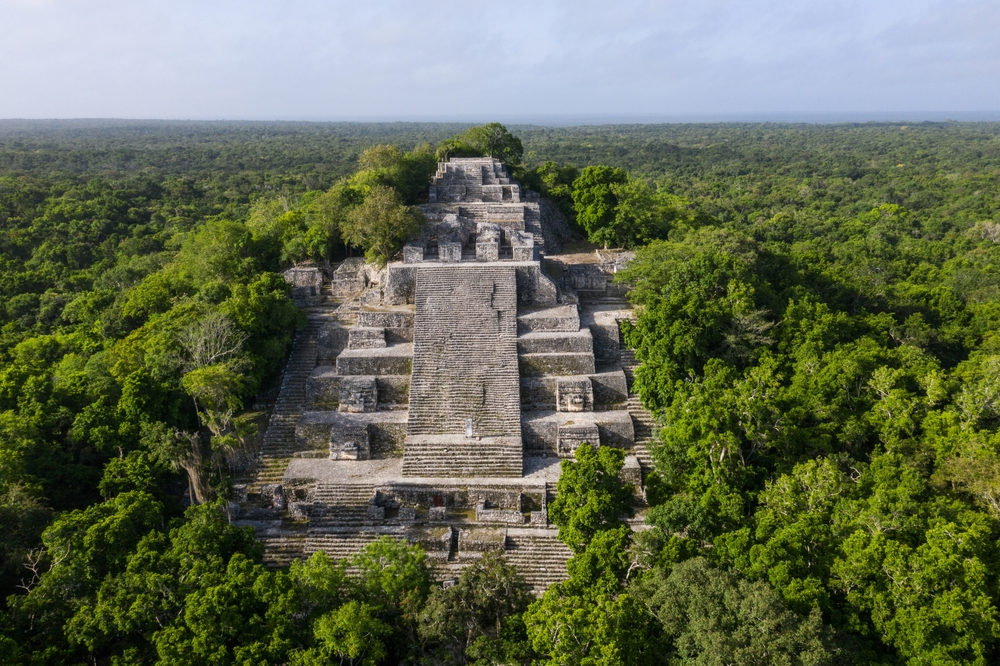
2. Stepped-pyramid design with temples on top

The Mayan pyramids were most commonly built in the stepped-pyramid style, often referred to as “pyramid-temples.” These impressive structures featured multiple levels, each serving a unique function.

A wide staircase ascended to the top platform, where a temple or shrine was built to house sacred artifacts or symbolize a particular deity. The number of steps often varied, reflecting significant numerical values in Mayan cosmology.

3. Aligned with celestial events and the Mayan calendar

The Mayans were talented astronomers and mathematicians with a profound knowledge of celestial cycles. Their pyramids were deliberately designed to align with key astronomical events, including solstices, equinoxes, and the positions of celestial bodies like the sun, moon, and Venus.

These alignments not only played a role in religious and ceremonial practices but also assisted the Mayans in agricultural planning, tracking key calendar dates, and strengthening their bond with the cosmos and their gods.

The accuracy of these alignments showcases the Mayans’ incredible knowledge of astronomy and their talent for creating structures that harmonized perfectly with the natural environment.

4. Constructed with limestone blocks

The Mayan pyramids were mainly constructed with limestone, a sedimentary rock found in abundance throughout the Yucatan Peninsula and other areas where the Mayan civilization thrived. It was a practical choice due to its availability and the ease with which it could be worked.

The Mayans gathered stone from local quarries and carved it into uniform blocks for their buildings. They used lime-based mortar to hold the stones together, ensuring the pyramids stayed stable and lasted through the years.

The Mayans added to the beauty of their structures by plastering the exteriors and painting them in bright, vibrant colors, transforming the pyramids into striking landmarks within their cities.

5. Vary in size based on the city’s importance

The size and design of Mayan pyramids varied based on the significance of the city or site. Bigger and more elaborate pyramids were typically located in major cities with strong political and religious influence.

The grand pyramids represented the city’s power and status, often becoming central hubs for social and religious events.

Smaller settlements or less prominent sites, on the other hand, often had simpler and less grand pyramids, but these structures still held deep religious significance for the local communities.

Mayan Ball Game

Mayan Ball Game

Chichen Itza, one of the largest sites near Cancun, Mexico, features a massive ball game court, measuring around 150 by 40 feet—bigger than a football field. It’s the largest court in the Mundo Maya. The ball game, that became known as Pok-A-Tok or Pitz to the Maya, was a popular activity among all Mesoamerican peoples and originated around 3,000 B.C., serving a ritualistic purpose for the ancient Maya.

The game is featured in many myths, often representing the struggle between deities of day and night or the clashes between sky gods and underworld rulers. The ball symbolized celestial bodies like the sun, moon, or stars, while the rings represented sunrise, sunset, or equinoxes.

There were two teams, and the number of players varied depending on the region where the game was played. Most ball courts featured two sloping parallel walls with three round disks known as markers or a single stone ring positioned at right angles to the ground.

hoop in ball court at Chichen Itza

The players scored by touching the markers or passing the ball—which was 50 centimeters in diameter and weighed more than two pounds—through the rings. The markers or rings were several yards above the ground, and the players could only touch the ball with their elbows, knees, or hips. Scoring was considered such a feat that it usually ended the game.

These games could go on for days.  The losing team was usually sacrificed.  

stone carving of a ball player

Mayan Food and Culture

The Ancient Maya had a rich and diverse food culture. They ate many different things, including food from the sea, plants, and animals. They got their food by hunting, gathering, and large-scale farming. The most important plant they grew was maize, also known as corn.

Much of the ancient Maya’s food came from their farms and special “forest gardens.” These gardens were called pet kot. The name comes from the circular stone walls that often surrounded them.

The Maya used clever farming methods to keep their soil healthy. One method was called slash-and-burn farming. This meant clearing land and burning plants. The ash from the burning helped make the soil richer for a short time. This method is still used in some areas today. They also used crop rotation to keep the soil fertile and grow different kinds of food.

Many foods and cooking methods from the ancient Maya are still used today. They are popular with modern Mayan people and have spread all over the world.

What Plants Did the Ancient Maya Eat?

Different types of maize or corn.

Scientists study old plant remains to learn about ancient Maya food. They find tiny bits of plants in the soil from old Maya sites. These studies show what plants the Maya grew and gathered.

Early plant findings come from a place called Cuello, in Belize. Most of the plant discoveries are from later periods. These show that the Maya ate both wild and farmed plants. Important sites like Cobá, Cerén, and Tikal give us clues. They also show how diets changed based on where people lived. For example, people near the coast ate more seafood.

The ancient Maya’s main foods were four farmed crops. These were maize (corn), squash, beans, and chili peppers. Corn, squash, and beans are sometimes called the “Three Sisters.” They provide important nutrients when eaten together.

Corn was the most important food for the ancient Maya. It was also very special in their stories and beliefs. They prepared corn in a special way called nixtamalization. This process involved soaking and cooking corn in a special water mixture. This helped release a vitamin called niacin. Niacin is important for health and prevents a disease called pellagra.

After nixtamalization, corn was ground into dough. This dough was used to make many dishes. Tortillas were common. They were cooked on a flat griddle called a comal. Tortillas were used to wrap other foods like meat and beans. Tamales were another popular dish. They were made from corn dough, often with a filling. Tamales were wrapped in corn husks and steamed.

The Maya also made liquid dishes from corn. Atole was a thick corn drink. Pozole was a soup with large corn grains, often in turkey broth. They added chili peppers, cacao, wild onions, and salt to these dishes for flavor.

Besides corn, beans, and squash, the Maya ate other plants. They grew fruits like tomatoes, avocados, guavas, papayas, and pineapples. They also grew vegetables like sweet potatoes and Xanthosoma. Chaya leaves and chayote fruit were also part of their diet.

Many herbs and spices were used too. These included vanilla, epazote, achiote (annatto seed), and allspice.

Maya farmers used different techniques to grow their crops. These included building terraces, raised fields, and using irrigation. Some fields were close to homes, while others were farther away.

What Meats Did the Ancient Maya Eat?

The ancient Maya got most of their meat from hunting. They also kept some animals like dogs and turkeys. Animals they hunted included deer, armadillos, tapirs, peccarys, and monkeys. They also ate different kinds of fowl, turtles, and iguanas. Most of their meat came from white-tailed deer.

People living near the coast also ate a lot of seafood. This included fish, lobster, shrimp, and shellfish like conch.

Scientists have studied animal bones found at Maya sites. These bones show what animals were eaten. For example, at sites like Lamanai, deer were always important. But over time, the Maya started eating more small mammals, birds like turkey, and seafood.

Even Maya cities far from the ocean ate seafood. At a site called Caracol, in the mountains, scientists found remains of marine animals. This suggests that the Maya brought live seafood, like stingrays and fish, from the ocean up the rivers.

Ancient Maya Food Today

Many foods and cooking styles from the ancient Maya are still enjoyed today. Their food traditions began as early as 1500 BC. With corn as a main food, the Maya learned to grow and use many other ingredients. This led to new Maya dishes that are now popular across the Americas.

Today, foods like chocolate, avocado (guacamole), tortillas, and tamales are eaten far beyond the Maya region.

Common cocoa seeds, used to make hot chocolate.

Chocolate: The cocoa tree grows naturally in Maya lands. The Maya were likely the first to grow the cacao plant for food. For them, cocoa was a special gift from the gods. The word theobroma, which is the cocoa plant’s scientific name, means “food of the gods.”

Cacao beans were even used in ceremonies for the Mayan gods. All Maya people, rich or poor, enjoyed cocoa. Maya couples drank chocolate during weddings.

Cocoa beans were ground and mixed with chili peppers, cornmeal, and honey. This made a drink called xocolatl. Only the wealthy could drink this. This ancient Maya chocolate drink was different from today’s hot chocolate. It was often unsweetened and had a frothy texture.

Avocado/Guacamole: Avocados came from southern Mexico and Guatemala. They became a key part of Maya cooking. Avocado trees grow well in warm, humid places, like where the Maya lived. Avocados are used in many modern dishes. Their smooth texture and rich taste make them a popular snack.

Corn Tortillas: Corn is very important in Maya culture and stories. The Maya creation story, the Popol Vuh, says that the first humans were made from corn dough.

Tortillas, made from corn, were a common food for everyone. Ancient Maya tortillas were smaller, about three to four inches wide. They were also thicker than today’s tortillas. This made them a strong base for other foods, like meat and avocado.

Today’s tortillas are thinner and often larger. They are used in many dishes like tacos, burritos, quesadillas, and chips.

Tamales: Tamales are made from corn dough, often with meat and vegetables inside. They were easy to carry, making them a convenient food. Like many Maya dishes, tamales were wrapped in corn husks for cooking. After cooking, the tamal was unwrapped and sometimes topped with salsa.

Tamales were often served at Maya celebrations. Maya women would also sell fresh tamales, sometimes trading them for cocoa seeds. Old Maya art and paintings show tamales often. Modern tamales are enjoyed in much the same way as they were long ago.

source: Ancient Maya cuisine facts for kids Kids Encyclopedia Facts