A place to grow your relationship with God

Archive for April, 2025

La vida de Cristo después de la resurrección: Eventos clave

La Resurrección

  • Jesús enseñó a sus discípulos que debía sufrir muchas cosas, ser rechazado, ser asesinado, ¡pero al tercer día resucitaría! (Los Evangelios)

La tumba vacía

  • ¡Jesús está vivo!
  • ¡Ha resucitado!

Apariciones de Jesús después de su resurrección

  • ¡Jesús se aparece primero a las mujeres! (María Magdalena, María madre de Santiago, Salomé, Juana y otras mujeres no nombradas)
  • Jesús se apareció a Pedro
  • Jesús se aparece a sus discípulos varias veces
  • Jesús camina con dos creyentes en el camino a Emaús (Cleofás; no se menciona el nombre del otro creyente)
  • Jesús se aparece a un grupo de quinientos a la vez
  • Jesús se aparece a Santiago
  • Jesús se aparece a todos los apóstoles, incluyendo a Pablo

Los cuarenta días antes de su ascensión (Hechos 1:2-8)

  • Jesús dio mandamientos a los apóstoles que había escogido
  • Jesús se presentó vivo después de su sufrimiento con muchas pruebas infalibles
  • Jesús les habló de las cosas que pertenecían al reino de Dios
  • Jesús les ordenó que no se apartaran de Jerusalén, sino que esperaran la Promesa del Padre: ser bautizados con el Espíritu Santo, recibir el poder de ser Sus testigos en la tierra.

La Ascensión

Y habiendo dicho estas cosas, viéndolo ellos, fue alzado, y le recibió una nube que le ocultó de sus ojos. 10 Y estando ellos con los ojos puestos en el cielo, entre tanto que él se iba, he aquí se pusieron junto a ellos dos varones con vestiduras blancas, 11 los cuales también les dijeron: Varones galileos, ¿por qué estáis mirando al cielo? Este mismo Jesús, que ha sido tomado de vosotros al cielo, así vendrá como le habéis visto ir al cielo. (Hechos 1:9-11)

El Trono de la Gracia (Hebreos 4, 7, 8, 12)

  • Jesus está ahora sentado a la diestra del trono de Dios
  • Jesús, como nuestro Sumo Sacerdote, siempre vive para interceder por nosotros
  • Jesús, como nuestro Sumo Sacerdote, se compadece de nuestra debilidad
  • podemos acercarnos confiadamente al trono de la Gracia para obtener misericordia
  • Podemos venir con valentía a encontrar la gracia para ayudar en tiempos de necesidad

El amor de Dios que es en Cristo Jesús Señor nuestro (Romanos 8:34-35, 37-39)

Nada puede separarnos del amor de Dios, ¡somos más que vencedores!

  • no tribulación
  • no espada
  • ni las cosas presentes
  • no angustia
  • ni la muerte
  • ni lo que vendrá
  • no persecución
  • ni la vida
  • ni altura
  • no la hambruna
  • ni ángeles
  • ni profundidad
  • no la desnudez
  • ni principados
  • No es peligro
  • ni ninguna otra cosa creada
  • ni potencias

He aquí que viene con las nubes, y todo ojo le verá, y los que le traspasaron; y todos los linajes de la tierra harán lamentación por él. Sí, amén. Yo soy el Alfa y la Omega, principio y fin, dice el Señor, el que es y que era y que ha de venir, el Todopoderoso.(Apocalipsis 1:7-8)

El Mensaje de Jesús: Cumpliendo las Profecías Bíblicas

La promesa del Mesías: Génesis 3:15
Y pondré enemistad [hostilidad/odio] entre ti [serpiente/Satanás] y la mujer [la humanidad], y entre tu descendencia [Satanás] y la descendencia suya [Mesías/Redentor]; ésta te herirá en la cabeza [Satanás], y tú le herirás en el talón [Jesús].

Profecía del Antiguo Testamento

  • Isaías 7:14
    • El Señor mismo dará una señal
    • Una virgen concebirá y dará a luz un Hijo
    • Su nombre será Emanuel – Dios con nosotros
  • Isaías 9:6-7
    • Nos ha nacido un Niño – humanidad
    • Nos ha sido dado un Hijo – deidad
    • Se llamará su nombre Admirable, Consejero, Dios Fuerte, Padre Eterno, Príncipe de Paz
  • Su gobierno – reino/reino
    • sobre Su hombro – autoridad
    • paz
    • sin fin – eterno/para siempre
    • sobre el trono de David – pacto
    • establecido con juicio y justicia

El Señor de los Ejércitos -Jehová Sabaot – nuestro Libertador – realizará esto

Profecía del Nuevo Testamento

  • En memoria de su misericordia…
  • En memoria de su santo pacto… (Lucas 1:54-55; 72-73)
  • En la plenitud de los tiempos, Dios envió a su Hijo (Gal 4:4)
  • María dio a luz un Hijo y lo llamó Jesús (Evangelios)
  • la palabra se hizo carne y habitó entre nosotros (Jn 1:14)
  • El ministerio de Jesús

Yo publicaré el decreto: El Señor me ha dicho: Mi Hijo eres tú, Yo te he engendrado hoy. (Salmo 2:7)
Respondió Jesús y le dijo: Permítelo ahora, porque así conviene que cumplamos toda justicia. Entonces se lo permitió. Después que fue bautizado, Jesús subió luego del agua; y he aquí los cielos le fueron abiertos, y vio al Espíritu de Dios que descendía como paloma y venía sobre él. Y de repente vino una voz del cielo, que decía: Éste es mi Hijo amado, en quien tengo complacencia. (Mateo 3:15-17)

Isaías 61:1-3; Lucas 4:18

  • el Espíritu del Señor Dios está sobre mí
  • el Señor me ha ungido
  • para predicar el Evangelio a los pobres
  • para sanar a los que tienen el corazón roto
  • para proclamar la libertad a los cautivos
  • para abrir la cárcel de los que están atados
  • para consolar a todos los que lloran
  • para consolar a los que lloran en Sion
  • para darles belleza por cenizas
  • para dar el óleo de la alegría por el luto
  • para dar el manto de alabanza por el espíritu de pesadez
  • Recuperación de la vista a los ciegos
  • para poner en libertad a los oprimidos
  • para proclamar el año agradable del Señor

1 Juan 3:8b

  • para destruir las obras del diablo

Juan 3:16-17

  • para traer vida eterna
  • para salvar el mundo

1 Pedro 1:20; Tito 2:11; 3:4

  • la gracia, la bondad y el amor de Dios nuestro Salvador se han manifestado a todos los hombres

Easy Homemade Quesadillas with Cheese


Ingredients:
  • 2 cups Masa harina
  • 1 3/4 cups warm water
  • 1lb of your favorite queso
  • oil for frying
Directions:
  1. Kneed together the Masa and water until a soft dough forms. See picture of dough  below.
  2. Form the dough into 12 equal balls.
  3. Using a tortilla press, flatten the balls.
  4. Place a piece of cheese into the center of the flattened dough. See picture below.
  5. Fold the dough around the cheese.
  6. Heat about 1 inch of oil in a deep-frying pan.
  7. Fry the quesadilla on both sides until it is a golden-brown color.
  8. Drain on paper towels.

Understanding the Tabernacle’s Spiritual Significance

The Tabernacle-Man’s Approach to God

A picture showing the various parts of the Tabernacle


When the Lord gave Moses the plan of the Tabernacle on Mt. Sinai, He admonished Moses to follow His specifications in its construction to the letter (Exodus 25:1-9). The Tabernacle was more than just a place to worship while in the wilderness. Its design and layout was a shadow of the redemptive work of Jesus, as well as a pattern of the salvation experienced in the present church age.

  1. The Court of the Tabernacle
    • The court of the Tabernacle was approximately 150 feet long and 75 feet wide. It had one gate on the east side. Four doorposts supported hangings of four colors of cloth: purple, scarlet, blue, and white. There was only one entrance into the courtyard. Likewise, there is also only one way of salvation-through Jesus Christ (John 10:9).
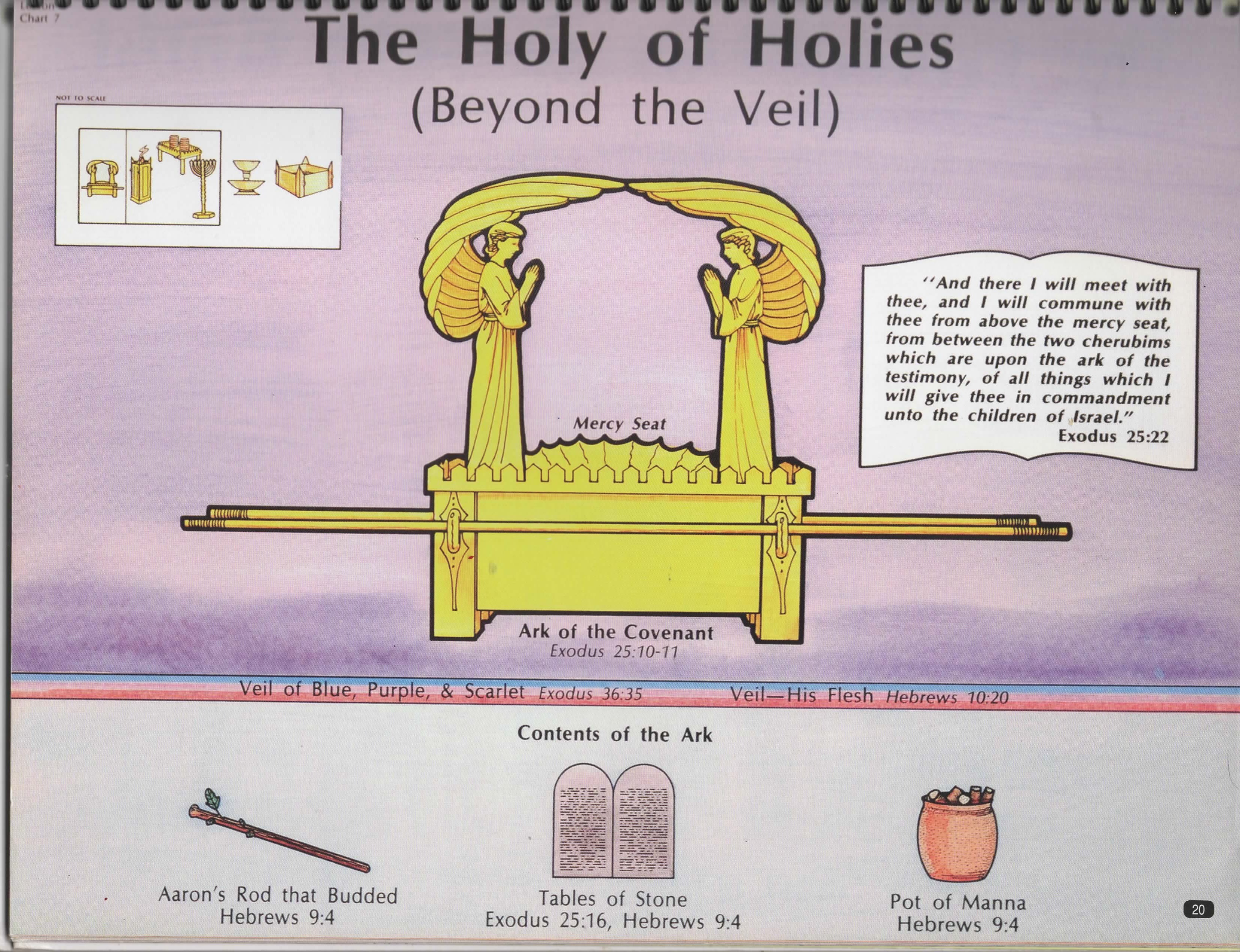
    • Inside the courtyard was the brazen altar, the brazen laver, and the Tabernacle itself. The Tabernacle was approximately 15 feet high, 15 feet wide, and 45 feet long. It consisted of the Holy Place and the Holy of Holies. These two rooms were separated by a veil of blue, purple, and scarlet. In the Holy Place was the golden candlestick, the table of showbread, and the altar of incense. In the Holy of Holies was the ark of the covenant. There abode the Spirit of God between two golden cherubims located on the lid of the ark, which was called the mercy seat.
      Of course. God is omnipresent, or present everywhere, but He manifested His glory there to show His covenant relationship with Israel. God has always desired to dwell with His people, but sin has always separated humanity from God. From the Day of Pentecost, fifty days after the death of Christ, God has dwelt in the hearts of His people in a new and wonderful way. “Know ye not that ye are the temple of God, and that the Spirit of God dwelleth in you?” (I Corinthians 3:16).
  2. The Altar of Sacrifice
    • The priest approached the Tabernacle first by way of the brazen altar, and there he offered the sacrifice for sin. The brazen altar was approximately seven and a half feet square and four and a half feet high. It was made of acacia wood overlaid with brass. It was a place of death and shedding of blood. It represents the death of Jesus, which purchased our salvation. It also points to repentance, which is our identification with the death of Jesus and our personal death to sin and self-will. Everyone must approach God through repentance. Jesus said, “Except ye repent, ye shall all likewise perish’ (Luke 13:3).
    • The altar was a prominent feature of the Tabernacle and its worship. It was placed immediately in front of the gate of the court of the Tabernacle. It was the first object that met the eye of the worshiper as he came into the court to present his sacrifice unto the Lord. The altar was not hidden in some remote place in the court, removed from the gaze of the people, nor did it stand inside the Tabernacle where only a few could approach it. It was placed where all could see it and where all could approach it. Only the priests could see the golden lampstand, the table of showbread, and the altar of incense, which were inside the Tabernacle itself. No one but the high priest was permitted to enter the Holy of Holies and he did so only on the Day of Atonement. By contrast, the altar was plainly visible from without. In fact, no one could enter into the Holy Place except by passing this sacred emblem where the sacrificial blood of the animals was offered. The altar teaches that not one will enter heaven except by the blood of Jesus, who stands as an altar of sacrifice for all who would approach God (John 14:6).
The Altar of Sacrifice
  • It was not merely the altar that gave the worshiper access to the Holy Place, by the putting away of his sins, for there had to be a sacrifice upon the altar. The relationship of the brazen altar to every other part of the Tabernacle service and its furniture was like that of the root to a tree, the heart to the body, and the foundation to a building. Everything inside and even the brazen laver in front of the door of the Tabernacle depended upon the work done at the altar.
  • Without the brazen altar, all else, no matter how magnificent, was useless. Everyone had to come to God by the way of the altar.
  • All the priests, their garments, the sacred vessels, and everything else were unfit for service until the blood shed at the brazen altar touched and sanctified them.
  • Here is the story of the Cross of Christ, Calvary. There is no pardon, no righteousness, no peace, no grace, no blessings, and no salvation without the sacrifice of the Cross. The altar represents the shedding of blood and the death of Jesus. And without the shedding of blood there is no remission of sins (Hebrews 9:27).
  • The fire upon the altar was never to go out (Leviticus 6:13). There is no hour, day or night, that a transgressor cannot find the atonement of Calvary.

3. The Laver of Water

The Laver of Water
  • The laver points to the cleansing from sin we have in Jesus – the initial washing at water
    baptism, which is for the remission of sins and the continual cleansing we have thereafter
    • Exo 30:21 So they shall wash their hands and their feet, that they die not: and it shall be a
      statute for ever to them, even to him and to his seed throughout their generations.
  • In the New Testament
    • Acts 2:38 Then Peter said unto them, Repent, and be baptized every one of you in the name
      of Jesus Christ for the remission of sins, and ye shall receive the gift of the Holy
      Ghost.
    • 1 John 1:7 But if we walk in the light, as he is in the light, we have fellowship one with
      another, and the blood of Jesus Christ his Son cleanseth us from all sin.
  • When we are baptized, God washes away our sins
    • Acts 22:16 And now why tarriest thou? arise, and be baptized, and wash away thy sins,
      calling on the name of the Lord.
  • Without believeth, we are not saved. This belief is demonstrated by baptism.
    • Mark 16:16 He that believeth and is baptized shall be saved; but he that believeth not shall
      be damned.
    • 1 Pet 3:21 The like figure whereunto even baptism doth also now save us (not the putting
      away of the filth of the flesh, but the answer of a good conscience toward God,) by
      the resurrection of Jesus Christ:
  • In the New Testament experience of salvation, repentance comes first, which is a death with
    Christ, a death to sin.
  • Then comes water baptism, which is a washing and burial with Christ.
    • Rom 6:3-4 Know ye not, that so many of us as were baptized into Jesus Christ were
      baptized into his death? 4 Therefore we are buried with him by baptism into death:
      that like as Christ was raised up from the dead by the glory of the Father, even so we
      also, should walk in newness of life.

4. The Holy Place

The Holy Place
  • The Holy Place was the golden candlestick (lampstand), the altar of incense, and the table of
    showbread show bread (sh½”brud”) n. The 12 loaves of blessed unleavened bread placed
    every Sabbath in the sanctuary of the Tabernacle as an offering by the Hebrew priests of
    ancient Israel.
  • These pieces of furniture point to Jesus and to our life in Christ through the indwelling of
    the Holy Spirit.
  • 1. THE GOLDEN CANDLESTICK
    • The candlestick was of pure gold and provided the only light in the Tabernacle. Just as
      Jesus is the light to the world
      • John 8:12 Then spake Jesus again unto them, saying, I am the light of the world: he that
        followeth me shall not walk in darkness, but shall have the light of life.
  • 2. THE TABLE OF SHOWBREAD
    • The showbread provided sustenance for the priest and also points to Jesus who is the Bread
      of Life and to His Word, which is food for the soul.
    • Just as the table exhibited the bread, so the Christian life shows forth Jesus to a dying world
      • John 6:51 I am the living bread which came down from heaven: if any man cat of this
        bread, he shall live for ever: and the bread that I will give is my flesh, which I will
        give for the life of the world.
  • 3. THE ALTAR OF INCENSE
    • The Altar of incense represents prayers to God each morning and evening.
      • We also should pray each morning and evening
    • God hears the prayers of a righteous person
      • 1 Pet 2:9 But ye are a chosen generation, a royal priesthood, an holy nation, a peculiar
        people; that ye should show forth the praises of him who hath called you out of
        darkness into his marvellous light:
      • James 5:16… The effectual fervent prayer of a righteous man availeth much.
        • fer vent (für”v…nt) adj. 1. Having or showing great emotion or zeal; ardent: fervent
          protests; a fervent admirer. 2. Extremely hot; glowing

4. The Holy of Holies (Beyond the Veil)

EPSON MFP image
  • The Holy of Holies represents God himself
  • By His mercy He saved us
    • Titus 3:5 Not by works of righteousness which we have done, but according to his mercy
      he saved us, by the washing of regeneration, and renewing of the Holy Ghost;

Unlocking the Meaning of Passover in Christianity

Passover in the Old Testament is comparative to Passover in the New Testament. In the chart below I will be showing how they are similar and different by talking about some of the different elements that was present in the 1st Passover. In 1st Corinthians 5:7-8 talks about keeping the feast of unleavened bread which is part of Passover.  “Purge out therefore the old leaven, that ye may be a new lump, as ye are unleavened. For even Christ our passover is sacrificed for us: Therefore let us keep the feast, not with old leaven, neither with the leaven of malice and wickedness; but with the unleavened bread of sincerity and truth.”

1st PassoverNew Testament Passover
Egypt: They are being delivered from slavery out of Egypt.
Exodus 3:7 And the Lord said, I have surely seen the affliction of my people which are in Egypt, and have heard their cry by reason of their taskmasters; for I know their sorrows;
Sin and death: Before receiving Jesus, we are slaves to sin. Sin is the yoke of bondage.
Galatians 5:1 Stand fast therefore in the liberty wherewith Christ hath made us free, and be not entangled again with the yoke of bondage.
Romans 8:1-4 There is therefore now no condemnation to them which are in Christ Jesus, who walk not after the flesh, but after the Spirit. For the law of the Spirit of life in Christ Jesus hath made me free from the law of sin and death.For what the law could not do, in that it was weak through the flesh, God sending his own Son in the likeness of sinful flesh, and for sin, condemned sin in the flesh:That the righteousness of the law might be fulfilled in us, who walk not after the flesh, but after the Spirit.
Lamb: The lamb paid the price for the Israelites. It died in the place of the 1st born.
Exodus 12:21 Then Moses called for all the elders of Israel, and said unto them, Draw out and take you a lamb according to your families, and kill the passover.
Jesus: Died in the place of you and me.
1 Corinthians 5:7 Purge out therefore the old leaven, that ye may be a new lump, as ye are unleavened. For even Christ our passover is sacrificed for us:
Blood on the door frame: The blood was placed on the door frames of their houses.
Exodus 12:22 And ye shall take a bunch of hyssop, and dip it in the blood that is in the bason, and strike the lintel and the two side posts with the blood that is in the bason; and none of you shall go out at the door of his house until the morning.
Blood on the Cross: He was nailed to the cross. Jesus died on the cross. He was bloody all over.
John 19:33-35 But when they came to Jesus, and saw that he was dead already, they brake not his legs: But one of the soldiers with a spear pierced his side, and forthwith came there out blood and water. And he that saw it bare record, and his record is true: and he knoweth that he saith true, that ye might believe.
Unleavened Bread
This bread symbolizes sin.
Exodus 12:15 Seven days shall ye eat unleavened bread; even the first day ye shall put away leaven out of your houses: for whosoever eateth leavened bread from the first day until the seventh day, that soul shall be cut off from Israel.
Bread of Life
John 6:35 And Jesus said unto them, I am the bread of life: he that cometh to me shall never hunger; and he that believeth on me shall never thirst.
Hyssop: Used to place the blood on the door frame.
Exodus 12:22 And ye shall take a bunch of hyssop, and dip it in the blood that is in the bason, and strike the lintel and the two side posts with the blood that is in the bason; and none of you shall go out at the door of his house until the morning.
Hyssop
John 19:28-30 After this, Jesus knowing that all things were now accomplished, that the scripture might be fulfilled, saith, I thirst. Now there was set a vessel full of vinegar: and they filled a spunge with vinegar, and put it upon hyssop, and put it to his mouth.
Journey began
Exodus 12:51 And it came to pass the selfsame day, that the Lord did bring the children of Israel out of the land of Egypt by their armies.
Journey Begins: We now have a new life set before us. This journey is thought of as a course.
2 Timothy 4:7
I have fought a good fight, I have finished my course, I have kept the faith:
Led by a prophet: Moses
Deuteronomy 34:10-12
And there arose not a prophet since in Israel like unto Moses, whom the Lord knew face to face, In all the signs and the wonders, which the Lord sent him to do in the land of Egypt to Pharaoh, and to all his servants, and to all his land, And in all that mighty hand, and in all the great terror which Moses shewed in the sight of all Israel.
Jesus:
Matthew 21:11 And the multitude said, This is Jesus the prophet of Nazareth of Galilee.
Acts 3:21-24 Whom the heaven must receive until the times of restitution of all things, which God hath spoken by the mouth of all his holy prophets since the world began. For Moses truly said unto the fathers, A prophet shall the Lord your God raise up unto you of your brethren, like unto me; him shall ye hear in all things whatsoever he shall say unto you. And it shall come to pass, that every soul, which will not hear that prophet, shall be destroyed from among the people. Yea, and all the prophets from Samuel and those that follow after, as many as have spoken, have likewise foretold of these days. Ye are the children of the prophets, and of the covenant which God made with our fathers, saying unto Abraham, And in thy seed shall all the kindreds of the earth be blessed.
God is King:
1 Chronicles 29:11-12: “Yours, O Lord, is the greatness and the power and the glory and the victory and the majesty, indeed everything that is in the heavens and the earth; Yours is the dominion, O Lord, and You exalt Yourself as head over all.”
Isaiah 33:22: “For the Lord is our judge; the Lord is our lawgiver; the Lord is our king; he will save us.”
Psalm 47:2-5: “For the Lord, the Most High, is to be feared, a great king over all the earth.”
Revelation 19:16: “On his robe and on his thigh he has a name written, King of kings and Lord of lords.”
Jesus is King
John 18:36 – Jesus answered, “You say correctly that I am a king.”
Revelation 17:14 – “He is Lord of lords and King of kings.”
Revelation 19:13, 16 – “On his robe and on his thigh he has a name written, King of kings and Lord of lords.”

Forgiveness: The priest made atonement
Leviticus 5:13
And the priest shall make an atonement for him as touching his sin that he hath sinned in one of these, and it shall be forgiven him: and the remnant shall be the priest’s, as a meat offering.
Forgiveness: Jesus is the High Priest
Hebrews 6:18-20  That by two immutable things, in which it was impossible for God to lie, we might have a strong consolation, who have fled for refuge to lay hold upon the hope set before us: Which hope we have as an anchor of the soul, both sure and stedfast, and which entereth into that within the veil; Whither the forerunner is for us entered, even Jesus, made an high priest for ever after the order of Melchisedec.
God is with them in the Ark
Exodus 25:22
“There, above the cover between the two cherubim that are over the ark of the Covenant law, I will meet with you and give you all my commands for the Israelites.”
The Spirit of God dwells within us
1 Corinthians 3:16
 Know ye not that ye are the temple of God, and that the Spirit of God dwelleth in you?

La Cruz: El Camino a la Salvación

 puestos los ojos en Jesús, el autor y consumador de la fe, el cual por el gozo puesto delante de él sufrió la cruz, menospreciando el oprobio, y se sentó a la diestra del trono de Dios.
(Hebreos 12:2)
 
La Cruz
  • la voluntad del Padre-Dios
  • El propio brazo de Dios produjo la salvación
  • Dios presentó a Jesús como una propiciación (sustituto sin pecado) por Su sangre
  • el sacrificio voluntario, la ofrenda del cuerpo del Hijo, Jesucristo
  • Jesús se humilló a sí mismo y fue obediente hasta el punto de la muerte: la cruz
  • Jesús fue entregado (crucificado) por nuestras ofensas (pecados) y resucitado (resucitado) para nuestra justificación
  • la justicia de Dios revelada; Demostrado
  • la demostración del amor de Dios por nosotros mientras aún éramos pecadores
  • Jesús ahora está sentado a la diestra del trono de Dios, ¡ya está consumado!!
  • Jesús ha triunfado sobre todos los principados y potestades
Todos han pecado y están destituidos de la gloria de Dios
  • los pecadores (¡es decir, tú y yo!) ahora son justificados (declarados justos) libremente por la gracia de Dios a través de la redención que es en Cristo Jesús
  • ahora somos justificados por la fe (creencia, confianza en Jesús)
  • ahora estamos reconciliados con Dios (en paz con Dios a través de la sangre de la cruz)
  • ahora somos salvados por la vida de Jesús
  • ahora somos vivificados con Jesús
  • Somos perdonados de todas nuestras ofensas (pecados)ahora tenemos acceso por fe a la gracia de Dios
  • ahora estamos en la gracia de Dios
  • ahora nos regocijamos en la esperanza de la gloria de Dios

La Obra de la Cruz y la Obra iniciada en la Cruz

  • propiciación – sustituto
  • Redención – Precio pagado
  • Reconciliación – Paz restaurada
  • Justificación – Imputado/Declarado Justo
  • Santificación – Sal a caminar
  • Glorificación -Perfeccionada, completada
La imagen del bautismo
Crucificado con Cristo
  • Viejo Hombre (Carne – Pecado, Naturaleza) Crucificado
Sepultado con Cristo a través del bautismo de muerte 
  • Muertos al pecado
Resucitados con Cristo
 
  • vivo para Dios
  • La muerte ya no tiene dominio
 
Camina en novedad de vida
  • presentarme como un instrumento de justicia para la santidad
 
He sido sepultado, resucitado y vivificado con Cristo. mi vida ahora está escondida
con Cristo en Dios. Cristo es ahora mi vida. (Romanos 6; Colosenses 2:12-13, 3:3)

… Despojémonos de todo peso y del pecado que tan fácilmente nos atrapa, y
Corramos con paciencia la carrera que tenemos por delante!! Hebreos 12:1)
Por favor, lea Romanos 6

The Beautiful Roses

Oh, the pretty roses, they are so very red and beautiful like the cherry blossoms in spring. The roses are also like pretty little baby birds a little shy at first peeping out of their eggshells. When the beautiful roses are just blossoming, it is a little shy, but then they show their beautiful colors.

Oh, but it is not just like a cherry blossom or a baby bird, it is also like a beautiful princess. If you don’t see how, listen and you will. Princesses have beautiful dresses and roses have pretty petals. Oh, the petals are like a dress on a princess. Oh, the beautiful roses are so very pretty.

by Bell

2nd grade week 10 out of 36

Subscribe to continue reading

Subscribe to get access to the rest of this post and other subscriber-only content.

Understanding the Law: From Sinai to Christ

Israel at Sinai (The Time of the Law)

  • Moses brought Israel from the Red Sea into the wilderness of Sinai. When they came to Marah, they found bitter water, unsuitable for drinking. When the people murmured against Moses, God showed him a tree. When Moses cut it down and cast it into the water, the water became sweet. Sometimes life may be bitter, but Jesus is the Tree that can sweeten every life.
  • After three months on their journey from Egypt, they arrived at Mt. Sinai. The people remained there for a period of one year. What took place at Sinai marked the beginning of Israel’s national history. The covenant that God made with Abraham and confirmed to Isaac and Jacob became a national covenant.
  • At Mt. Sinai, God gave Moses the law, which included the Ten Commandments as well as other moral, ceremonial, and civil laws. God intended for Israel to live by the law until Jesus came in the fullness of time. “The law was our schoolmaster to bring us unto Christ, that we might be justified by faith” (Galatians 3:24). The law pointed out sin and the shortcomings of all human efforts to live holy without God’s indwelling Spirit. God also gave Moses the plan of the Tabernacle, which was the physical dwelling place of God’s Spirit in the midst of the people of Israel.

From the Tabernacle to the Cross (Read Hebrews Chapter 9)

  • The mission and the object of the law was the Cross of Christ.
  • The things shown to Moses point to the One who was to come, Jesus
    • Gal 3:24 Wherefore the law was our schoolmaster to bring us unto Christ, that we might be
      justified by faith.
  • Jesus was literally God tabernacled in flesh, God coming into this world to be our Savior
    • Mat 1:21 And she shall bring forth a son, and thou shalt call his name JESUS: for he shall
      save his people from their sins.
    • Mat 1:23 Behold, a virgin shall be with child, and shall bring forth a son, and they shall
      call his name Emmanuel, which being interpreted is, God with us.
    • Col 1:14-15 In whom we have redemption through his blood, even the forgiveness of sins: Who is the image of the invisible God, the firstborn of every creature:
    • 1 Tim 3:16 And without controversy great is the mystery of godliness: God was manifest in
      the flesh, justified in the Spirit, seen of angels, preached unto the Gentiles, believed on in the world, received up into glory.
    • Isa 53:1-10 Who hath believed our report? and to whom is the arm of the LORD revealed?
      2 For he shall grow up before him as a tender plant, and as a root out of a dry ground: he hath no form nor comeliness; and when we shall see him, there is no beauty that we should desire him. 3 He is despised and rejected of men; a man of sorrows, and acquainted with grief: and we hid as it were our faces from him; he was despised, and we esteemed him not. 4 Surely he hath borne our griefs, and carried our sorrows: yet we did esteem him stricken, smitten of God, and afflicted. 5 But he was wounded for our transgressions, he was bruised for our iniquities: the
      chastisement of our peace was upon him; and with his stripes we are healed. 6 All we like sheep have gone astray: we have turned every one to his own way; and the LORD hath laid on him the iniquity of us all. 7 He was oppressed, and he was afflicted, yet he opened not his mouth: he is brought as a lamb to the slaughter, and as a sheep before her shearers is dumb, so he openeth not his mouth. 8 He was taken from prison and from judgment: and who shall declare his generation? for he was cut off out of the land of the living: for the transgression of my people was he stricken. 9 And he made his grave with the wicked, and with the rich in his death; because he had done no violence, neither was any deceit in his mouth. 10 Yet it pleased the
      LORD to bruise him; he hath put him to grief: when thou shalt make his soul an offering for sin, he shall see his seed, he shall prolong his days, and the pleasure of the LORD shall prosper in his hand.

Understanding the Exodus: God’s Plan of Redemption

The Exodus-The Plan of Redemption

  • Nearly four centuries passed after the Israelites came to Egypt in the days of Joseph. “And the children of Israel were fruitful and increased abundantly, and multiplied and waxed exceeding mighty; and the land was filled with them. Now there arose up a new king over Egypt, which knew not Joseph” (Exodus 1:7-8). The new king set harsh taskmasters over the Israelites and set them at hard labor in the fields and in constructing cities and walls. This story is rich in typology, for the deliverance of Israel from bondage illustrates God’s plan of redemption for fallen humanity. I Corinthians 10:1-11 teaches that we can use the flight from Egypt as an example for us today.
  • Forty Years in Egypt
    • The Birth of Moses
      • Pharaoh became fearful that the Hebrews would rise up and overthrow the Egyptians, so he commanded the midwives to kill every newborn male Hebrew at the time of birth.
      • “But the midwives feared God, and did not as the king of Egypt commanded them, but saved the men children alive” (Exodus 1:17).
      • Then Pharaoh commanded all his people to destroy the baby boys by throwing them into a river (Exodus 1:22). After Moses was born, he was hid three months by his parents, Jochebed and Amram. When they could no longer hide him in their home, his mother made an ark of bulrushes and waterproofed it with slime and pitch. She hid him each day in the reeds along the river. His sister, Miriam, watched the baby Moses from the shore.
      • One day while on her way to wash herself at the river, Pharaoh’s daughter chanced to find the ark there among the reeds. She had the ark brought to her, and when she opened it, Moses wept and Pharaoh’s daughter had compassion on the small baby. She determined to take the child and bring him up in the palace. Miriam offered to contact a Hebrew woman to nurse the child for the daughter of Pharaoh. “And Pharaoh’s daughter said unto her, Take this child away, and nurse it for me, and I will give thee thy wages. And the woman took the child, and nursed it” (Exodus 2:9). The woman, who was Jochebed, took the child to her home, nursed him, and received wages for nursing her own baby. “And the child grew, and she brought him [Moses] unto Pharaoh’s daughter, and he became her son” (Exodus 2:10). The same river that could have been the means of destruction of Moses became his salvation, just as Jesus becomes our Savior instead of our Judge if we follow His plan of salvation for us.
    • Moses’ Choice
      • When Moses was grown, he went out one day among his brethren and saw an Egyptian beating a Hebrew. He killed the Egyptian and hid him in the sand. The next day he saw two Hebrews fighting and attempted to separate them. One of them said, “Who made thee a prince and a judge over us? intendest thou to kill me, as thou killedst the Egyptian?” (Exodus 2:14). Because Moses had acted out of God’s will, his efforts to lead were rejected by the people. He was unprepared at this stage for the task that he would later perform. (See also Hebrews 11:23-29.)
  • Forty Years in Midian
    • Moses realized that his deed was known, and fearing revenge by Pharaoh, he fled to the land of Midian. There he met and married Zipporah, a daughter of the Midianite priest Jethro.
    • Moses’ Call
      • One day as Moses was tending sheep, he beheld a bush burning. Upon closer examination, he was amazed when he saw it was not consumed with the fire. God called to him out of the midst of the bush, giving him his call for his life’s work. God told Moses that He had heard the cries of the people and that He would use him to deliver them from bondage and lead them to their promised land.
    • God Proves Himself to Moses
      • Moses expressed doubts that he could do the job, so God had him to cast down the rod he held in his hand. When he did so, the rod changed into a serpent. God had him pick it up by the tail, and it turned back into the rod. God then told Moses to put his hand into his bosom. Moses obeyed, and when he took his hand out it was white with leprosy. Then Moses was told to thrust his hand back into his garment. When he removed his hand, this time it was healed. Thus he was shown that God could make him victorious over everything that would confront him. Likewise God’s people today can totally trust in the Lord, knowing that He will bring triumph over the devil, the world, and the flesh.
  • Moses the Deliverer
    • Moses Before Pharaoh-Ten Plagues
      • Moses obeyed the Lord, returned to Egypt, went to Pharaoh, and told him that God had said, “Let my people go.” Pharaoh desired to keep the Hebrews in bondage and rebelled against God’s will. Disaster came to Egypt in the form of ten plagues from God. Significantly, God used the things the Egyptians worshiped-frogs, cattle, the sun, and the Nile river-to demonstrate His great power. After each of the first nine plagues, Pharaoh agreed to let the Israelites go, but in each instance, he later had a change of heart. His deceit set the stage for the most dreadul plague yet to come.
    • Passover-Deliverance by the Blood
      • The Lord told Moses to speak to the congregation and tell them to take a male lamb of the first year without blemish for each household. He instructed them to kill the lamb and to apply its blood to the two doorposts and the lintel of each house. They were then to roast the lamb and eat it that night, along with unleavened bread and bitter herbs. They were to eat in haste with shoes on their feet, belts on their waist, and a staff in their hand, because it was time to leave Egypt. At midnight the Lord passed through the land of Egypt and killed the firstborn of every household that did not have blood upon the doorpost. When he saw blood on the doorpost, He passed by that house and the inhabitants inside were safe.
      • Salvation in this age is dependent upon the blood of the Lamb, Jesus Christ. “For even Christ our passover is sacrificed for us” (1 Corinthians 5:7). The blood of Jesus must be applied through obedience to the gospel. If the Lord did not find blood applied to the doorpost, instant death resulted. The blood of the innocent lamb is symbolic of the blood of the Lamb of God that delivers from spiritual bondage.
    • Deliverance through the Red Sea
      • Pharaoh at last agreed to let the Hebrews go. The Lord led them out of Egypt with a pillar of fire by night and a pillar of cloud by day (Exodus 13:21). After the people left Egypt, Pharaoh changed his mind again and sent his army after the Israelites. God led the Israelites to the Red Sea. When the people saw Pharaoh’s chariots closing in on them, they cried out against Moses. Moses told the people, “Fear ye not, stand still, and see the salvation of the LORD which he will shew to you to day: for the Egyptians whom ye have seen to day, ye shall see them again no more for ever’ (Exodus 14:13). Moses lifted his rod, and the Lord caused the sea to go back by a strong east wind all that night (Exodus 14:7-21). The people miraculously crossed over upon dry ground with the waters as a great wall on either side. In every situation the Lord will always make a way of escape for His people. (See I Corinthians 10:13.) The Egyptians were in pursuit, but as soon as the Israelites got across, the Lord had Moses to stretch out his hand over the sea. The waters fell on the Egyptians and they were all drowned. “And Israel saw the Egyptians dead upon the sea shore” (Exodus 14:30). Salvation is the whole process by which Christ rescues a person from sin and makes him a child of God.
  • Jesus Christ rescues from sin and death; He restores the soul, and He puts a new song into the heart.
  • In typology, Egypt represents bondage, or sin. The Red Sea is a type of baptism for “all our fathers.. baptized unto Moses in the cloud and in the sea” (I Corinthians 10:1-2). A future lesson will show that entering the promised land is a type of receiving God’s promise. There were battles to be fought, giants to face, and walls to bring down. Thus we see God’s plan of salvation: repentance (leaving Egypt), baptism (crossing the Red Sea), and moving into the promise of God (the Holy Spirit).