A place to grow your relationship with God

Archive for September, 2025

Kindergarten Week 13 out of 36

Subscribe to continue reading

Subscribe to get access to the rest of this post and other subscriber-only content.

Preface to the Witness of the Stars by Rev. Ethelbert William Bullinger

Preface

Some years ago it was my privilege to enjoy the acquaintance of Miss Frances Rolleston, of Keswick, and to carry on a correspondence with her with respect to her work, Mazzaroth: or, the Constellations. She was the first to create an interest in this important subject. Since then Dr. Seiss, of Philadelphia, has endeavoured to popularize her work on the other side of the Atlantic; and brief references have been made to the subject in such books as Moses and Geology, by Dr. Kinns, and in Primeval Man; but it was felt, for many reasons, that it was desirable to make another effort to set forth, in a more complete form, the witness of the stars to prophetic truth, so necessary in these last days.

To the late Miss Rolleston, however, belongs the honour of collecting a mass of information bearing on this subject; but, published as it was, chiefly in the form of notes, unarranged and unindexed, it was suited only for, but was most valuable to, the student. She it was who performed the drudgery of collecting the facts presented by Albumazer, the Arab astronomer to the Caliphs of Grenada, 850 a.d.; and the Tables drawn up by Ulugh Beigh, the Tartar prince and astronomer, about 1450 a.d., who gives the Arabian Astronomy as it had come down from the earliest times.

Modern astronomers have preserved, and still have in common use, the ancient names of over a hundred of the principal stars which have been handed down; but now these names are used merely as a convenience, and without any reference to their significance.

This work is an attempt to popularize this ancient information, and to use it in the interests of truth.

For the ancient astronomical facts and the names, with their signification, I am, from the very nature of the case, indebted, of course, to all who have preserved, collected, and handed them down; but for their interpretation I am alone responsible.

It is for the readers to judge how far my conclusions are borne out by the evidence; and how far the foundation of our hopes of coming glory are strengthened by the prophecies which have been written in the stars of heaven, as well as in the Scriptures of truth.

For the illustrations I am greatly indebted to Jamieson’s Celestial Atlas, 1820; Flammarion’s L’Étoiles; Sir John W. Lubbock’s Stars in Six Maps, 1883; and to the late Mr. Edward J. Cooper’s Egyptian Scenery, 1820. For the general presentation and arrangement of the Constellations I am responsible, while for the drawings my thanks are due to my friend Miss Amy Manson.

It is the possession of “that blessed hope” of Christ’s speedy return from Heaven which will give true interest in the great subject of this book.

No one can dispute the antiquity of the Signs of the Zodiac, or of the Constellations. No one can question the accuracy of the ancient star-names which have come down to us, for they are still preserved in every good celestial atlas. And we hope that no one will be able to resist the cumulative evidence that, apart from God’s grace in Christ there is no hope for sinners now: and apart from God’s glory, as it will be manifested in the return of Christ from Heaven, there is no hope for the Church, no hope for Israel, no hope for the world, no hope for a groaning creation. In spite of all the vaunted promises of a religious World, and of a worldly Church, to remove the effects of the curse by a Social Gospel of Sanitation, we are more and more shut up to the prophecy of Gen. iii. 15, which we wait and long to see fulfilled in Christ as our only hope. This is beautifully expressed by the late Dr. William Leask:—

And is there none before? No perfect peace

Unbroken by the storms and cares of life,

Until the time of waiting for Him cease,

By His appearing to destroy the strife?

No, none before.

Do we not hear that through the flag of grace

By faithful messengers of God unfurled,

All men will be converted, and the place

Of man’s rebellion be a holy world?

Yes, so we hear.

Is it not true that to the Church is given

The holy honour of dispelling night,

And bringing back the human race to heaven,

By kindling everywhere the Gospel light?

It is not true.

Is this the hope—that Christ the Lord will come,

In all the glory of His royal right,

Redeemer and Avenger, taking home

His saints, and crushing the usurper’s might?

This is the hope.

May the God of all grace accept and bless this effort to show forth His glory, and use it to strengthen His people in waiting for His Son from Heaven, even Jesus which delivered us from the wrath to come.

Ethelbert W. Bullinger.

August 31st, 1893.

Entendiendo el Nuevo Testamento: Libros y autores clave

Introducción al Nuevo Testamento

20250926_0935243782320624039034769
  • Los libros desde Mateo hasta Apocalipsis se denominan Nuevo Testamento porque representan el nuevo pacto que Jesús hizo.
  • El Nuevo Testamento consta de veintisiete libros.
  • Estos libros fueron escritos por ocho autores a lo largo de un período de aproximadamente 50 años y abarcan alrededor de 100 años de historia.
  • El Nuevo Testamento se divide en cinco secciones: los cuatro Evangelios, un libro de historia, las trece Epístolas Paulinas, las ocho Epístolas Generales y un libro de profecía.
  • Es fundamental reconocer el propósito de cada libro y a quién estaba dirigido originalmente. Esto facilita la interpretación de las Escrituras.
  • Los primeros cuatro libros: Mateo, Marcos, Lucas y Juan, describen la muerte, sepultura y resurrección de Jesucristo.

MATEO

  • El libro de Mateo se dirige principalmente a los lectores judíos.
  • Hace un fuerte énfasis en Jesucristo como el Mesías y rey ​​predicho por los profetas del Antiguo Testamento.

MARCOS

  • Marcos fue escrito pensando en los lectores gentiles.
  • Presenta a Jesús como un siervo que atendía las necesidades del pueblo.
  • Enfatiza el poder sobrenatural de Jesús, demostrando su deidad mediante los milagros que realizó.
  • Enfatiza las palabras de Jesús con sus acciones.

LUCAS

  • Lucas presenta a Jesús como el Hijo de Dios.
  • Se centra especialmente en la humanidad de Jesús, destacando su compasión por los débiles, los que sufren y los marginados.

Los Evangelios Sinópticos

  • Los primeros tres evangelios a veces se denominan Evangelios Sinópticos, lo que significa que adoptan una visión común del orden de los acontecimientos que rodearon la vida de Cristo.
    • Mateo tenía en mente a los judíos.
    • Marcos tenía en mente a los romanos.
    • Lucas tenía en mente a los griegos.
  • Mateo y las Escrituras
    • Los judíos fueron instruidos diligentemente en las Escrituras.
    • Se les enseñó a ver todo desde la perspectiva bíblica.
    • Mateo cita el Antiguo Testamento una y otra vez para respaldar la afirmación de que Jesús es el Mesías.
  • Marca y Autoridad
    • La mentalidad romana se centraba en la autoridad y el poder del gobierno.
    • Marcos destaca los milagros de Cristo, enfatizando su autoridad sobrenatural sobre todas las cosas.
  • Lucas y la gloriosa perfección de Jesús
    • La mentalidad griega se sentía atraída por la cultura, la filosofía, la sabiduría, la razón, la belleza y la educación.
    • Lucas presenta una historia completa, ordenada y clásica en lo que se ha llamado «el libro más hermoso jamás escrito».
    • El Evangelio de Lucas revela la gloriosa belleza y perfección del hombre ideal, el Señor Jesucristo.

JUAN Y LA DEIDAD DE JESÚS

  • Juan equilibra los otros tres Evangelios con su énfasis especial en la deidad de Jesús.
  • El libro comienza de forma muy similar al Génesis. Revela que Jesucristo es el Verbo hecho carne y que desde el principio fue Dios, el Creador de todas las cosas.
    • Timoteo 3:16 (RVR1960) E indiscutiblemente, grande es el misterio de la piedad: Dios fue manifestado en carne, justificado en el Espíritu, visto de los ángeles, predicado a los gentiles, creído en el mundo, recibido arriba en gloria.
    • Colosenses 1:12-20 (RVR1960) Dando gracias al Padre que nos hizo aptos para participar de la herencia de los santos en luz; el cual nos libró de la potestad de las tinieblas y nos trasladó al reino de su amado Hijo, en quien tenemos redención por su sangre, el perdón de pecados; el cual es la imagen del Dios invisible, el primogénito de toda creación. 16 Porque en él fueron creadas todas las cosas, las que hay en los cielos y las que hay en la tierra, visibles e invisibles. Ya sean tronos, dominios, principados o potestades, todo fue creado por él y para él. Y él es antes de todas las cosas, y en él todas las cosas subsisten. Y él es la cabeza del cuerpo, que es la iglesia, quien es el principio, el primogénito de entre los muertos, para que en todo tenga la preeminencia. 19 Por cuanto agradó al Padre que en él habitara toda plenitud, y por medio de él, haciendo la paz mediante la sangre de su cruz, reconciliar consigo todas las cosas, ya sean las que están en la tierra o las que están en los cielos.
    • Mateo 22:32 (RVR1960) Yo soy el Dios de Abraham, el Dios de Isaac y el Dios de Jacob. Dios no es Dios de muertos, sino de vivos.
    • Juan 14:9 (RVR1960) Jesús le dijo: ¿Tanto tiempo hace que estoy con vosotros, y no me has conocido, Felipe? El que me ha visto a mí, ha visto al Padre. ¿Cómo, pues, dices tú: «Muéstranos al Padre»?
    • Santiago 2:19 (RVR1960) Tú crees que hay un solo Dios; bien haces. También los demonios creen, y tiemblan.
    • Marcos 12:29 (RVR1960) Jesús le respondió: «El primer mandamiento de todos es: Escucha, Israel: El Señor nuestro Dios, el Señor uno es.»

HECHOS HISTORIA DE LA IGLESIA PRIMITIVA

  • El libro de los Hechos ofrece un relato histórico de la iglesia primitiva.
  • El primer capítulo continúa con los últimos momentos de Cristo mientras permaneció en la tierra y luego registra el establecimiento de la iglesia del Nuevo Testamento en Jerusalén.
  • Allí, la promesa del Espíritu Santo se derramó sobre quienes esperaban.
  • Para comprender cómo se fundó la iglesia y cómo el pueblo se unió a la iglesia primitiva, es necesario estudiar el libro de los Hechos.

LAS EPÍSTOLAS

  • Los siguientes veintiún libros (Romanos – Judas) son epístolas (cartas formales) que enseñan a los nuevos cristianos cómo vivir una vida victoriosa.
  • Las epístolas no se escribieron para enseñar cómo ser salvos, sino para quienes ya son salvos. Enseñan cómo mantenerse salvos y cómo crecer en la gracia y el conocimiento del Señor Jesucristo.
  • Las Epístolas Paulinas
    • Pablo escribió trece de las veintiuna epístolas. Se llaman Epístolas Paulinas.
    • Escribió una carta a la iglesia de Roma, dos cartas a la iglesia de Corinto, una carta a las iglesias de Galacia, una a la iglesia de Éfeso, y así sucesivamente.
    • Dentro de las Epístolas Paulinas se encuentran tres libros comúnmente llamados Epístolas Pastorales: 1 Timoteo, 2 Timoteo y Tito, llamados así porque ofrecen instrucciones sobre el liderazgo en las iglesias.
  • Las Epístolas Generales
    • Los siguientes ocho libros —Hebreos, Santiago, 1 Pedro, 2 Pedro, 1 Juan, 2 Juan, 3 Juan y Judas
      • se llaman Epístolas Generales porque fueron escritos para la iglesia en general.

LIBRO DE PROFECÍAS DEL APOCALIPSIS

  • El libro del Apocalipsis es único en su clase.
  • Es principalmente de naturaleza profética, aunque comienza con cartas a siete iglesias en Asia Menor:
    • Asia Menor es una península del oeste de Asia entre el Mar Negro y el Mar Mediterráneo.
  • Luego, describe lo que sucederá en el fin de los tiempos. La gente aún discrepa sobre muchos aspectos del libro del Apocalipsis. Existen diversas creencias sobre cómo se cumplirán exactamente las profecías.
  • Cualquiera que lea y estudie este libro debe hacerlo con cuidado y con abundante oración, pidiendo al Espíritu Santo que le ayude.
    • Juan 16:13 Pero cuando Él, el Espíritu de Verdad, venga, os guiará a toda la verdad [verdad plena y completa]. Porque no hablará por su propia cuenta, sino que hablará todo lo que oiga [del Padre: el mensaje acerca del Hijo], y os hará saber lo que ha de venir [en el futuro].
    • El Espíritu de Verdad es el Espíritu Santo.

Understanding Zephaniah’s Prophecies and Themes

Zephaniah (NKJV) Seek the LORD, all you meek of the earth, Who have upheld His justice. Seek
righteousness, seek humility. It may be that you will be hidden in the day of the
LORD’S anger.

Author:

  • Zephaniah
  • Zephaniah means that the Lord has Hidden

Date:

  • 630 BC
  • Zephaniah prophesied during the reign of Josiah, the young king of Judah.
  • Other Prophets during this time include Jeremiah and Nahum.
  • Zephaniah was the last prophet before Judah went into captivity.

Theme:

  • The wrath and judgement of a loving God toward the nations and the restoration of a remnant.

Purpose:

  • During this time, Judah had been paying tribute to Assyria, which opened the doors for increasing pagan worship. Zephaniah prophesied against the complacency of the people of Judah.
  • He painted the darkest picture of God’s judgment and the brightest picture of God’s restoration.

Content:

  • God’s judgement announced: Zephaniah 1:1-2:3
    • Zephaniah 1:2-4 I will utterly consume all things from off the land, saith the Lord. I will consume man and beast; I will consume the fowls of the heaven, and the fishes of the sea, and the stumbling blocks with the wicked: and I will cut off man from off the land, saith the Lord. I will also stretch out mine hand upon Judah, and upon all the inhabitants of Jerusalem; and I will cut off the remnant of Baal from this place, and the name of the Chemarims with the priests;
  • Judgment against the nations: Zephaniah 2:4-15
    • Here there is a list of judgments against the nations
  • The future of Jerusalem 3:1-20
    • Zephaniah 3:13(NKJV) The remnant of Israel shall do no unrighteousness And speak no lies, Nor shall a deceitful tongue be found in their mouth; For they shall feed their flocks and lie down, And no one shall make them afraid.”
    • Zephaniah 3:17(NKJV) The LORD your God in your midst, The Mighty One, will save; He will rejoice over you with gladness, He will quiet you with His love, He will rejoice over you with singing.”

Christ in the Book of Zephaniah

  • Hidden in Christ
    • Zephaniah means “The Lord has Hidden”
    • Colossians 3:1-3(NKJV)If then you were raised with Christ, seek those things which are above, where Christ is, sitting at the right hand of God. Set your mind on things above, not on things on the earth. For you died, and your life is hidden with Christ in God.

How to Make Delicious Cherry Jelly at Home

Makes 6 eight-ounce glasses

Ingredients:

  • 3½ cups cherry juice (about
  • 3 pounds or 2-quart boxes fully ripe sour cherries and 1/2 cup water)
  • 1 package (1 3/4 ounces) powdered pectin
  • 4½ cups sugar

Directions:

  1. Sort, wash and remove stems from cherries; do not pit.
  2. Crush cherries; add water.
  3. Cover and bring to a boil on high heat.
  4. Reduce heat; simmer 10 minutes.
  5. Extract juice.
  6. Measure juice into kettle; add pectin, stirring well.
  7. Heat quickly, stirring constantly, to a full rolling boil.
  8. Add sugar; continue stirring and reheat to a full rolling boil. Boil hard 1 minute.
  9. Remove from heat; skim off foam quickly.
  10. Pour jelly immediately into hot containers.
  11. Process in a boiling hot water bath (212F) for 15 minutes.
  12. Remove jars and let cool in a draft free area.

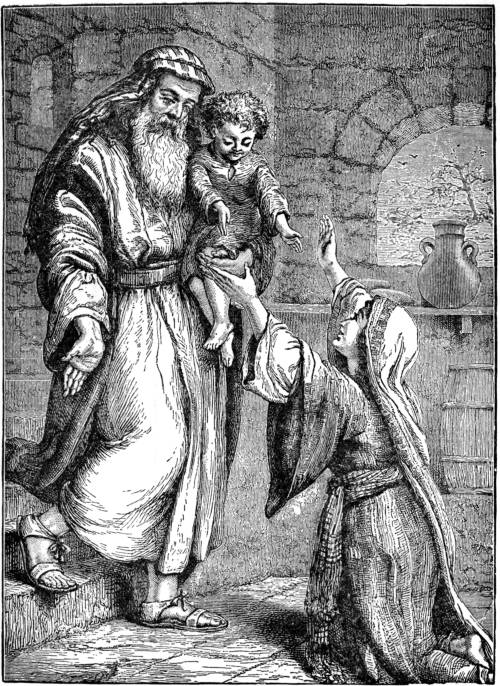
The Shunammite’s Son

THE SHUNAMMITE’S SON

Many interesting stories are told in the Bible, few of which are more touching than that of Elisha the prophet, and the Shunammite woman. This story we find in the fourth chapter of the Second Book of Kings.

We read of the prophet journeying to and fro, and resting in the little chamber that the kind Shunammite had built for him on the wall of her house. We see its bed, table, stool, and candlestick; and the joy beaming upon the good woman’s face when a tiny infant son was given her. How she loved him! And as he grew up how carefully she watched over him. But a sad time was coming.

The golden corn was in the field ready for reaping, for the harvest time had come. The hot sun shone overhead, and the little lad was out with his father in the field, probably running about among the corn. Suddenly he felt a violent pain, and cried out, “My head, my head!” Then joy was changed to sorrow. The father saw his son was ill, and bade a lad carry the little boy to his mother, on whose knees he sat till noon, and then he died.

Next we see the mother leaving her dead son, and journeying to find the prophet. Elisha sees her coming, and sends Gehazi to inquire if all is well. Then she falls down before the prophet and tells him her trouble; and he sends his servant with his staff to lay it upon the dead child. The story closes by stating how Elisha follows Gehazi, goes to the chamber where the dead boy lay, prays to God that the life may be restored, and finally has the joy of giving the lad, alive and well again, into the arms of his mother.
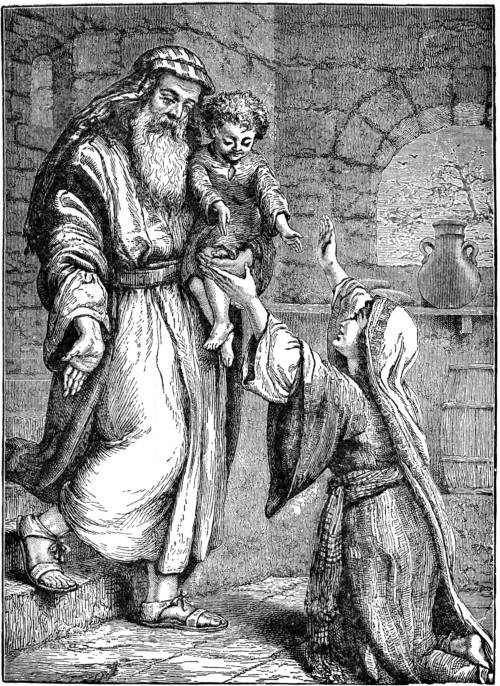
THE SHUNAMMITE’S SON RESTORED

1st grade week 12 out of 36

Subscribe to continue reading

Subscribe to get access to the rest of this post and other subscriber-only content.

How to Make Lemon-Apple Jelly at Home

Makes 4 half -pint jars

Ingredients:

  • 3 cups sugar
  • 1½ cups apple juice
  • 1/2 cup fresh-squeezed lemon juice
  • 1 pouch (3 ounces) liquid fruit pectin

Directions:

  1. Combine sugar and apple and lemon juices in a large saucepan; bring to a full rolling boil over high heat, stirring occasionally.
  2. Add pectin; bring back to a full rolling boil and boil 30 seconds, stirring constantly.
  3. Skim off foam.
  4. Pour into hot, sterilized half-pint jars, filling to 3/4 inch of top.
  5. Wipe tops of jars clean; seal.
  6. Process in a boiling water bath for 10 minutes.

The Children’s Six Minutes: Helping Fingers

HELPING FINGERS

For three years I lived in Manila, Philippine Islands. Not far from my home was an orphanage for children who were deaf and dumb. Frequently these children were seen at different entertainments that were given about the city. One evening I went to attend a lecture in the Y.M.C.A. Right in front of me sat three children. They were very quiet and orderly. When the lecture began the boy who sat in the middle began to make his fingers go as fast as he could, the two children on either side watching him intently. That center boy could hear, the other two were deaf. So he heard the lecture for them and told it to them by the finger language.

One day a girl, coming out from school, got on a streetcar to go to her home. The car was crowded. She found a seat next to a woman who was heavily laden with bundles. She had all she could do to hold those bundles in her lap and keep them from falling and scattering their contents on the floor. Then a string about one of the packages became untied. She struggled to get that string fastened securely. She had so many packages, her fingers were numb with cold, and again and again the string slipped just at the crucial time. Finally, this schoolgirl, who was an attractive, well-dressed girl, reached over and placed her nicely gloved finger on the obstreperous knot. There was a grateful smile from the troubled woman and a hearty “Thank you.” The next stop was the girl’s home. As she went to the end of the car, she passed a school friend who had watched the little incident. She said to her, “I see you belong to the helping hand society.” “No,” replied the girl, “not the helping hand, just the helping finger society.” This is a great society, girls and boys. Admission to it requires no initiation fee, no dues, simply the desire and the will to be helpful wherever you are.

MEMORY VERSE, Ecclesiastes 9: 10

“Whatsoever thy hand findeth to do, do it with thy might.”

MEMORY HYMN [349]

“Saviour, thy dying love thou gavest me.”

El impacto de los profetas en la restauración de Jerusalén

El regreso a Jerusalén

  • La primera expedición que regresó a Jerusalén tuvo lugar después de que expirara el tiempo profético de 70 años de cautiverio.
    • Esta expedición tuvo lugar alrededor del año 536 a. C. y fue liderada por Zorobabel.
      • Trajo a unos 50.000 judíos de regreso a Jerusalén.
  • El segundo año después de su
    • Hageo 1:1-3 (Amp) En el segundo año del rey Darío [de Persia], el primer día del sexto mes (29 de agosto de 520 a. C.), la palabra del Señor vino por medio del profeta Hageo a Zorobabel hijo de Salatiel, gobernador de Judá, y a Josué hijo de Josadac, sumo sacerdote, diciendo: «Así dice el Señor de los ejércitos: “Este pueblo dice: “No ha llegado el tiempo para que la casa (templo) del Señor sea reconstruida”. Entonces la palabra del Señor vino por medio del profeta Hageo, diciendo: “¿Es tiempo para ustedes de vivir en sus [costosas] casas artesonadas mientras esta casa [del Señor] está en ruinas?” Ahora pues, así dice el Señor de los ejércitos: «Considerad vuestros caminos, y reflexionad en vuestra conducta.

OPOSICIÓN

  • Los judíos se enfrentaron a la oposición de sus enemigos cuando intentaron reconstruir el Templo.
    • Esdras 4:4-5 (Amp) Entonces [los samaritanos y otros de] la gente de la tierra desanimaron a la gente de Judá, y los atemorizaron [para disuadirlos] de edificar, y contrataron consejeros [para trabajar] contra ellos para frustrar sus planes durante todo el tiempo que reinó Ciro rey de Persia, [y esto duró] incluso hasta el reinado de Darío rey de Persia.

LOS PROFETAS Y EL MENSAJE DE RESTAURACIÓN

  • El período de la restauración también tuvo sus profetas.
    • Dios envió hombres como Hageo, Zacarías y Malaquías para animar y castigar (corregir y disciplinar) a los judíos.

EL ANTIGUO TESTAMENTO TERMINA

  • La vida de los israelitas en el Antiguo Testamento parece ser una continua reincidencia.
  • El Antiguo Testamento termina con el pueblo olvidándose de Dios y su palabra.
    • Malaquías 3:5-6 (amp) “Entonces me acercaré a vosotros para juicio; seré un testigo veloz contra los hechiceros, contra los adúlteros, contra los perjuros, contra los que oprimen al trabajador en su salario, a las viudas y a los huérfanos, contra los que desvían al extranjero [de su derecho] y contra los que no me temen [con reverencia reverente]”, dice el Señor de los ejércitos. “Porque yo, el Señor, no cambio [sino que permanezco fiel a mi pacto con vosotros]; por eso, hijos de Jacob, no habéis llegado a su fin”.
  • Aunque ya no practicaban la idolatría en su mayor parte, la mayoría olvidó la manifestación de su gran poder y cayó en la apostasía.
  • El Antiguo Testamento termina con los judíos fuera de la voluntad de Dios.
  • No volvieron a escuchar otro mensaje profético de Dios durante unos 400 años.