Kitchen thermometers help ensure that food are cooked to safe internal temperatures and are stored at proper temperatures. There are many types of thermometers that can be used.
Appliance Thermometers
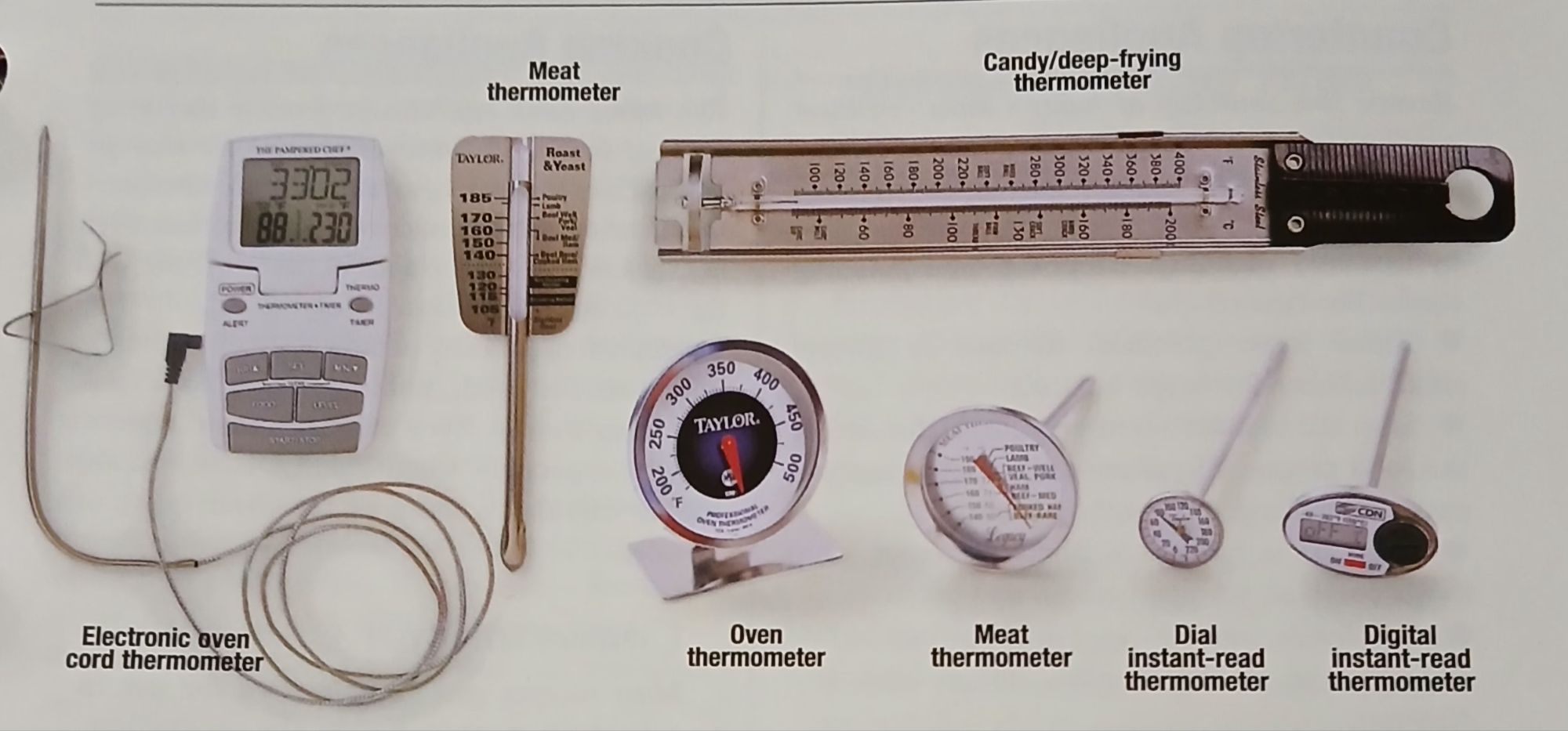
- Oven thermometer: This lets you check the accuracy of your oven’s temperature.
- Refrigerator/freezer thermometer: This verifies whether the appliance is chilling correctly.
- For food safety, refrigerators should maintain a temperature of no higher than 40°F, and freezers should maintain a temperature of 0°F or less.
Food Thermometers
- Candy/deep-frying thermometer: These thermometers can safely measure extra-high temperatures. They are marked with candy making stages and for deep in frying.
- Disposable temperature indicator:
- This single use thermometer, designed for specific temperature ranges, has a sensor that changes when the when the appropriate temperature is reached.
- Follow the manufacturer’s directions and use it for the food for which it is designed.
- Electronic oven cord thermometer: Best for roasts or large cuts of meats.
- This thermometer features a probe designed to stay in the meat as it cooks.
- A stay cool cord aches to a magnet-backed unit attaches to the oven door.
- An alarm sounds when the food reaches the desired temperature.
- Though designed for oven use, it also can be used to check food cooking on the stove top.
- Fork thermometer: Handy for grill.
- This thermometer can be used for most foods
- To ensure an accurate reading, be sure that the tine of the fork containing the sensor is fully inserted. Do not leave it in food while the food is cooking
- Instant-read thermometer: It gives an internal reading in seconds.
- The sensor in a digital instant-read thermometer is in the tip.
- Use this type to verify internal temperatures of thin or thick foods. The sensor of a dial instant-read thermometer is in the stem, not the tip, so the stem must be inserted at least 2 inches into the food you are testing for an accurate reading.
- For thinner cuts, you may need to insert the thermometer sideways into the food.
- Do not leave the thermometer in food while the food is cooking.
- Meat thermometer: Typically used to check the internal temperature of large cuts of meats, such as roasts and whole poultry, it generally is not appropriate for thin foods.
- An oven-safe meat thermometer may be left in a conventional oven but not in a microwave oven.
- Pop-up thermometer: Sometimes turkey or other meat comes with an embedded thermometer that pops up when the food is done.
- Even when such a device is present. the food should be tested with a reliable food thermometer to ensure that it reaches the proper temperatures for safety and doneness.
Temperature and Safety
- Cooking foods to their proper temperatures is about maximizing flavor, texture, and safety.
- Always use a thermometer to determine if something is done. Never just guess by looking at it or by the amount of time it has spent in the oven or on the grill.

 articlesforchristians
Comments on: "Kitchen Thermometers" (2)
[…] Kitchen Thermometers […]
[…] Thermometers: Click here. […]