Chapter III. The Sign CANCER (The Crab)
Messiah’s Redeemed Possessions held fast.
With regard to the sign of Cancer, one thing is certain, that we have not got the original picture, or anything like it.
It does not agree with the names either of its three constellations which have come down to us, or of its stars.
In the ancient Denderah Zodiac it is represented as a Scarabæus, or sacred beetle. In the Zodiac of Esneh and in a Hindu Zodiac (400 b.c.) it is the same.
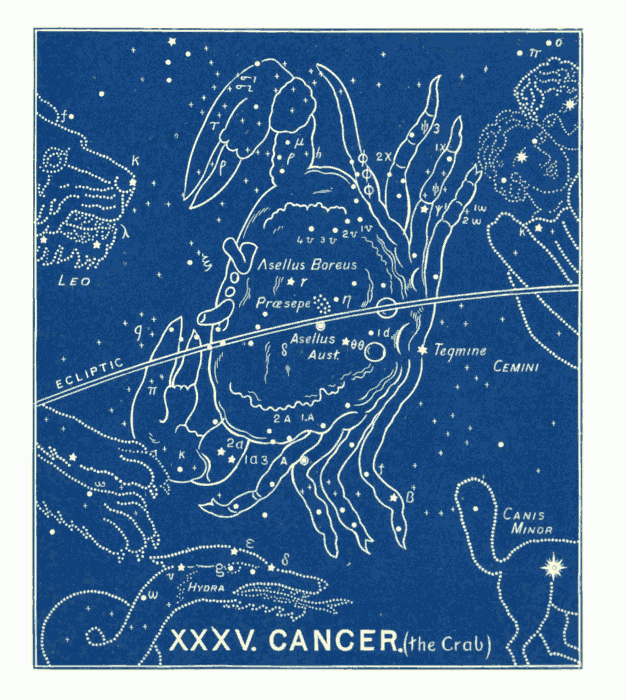
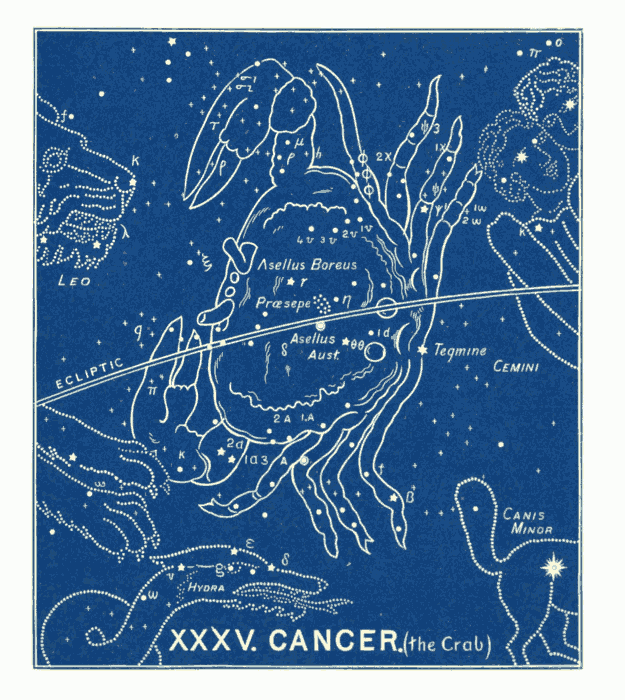
According to the Greeks, Jupiter placed this Crab amongst the signs of the Zodiac.
In Sir William Jones’s Oriental Zodiac we meet with a crab, and an Egyptian Zodiac found at Rome bears also the crab in this sign.
The more ancient Egyptians placed Hermanubis, or Hermes, with the head of an ibis or hawk, as the symbol of the sign now allotted to Cancer.
The Denderah name is Klaria, or the cattle-folds, and in this name we have the key to the meaning of the sign, and to the subject of this chapter.
The Arabic name is Al Sartan, which means who holds or binds, and may be from the Hebrew אָסַר, to bind together (Gen. xlix. 11). There is no ancient Hebrew word known for the crab. It was classed with many other unclean creatures, and would be included in the general term “vermin.”
The Syriac, Sartano, means the same. The Greek name is Karkinos, which means holding or encircling, as does the Latin, Cancer, and hence is applied to the crab. In the word Khan, we have the traveller’s rest or inn; while Ker or Cer is the Arabic for encircling. The ancient Akkadian name of the month is Su-kul-na, the seizer or possessor of seed.
The sign contains 83 stars, one of which is of the 3rd magnitude, and seven are of the 4th magnitude, and the remainder of inferior magnitudes.
In the centre of the Sign there is a remarkably bright cluster of stars, so bright that they can be sometimes seen with the naked eye. It looks like a comet, and is made up of a great multitude of stars. Modern astronomers have called it the Beehive. But its ancient name has come down to us as Praesepe, which means a multitude, offspring.
The brightest star, ζ (in the head), is called Tegmine, holding. The star α (or α1 and α2), in the lower large claw, is called Acubene, which, in Hebrew and Arabic, means the sheltering or hiding-place. Another is named Ma’alaph (Arabic), assembled thousands; Al Himarein (Arabic), the kids or lambs.
North and south of the nebula Praesepe are two stars, which Orientalists speak of by a name evidently of some antiquity. Asellus means an Ass, and one was called Asellus Boreas, the northern Ass; while the other, Asellus Australis, is the southern Ass.
The sign was afterwards known by the symbol ♋, which stands for these two asses.
This connects it with the Tribe of Issachar, who is said to have borne upon the Tribal standard the sign of two asses.
This is doubtless the reference in Jacob’s blessing (Gen. xlix. 11, r.v.):—
“Issachar is a strong ass,
Couching down between the sheepfolds;
And he saw a resting-place that it was good;
And the land that it was pleasant;
And he bowed his shoulder to bear,
And became a servant under task work.”
Have we not here the gathering up of the teaching of this sign—
Messiah’s redeemed possessions held fast.
Here we come to the completion of His work. In Cancer we see it with reference to His redeemed, and in the next (the last) Sign, Leo, with reference to His enemies.
The three constellations develope the truth. What is now called Ursa Minor is the Lesser Flock; Ursa Major gives us The Sheepfold and the Sheep; while Argo, The Ship, shows the travellers and the pilgrims brought safely home—all conflict over.
To accomplish this, we see the true Issachar bowing his shoulder to bear. He could say, “My soul is bowed down” (Ps. lvii. 6). He became a servant, and humbled Himself to death. He undertook the mighty task of saving His people from their sins. “Their Redeemer is strong” (Jer. l. 34); for help was laid on “One that was mighty” (Ps. lxxxix. 19). And His redeemed shall come to a resting-place that is good, and to a land that is pleasant. No earthly Khan on earth affords them a home. They look for a heavenly home, and in the many mansions of the Father’s house they shall find eternal rest.
Here we see that sheltering home to which the names of these stars point; where the assembled thousands (Ma’alaph) shall be received into the true Klaria, even the “everlasting habitations.”
These are now to be shown to us.

 articlesforchristians
Comments on: "Witness of the Stars: Chapter III. The Sign CANCER (The Crab)" (1)
[…] Chapter III. The Sign CANCER (The Crab). […]