Specialty Pans
While not essential, these specialty pans offer features that make it easier to prepare specific foods.
- Griddle: This flat, often rimless pan makes flipping pancakes a cinch. A nonstick griddle also helps you cook with a minimum amount of fat.
- Grill pan: The grooves of this heavy, stove-top, griddle-type pan allow fat to drain away from
food and add appetizing grill marks to the cooked items. - Omelet pan: Sloped sides and a nonstick surface make it easy to fold and slide omelets from the
pan onto the plate. - Wok: Available with a rounded or flat bottom, this pan offers deep, sloping sides that help keep
food pieces in the pan when stir-frying.
About Nonstick Pans
Choose moderately priced, fairly heavy nonstick pans. With proper care and by using heat-proof spatulas and wooden spoons, these pans can last three to five years before needing replacement. However, I don’t recommend them, as scratches in the nonstick coating can release toxic fumes into the air.
Baking Pans and Dishes
For our purposes, a baking pan refers to a metal container, and a baking dish refers to an oven-safe glass or ceramic container. (If substituting glass or ceramic cookware for recipes that call for baking pans, reduce baking temperature by about 25°F.)
Baking Pans (Metal)
- Use for nicely browned baked goods.
- Use for broiling. Do not use glass dishes or casseroles when broiling because the high temperatures may cause the glass to shatter.
Baking Dishes (Glass or Ceramic)
- Use for dishes made with eggs or with acidic ingredients such as tomatoes and lemon. Baking pans made of aluminum, iron, and tin can react with these foods, causing the foods to discolor.
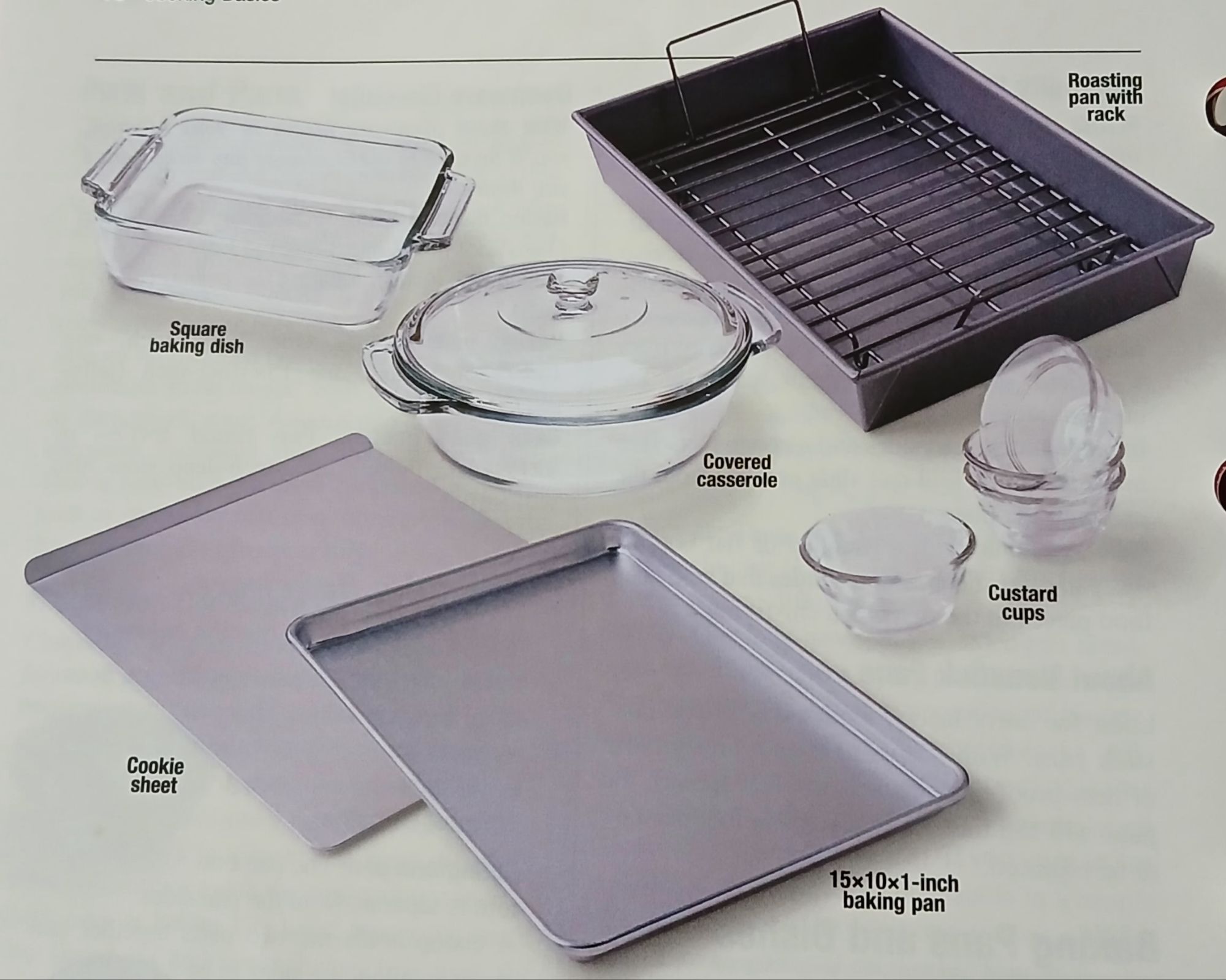
Ovenware Checklist
With these ovenware pieces in your kitchen, you’ll be able to make almost any baked good you desire. If you are on a budget, many of these can be used as substitutes for the rest. Think about what you would be cooking the most. Then think about how those might be used as a substitute for the rest. A few can’t be substituted. If you really want to cook those items, save up and get a good one.
- Baking dishes (glass), rectangular:
- One 2-quart (12x72x2-inch)
- One 3-quart (13x9x2-inch).
- Baking dish (glass), square:
- One 2-quart (8x8x2-inch).
- Baking pans (metal):
- One 9x9x2-inch
- One 13x9x2-inch
- One 15x10x1-inch (jellyroll).
- Cake pans (metal):
- Two round 8×12- or 9×1½-inch; those with 2-inch-deep sides also
will suffice.
- Two round 8×12- or 9×1½-inch; those with 2-inch-deep sides also
- Cookie sheets (metal):
- At least two with either no sides or low sides; in a pinch, substitute a 15x10x1-inch (jelly-roll) baking pan, though its rims may inhibit even browning.
- Covered casseroles:
- Several round, deep, glass, various sizes (1-, 2-, and 3-quart). If a recipe calls for a covered casserole and you do not have a lid, use foil to cover.
- Custard cups:
- Six round, glass, 6-ounce.
- Use them for cooking custards and other individual desserts and when measuring and preparing small amounts of ingredients, such as garlic, in advance so that the ingredients are ready when you need them in a recipe.
- Six round, glass, 6-ounce.
- Loaf pans (metal) or dishes (glass):
- Several 72x32x2-inch, 8×4×2-inch, or 9×5×3-inch.
- Muffin pan:
- One pan with twelve 21/2-inch cups or one or two pans with twelve 1/4-inch cups.
- Pie plate (glass) or pan (metal):
- One round 9-inch.
- Pizza pan (metal):
- One round 12- to 14-inch; in a pinch, substitute a baking sheet, but build up the pizza crust edges to hold toppings.
- Roasting pan with rack:
- One large enough to accommodate a roast yet fit in your oven.
- A rack helps promote even cooking and prevents the roast from stewing in the pan juices.
- Soufflé dish:
- One round, glass, 1½-quart; in a pinch, substitute a straight-sided casserole with the same volume
Specialty Bakeware
Some desserts require specific bakeware.
- Fluted tube pan: Fluted sides bring a decorative look to cakes. This pan comes in various sizes, with a 10-inch, 12-cup being the most common.
- Springform pan: The pan bottom is separate from the pan sides. A clamp holds the two parts together and opens to allow the sides to be pulled away from the baked dessert.
- Use this round pan for making cheesecakes and other desserts that are tricky to remove from their pans.
- The 8- and 9-inch sizes are most common; 10- and 11-inch pans also are available.
- Tart pan with removable bottom: A removable bottom makes it easy to neatly transfer a tart to a serving plate.
- Pans come in 9- to 11-inch sizes. (Shallow quiche or flan pans are one piece, without removable bottoms.)
- Tube pan: This deep pan, also known as an angel food cake pan, has a hollow center tube that promotes even baking.
- Most tube pans have removable bottoms.
- A 10-inch pan is a common size.

 articlesforchristians
Comments on: "Specialty pans" (1)
[…] Specialty pans […]