The First Book. The Redeemer.
(His First Coming.)
“The Sufferings of Christ.”
The First Book is occupied with the PERSON of the Coming One. It covers the whole ground, and includes the conflict and the victory of the Promised Seed, but with special emphasis on His Coming. The book opens with the promise of His coming, and it closes with the Dragon cast down from heaven.
Chapter I. The Sign VIRGO.
The Promised Seed of the Woman.
Here is the commencement of all prophecy in Gen. iii. 15, spoken to the serpent:—“I will put enmity between thee and the woman, and between thy seed and her seed: it shall bruise thy head, and thou shalt bruise His heel.” This is the prophetic announcement which the Revelation in the heavens and in the Book is designed to unfold and develope. It lies at the root of all the ancient traditions and mythologies, which are simply the perversion and corruption of primitive truth.
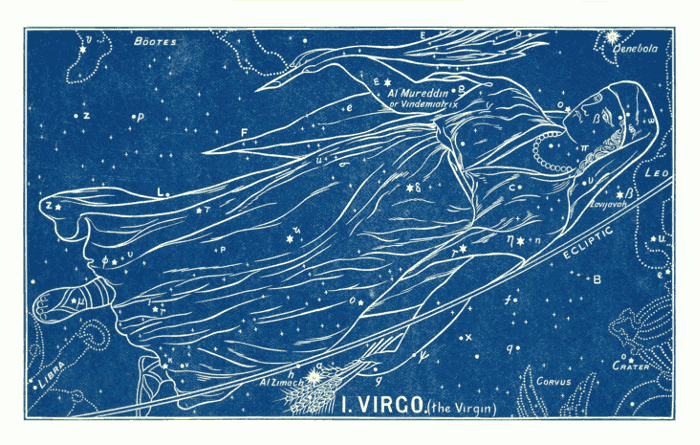
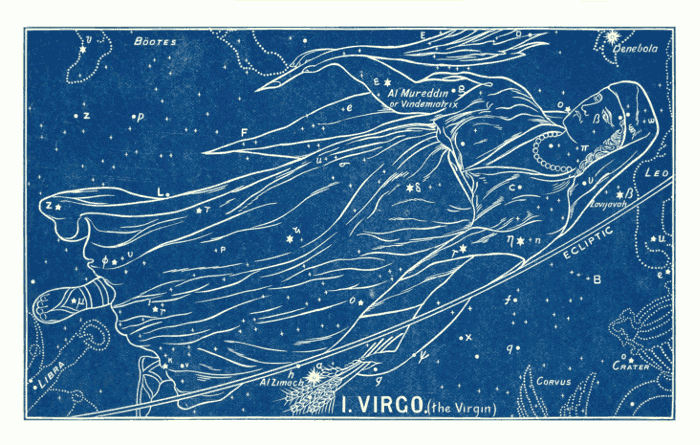
Virgo is represented as a woman with a branch in her right hand, and some ears of corn in her left hand. Thus giving a two-fold testimony of the Coming One.
The name of this sign in the Hebrew is Bethulah, which means a virgin, and in the Arabic a branch. The two words are connected, as in Latin—Virgo, which means a virgin; and virga, which means a branch (Vulg. Isa. xi. 1). Another name is Sunbul, Arabic, an ear of corn.
In Gen. iii. 15 she is presented only as a woman; but in later prophecies her nationality is defined as being of the stock of Israel, the seed of Abraham, the line of David; and, further, she is to be a virgin. There are two prominent prophecies of her and her seed: one is connected with the first coming in incarnation, Isa. vii. 14 (quoted in Matt. i. 23.)
“Behold, a virgin shall conceive and bear a son,
And shall call his name Immanuel.”
The other is connected with His second coming, leaping over the sufferings and this present interval of His rejection, and looking forward to His coming in glory and judgment, Isa. ix. 6, 7 (quoted in Luke ii. 11 and i. 32, 33)—
“For unto us a child is born,
Unto us a son is given;
And the government shall be upon His shoulder;
And His name shall be called Wonderful, Counsellor,
The Mighty God, The Everlasting Father, The Prince of Peace.
Of the increase of His government there shall be no end.
Upon the throne of David, and upon His kingdom,
To order it, and to establish it
With judgment and with justice
From henceforth even for ever.
The zeal of the LORD of hosts will perform this.”
It is difficult to separate the Virgin and her Seed in the prophecy, and so, here, we have first the sign Virgo, where the name points to her as the prominent subject; while in the first of the three constellations of this sign, where the woman appears again, the name Coma points to the child as the great subject.
Virgo contains 110 stars, viz., one of the 1st magnitude, six of the 3rd, ten of the 4th, etc.
Aratus thus sings of them:—
“Beneath Boötes feet the Virgin seek,
Who carries in her hand a glittering spike….
Over her shoulder there revolves a star
In the right wing, superlatively bright;
It rolls beneath the tail, and may compare
With the bright stars that deck the Greater Bear.
Upon her shoulder one bright star is borne,
One clasps the circling girdle of her loins,
One at her bending knee; and in her hand
Glitters that bright and golden Ear of Corn.
Thus, the brightest star in Virgo (α) has an ancient name, handed down to us in all the star-maps, in which the Hebrew word (צֶמֶח) Tsemech is preserved. It is called in Arabic Al Zimach, which means the branch. This star is in the ear of corn which she holds in her left hand. Hence the star has a modern Latin name, which has almost superseded the ancient one, Spica, which means, an ear of corn. But this hides the great truth revealed by its name Al Zimach. It foretold the coming of Him who should bear this name. The same Divine inspiration has, in the written Word, four times connected it with Him. There are twenty Hebrew words translated “Branch,” but only one of them (Tsemech) is used exclusively of the Messiah, and this word only four times. Each of these further connects Him with one special account of Him, given in the Gospels.
(1.) Jer. xxiii. 5, 6—
“Behold, the days come, saith the LORD,
That I will raise unto David a righteous BRANCH
(i.e., a Son),
And a KING shall reign and prosper.”
The account of His coming as King is written in the Gospel according to Matthew, where Jehovah says to Israel, “Behold thy KING.” (Zech. ix. 9; Matt. xxi. 9.)
(2.) Zech. iii. 8.—“Behold I will bring forth my SERVANT the BRANCH.” In the Gospel according to Mark we find the record of Jehovah’s servant and His service, and we hear Jehovah’s voice saying, “Behold my SERVANT.” (Isa. xlii. 1.)
(3.) Zech. vi. 12.—“Thus speaketh the Lord of hosts, saying, Behold the MAN whose name is the [pg 033]BRANCH.” In the Gospel according to Luke we behold Him, presented in “the MAN Christ Jesus.”
(4.) Isa. iv. 2.—“In that day shall the BRANCH of JEHOVAH be beautiful and glorious.” So that this Branch, this Son, is Jehovah Himself; and as we read the record of John we hear the voice from heaven saying, “Behold your GOD.” (Isa. xl. 9.)
This is the Branch foretold by the star Al Zimach in the ear of corn.
The star β is called Zavijaveh, which means the gloriously beautiful, as in Isa. iv. 2. The star ε, in the arm bearing the branch, is called Al Mureddin, which means who shall come down (as in Ps. lxxii. 8), or who shall have dominion. It is also known as Vindemiatrix, a Chaldee word which means the son, or branch, who cometh.
Other names of stars in the sign, not identified, are—
Subilah, who carries. (Isa. xlvi. 4.)
Al Azal, the Branch. (As in Isa. xviii. 5.)
Subilon, a spike of corn. (As in Isa. xvii. 5.)
The Greeks, ignorant of the Divine origin and teaching of the sign, represented Virgo as Ceres, with ears of corn in her hand.
In the Zodiac in the Temple of Denderah, in Egypt, about 2000 b.c. (now in Paris), she is likewise represented with a branch in her hand, but ignorantly explained by a false religion to represent Isis! Her name is called Aspolia, which means ears of corn, or the seed, which shows that though the woman is seen, it is her Seed who is the great subject of the prophecy.
Passing to the three constellations anciently assigned to the sign Virgo, we come to what may be compared to three sections of the chapter, each giving some further detail as to the interpretation of its teaching.

 articlesforchristians
Comments on: "Witness of the Stars: The First Book. The Redeemer." (2)
[…] The Redeemer: Chapter I. The Sign VIRGO. […]
[…] Witness of the Stars: The First Book. The Redeemer […]