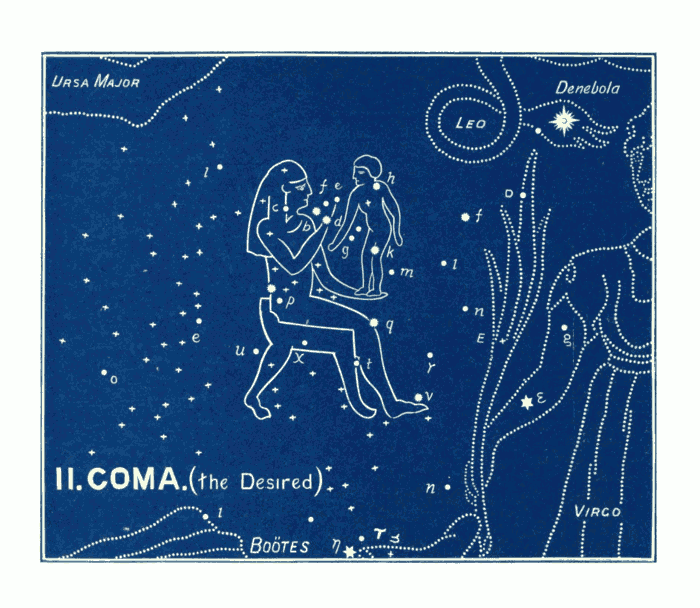
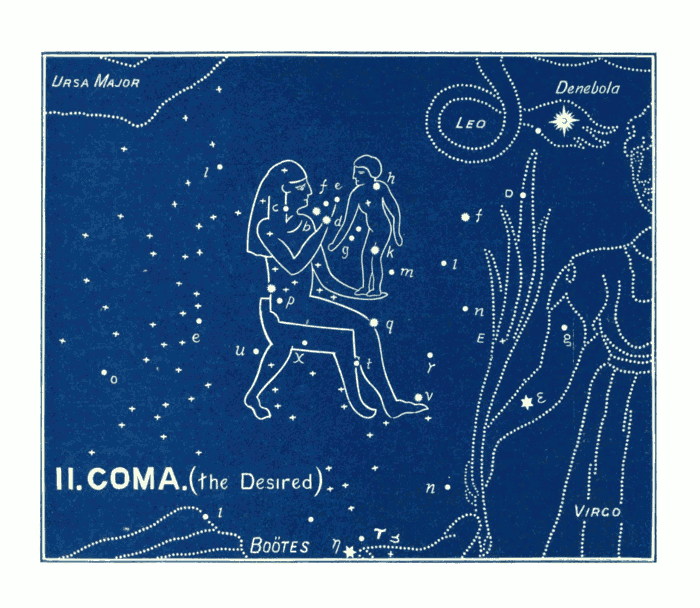
COMA (The Woman and Child)
The Desired of all Nations.
The first constellation in Virgo explains that this coming “Branch” will be a child, and that He should be the “Desire of all nations.”
The ancient name of this constellation is Comah, the desired, or the longed for. We have the word used by the Holy Spirit in this very connection, in Hag. ii. 7: “The DESIRE of all nations shall come.”

The ancient Zodiacs pictured this constellation as a woman with a child in her arms. Albumazar (or Abu Masher), an Arabian astronomer of the eighth century, says, “There arises in the first Decan, as the Persians, Chaldeans, and Egyptians, and the two Hermes and Ascalius teach, a young woman, whose Persian name denotes a pure virgin, sitting on a throne, nourishing an infant boy (the boy, I say), having a Hebrew name, by some nations called IHESU, with the signification IEZA, which in Greek is called CHRISTOS.”
But this picture is not found in any of the modern maps of the stars. There we find to-day a woman’s wig! It appears that Berenice, the wife of Euergetes (Ptolemy III.), king of Egypt in the third century b.c., when her husband once went on a dangerous expedition, vowed to consecrate her fine head of hair to Venus if he returned in safety. Her hair, which was hung up in the Temple of Venus, was subsequently stolen, and to comfort Berenice, Conon, an astronomer of Alexandria (b.c. 283-222), gave it out that Jupiter had taken it and made it a constellation!
This is a good example of how the meaning of other constellations have been perverted (ignorantly or intentionally). In this case, as in others, the transition from ancient to more modern languages helped to hide the meaning. The Hebrew name was Coma (desired). But the Greeks had a word for hair, Có-me. This again is transferred to the Latin coma, and thus “Coma Berenicæ” (the hair of Berenice) comes down to us to-day as the name of this constellation, and gives us a woman’s wig instead of that Blessed One, “the Desire of all Nations.”
In this case, however, we are able to give absolute proof that this is a perversion.
The ancient Egyptian name for this constellation was Shes-nu, the desired son!
The Zodiac in the Temple of Denderah, in Egypt, going back at least 2,000 years b.c., has no trace of any hair, but it has the figure of a woman and child. In our illustration we have given a copy of this very ancient picture, and not the wig of hair!
We have been permitted to trace it from a work on Egyptian Scenery by the late eminent astronomer, Edward J. Cooper, of Markree Castle, co. Sligo, who visited that Temple in the year 1820 with an Italian artist, Signor Bossi. The original drawing from which our tracing is made (and enlarged) was drawn by Signor Bossi on the spot, before it was taken to Paris in 1821. We thus have before us the exact representations of one of these star-pictures at least 4,000 years old.
Even Shakespeare understood the truth about this constellation picture, which has been so long covered by modern inventions. In his Titus Andronicus he speaks of an arrow being shot up to heaven to the “Good boy in Virgo’s lap.”
The constellation itself is very remarkable. Others contain one or two stars of the first or second magnitude, and then a greater or less variety of lesser stars; but this is peculiar from having no one very bright star, but contains so many stars of the 4th and 5th magnitudes. It contains 43 stars altogether, ten being of the 4th magnitude, and the remainder of the 5th, 6th, etc.
It was in all probability the constellation of Coma in which “the Star of Bethlehem” appeared. There was a traditional prophecy, well-known in the East, carefully preserved and handed down, that a new star would appear in this sign when He whom it foretold should be born.
This was, doubtless, referred to in the prophecy of Balaam, which would thus receive a double fulfilment, first of the literal “Star,” and also of the person to whom it referred. The Lord said by Balaam (Num. xxiv. 17),
“There shall come a star out of Jacob,
And a sceptre shall rise out of Israel.”
Thomas Hyde, an eminent Orientalist (1636-1703), writing on the ancient religion of the Persians, quotes from Abulfaragius (an Arab Christian Historian, 1226-1286), who says that Zoroaster, or Zerdusht, the Persian, was a pupil of Daniel the Prophet, and that he predicted to the Magians (who were the astronomers of Persia), that when they should see a new star appear it would notify the birth of a mysterious child, whom they were to adore. It is further stated in the Zend Avesta that this new star was to appear in the sign of the Virgin. Some have supposed that this passage is not genuine. But whether it was interpolated before or after the event, it is equally good evidence for our purpose here. For if it was written before the event, it is evidence of the prophetic announcement; and if it was interpolated after the event it is evidence of the historic fact.
The Book of Job shows us how Astronomy flourished in Idumea; and the Gospel according to Matthew shows that the Persian Magi, as well as others, were looking for “the Desire of all nations.”
New stars have appeared again and again. It was in 125 b.c. that a star, so bright as to be seen in the day-time, suddenly appeared. It was this that caused Hipparchus to draw up his catalogue of stars, which has been handed down to us by Ptolemy (150 a.d.).
This new star would show the latitude, passing at that time immediately overhead at midnight, every twenty-four hours; while the prophecy would give the longitude as the land of Jacob. Having these two factors, it would be only a matter of observation, and easy for the Magi to find the place where it would be vertical, and thus to locate the very spot of the birth of Him of whom it was the sign, for they emphatically called it “His Star.” There is a beautiful tradition which relates how, in their difficulty, on their way from Jerusalem to find the actual spot under the Zenith of this star, these Magi sat down beside David’s “Well of Bethlehem” to refresh themselves. There they saw the star reflected in the clear water of the well. Hence it is written that “when they saw the star they rejoiced with exceeding joy,” for they knew they were at the very spot and place of His appearing whence He was to “come forth.”
There can be little doubt that it was a new star. In the first place a new star is no unusual phenomenon. In the second place the tradition is well supported by ancient Christian writers. One speaks of its “surpassing brightness.” Another (Ignatius, Bp. of Antioch, a.d. 69) says, “At the appearance of the Lord a star shone forth brighter than all the other stars.” Ignatius, doubtless, had this from those who had actually seen it! Prudentius (4th cent. a.d.) says that not even the morning star was so fair. Archbishop Trench, who quotes these authorities, says “This star, I conceive, as so many ancients and moderns have done, to have been a new star in the heavens.”
One step more places this new star in the constellation of Coma, and with new force makes it indeed “His star”—the “Sign” of His “coming forth from Bethlehem.” Will it be “the sign of the Son of Man in heaven” (Matt. xxiv. 30) when He shall “come unto” this world again to complete the wondrous prophecies written of Him in the heavenly and earthly Revelations?
Thus does the constellation of Coma reveal that the coming “Seed of the woman” was to be a child born, a son given.
But He was to be more: He was to be God and man—two natures in one person! This is the lesson of the next picture.

2 responses to “The Witness of the Stars: COMA (The Woman and Child)”
[…] Part 1: COMA (The Woman and Child) […]
[…] COMA (The Woman and Child) […]