The Coming of the Dutch
While Captain John Smith was in Virginia, he had a notion that there was a passage into the Pacific Ocean somewhere to the north of the Virginia Colony. He may have got this opinion from some old maps, or from misunderstanding something that the American Indians told him while he was exploring the Chesapeake Bay. He sent to his old friend Henry Hudson, in England, a letter and a map, which showed a way to go by sea into the Pacific Ocean, a little to the north of Virginia.
Henry Hudson was an Englishman already known as a bold explorer. In 1609, soon after getting John Smith’s letter and map, Hudson went to Holland and hired himself to the Dutch East India Company. This company sent him out with a little yacht, called the Half-Moon, manned by twenty sailors, to find a passage to China, by going around the north coast of Europe. But he found the sea in that direction so full of ice that he was obliged to give up the attempt to get to China in that way. So, remembering John Smith’s map, he set sail for America.
Hudson sailed as far to the south as the entrance to the Chesapeake, and then explored the coast to the northward. He went into Delaware Bay, and afterward into New York Harbor. In hope of finding a way to the East Indies, he kept on up the river, which we now call Hudson River, for eleven days. But when he had gone nearly as far as to the place where Albany is now, Hudson became satisfied that the road to China did not lie there, and so he sailed down and returned to Europe.
Though Hudson was an Englishman, he made this voyage for the Dutch, and the very next year the Dutch merchants began a fur trade with the American Indians on this river that Hudson had discovered. In the year that followed (1611) they explored the coast northeastward beyond Boston Harbor, and to the southward they sailed into the Delaware River, claiming all this country, which was then without any inhabitants but American Indians. They called this territory New Netherland. Netherland is another name for what we call Holland.
The Dutch had built a trading post, called a “fort,” at what is now Albany, and perhaps others like it elsewhere, but they did not send out a colony until 1623. Then two principal settlements were made, the one at Albany, the other at Wallabout, now part of Brooklyn. But the island of Manhattan, on which New York now stands, had been the center of their trade, and it soon became the little capital of the colony. The town which grew about the fort that stood at the south end of what is now New York city, was called by the Dutch New Amsterdam, after the principal city of Holland, their own country.
The Dutch also had settlements on the Connecticut River and on the Delaware River. But on the Connecticut River they got into trouble with the English settlers, who claimed the whole of that country. On the Delaware River the Dutch had trouble with some Swedes, who had planted a colony there in 1638. This colony the Swedes called New Sweden, just as the Dutch called theirs New Netherland, and as the English called their northern colonies New England, while the French named their settlements in Canada New France. After a great deal of quarreling between the Swedes and Dutch, the Dutch governor, Peter Stuyvesant, in 1655, mustered a little fleet with six or seven hundred men, and, sailing to the Delaware River, captured New Sweden.
But the English at this time claimed that all the territory between Virginia and New England belonged to England. They said that all that coast had been discovered by Cabot for Henry VII more than a century and a half before. In 1664, in time of peace, four English ships appeared in the harbor of New Amsterdam and demanded its surrender. Stout old Peter Stuyvesant, the lame governor who had ruled in the Dutch colonies for many years, resolved to fight. But the city was weak and without fortifications, and the people, seeing the uselessness of contending against the ships, persuaded Stuyvesant to surrender. The name New Amsterdam was immediately changed to New York, the whole province having been granted to the Duke of York.
At the time of the surrender New York city had but fifteen hundred people, most of them speaking the Dutch language. Today there are nearly a thousand times as many people in New York city. Many thousands of the people of New York and many in other States have descended from the first Dutch settlers and bear the old Dutch names. The Dutch settlers were generally industrious, frugal, and religious.
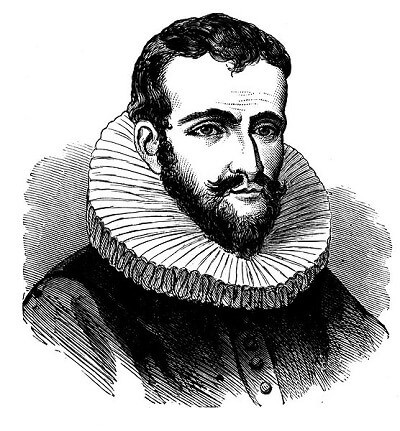
HENRY HUDSON
The time of Hudson’s birth is not known. Nor is anything known of the early voyages by which he became famous. In 1607, in the employ of an English company, he undertook to find the much-desired route to China by sailing straight across the north pole. He failed, of course, though he got farther north than any other voyager had done. In the next year, 1608, for the same company, he tried to find a passage to the East Indies by sailing to the northeast. He did not succeed, but he sets down in his journal that some of his company saw one day a mermaid, with a body like a woman and a tail like a porpoise. Intelligent people believed in such monsters in that day. In the next year Holland and France both tried to secure Hudson’s services. It is told in the text how, in this voyage in the Half-Moon, he discovered the great river of New York for the Dutch. In the year following he tried to find a way to China by the northwest, but, while sailing in what is now called Hudson Bay, part of his crew rose against him, and, putting Hudson and some of his men into an open boat, sailed away, leaving them to perish.

 articlesforchristians
Comments on: "The Coming of the Dutch" (2)
[…] The Coming of the Dutch […]
[…] The Coming of the Dutch […]