The Struggle with the Enemy
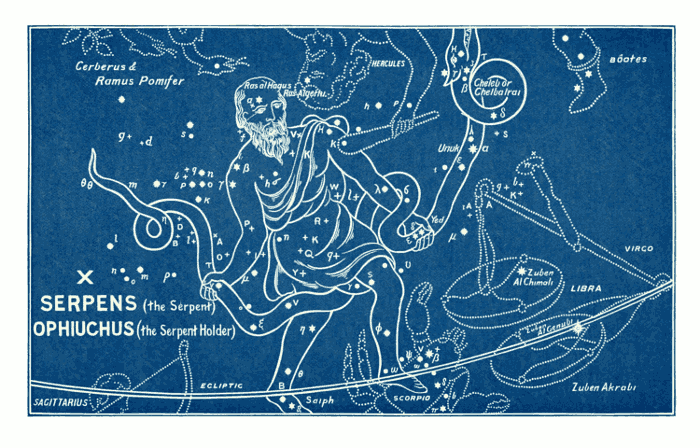
Here, Serpens, the serpent, is seen struggling vainly in the powerful grasp of the man who is named O-phi-u-chus. In Latin he is called Serpentarius. He is at one and the same moment shown to be seizing the serpent with his two hands, and treading on the very heart of the scorpion, marked by the deep red star Antares (wounding).
Just as we read the first constellation of the woman and child Coma, as expounding the first sign Virgo, so we have to read this first constellation as expounding the second sign Libra. Hence, we have here a further picture, showing the object of this conflict on the part of the scorpion.
In Scorpio we see merely the effort to wound Ophiuchus in the heel; but here we see the effort of the serpent to seize the Crown, which is situated immediately over the serpent’s head, and to which he is looking up and reaching forth.
The contest is for Dominion! It was the Devil, in the form of a serpent, that robbed the first man of his crown; but in vain he struggled to wrest it from the sure possession of the Second Man. Not only does he fail in the attempt, but is himself utterly defeated and trodden under foot.
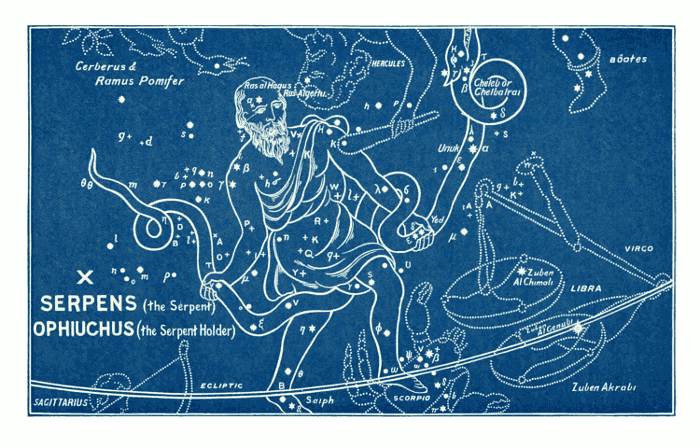
There are no less than 134 stars in these two constellations. Two are of the 2nd magnitude, fourteen of the 3rd, thirteen of the 4th, etc.
The brightest star in the Serpent, α (in the neck), is named Unuk, which means encompassing. Another Hebrew name is Alyah, the accursed. From this is Al Hay (Arabic), the reptile. The next brightest star is β (in the jaw), named, in Arabic, Cheleb, or Chelbalrai, the serpent enfolding. The Greek name, Ophiuchus, is itself from the Hebrew and Arabic name Afeichus, which means the serpent held. The brightest star in Ophiuchus, α (in the head), is called Ras al Hagus (Arabic), the head of him who holds.
Other Hebrew names of stars, not identified, are Triophas, treading under foot; Saiph (in the foot of Ophiuchus), bruised; Carnebus, the wounding; Megeros, contending. In the Zodiac of Denderah we have a throned human figure, called Api-bau, the chief who cometh. He has a hawk’s head to show that he is the enemy of the serpent, which is called Khu, and means ruled or enemy.
All these combines to set before us in detail the nature of the conflict and its final issue. That final issue is, however, exhibited by the last of the three constellations of this chapter. The Victor Himself requires a whole picture to fully set forth the glorious victory.

 articlesforchristians
Comments on: "Witness of the Stars: SERPENS and OPHIUCHUS" (2)
[…] Part 1 and 2: SERPENS and OPHIUCHUS […]
[…] SERPENS and OPHIUCHUS […]