The four ways that Jews worship God according to Jewish tradition are:
- Daily Prayer: Jews pray three times a day, in the morning (Shaharith), afternoon (Minhah), and evening (Maariv), to honor God and reflect on their daily lives.
- Shema: The Shema is recited during morning and evening prayers, emphasizing the unity of God and the importance of faith.
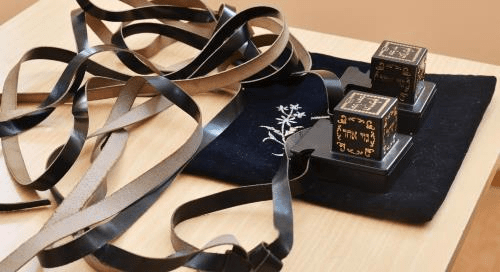
- Tefillin and Kippah: During morning prayers, Jewish men wear tefillin (prayer boxes) and cover their heads with a kippah (skullcap) as a sign of reverence for God.
- Synagogue Worship: Jewish worship in the synagogue includes daily services, special rites of passage, and the celebration of Jewish festivals, fostering a sense of collective identity and shared purpose.
These practices are integral to Jewish life and are rooted in the teachings of the Torah and the Talmud.
What are these practices and how are these practices carried over to the New Testament?
Daily Prayer:
- Hours of Prayer
- In Jewish tradition, prayer has its roots in the practice of the continual burnt offering, made daily at the Temple. These offerings took place at specific times that align with Jewish prayer times. Each morning began with a male lamb offered as a burnt sacrifice, and priests continued presenting lambs throughout the day. The Temple services were structured around this continual offering, setting the pattern for daily worship. Jewish prayer times remain tied to these moments, highlighting the significance of morning worship in the faith.
- Psalm 55:17 ESV
- Evening and morning and at noon I utter my complaint and moan, and he hears my voice.
- Peter and John continued praying at the hours of prayer.
- Acts 3:1
- Now Peter and John were going up to the temple at the hour of prayer, the ninth hour (3:00 p.m.),
- Acts 3:1
- We are commanded to pray.
- Colossians 4:2 ESV
- Continue steadfastly in prayer, being watchful in it with thanksgiving.
- 1 Thessalonians 5:17 ESV
- Pray without ceasing,
- Colossians 4:2 ESV
Shema:
- The Shema prayer is one of the most well-known prayers in the Bible. It was a daily practice for the ancient Israelites and is still recited by Jewish people today. Its first appearance is in the book of Deuteronomy, and its name comes from the first Hebrew word of the prayer—“shema,” meaning “hear” or “listen.” Ancient Jewish tradition combined lines from Deuteronomy 6:4-5 with other passages from the Torah (Deut. 11:13-21; Num. 15:37-41) and recited them every morning and evening. This prayer has been a deeply influential tradition in Jewish history, serving both as a pledge of allegiance and a hymn of praise.
- At the start of Deuteronomy, where this well-known prayer is first introduced, Moses speaks to the new generation of Israel as they get ready to enter the promised land. He encourages them to avoid repeating the mistakes of their parents, hoping they will enjoy the full blessings awaiting them. To achieve this, they must learn to listen to and love God wholeheartedly, above everything else. Let’s take a closer look at the powerful words of the Shema to see why it held such importance for the Jewish people and how modern Christians can also draw wisdom from this ancient prayer.
- The Shema:
- Hear O’ Israel, the Lord is our God, the Lord is One.
- Blessed be the name of the glory of His kingdom forever and ever.
- You shall love the Lord your God with all your heart, with all your soul, and with all your might. And these words which I command you today shall be upon your heart. You shall teach them thoroughly to your children, and you shall speak of them when you sit in your house and when you walk on the road, when you lie down and when you rise. You shall bind them as a sign upon your hand, and they shall be for a reminder between your eyes. And you shall write them upon the doorposts of your house and upon your gates.
- And it will be, if you will diligently obey My commandments which I enjoin upon you this day, to love the Lord your G‑d and to serve Him with all your heart and with all your soul, I will give rain for your land at the proper time, the early rain and the late rain, and you will gather in your grain, your wine and your oil. And I will give grass in your fields for your cattle, and you will eat and be sated. Take care lest your heart be lured away, and you turn astray and worship alien gods and bow down to them. For then the Lord’s wrath will flare up against you, and He will close the heavens so that there will be no rain and the earth will not yield its produce, and you will swiftly perish from the good land which the Lord gives you. Therefore, place these words of Mine upon your heart and upon your soul, and bind them for a sign on your hand, and they shall be for a reminder between your eyes. You shall teach them to your children, to speak of them when you sit in your house and when you walk on the road, when you lie down and when you rise. And you shall inscribe them on the doorposts of your house and on your gates – so that your days and the days of your children may be prolonged on the land which the Lord swore to your fathers to give to them for as long as the heavens are above the earth.
- The Lord spoke to Moses, saying: Speak to the children of Israel and tell them to make for themselves fringes on the corners of their garments throughout their generations, and to attach a thread of blue on the fringe of each corner. They shall be to you as tzitzit, and you shall look upon them and remember all the commandments of the Lord and fulfill them, and you will not follow after your heart and after your eyes by which you go astray – so that you may remember and fulfill all My commandments and be holy to your God. I am the Lord your God who brought you out of the land of Egypt to be your God; I, the Lord, am your God. True.
- tzitzit is Fringes
- Jesus quoted from the Shema
- Mark 12:29
- Jesus answered, “The first and most important one is: ‘Hear, O Israel, the Lord our God is one Lord;
- Mark 12:29
Tefillin and Kippah:
- Tefillin (תְּפִלִּין) are a pair of black leather boxes containing Hebrew parchment scrolls. A set includes two—one for the head and one for the arm. Each consists of three main components: the scrolls, the box and the strap.
- The Torah commands Jewish men to bind tefillin onto their head and upper arm every weekday, in fulfillment of the verse (Deut. 6:8), “You shall bind them as a sign upon your hand, and they shall be for a reminder between your eyes.”
- Today the law is written on our hearts.
- Jeremiah 31:33 “But this is the covenant which I will make with the house of Israel after those days,” says the Lord, “I will put My law within them, and I will write it on their hearts; and I will be their God, and they will be My people.
- Hebrews 10:15-17
- And the Holy Spirit also adds His testimony to us [in confirmation of this]; for after having said,
- “This is the covenant that I will make with them
- After those days, says the Lord:
- I will imprint My laws upon their heart,
- And on their mind I will inscribe them [producing an inward change],”
- He then says,
- “And their sins and their lawless acts
- I will remember no more [no longer holding their sins against them].”
- Now where there is [absolute] forgiveness and complete cancellation of the penalty of these things, there is no longer any offering [to be made to atone] for sin.
- Kippah (literally: dome) (is the Hebrew word for skullcap, also referred to in Yiddish as a yarmulke, or less frequently as a koppel.
- Jewish law requires men to cover their heads as a sign of respect and reverence for G‑d when praying, studying Torah, saying a blessing or entering a synagogue.
- This practice has its roots in biblical times, when the priests in the Temple were instructed to cover their heads.
- Traditionally, Jewish men and boys wear the kippah at all times, a symbol of their awareness of, and submission to, a “higher” entity.

- Jesus is now our High Priest.
- Hebrews 3:1 (Amp)
- Therefore, holy brothers and sisters, who share in the heavenly calling, [thoughtfully and attentively] consider the Apostle and High Priest whom we confessed [as ours when we accepted Him as Savior], namely, Jesus;
- 1 Corinthians 11:3-5 (amp)
- But I want you to understand that Christ is the head (authority over) of every man, and man is the head of woman, and God is the head of Christ. Every man who prays or prophesies with something on his head dishonors his head [and the One who is his head]. And every woman who prays or prophesies when she has her head uncovered disgraces her head; for she is one and the same as the woman whose head is shaved [in disgrace]
- for more information on head coverings click here.
- But I want you to understand that Christ is the head (authority over) of every man, and man is the head of woman, and God is the head of Christ. Every man who prays or prophesies with something on his head dishonors his head [and the One who is his head]. And every woman who prays or prophesies when she has her head uncovered disgraces her head; for she is one and the same as the woman whose head is shaved [in disgrace]
- Hebrews 3:1 (Amp)
Synagogue Worship:
- A synagogue (also known as a beit knesset or shul) is a place of Jewish worship. In addition to housing a sanctuary for services, synagogues often serve as the centerpoint of Jewish life. It contains seating for men and women, an ark to hold the holy Torah and a platform upon which it is read.
- The word “synagogue” comes from Greek and parallels the Hebrew term beit knesset, meaning “house of gathering.” It’s also called a shul, a Yiddish word related to the English “school,” since it’s a place where the Torah is studied. Synagogues are found almost anywhere there are Jewish communities and have been in use since the Babylonian exile.
- Today we are called to study the word of God. It is helpful to have teachers. It is helpful to have a place to learn God’s word.
- 2 Timothy 2:15
- Study and do your best to present yourself to God approved, a workman [tested by trial] who has no reason to be ashamed, accurately handling and skillfully teaching the word of truth.
- Paul teaches us in Romans 15:4 (ESV) For whatever was written in former days was written for our instruction, that through endurance and through the encouragement of the Scriptures we might have hope. This means that the Old Testament including the Torah (1st five books of the Old Testament) in our instructions. Those things, when we learn it, gives us hope. Notice how it is written in the KJV: For whatsoever things were written aforetime were written for our learning, that we through patience and comfort of the scriptures might have hope. This clarifies that the Old Testament was written for our learning. We are supposed to learn and be instructed by the Old Testament so that we can have hope.
- Acts 19:8-10 (Amp)
- And he (Paul) went into the synagogue and for three months spoke boldly, reasoning and arguing and persuading them about the kingdom of God. 9 But when some were becoming hardened and disobedient [to the word of God], discrediting and speaking evil of the Way (Jesus, Christianity) before the congregation, Paul left them, taking the disciples with him, and went on holding daily discussions in the lecture hall of Tyrannus [instead of in the synagogue]. This continued for two years, so that all the inhabitants of [the west coast province of] Asia [Minor], Jews as well as Greeks, heard the word of the Lord [concerning eternal salvation through faith in Christ].
- Paul basically was a teacher at a school (lecture hall).
- And he (Paul) went into the synagogue and for three months spoke boldly, reasoning and arguing and persuading them about the kingdom of God. 9 But when some were becoming hardened and disobedient [to the word of God], discrediting and speaking evil of the Way (Jesus, Christianity) before the congregation, Paul left them, taking the disciples with him, and went on holding daily discussions in the lecture hall of Tyrannus [instead of in the synagogue]. This continued for two years, so that all the inhabitants of [the west coast province of] Asia [Minor], Jews as well as Greeks, heard the word of the Lord [concerning eternal salvation through faith in Christ].
- 2 Timothy 2:15

 articlesforchristians
Comments on: "The Significance of Jewish Worship Traditions and How it Relates to the New Testament" (3)
[…] The Significance of Jewish Worship Traditions and How it Relates to the New Testament […]
[…] Not to worship idols in the four ways we worship God […]
[…] The Significance of Jewish Worship Traditions and How it Relates to the New Testament […]