1. LYRA (The Harp)
Praise prepared for the Conqueror.
“Praise waiteth for thee, O God, in Zion” (Ps. lxv. 1). And when the waiting time is over, and the Redeemer comes forth, then the praise shall be given. “We give Thee thanks, O Lord God, the Almighty, which art, and which wast, because thou hast taken to Thee Thy great power, and didst reign” (Rev. xi. 17, r.v.). “Let us be glad and rejoice and give honour unto Him” (Rev. xix. 7). The Twenty-first Psalm should be read here, as it tells of the bursting forth of praise on the going forth of this all-gracious Conqueror.
“The King shall rejoice in Thy strength, O Lord;
And in Thy salvation how greatly shall He rejoice!…
Thine hand shall find out all Thine enemies;
Thy right hand shall find out all that hate thee….
Their fruit shalt Thou destroy from the earth;
And their seed from among the children of men.
For they intended evil against Thee;
They imagined a mischievous device which they are not able to perform,
Therefore shalt thou make them turn their back (Heb. Margin, “set them as a butt”),
When Thou shalt make ready Thine arrows upon Thy strings
[And shoot them] against the face of them.
Be thou exalted, Lord, in thine own strength;
SO WILL WE SING AND PRAISE THY POWER.”
(Ps. xxi. 1, 8, 10-13.)
Beautifully, then, does the harp come in here, following upon the going forth of this victorious Horseman. This Song of the Lamb follows as naturally as does the Song of Moses in Ex. xv. 1: “I will sing unto the Lord, for He hath triumphed gloriously.”
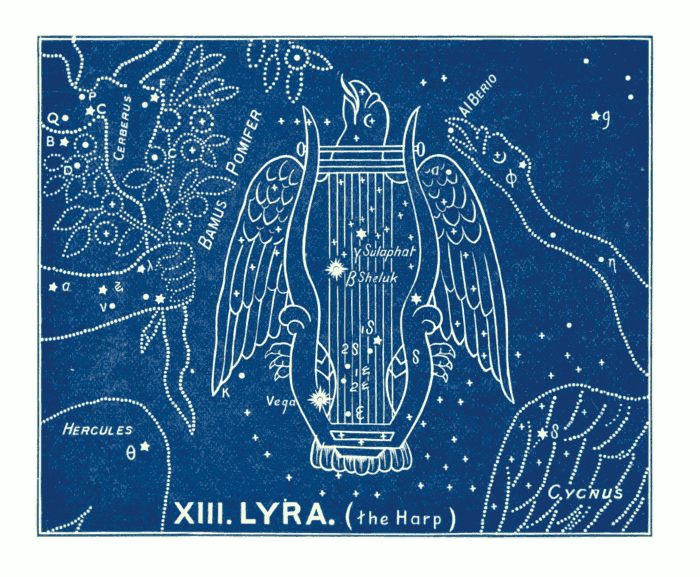
Its brightest star, α, is one of the most glorious in the heavens, and by it this constellation may be easily known. It shines with a splendid white lustre. It is called Vega, which means He shall be exalted. Its root occurs in the opening of the Song of Moses, quoted above. Is not this wonderfully expressive?
Its other stars, β and γ, are also conspicuous stars, of the 2nd and 4th magnitude. β is called Shelyuk, which means an eagle (as does the Arabic, Al Nesr); γ is called Sulaphat, springing up, or ascending, as praise.
In the Zodiac of Denderah, this constellation is figured as a hawk or an eagle (the enemy of the serpent) in triumph. Its name is Fent-kar, which means the serpent ruled.
There may be some confusion between the Hebrew נֶשֶׁר, Nesher, an eagle, and עָשׂוֹר, Gnasor, a harp; but there can be no doubt about the grand central truth, that praise shall ascend up “as an eagle toward heaven,” when “every creature which is in heaven, and on the earth, and such as are in the sea, and all that is in them,” shall send up their universal song of praise: “Blessing, and honour, and glory, and power, be unto Him that sitteth upon the throne and unto the Lamb for ever and ever. Amen” (Rev. v. 13, 14).
And for what is all this wondrous anthem of Praise? Listen once again. “Alleluia: Salvation, and glory, and honour, and power, unto the Lord our God; for TRUE AND RIGHTEOUS ARE HIS JUDGMENTS…. And again they said Alleluia” (Rev. xix. 1-3).
With “that blessed hope” before us,
Let no harp remain unstrung,
Let the coming advent chorus
Onward roll from tongue to tongue, Hallelujah,
“Come, Lord Jesus,” quickly come.

 articlesforchristians
Comments on: "Witness of the Stars: Lyra (the Harp)" (2)
[…] LYRA (The Harp) […]
[…] Lyra (the Harp) […]