The Stations of the Cross, also called the Way of the Cross, Way of Suffering, or Via Dolorosa, is a series of fourteen images depicting scenes from the day of Jesus Christ’s crucifixion, each accompanied by prayers. It is inspired by the Via Dolorosa in Jerusalem, a traditional route symbolizing the path Jesus walked from the Lion’s Gate to Mount Calvary. Its purpose is to guide Christians on a spiritual journey through reflection on the Passion of Christ. This devotion is widely practiced and found in many Western Christian traditions, including the Roman Catholic, Lutheran, Anglican, and Methodist churches.
Typically, a set of fourteen images is arranged in numerical order along a path, where the faithful, alone or in procession, move from one station to the next, stopping at each one to pray and reflect on its meaning. These devotions are especially common during Lent, particularly on Good Friday, and express a spirit of reparation for the suffering and humiliations that Jesus endured during his Passion. As a physical act of devotion involving standing and kneeling, the Stations of the Cross are closely related to the Christian themes of repentance and self-denial.
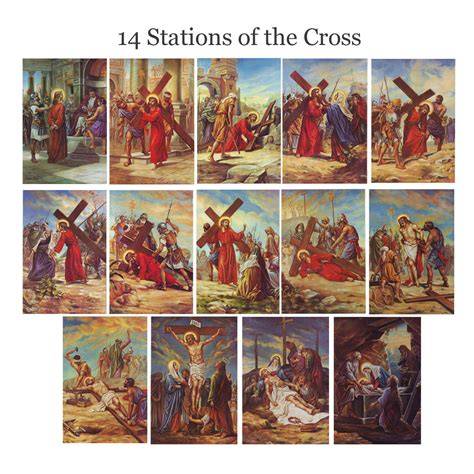
The style, form, and location of the Stations of the Cross can vary considerably. Traditional versions typically consist of small plaques with reliefs or paintings arranged around the central part of a church. Modern, minimalist versions may be simple crosses with a number in the center. Sometimes, the Stations of the Cross are prayed without images, such as when the Pope leads the devotion around the Colosseum in Rome on Good Friday.
This devotion is not obligatory, but it is a good way to remember the supreme sacrifice Jesus made, offering his life to save us from our sins. This devotion helps foster gratitude for what Jesus did and encourages believers to carry their own crosses in life, enduring inevitable suffering.
Whether or not you participate in the Stations of the Cross, the Bible commands us to remember the Lord’s death until his return.
- 1 Corintios 11:23-26
- For I received from the Lord what I also passed on to you: The Lord Jesus, on the night he was betrayed, took bread,
- and when he had given thanks, he broke it and said, “Take, eat; this is my body, which is broken for you; do this in remembrance of me.”
- In the same way, after supper he took the cup, saying, “This cup is the new covenant in my blood; do this, whenever you drink it, in remembrance of me.”
- For whenever you eat this bread and drink this cup, you proclaim the Lord’s death until he comes.
Here are the Stations of the Cross according to tradition. Biblical references are included whenever possible.
1. Jesus is condemned to death.
- Luke 23:24-25
- Then Pilate sentenced that their request should be granted; and he released to them the man who had been thrown into prison for sedition and murder, the one they had asked for; and he handed Jesus over to their will.
2. Jesus takes up his cross.
- John 19:17
- And he, carrying his cross, went out to the place called the Place of the Skull, which in Hebrew is called Golgotha;
3. Jesus falls for the first time (by inference from Stations 2 and 5).
4. Jesus meets his grieving mother (by inference from John 19:25-27).
- John 19:25-27
- Standing near the cross of Jesus were his mother, his mother’s sister, Mary the wife of Clopas, and Mary Magdalene.
- When Jesus saw his mother and the disciple whom he loved standing nearby, he said to his mother, “Woman, here is your son.”
- Then he said to the disciple, “Here is your mother.” From that hour on, the disciple took her into his home.
5. Simon of Cyrene helps carry the cross.
- Matthew 27:32
- As they were going out, they found a man from Cyrene named Simon, and they forced him to carry the cross.
6. Veronica wipes the face of Jesus (an episode not recorded in the Scriptures).
- The Bible does not recount the story of Veronica wiping Jesus’ face on the way to Calvary. Instead, her story appears in a work called the “Acts of Pilate,” which identifies her as the woman who had suffered from hemorrhages for twelve years, approached Jesus from behind, touched the hem of his garment, and was healed (Matthew 9:20-22). This non-canonical text also claims that Jesus left the image of his face imprinted on the cloth she used. The story goes on to say that Veronica later traveled to Rome and healed Emperor Tiberius by showing him a painting of Christ that she had made after her own healing.
7. Jesus falls for the second time (this event is not recorded in the Scriptures).
8. Jesus meets the holy women of Jerusalem.
- Luke 23:27-31
- And a great multitude of the people followed him, and of women who were weeping and lamenting for him.
- But Jesus, turning to them, said, “Daughters of Jerusalem, do not weep for me, but weep for yourselves and for your children.
- For behold, the days are coming when they will say, ‘Blessed are the barren, and the wombs that never bore children, and the breasts that never nursed.’
- Then they will begin to say to the mountains, ‘Fall on us!’ and to the hills, ‘Cover us!’
- For if they do these things in the green wood, what will happen in the dry?”
9. Jesus falls for the third time (this event is not recorded in the Scriptures).
10. Jesus is stripped of his clothes.
- John 19:23
- When the soldiers had crucified Jesus, they took his clothes and divided them into four parts, one for each soldier. They also took his tunic, which was seamless, woven in one piece from top to bottom.
11. Jesus is nailed to the cross.
- Mark 15:24
- And when they had crucified him, they parted his garments, casting lots upon them, what every man should take.
12. Jesus dies on the cross.
- Mark 15:37
- And Jesus cried with a loud voice, and gave up the ghost.
13. Jesus’ body is taken down from the cross.
- Luke 23:52-53
- He went to Pilate and asked for the body of Jesus.
- And taking it down, he wrapped it in a linen cloth and laid it in a tomb cut into the rock, where no one had yet been laid.
14. Jesus’ body is placed in the tomb.
- Matthew 27:59-60
- And Joseph took the body, wrapped it in a clean linen shroud,
- and placed it in his own new tomb, which he had cut out of the rock; and after rolling a large stone to the entrance of the tomb, he went away.

 articlesforchristians
Leave a comment