1. CASSIOPEIA (The Enthroned Woman)
The Captive Delivered, and Preparing for her Husband, the Redeemer.
In the last chapter we saw the woman bound; here we see the same woman freed, delivered, and enthroned.
Ulugh Bey says its Arabic name is El Seder, which means the freed.
In the Denderah Zodiac her name is Set, which means set, set up as Queen. Albumazer says this constellation was anciently called “the daughter of splendour.” This appears to be the meaning of the word Cassiopeia, the enthroned, the beautiful. The Arabic name is Ruchba, the enthroned. This is also the meaning of its Chaldee name, Dat al cursa.
There are 55 stars in this constellation, of which five are of the 3rd magnitude, five of the 4th, etc.
This beautiful constellation passes vertically over Great Britain every day, and is easily distinguished by its five brightest stars, forming an irregular W.
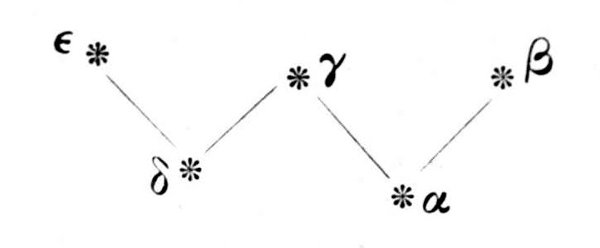
This brilliant constellation contains one binary star, a triple star, a double star, a quadruple star, and a large number of nebulæ.
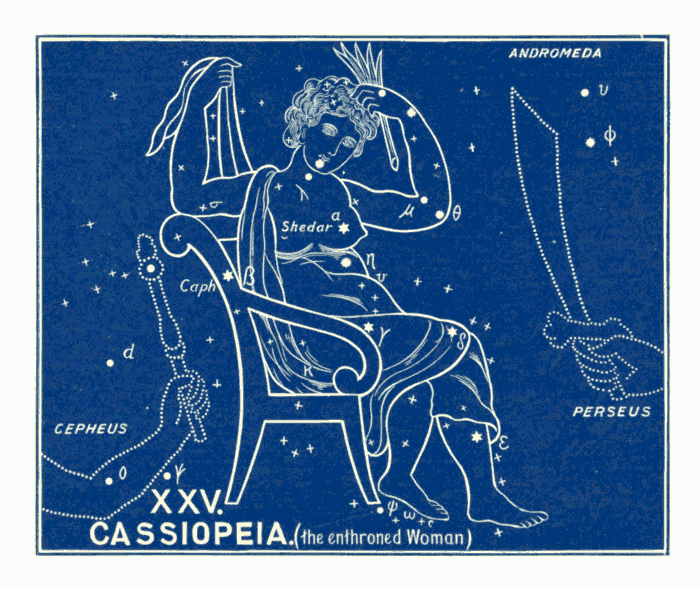
In the year 1572 Tycho Brahe discovered in this constellation, and very near the star κ (under the arm of the chair), a new star, which shone more brightly than Venus. It was observed for nearly two years, and disappeared entirely in 1574.
The brightest star, α (in the left breast), is named Schedir (Hebrew), which means the freed. The next, β (in the top of the chair), likewise bears a Hebrew name—Caph, which means the branch; it is evidently given on account of the branch of victory which she bears in her hand.
She is indeed highly exalted, and making herself ready. Her hands, no longer bound, are engaged in this happy work. With her right hand she is arranging her robes, while with her left she is adorning her hair. She is seated upon the Arctic circle, and close by the side of Cepheus, the King.
This is “the Bride, the Lamb’s wife, the heavenly city, the new Jerusalem,” the “partakers of the heavenly calling.”
He who has redeemed her is “the Lamb that was slain,” and He addresses her thus:
“Thy Maker is thine husband;
The Lord of Hosts is His name;
And the Holy One of Israel is thy Redeemer;
The God of the whole earth shall He be called.
For the Lord hath called thee as a woman forsaken and grieved in spirit,
Even a wife of youth when she is cast off, saith thy God.
For a small moment have I forsaken thee;
But with great mercies will I gather thee.
In overflowing wrath I hid my face from thee for a moment;
But with everlasting kindness will I have mercy on thee, saith the Lord thy Redeemer.”
(Isa. liv. 5-8. r.v.)
“Thou shalt be a crown of beauty in the hand of the Lord,
And a royal diadem in the hand of thy God,
Thou shalt no more be termed Forsaken;
Neither shall thy land any more be termed Desolate;
But thou shalt be called Hephzi-bah (i.e., my delight is in her),
And thy land Beulah (i.e., married);
For the Lord delighteth in thee,
And thy land shall be married.
For as a young man marrieth a virgin,
So shall thy sons (Heb. thy Restorer) marry thee:
And as the bridegroom rejoiceth over the bride,
“So shall thy God rejoice over thee.
(Isa. lxii. 3-5, r.v.)
“The Lord hath appeared of old (or from afar) unto me, saying,
Yea, I have loved thee with an everlasting love;
Therefore with loving kindness have I drawn thee.
Again will I build thee, and thou shalt be built, O Virgin of Israel….
He that scattered Israel will gather him,
And keep him as a shepherd doth his flock,
For the Lord hath ransomed Jacob,
And redeemed him from the hand of him that was stronger than he.”
(Jer. xxxi. 3-12, r.v.)
Can we close our eyes to the testimony of these scriptures—that Israel is the Bride of the Lamb? When we have all these, and more, why should we read “the Church” into these ancient prophecies, which was the subject of a long-subsequent revelation, merely because (in Eph. v. 25) Christ’s love to His Church is compared to a husband’s love for his wife? “Husbands, love your wives, even AS Christ also loved the Church.” There is not a word here about the Church being His wife. On the contrary, it reveals the secret that the Church of Christ is to be the mystical “Body of Christ,” part of the Husband in fact, “One new man” (Eph. ii. 15)! whereas restored Israel is to be the Bride of this “New Man,” the Bride of Christ, the Lamb’s wife! Blessed indeed it is to be united to Christ as a wife to a husband, but glorious beyond all description to be “one” with Christ Himself, part of His mystical Body.
If men had only realised the wondrous glory of this mystery, they would never have so wrongly divided the Word of Truth by interpreting Psalm xlv. of this Mystical Christ. If we “rightly divide” it, we see at once that this Psalm is in harmony with all the Old Testament scriptures, which must be interpreted alike, and can be interpreted only of Israel however they may be applied.
Having spoken of the Godhead and glory of this King (faintly and in part foreshown by Cepheus), the Holy Spirit goes on in the latter part of the Psalm to speak of the Bride—the Queen:
“At Thy right hand doth stand the Queen in gold of Ophir,
Hearken, O daughter, and consider, incline thine ear;
Forget also thine own people, and thy father’s house;
So shall the King desire thy beauty;
For He is thy Lord; and worship thou Him….
The King’s daughter within the palace is all glorious;
Her clothing is inwrought with gold,
She shall be led unto the King in broidered work;
The virgins her companions that follow her shall be brought unto thee,” etc.
(Ps. xlv. 9-17, r.v.)
Then shall she sing her Magnificat:
“I will greatly rejoice in the Lord,
My soul shall be joyful in my God;
For He hath clothed me with the garments of salvation,
He hath covered me with the robe of righteousness,
As a bridegroom decketh himself with ornaments,
And as a bride adorneth herself with her jewels.
For as the earth bringeth forth her bud,
And as the garden causeth the things that are sown in it to spring forth;
So the Lord God [Adonai Jehovah] will cause righteousness and praise to spring forth before all the nations.”
(Isa. lxi. 10, 11.)
This, then, is the truth set forth by this enthroned woman. The blessing founded on Atonement, and the Redemption wrought by the Lamb that was slain, result in a glorious answer to Israel’s prayer, “Turn our captivity, O Lord” (Ps. cxxvi. 4): when they that have “sown in tears shall reap in joy,” and the Lord shall loosen her bonds, and place her enthroned by His side.
This, however, involves the destruction of her enemy, and this is what we see in the next section.

 articlesforchristians
Comments on: "Witness of the Star: CASSIOPEIA (The Enthroned Woman)" (2)
[…] CASSIOPEIA (The Enthroned Woman) […]
[…] CASSIOPEIA (The Enthroned Woman) […]