CETUS (The Sea Monster)
The Great Enemy Bound.
When John sees the New Jerusalem, the Bride, the Lamb’s wife (Rev. xxi. 10, 2), Satan has been bound already: for we read, a few verses before (xx. 1-3): “I saw an angel come down from heaven, having the key of the bottomless pit and a great chain in his hand. And he laid hold of the dragon, that Old Serpent, which is the Devil, and Satan, and bound him [and kept him bound] a thousand years, and cast him into the bottomless pit, and shut him up, and set a seal upon him, that he should deceive the nations no more, till the thousand years should be fulfilled.”
This is what we see in the second section of this chapter—the second constellation in Aries.
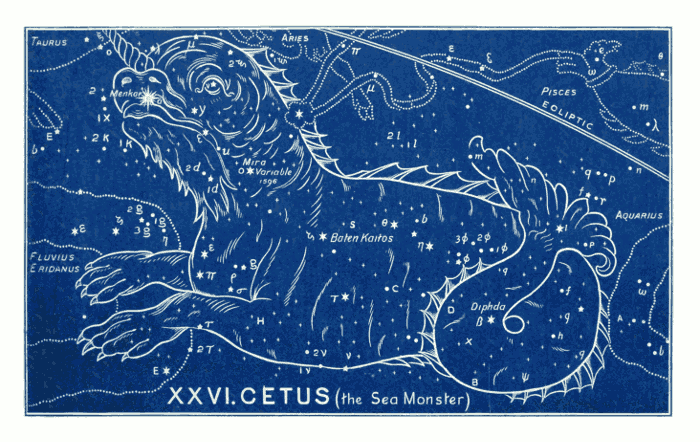
The picture is that of a great Sea-monster, the largest of all the constellations. It is the natural enemy of fishes, hence it is placed here in connection with this last chapter, in which fishes are so prominent.
It is situated very low down among the constellations—far away towards the south or lower regions of the sky.
Its name in the Denderah Zodiac is Knem, which means subdued. It is pictured as a monstrous head, trodden under foot by the swine, the natural enemy of the serpent. The hawk also (another enemy of the serpent) is over this figure, crowned with a mortar, denoting bruising.
It consists of 97 stars, of which two are of the 2nd magnitude, eight of the 3rd, nine of the 4th, etc.
The names of the stars interpret for us infallibly the meaning of the picture.
The brightest star, α (in the upper mandible), is named Menkar, and means the bound or chained enemy. The next, β (in the tail), is called Diphda, or Deneb Kaitos, overthrown, or thrust down. The star ο (in the neck) is named Mira, which means THE REBEL. Its name is ominous, for the star is one of the most remarkable. It is very bright, but it was not till 1596 that it was discovered to be variable. It disappears periodically seven times in six years! It continues at its brightest for fifteen days together. M. Bade says that during 334 days it shines with its greatest light, then it diminishes, till it entirely disappears for some time (to the naked eye). In fact, during that period it passes through several degrees of magnitude, both increasing and diminishing. Indeed its variableness is so great as to make it appear unsteady!
Here, then, is the picture of the Great Rebel as shown in the heavens. What is it, as written in the Word?
The Almighty asks man:—
“Canst thou draw out Leviathan with a fish hook?
Or press down his tongue with a cord?
Canst thou put a rope into his nose?
Or pierce his jaw through with a hook?…
Shall not one be cast down even at the sight of him?
None is so fierce that he dare stir him up.”
(Job xli. 1-10, r.v.)
But he whom man cannot bind can be bound by the Lamb, and He is seen with “the Band” that has bound the fishes, now in His hands, which he has fastened with a bright star to his neck, saying,—
“Behold, I have taken out of thine hand the cup of trembling,
Even the dregs of the cup of My fury;
Thou shalt no more drink it again,
But I will put it into the hand of them that afflict thee.”
(Isa. li. 22, 23.)
“Behold, the Lord cometh forth out of His place
To punish the inhabitants of the earth for their iniquity….
In that day the Lord, with His sore, and great, and strong sword,
Shall punish Leviathan, the piercing serpent,
And Leviathan, the crooked serpent;
And He shall slay the dragon that is in the sea.”
(Isa. xxvi. 21-xxvii. 1.)
“For God is my king of old,
Working salvation in the midst of the earth.
Thou didst divide (marg. Heb., break) the sea by Thy strength,
Thou brakest the heads of the dragons (r.v. marg., sea monsters) in the waters.
Thou brakest the heads of Leviathan in pieces.”
(Ps. lxxiv. 12-14.)
And this Second Book closes by revealing to us this glorious “Breaker.”
3. PERSEUS (“The Breaker.”)
“The Breaker” delivering His Redeemed.
Here we have set before us a mighty man, called in the Hebrew Peretz, from which we have the Greek form Perses, or Perseus (Rom. xvi. 13). It is the same word which is used of Christ in Micah ii. 13. When He shall surely “gather the remnant of Israel” (v. 12), it is written—
“THE BREAKER is gone up before them….
Their King is passed on before them,
And the Lord at the head of them.”
This is what is pictured to us here. We see a glorious “Breaker” taking His place before His redeemed, breaking forth at their head, breaking down all barriers, and breaking the heads of Leviathan and all his hosts. In His right hand He has His “sore, and great, and strong sword” lifted up to smite and break down the enemy. He has wings on His feet, which tell us that He is coming very swiftly. In His left hand He carries the head of the enemy, whom he has slain.[pg 116]
In the Denderah Zodiac His name is Kar Knem, he who fights and subdues.
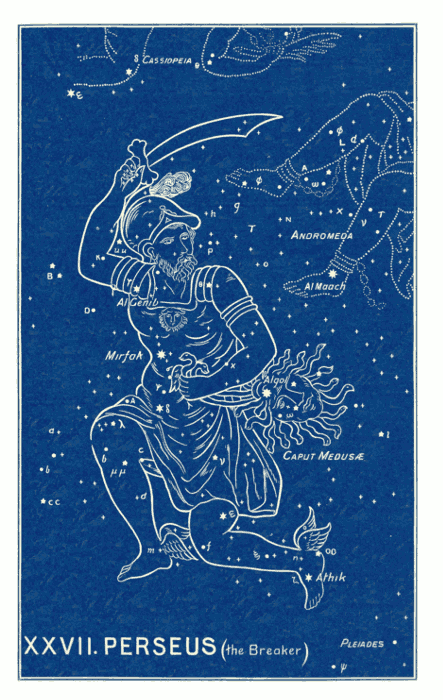
It is a beautiful constellation of 59 stars, two of which are of the 2nd magnitude, four of the 3rd, twelve of the 4th, etc.
Their names supply us with the key to the interpretation of the picture.
The star α (in the waist) is called Mirfak, who helps. The next, γ (in the right shoulder), is named Al Genib, which means who carries away. The bright star in the left foot is called Athik, who breaks!
In his left hand he carries a head, which, by perversion, the Greeks called the head of Medusa, being ignorant that its Hebrew root meant the trodden under foot. It is also called Rosh Satan (Hebrew), the head of the adversary, and Al Oneh (Arabic), the subdued, or Al Ghoul, the evil spirit.
The bright star, β (in this head), has come down to us with the name Al Gol, which means rolling round.
It is a most remarkable phenomenon that so many of these enemies should be characterised by variable stars! But this head of Medusa, like the neck of Cetus, has one. Al Gol is continually changing. In about 69 hours it changes from the 4th magnitude to the 2nd. During four hours of this period it gradually diminishes in brightness, which it recovers in the succeeding four hours; and in the remaining part of the time invariably preserves its greatest lustre. After the expiration of this time its brightness begins to decrease again. Fit emblem of our great enemy, who, “like a roaring lion, goeth about seeking whom he may devour” (1 Pet. v. 8.); then changing into a subtle serpent (Gen. iii. 8.); then changing again into “an angel of light” (2 Cor. xi. 14.). “Transforming himself” continually, to devour, deceive, and destroy.
This brings us to the conclusion of the Second Book, in which we have seen the Redeemed blessed with all blessings, delivered out of all conflict, saved from all enemies. We have seen their Redeemer, “the Lamb slain from the foundation of the world,” “the Conqueror,” “the King of Kings and Lord of Lords.”
This is the Revelation recorded in the heavens. This is the prophetic testimony inspired in the Book. And this is the heart-cry prompted by both:—
“Come, Lord, and tarry not,
Bring the long-looked-for day;
Oh, why these years of waiting here,
These ages of delay?
Come, for Thy saints still wait;
Daily ascends their cry:
‘The Spirit and the Bride say, Come’;
Dost Thou not hear their cry?
Come, for creation groans,
Impatient of Thy stay;
Worn out with these long years of ill,
These ages of delay.
Come, for Thine Israel pines,
An exile from Thy fold;
Oh, call to mind Thy faithful word,
And bless them as of old.
Come, for Thy foes are strong;
With taunting lips they say,
‘Where is the promised advent now,
And where the dreaded day?’
Come, for the good are few;
They lift the voice in vain;
Faith waxes fainter on the earth,
And love is on the wane.
Come, in Thy glorious might;
Come, with Thine iron rod;
Disperse Thy foes before Thy face,
Most mighty Son of God.
Come, and make all things new,
Build up this ruined earth;
Restore our faded paradise,
Creation’s second birth.
Come, and begin Thy reign
Of everlasting peace;
Come, take the kingdom to Thyself,
Great King of Righteousness.”
Dr. Horatius Bonar.

 articlesforchristians

Leave a comment