Chapter II. The Sign GEMINI (The Twins)
Messiah’s Reign as Prince of Peace.
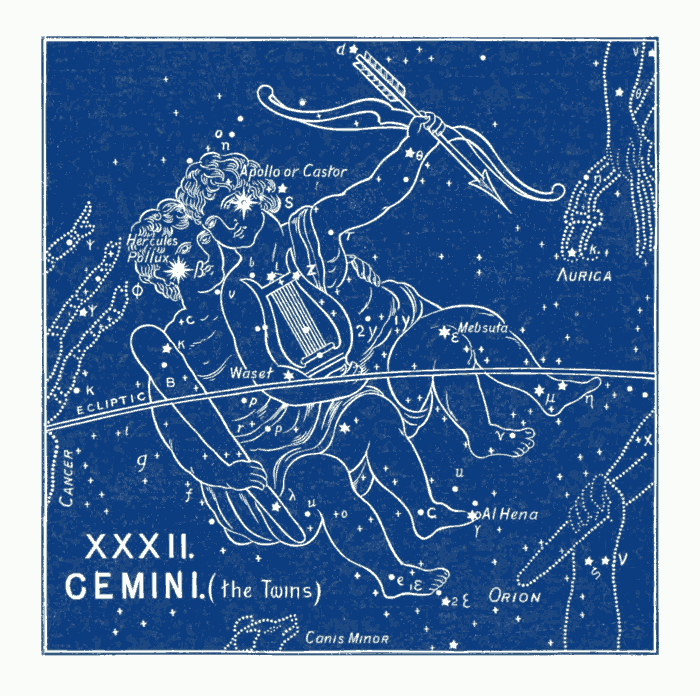
All the pictures of this sign are confused. The Greeks claimed to have invented them, and they called them Apollo and Hercules. They are given in our illustration. The Latins called the Castor and Pollux; and the name of a vessel in which Paul sailed is so called in Acts xxviii. 11, Διοσκούροι.
The name in the ancient Denderah Zodiac is Clusus, or Claustrum Hori, which means the place of Him who cometh. It is represented by two human figures walking, or coming. The second appears to be a woman. The other appears to be a man. It is a tailed figure, the tail signifying He cometh.
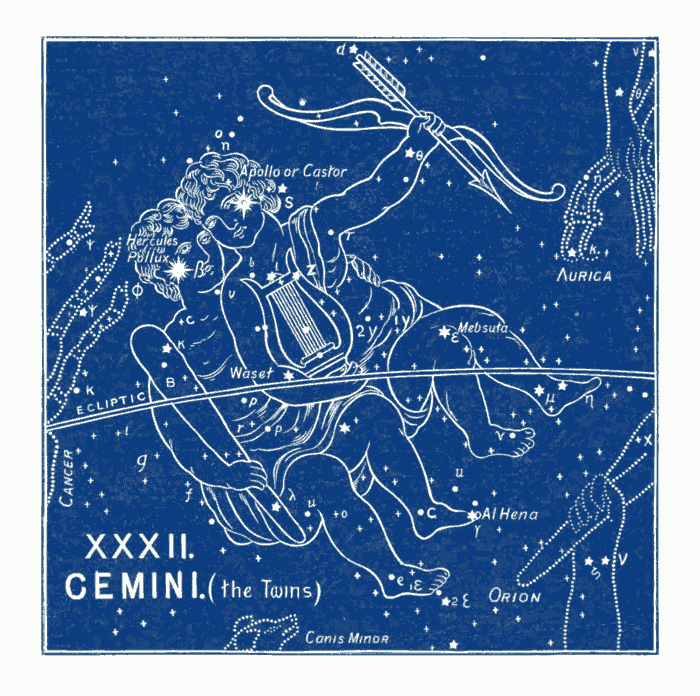
The old Coptic name was Pi-Mahi, the united, as in brotherhood. Not necessarily united by being born at the same time, but united in one fellowship or brotherhood. The Hebrew name is Thaumim, which means united. The root is used in Exod. xxvi. 24: “They (the two boards) shall be coupled together beneath.” In the margin we read, “Heb. twinned” (r.v. double). The Arabic Al Tauman means the same.
We need not trouble ourselves with the Grecian myths, even though we can see through them the original and ancient truth. The two were both heroes of peculiar and extraordinary birth—sons of Jupiter. They were supposed to appear at the head of armies; and as they had cleared the seas of pirates, they were looked upon as the patron saints of navigation. (Hence the name of the ship in Acts xxviii. 11.) They were held in high esteem both by Greeks and Romans; and the common practice of taking oaths and of swearing by their names has descended even to our own day in the still surviving vulgar habit of swearing “By Gemini!”
The more ancient star-names help us to see through all these and many other myths, and to discern Him of whom they testify; even Him in His twofold nature—God and Man—and His twofold work of suffering and glory, and His twofold coming in humiliation and in triumph.
There are 85 stars in the sign: two of the 2nd magnitude, four of the 3rd, six of the 4th, etc.
The name of α (in the head of the one at our right hand) is called Apollo, which means ruler, or judge; while β (in the head of the other) is called Hercules, who cometh to labour, or suffer. Another star, γ (in his left foot), is called Al Henah, which means hurt, wounded, or afflicted. Can we have a doubt as to what is the meaning of this double presentation? In Ophiuchus we have the two in one person: the crushed enemy, and the wounded heel. But here the two great primeval truths are presented in two persons; for He was “two persons in one God,” “God and man in one Christ.” As man, suffering for our redemption; as God, glorified for our complete salvation and final triumph. A star, ε (in the centre of his body), is called Waset, which means set, and tells of Him who “set His face like a flint” to accomplish this mighty Herculean work; and, when the time was come, “steadfastly set His face to go” to complete it.
He bears in his right hand (in some pictures) a palm branch. In the one from which our illustration is taken, it is a club; but both the club of this one and the bow of the other are in repose! These united ones are neither in action nor are they preparing for action, but they are at rest and in peace after victory won. The star ε (in the knee of the other, “Apollo”) is called Mebsuta, which means treading under feet. The names of other stars, which are not identified, have come down to us with the same testimony. One is called Propus (Hebrew), the branch, spreading; another is called Al Giauzâ (Arabic), the palm branch; another is named Al Dirâ (Arabic), the seed, or branch.
The day has here come to fulfil the prophecies concerning Him who is “the Branch,” “the Branch of Jehovah,” “the man whose name is the Branch.”
“In that day shall the Branch of Jehovah be beautiful and glorious;
And the fruit of the earth shall be excellent and comely
For them that are escaped of Israel.”
(Isa. iv. 2.)
“Behold, a king shall reign in righteousness,
And princes shall rule in judgment;
And a man shall be as an hiding place from the wind.”
(Isa. xxxii. 1, 2.)
“Behold, the days come, saith the Lord,
That I will raise unto David a righteous Branch,
And He shall reign as King and deal wisely,
And shall execute judgment and justice in the land.
In His days Judah shall be saved,
And Israel shall dwell safely:
And this is His name whereby He shall be called,
The Lord is our Righteousness.”
(Jer. xxiii. 5, 6, r.v.)
“Behold, the days come, saith the Lord,
That I will perform that good word which I have spoken
Concerning the house of Israel and concerning the house of Judah.
In those days, and at that time.
Will I cause a Branch of Righteousness to grow up unto David;
And He shall execute judgment and righteousness in the land.”
(Jer. xxxiii. 14, 15, r.v.)
This is what we see in this sign—Messiah’s peaceful reign. All is rest and repose. We see “His days,” in which “the righteous shall flourish; and abundance of peace, so long as the moon endureth” (Ps. lxxii.).
But, for this blessed time to come, there must be no enemy! All enemies must be subdued.

 articlesforchristians
Comments on: "Witness of the Stars: Chapter II. The Sign GEMINI (The Twins)" (1)
[…] Chapter II. The Sign GEMINI (The Twins) […]