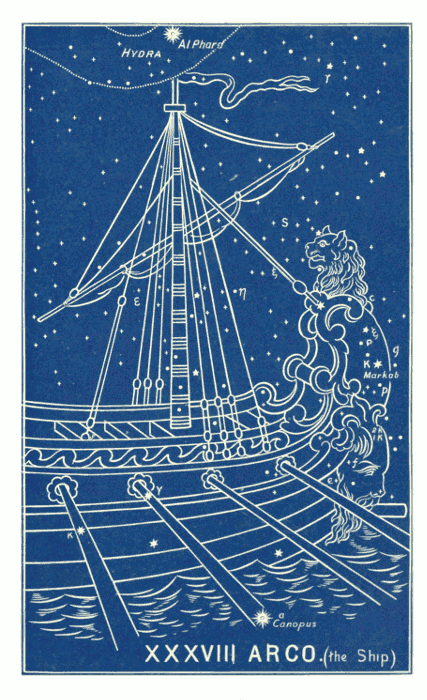
- ARGO (The Ship)
The Pilgrims safe at Home
This is the celebrated ship of the Argonauts, which Homer sung nearly ten centuries before Christ. Sir Isaac Newton puts the expedition of the Argonauts shortly after the death of Solomon (about 975 b.c.). While Dr. Blair’s chronology puts it 1236 b.c.
Whatever fables have gathered round the story there can be no doubt as to its great antiquity. Some think that the story had its origin in name, as well as in fact, from the Ark of Noah and its mysterious journey. All that is clear, when divested of mythic details, is that the sailors in that ship, after all their dangers, and toils, and battles were over, came back victorious to their own shores. The “golden fleece,” for which the Argonauts went in search, tells of a treasure that had been lost. “Jason,” the great captain, tells of Him who recovered it from the Serpent, which guarded it with ever-watchful eye, when none else was able to approach it. And thus, through the fables and myths of the Greeks, we can see the light primeval shine; and this light, once seen, lights up this Sign and its constellations, so that their teaching cannot be misunderstood.
Aratus sings of Argo:—
“Stern-foremost hauled; no mark of onward-speeding ship.
Sternward she comes, as vessels do
When sailors turn the helm
On entering harbour: all the oars back-water,
And gliding backward, to an anchor comes.”
It tells of that blessed home-coming, when—
“The ransomed of the Lord shall return
And come to Zion with songs,
And everlasting joy upon their heads;
They shall obtain joy and gladness,
And sorrow and sighing shall flee away.”
(Isa. xxxv. 10.)
It tells of the glorious Jason, of whom it is asked:
“Art thou not it which hath cut Rahab,
And wounded the dragon?
Art thou not it which hath dried the sea, the waters of the great deep;
That hath made the depths of the sea a way for the ransomed to pass over?
Therefore the redeemed of the Lord shall return,
And come with singing unto Zion,” etc.
(Isa. li. 9-11.)
“For the Lord hath redeemed Jacob,
And ransomed him from the hand of him that was stronger than he.
Therefore they shall come and sing in the height of Zion
And shall flow together to the goodness of the Lord.”
(Jer. xxxi. 11, 12.)
This is the return of the great emigrant-ship (Argo) and all its company of travellers (for this is the meaning of the word Argo).
In Kircher’s Egyptian Planisphere Argo is represented by two galleys (as we have two sheepfolds), whose prows are surmounted by rams’ heads; and the stern of one of them ends in a fish’s tail. One of the two occupies four segments of the sphere (from Taurus to Virgo), while the other occupies the four from Leo to Capricorn. One half of the southern meridians is occupied with these galleys and their construction and decorations. Astronomers tell us that they carry us back, the one to the period when the Bull opened the year (to which time Virgil refers); and the other to the same epoch, when the summer solstice was in Leo—“an era greatly antecedent to the Argonautic expedition. How else, they ask, do we account for the one ship having her prow in the first Decan of Taurus, and her poop in the last Decan of Leo? or for one galley being freighted with the installed Bull, and the other with the solstitial Lion?”
These are the words of an astronomer who knows nothing whatever of our interpretation of the heavens which is set forth in this work.
It will indeed be a large vessel, the true Argo, with its company of travellers, “a great multitude which no man can number.” All this is indicated by the immense size of the Constellation, as well as by the large number of its stars. There are 64 stars in Argo (reckoning by the Britannic catalogue); one of the 1st magnitude, six of the 2nd, nine of the 3rd, nine of the 4th, etc. Only a small part of the ship’s poop is visible in Britain.
Its brightest star, α (near the keel), is called Canopus or Canobus, which means the possession of Him who cometh. Other star-names, not identified, are—Sephina, the multitude or abundance; Tureis, the possession; Asmidiska, the released who travel; Soheil (Arabic), the desired; and Subilon, the Branch.
Is not all this exactly in harmony with the rest of this sign? And is not this what is written in the Book?
“Therefore, fear thou not, O My servant Jacob, saith the Lord;
Neither be dismayed, O Israel:
For, lo, I will save thee from afar,
And thy seed from the land of their captivity;
And Jacob shall return and be in rest,
And be quiet, and none shall make him afraid,
For I am with thee, saith the Lord, to save thee.”
(Jer. xxx. 10, 11.)
“Lift up thine eyes round about, and see;
All they gather themselves together, they come to thee;
Thy sons shall come from far,
And thy daughters shall be nursed at thy side,
Then thou shalt see, and flow together,
And thine heart shall fear and be enlarged;
Because the abundance of the sea shall be converted unto thee….
Who are these that fly as a cloud?
And as doves to their windows?
Surely the isles shall wait for me,
And the SHIPS of Tarshish first, to bring thy sons from far.”
(Isa. lx. 4, 5, 8, 9.)
The whole chapter (Isa. lx.) should be read if we wish to understand the great teaching of this Sign, which tells of Messiah’s secured possessions, the safe folding of His blood-bought flock, the blessed return of His pilgrims, and their abundant entrance into everlasting rest.
“There is a blessed home
Beyond this land of woe,
Where trials never come,
Nor tears of sorrow flow;
Where faith is lost in sight,
And patient love is crowned,
And everlasting light
Its glory throws around.
O joy, all joys beyond,
To see the Lamb who died,
And count each sacred wound
In hands, and feet, and side;
To give to Him the praise
Of every triumph won,
And sing through endless days
The great things He hath done.
Look up, ye saints of God,
Nor fear to tread below
The path your Saviour trod
Of daily toil and woe;
Wait but a little while
In uncomplaining love,
His own most gracious smile
Shall welcome you above.”

 articlesforchristians
Comments on: "Witness of the Stars: ARGO (The Ship)The Pilgrims safe at Home" (1)
[…] (The Ship) The Pilgrims safe at […]