Appendix. Note on the Sign LIBRA.
In Chapter II. The Sign LIBRA, we called attention to the point that in all probability the Sign Libra was a very ancient corruption.
The ancient Akkadian name for the seventh month, which was the month when the sun was in the Sign now called Libra, was Tul-ku, which means the sacred mound, or altar. The Akkadian name for this Sign was Bir, which means the Light, hence, the Lamp with its light, or the Altar with its fire.
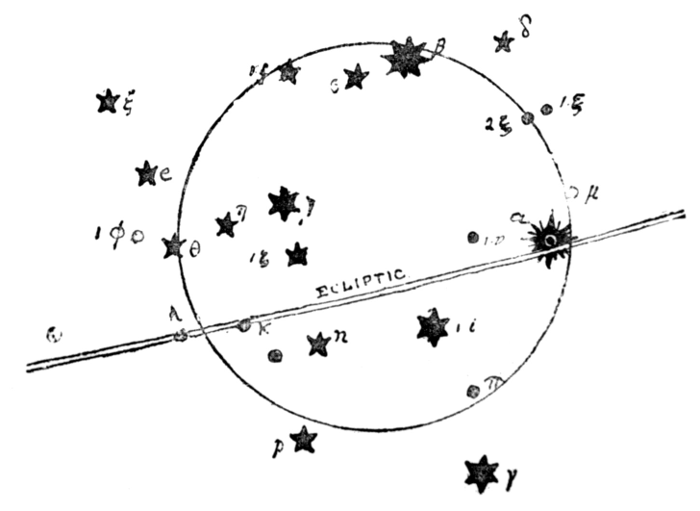
Its most ancient form was a circular altar. In Figure 1 we have reproduced this, and it will be at once seen that we have the original of the disc now preserved in the two circular scales which form the Sign of Libra.
The next stage of the corruption is shown in the Akkadian name of Scorpio (the Scorpion)—the Sign immediately to the left of the Altar. It was called Gir-tab, which means the Seizer and Stinger, and the next Figure (2), taken from an Euphratean boundary stone, shows the two Signs combined, for the Scorpion is stretching out its claws in order to seize the Lamp or Altar.
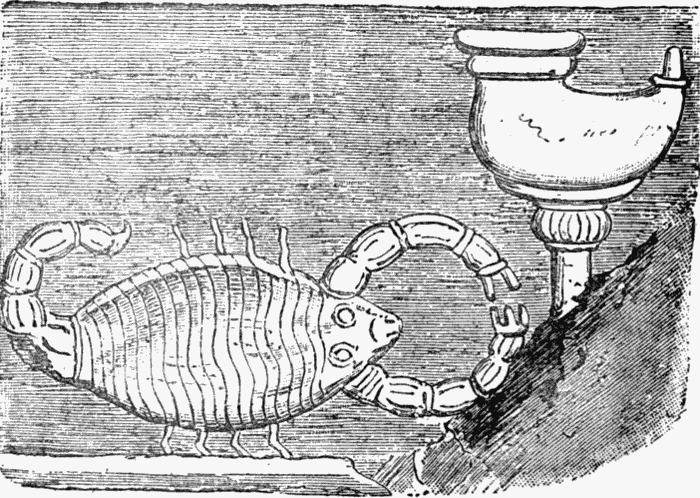
Thus, the meaning of its name is exemplified. It is called the Seizer and Stinger. And just as in the constellation above it, the Serpent is struggling with the man, while at the same time it is stretching out its neck to seize the crown, so here the Scorpion, while trying to sting the same man in the heel, is stretching out its claws to seize the altar.
A seal on a contract, nearly 700 b.c., shows this Circular Altar actually in the grasp of the Scorpion.
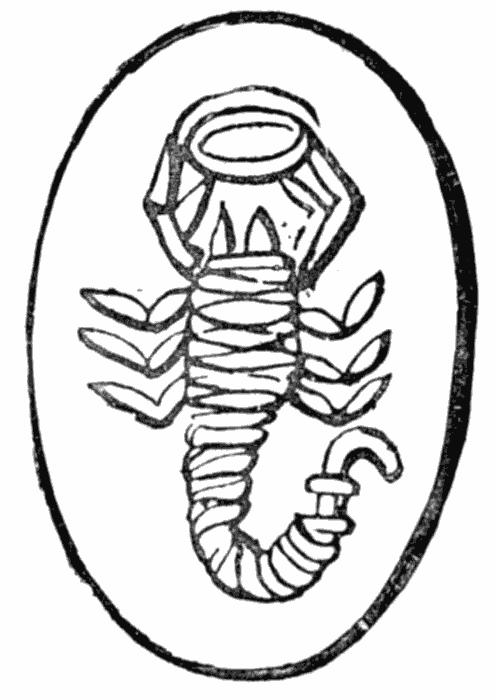
Figure 3 is a picture of this Euphratean Seal, preserved on a contract made on the 8th day of the month Tisri, i.e., this same seventh month!
This then is the next stage. But Mr. Robert Brown, junr., observes, “The Circle or other representation of an Altar not unnaturally disappeared as the use of the Sign advanced westward; whether by sea, or across Asia Minor, or both, and the Chelai alone remained when the shores of the Ægean were reached.”
This is quite true, for the Greek name for the Sign was Chelai, which means simply the Claws. And thus, the Scorpion monopolised two Signs: its body one, and its claws the other. This led to the mistake of Servius, the intelligent commentator on Virgil, that “the Chaldean Zodiac consisted of but eleven constellations.” We now know that there were twelve Signs, and the mistake is thus explained.
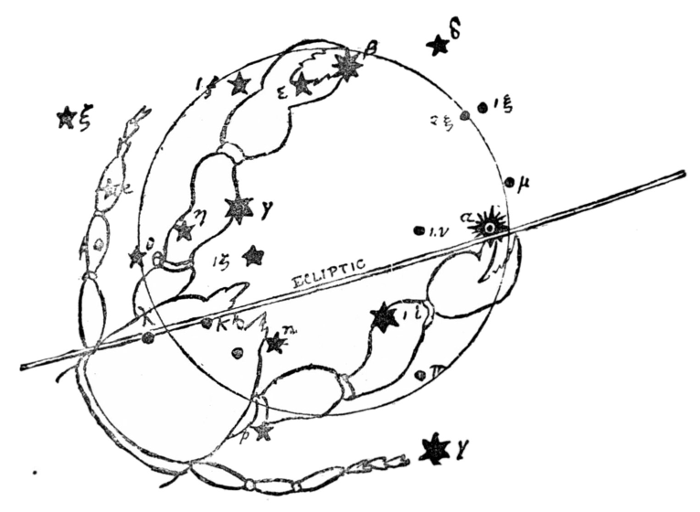
Mr. Brown quotes Achilles Tatius, about 475 a.d., in a Fragment on the Phainomena, who says, τὰς χηλὰς τὰς καλόυμένας ὑπ Ἀιγυπτίων Ζυγὸν.
Aratus says that “some few stars of the Claws are in the (Celestial) Equator.” And Ptolemy describes the stars, now reckoned in Libra, as being in what he calls “The Constellation of the Claws.” We have reproduced them so that his description of them may be readily traced. He speaks of—
“The bright one of those at the end of the southern Claw.” (It is named Zuben el Genubi and now marked α).
“The one more northerly than it, and dimmer” (now marked μ).
“The bright one of those at the end of the northern Claw”(named Zuben el Chemali, and now marked β).
“The one in front of it and dim” (δ).
“The one in the middle of the southern Claw” (1 i).
“The one in the middle of the northern Claw” (now marked γ).
“The one behind it in the same Claw” (η).
“The foremost of the three more northerly than the northern Claws” (1 f).
“The southern one of the two hindmost” (ε).
“The hindmost of the three between the Claws” (one of the stars now marked κ or λ).
“The northern of the two remaining and preceding ones”(ζ).
“The southern one of them” (n).
This is how the stars formerly in the Sign of the (Circular) Altar, came to be reckoned in the Claws of the Scorpion; and this is how the circular scales of Libra came to be substituted for the ancient Circular Altar.
This corruption of the primitive teaching of the Altar, shows how the enemy attempted to seize on the Atonement, bring in “the way of Cain,” and substitute human merit for the atoning sacrifice of Christ; thus perverting the truth at its fountain head. Just as in Gen. iii. we have the woman’s promised Seed in conflict with the Enemy, so in Gen. iv. we see the Scorpion’s claws—“the way of Cain” in conflict with “the way of God.”
There can be but little doubt, therefore, that the first Sign of the Zodiac was Virgo, the second was the Altar, and the third was the Scorpion. The lesson which they teach is clear: The Seed of the woman (Virgo), who was to come as a child, should be a sacrifice (the Altar) for the sins of His people; endure a great conflict with the enemy (Scorpio), in which He should be wounded in the heel; but should in the end crush and tread the enemy under foot.

 articlesforchristians
Leave a comment