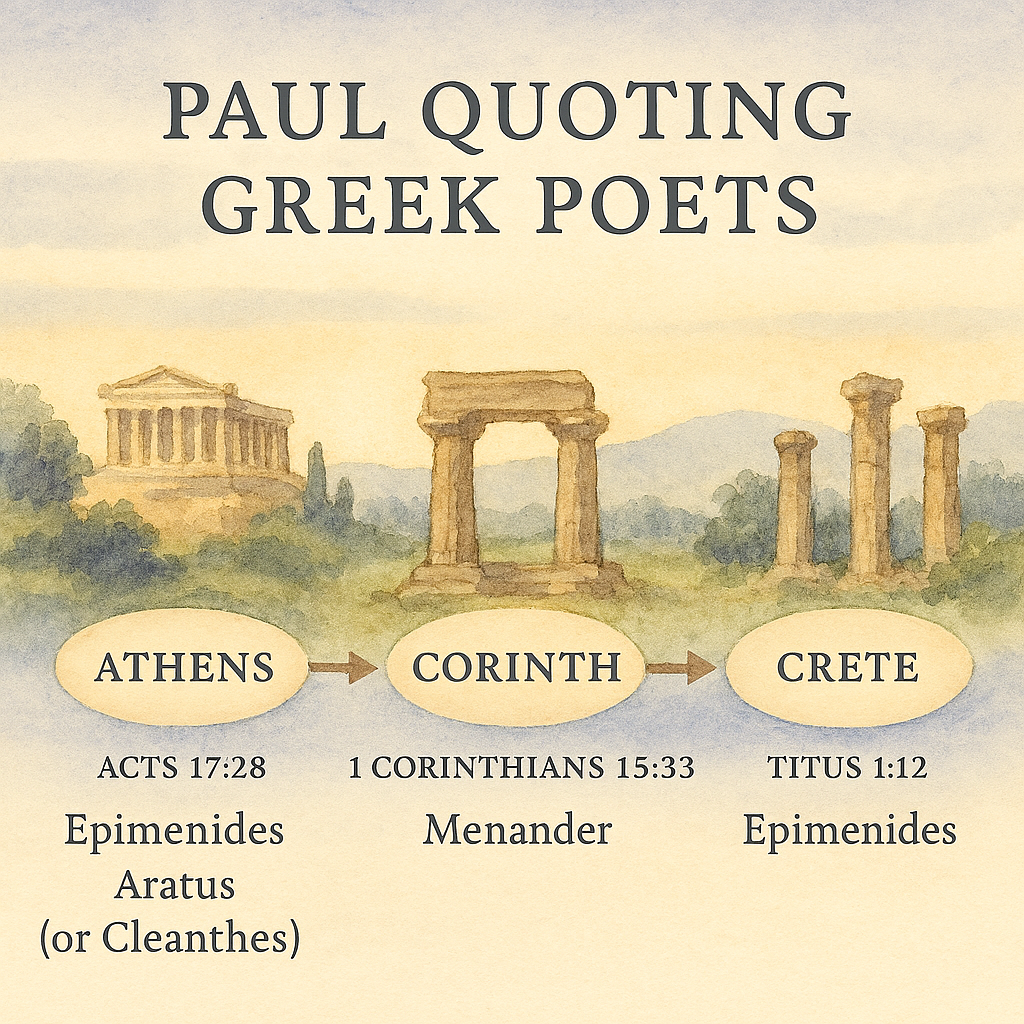
Paul quotes Greek poets three times in the New Testament, each time to connect with Gentile audiences by drawing from familiar cultural sources. These quotes appear in:


1. Acts 17:28 — Addressing the Areopagus in Athens
“For in him we live, and move, and have our being; as certain also of your own poets have said, For we are also his offspring.”
- First quote: “For in him we live and move and have our being” — attributed to Epimenides of Crete, a 6th-century BCE philosopher-poet.
- Second quote: “For we are also his offspring” — likely from Aratus (Phaenomena) or possibly Cleanthes (Hymn to Zeus).
- Paul uses these lines to affirm that the true God is near and knowable, contrasting with pagan idols.
2. 1 Corinthians 15:33 — Warning against corrupt influences
“Be not deceived: evil communications corrupt good manners.”
- This is a direct quote from Menander, a Greek dramatist of the 4th century BCE.
- Paul uses it to warn the Corinthian church about the influence of false teachers denying the resurrection.
3. Titus 1:12 — Critiquing Cretan culture
“One of themselves, even a prophet of their own, said, The Cretans are always liars, evil beasts, slow bellies.”
- This quote is also attributed to Epimenides of Crete.
- Paul uses it to highlight the moral challenges Titus would face in ministering to the Cretans.
These quotations show Paul’s ability to engage thoughtfully with the surrounding culture while remaining anchored in biblical truth.
