⭐ Short Answer
We do not know which tribes the individual disciples came from. Scripture never identifies their tribal lineage.
But we do know that Jesus intentionally chose twelve men to represent a “New Israel,” mirroring the twelve tribes. The correlations are theological, symbolic, and covenantal—not genealogical.
📜 1. Did the disciples belong to specific tribes?
❗ What Scripture tells us:
- The New Testament never records the tribal ancestry of Peter, Andrew, James, John, or any of the Twelve.
- By the first century, most Jews no longer knew their tribal lineage, except some Levites (e.g., families with names like Cohen or Levi).
❗ What we can reasonably assume:
- The disciples were Galilean Jews, so they were most likely from tribes associated with the northern region (Judah, Benjamin, or remnants of other tribes who resettled there).
- But no biblical or historical source assigns each apostle to a specific tribe.
👉 Conclusion:
There is no one‑to‑one mapping like “Peter = Judah” or “John = Levi.” Any such charts you may see are speculative.
🌿 2. So why did Jesus choose twelve disciples?
Because He was reconstituting Israel around Himself.
✨ Key theological correlations:
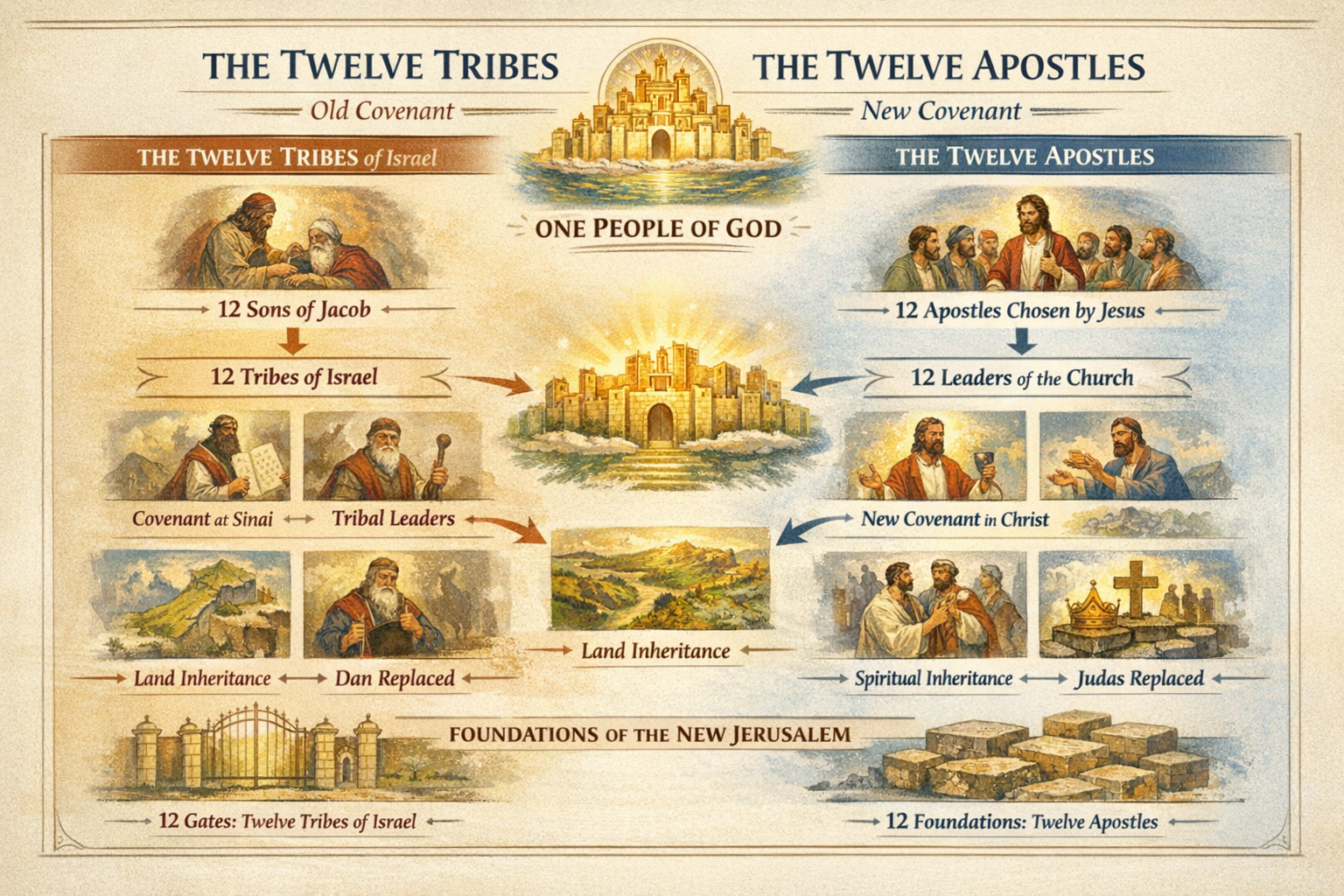
| Old Covenant | New Covenant |
|---|---|
| 12 sons of Jacob → 12 tribes | 12 apostles chosen by Jesus |
| Israel formed around the covenant at Sinai | New Israel formed around Jesus, the Mediator of the New Covenant |
| Tribal leaders governed God’s people | Apostles govern and shepherd the early Church |
| Tribal land inheritance | Spiritual inheritance in Christ |
| Dan falls into idolatry and is replaced in Revelation | Judas betrays Jesus and is replaced by Matthias |
🪜 3. Major Biblical Parallels Between the Tribes & the Apostles
A. Covenant Continuity
Jesus says the apostles will sit on twelve thrones judging the twelve tribes of Israel (Matt. 19:28; Luke 22:29–30).
This shows:
- The apostles represent the renewed leadership of God’s people.
- The Church is the continuation—not replacement—of God’s covenant plan.
B. Betrayal and Replacement
- Dan: associated with idolatry; disappears from the list in Revelation 7.
- Judas: betrays Jesus; replaced by Matthias in Acts 1.
Both stories show:
- Human failure does not break God’s covenant purposes.
- God preserves the symbolic number twelve.
C. Foundations of the New Jerusalem
Revelation 21:14:
The twelve foundations of the New Jerusalem bear the names of the twelve apostles.
Revelation 21:12:
The twelve gates bear the names of the twelve tribes.
Together they form:
- One people of God
- Old and New Covenant united
- A complete, restored family
🔍 4. Additional Symbolic Connections
These aren’t genealogical but thematic—useful for teaching:
1. Leadership
- Judah → kingship
- Peter → leadership among the apostles
(Not a direct match, but a thematic echo.)
2. Mission
- Israel was called to be a light to the nations.
- The apostles are sent to the nations with the gospel.
3. Identity
- The tribes formed the identity of God’s people.
- The apostles form the foundation of the Church’s identity.
4. Restoration
- Israel’s story includes exile and return.
- The apostles’ story includes betrayal (Judas) and restoration (Matthias).
🌟 5. How You Might Use This in Teaching or Study Materials
Here are some angles that fit beautifully with your faith‑rooted teaching style:
A. “The Twelve: God’s Pattern of Covenant Faithfulness”
- Twelve tribes → Twelve apostles → Twelve foundations of the New Jerusalem
- God keeps His promises across generations.
B. “From Old Israel to New Israel”
- Jesus doesn’t discard the old; He fulfills and renews it.
C. “Betrayal, Replacement, and Restoration”
- Dan and Judas show human failure.
- Matthias and Manasseh show God’s restoration.
D. “The Family of God: One Story, One People”
- The tribes and apostles are two halves of the same redemptive story.
