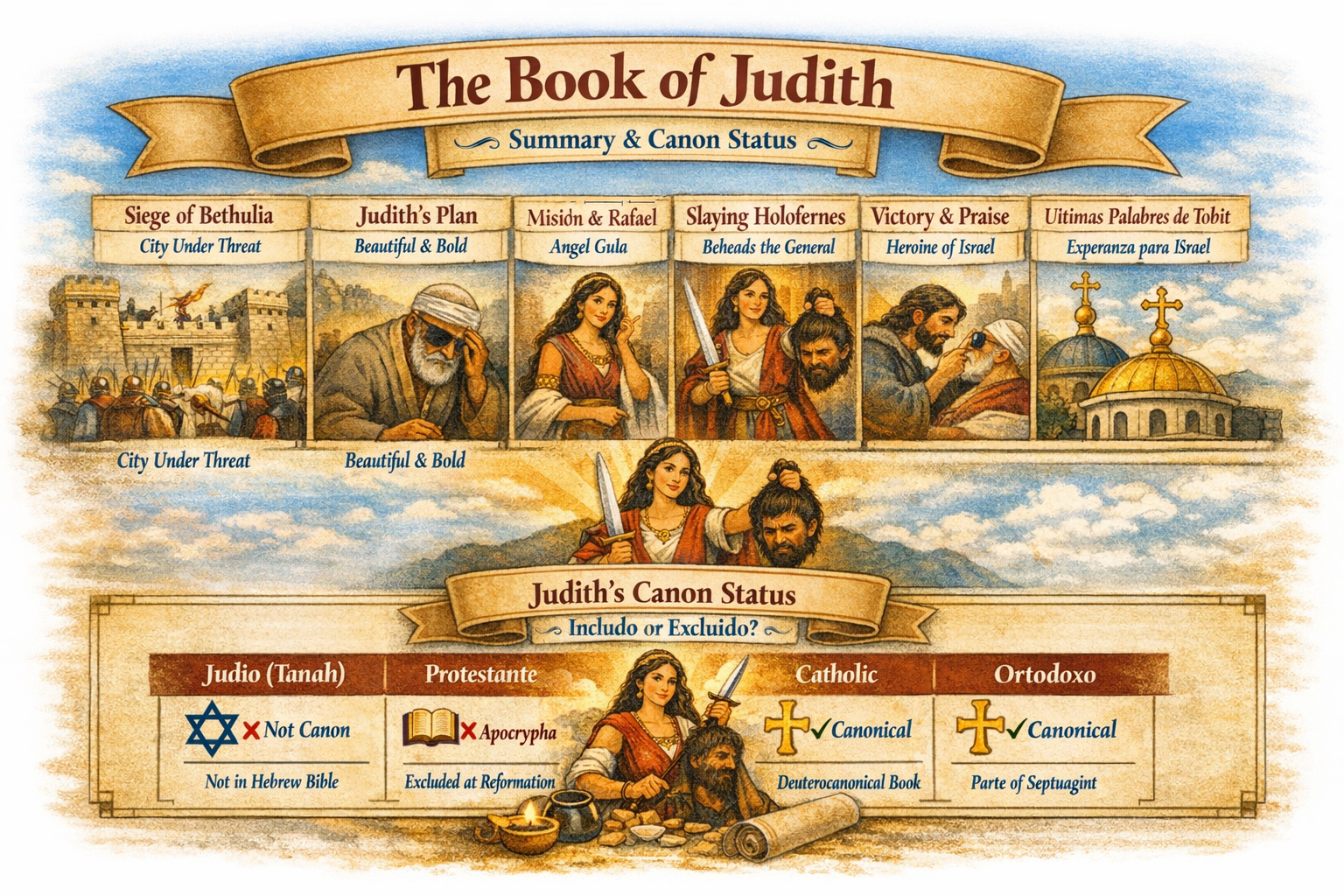
📘 Outline of the Book of Judith (16 Chapters)
Setting: Fictionalized Assyrian siege of Bethulia, written c. 150–100 BCE
Themes: Divine Deliverance, Courage, Faith over Military Might
I. Siege and Despair (Ch. 1–7)
- Assyrian general Holofernes, under Nebuchadnezzar, invades the region
- Jewish town Bethulia is besieged; water supply cut off
- Leaders give God five days to act before surrendering
II. Judith’s Plan and Mission (Ch. 8–10)
- Judith, a wealthy widow, rebukes the leaders for lack of faith
- She dresses elegantly, prays, and enters the enemy camp with her maid
- Holofernes is captivated by her beauty
III. Assassination and Escape (Ch. 11–13)
- Judith pretends to defect, attends Holofernes’ banquets
- On the fourth night, he gets drunk trying to seduce her
- Judith beheads him with his own sword and escapes with the head
IV. Victory and Praise (Ch. 14–16)
- The Israelites display Holofernes’ head; Assyrians panic and flee
- Judith leads a victory procession and sings a hymn of praise
- She lives in honor and dies at 105
Key Verse:
“The Lord Almighty has foiled them by the hand of a woman.” — Judith 16:5
📜 Canon Status: Why Judith Is Included or Excluded
✡️ Jewish Canon (Tanakh) — ❌ Not included
- Not part of the final Hebrew canon
- Possibly excluded due to historical anachronisms and fictional elements
- Bethulia is not a known historical city
- Judith’s story may have been viewed as parable or patriotic fiction
✝️ Protestant Canon — ❌ Not included
- Considered Apocrypha: valuable but not inspired
- Excluded during the Reformation, which returned to the Hebrew canon
- Martin Luther placed Judith at the head of the Apocrypha section
✝️ Catholic Canon — ✔️ Included
- Recognized as Deuterocanonical, affirmed at the Council of Trent (1546)
- Long used in liturgy and teaching
- Celebrated for its themes of faith, courage, and divine deliverance
✝️ Eastern Orthodox Canon — ✔️ Included
- Included in the Septuagint, the Greek Bible used by early Christians
- Accepted as Scripture, often placed between Nehemiah and Esther
- Judith is honored as a heroine of faith
🕊️ Summary Chart
| Tradition | Judith Status | Reason |
|---|---|---|
| Jewish | ❌ Not Canon | Not in Hebrew Bible; viewed as fiction |
| Protestant | ❌ Apocrypha | Excluded at Reformation |
| Catholic | ✔️ Canonical | Deuterocanonical; affirmed at Trent |
| Orthodox | ✔️ Canonical | Part of Septuagint tradition |
