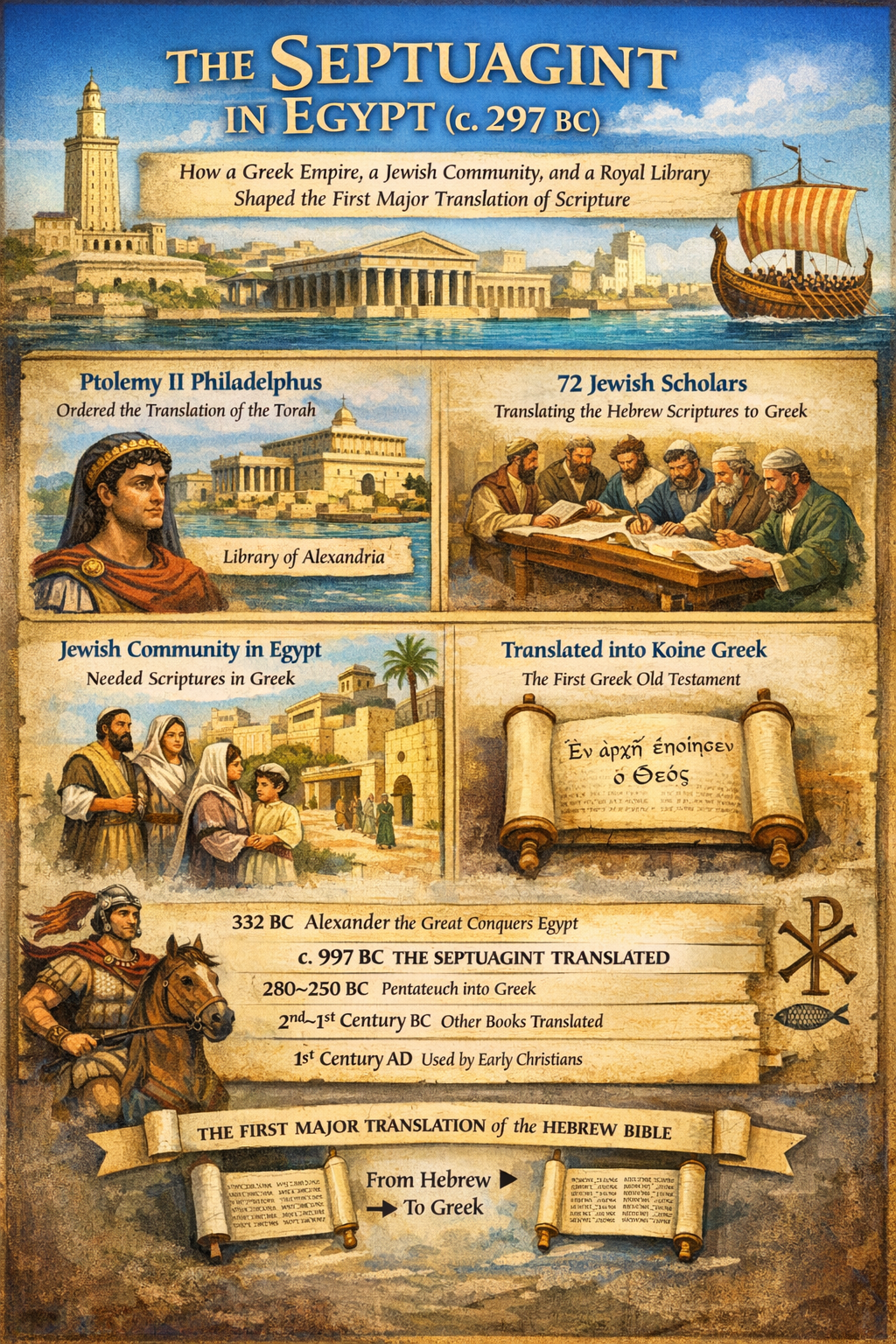
🏛️ The Septuagint in Egypt (c. 297 BC)
How a Greek Empire, a Jewish community, and a royal library shaped the first major translation of Scripture
🌍 1. The World of 3rd‑Century BC Egypt
By the late 4th and early 3rd century BC, Egypt was ruled by the Ptolemaic dynasty, successors of Alexander the Great. Greek became the administrative and cultural language of the region, especially in Alexandria, a thriving center of learning, trade, and multicultural life.
- Alexandria housed the Library of Alexandria, the most ambitious literary project of the ancient world.
- A large Jewish population lived in Egypt, many no longer fluent in Hebrew.
- Greek (Koine) was the common language of daily life.
This created a practical need: Hebrew Scriptures had to be accessible to Greek‑speaking Jews.
📜 2. The Traditional Story: The Letter of Aristeas
The earliest narrative about the Septuagint’s creation comes from the Letter of Aristeas, a 2nd‑century BC document.
According to this account:
- Ptolemy II Philadelphus (285–246 BC) requested a Greek translation of the Jewish Law for the Library of Alexandria.
- 72 Jewish scholars (six from each tribe) were sent from Jerusalem to Alexandria.
- They allegedly translated the Torah in perfect agreement; a detail scholars view as symbolic rather than literal.
Even though the letter contains legendary elements, historians agree on several reliable points:
- Location: Alexandria, Egypt
- Timeframe: During Ptolemy II’s reign (mid‑3rd century BC)
- Initial scope: The Pentateuch (Genesis–Deuteronomy)
- Purpose: Use in synagogue worship and instruction for Greek‑speaking Jews
📘 3. Why 297 BC?
While exact dates vary, the mid‑3rd century BC—roughly 280–250 BC—is the widely accepted period for the translation of the Torah.
A date like 297 BC fits within the early Ptolemaic context and reflects the era when:
- Jewish communities were firmly established in Egypt
- Greek had become dominant
- The Library of Alexandria was actively collecting texts
- Ptolemaic rulers were sponsoring translation projects
Thus, 297 BC represents the cultural moment that made the Septuagint possible, even if the translation itself likely occurred slightly later within that century.
📚 4. Expansion Beyond the Torah
After the Pentateuch was completed, other books of the Hebrew Scriptures were translated gradually over the next 100–150 years.
- Some books (like Job) may not have been translated until the late 2nd century BC.
- The translation style varies from book to book, showing different translators and eras.
🔍 5. What Made the Septuagint Unique?
A. A New Language for Scripture
The Septuagint was the first major translation of the Hebrew Bible into another language—Koine Greek.
B. A Different Textual Tradition
The Septuagint sometimes reflects older Hebrew source texts than the later Masoretic Text.
- Example: Jeremiah in the Septuagint is shorter and arranged differently.
C. A Foundation for Early Christianity
Because the early church used Greek, the Septuagint became:
- The Old Testament of the early Christians
- The basis for many later translations (Old Latin, Coptic, Armenian, etc.)
Britannica
🕊️ 6. Why the Septuagint Matters
The Septuagint is a powerful historical bridge:
- It shows how Scripture traveled across languages and cultures.
- It highlights the Jewish diaspora’s need for accessible Scripture.
- It explains why New Testament writers often quote the Old Testament in Greek wording.
📖 7. A Simple Timeline
332 BC — Alexander the Great conquers Egypt; Greek influence spreads
305–283 BC — Ptolemy I establishes the Library of Alexandria
285–246 BC — Reign of Ptolemy II Philadelphus
c. 280–250 BC — Translation of the Pentateuch into Greek (the core of the Septuagint)
2nd–1st century BC — Remaining books translated
1st century AD — Septuagint widely used by early Christians
