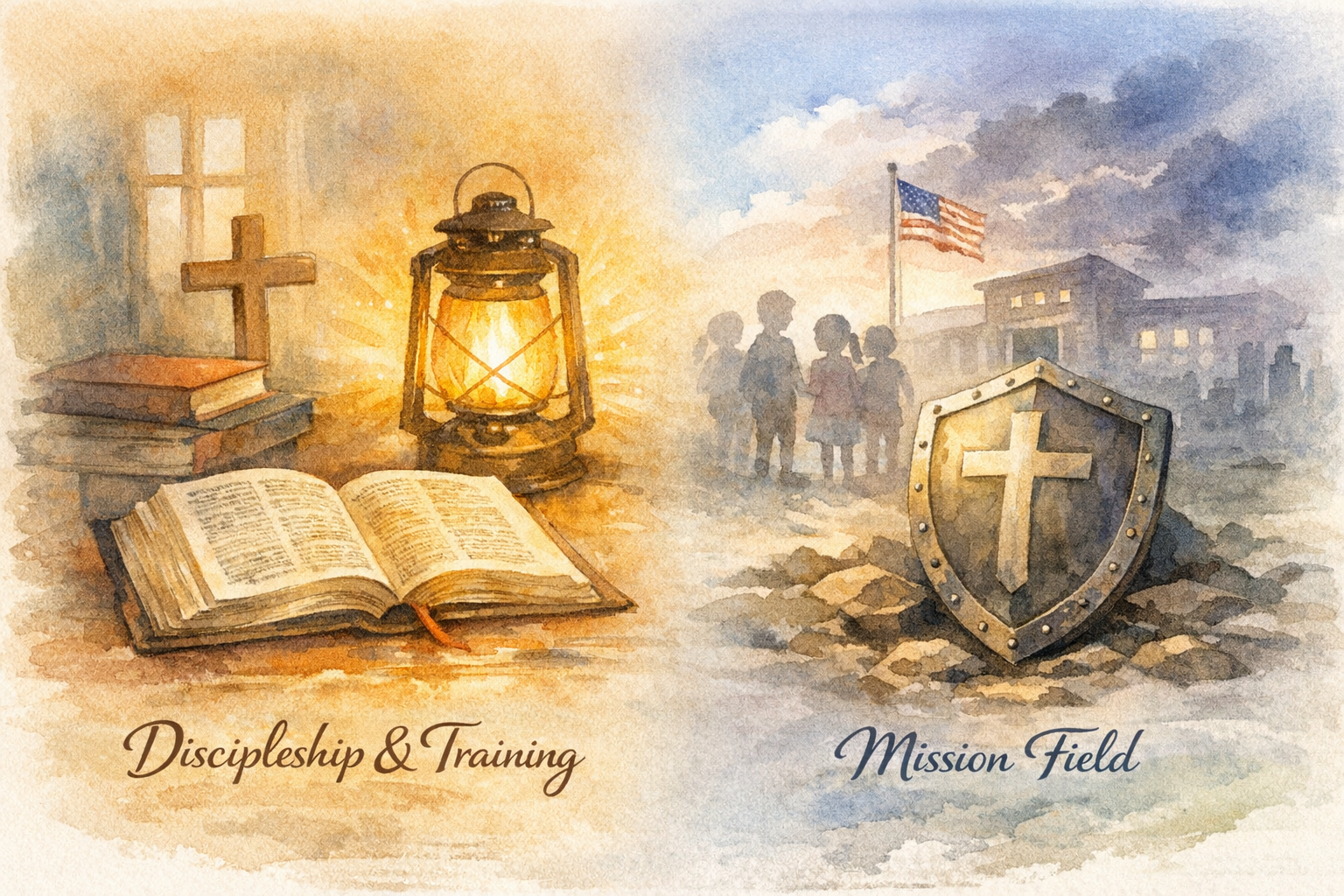
For years, some parents, pastors, and well‑meaning Christian leaders have repeated the idea that Christian children should be sent into public schools as “little missionaries.” It sounds spiritual on the surface — almost noble. But when we look at Scripture, discipleship, and the actual work of missions, the idea simply doesn’t hold up.
Children are not missionaries.
They are disciples in training.
And expecting them to carry the weight of evangelistic responsibility in a spiritually complex environment is not only unrealistic — it misunderstands what true missionary work requires.
What Real Missionaries Actually Do
Missionaries do not enter the mission field unprepared. They don’t walk into spiritually challenging environments with only a vague understanding of their faith. They train intentionally and thoroughly.
Missionaries spend years:
- Studying Scripture deeply
- Learning doctrine and theology
- Practicing how to explain the gospel clearly
- Preparing for difficult questions and objections
- Developing emotional and spiritual maturity
- Building resilience, discernment, and accountability
- Training under experienced teachers and mentors
Missionary work is not casual.
It is not spontaneous.
It is not something done without preparation.
It is a calling that requires knowledge, maturity, and spiritual grounding — qualities children simply have not yet developed.
Children Are Still Learning Their Faith
A child in kindergarten is still learning how to share toys and follow instructions.
A child in elementary school is still learning how to read fluently.
A child in middle school is just beginning to understand abstract concepts.
Yet some adults insist these same children should be “salt and light” in a system where:
- Their beliefs may be challenged
- Their peers may pressure or mock them
- Their teachers may contradict their worldview
- They have no training in apologetics or doctrine
This is not evangelism.
This is placing adult spiritual expectations on children who are not developmentally ready.
Children are not equipped to defend their faith.
They are barely beginning to understand it.
Public Schools Are Not Mission Fields Assigned to Children
Some argue that Christian children “need” to be in public schools so they can reach the lost. But this argument collapses under basic biblical and practical reasoning.
1. God never commanded children to evangelize.
Scripture places the responsibility for teaching, leading, and defending the faith on adults — parents, elders, mature believers.
2. Evangelism requires preparation.
Missionaries are trained before they are sent. Children are still being trained.
3. Exposure is not discipleship.
Throwing children into spiritually challenging environments does not strengthen their faith — it often confuses or weakens it.
4. A child’s calling is to grow, learn, and be nurtured.
Not to carry the burden of adult ministry.
5. Public schools are educational institutions, not missionary assignments.
Children attend school to learn reading, writing, math, and life skills — not to serve as evangelistic representatives.
Discipleship Comes Before Mission
Jesus did not say, “Send your children into the world and hope they figure it out.”
He said, “Make disciples.”
Discipleship is the foundation of mission.
Training comes before sending.
Maturity comes before responsibility.
Children need:
- Strong homes
- Strong churches
- Strong teaching
- Strong foundations
- Safe environments
- Wise mentors
Only after years of discipleship do believers become ready to serve as missionaries.
Protecting Children Is Not a Lack of Faith — It Is Obedience
Some Christians fear that keeping children out of spiritually hostile environments is “sheltering.” But Scripture consistently calls parents and the church to protect, teach, and nurture children.
Children are not spiritual warriors.
They are not evangelistic tools.
They are not miniature adults.
They are souls entrusted to our care.
Our job is to disciple them, not deploy them.
Scriptural Foundations: Discipleship Before Mission
The Bible consistently shows that spiritual preparation comes before being sent out.
Mission follows maturity — not the other way around.
Luke 6:40
“A disciple is not above his teacher, but everyone when he is fully trained will be like his teacher.”
Jesus makes it clear: disciples must be trained before they can teach others. Children are still learning — they are not yet “fully trained.”
Hebrews 5:12–14
“Though by this time you ought to be teachers, you need someone to teach you again the basic principles of the oracles of God… But solid food is for the mature.”
This passage reminds us that spiritual maturity takes time. Children are still on “milk,” learning the basics of faith.
Ephesians 6:4
“Fathers, do not provoke your children to anger, but bring them up in the discipline and instruction of the Lord.”
Parents are called to teach and nurture, not to send children into spiritual battle before they’re ready.
Matthew 28:19–20
“Go therefore and make disciples of all nations… teaching them to observe all that I have commanded you.”
The Great Commission begins with making disciples — teaching and grounding believers before sending them out.
Proverbs 22:6
“Train up a child in the way he should go; even when he is old he will not depart from it.”
Training comes first. Mission comes later, when the child is grown and grounded.
A Faithful Pattern
From Moses to Paul, God’s servants were prepared before being sent.
Children deserve the same care — time to learn, grow, and be discipled before facing the world’s challenges.
Conclusion: Let Children Be Children
The idea that Christian children should serve as missionaries in public schools may sound spiritual, but it misunderstands both childhood and missions.
Children are not missionaries.
They are disciples in training — and they deserve the time, teaching, and protection required to grow into the believers God calls them to be.
If we want missionaries, we must first make disciples.
And discipleship begins at home, in the church, and in safe, nurturing environments where children can learn their faith before being asked to defend it.
