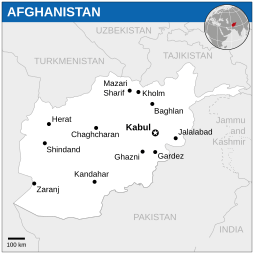

Afghanistan, officially known as the Islamic Emirate of Afghanistan, is a country that doesn’t have a coastline. It’s located where Central Asia and South Asia meet. People sometimes call it the “Heart of Asia.” It shares borders with Pakistan, Iran, Turkmenistan, Uzbekistan, Tajikistan, and China.
Afghanistan covers about 652,864 square kilometers (252,072 square miles). Most of the country is mountainous, especially with the Hindu Kush mountain range. There are also flatter areas in the north and southwest. Kabul is the biggest city and the capital. In 2021, Afghanistan’s population was around 40.2 million people. It’s made up of many different ethnic groups, like Pashtuns, Tajiks, Hazaras, and Uzbeks.
Afghanistan Geography
Afghanistan is in Southern-Central Asia. It’s often called the “crossroads of Asia” or the “Heart of Asia.” A famous poet once wrote that Afghanistan is like the heart of Asia. If Afghanistan is in trouble, Asia is in trouble. If Afghanistan is peaceful, Asia is peaceful.
Afghanistan is about 652,864 square kilometers (252,072 square miles). This makes it the 41st largest country in the world. It’s a bit bigger than France. Since it’s landlocked, it has no coastline. Its longest border is with Pakistan. It also borders Tajikistan, Iran, Turkmenistan, Uzbekistan, and China.
Mountains, Plains, and Rivers

Afghanistan’s land is mostly mountainous and rugged. The Hindu Kush mountain range runs through it. This range is part of the Himalayas. Most of the highest points are in the east. These areas have fertile mountain valleys. The Hindu Kush ends in the west-central highlands. This creates plains in the north and southwest. These plains have grasslands, semi-deserts, and hot, windy deserts. Forests are found in some eastern provinces. The highest point is Noshaq, which is 7,492 meters (24,580 feet) above sea level.
Even with many rivers and lakes, large parts of Afghanistan are dry. The Amu Darya river starts north of the Hindu Kush. Other rivers like the Hari Rud and Helmand River flow through the country. The Kabul River flows east towards the Indus River. In winter, the mountains get heavy snow. This melting snow fills the rivers and lakes in spring. However, two-thirds of Afghanistan’s water flows into neighboring countries.
Wildlife and Nature

Many different animals live in Afghanistan. Snow leopards and brown bears live in the high mountains. The Marco Polo sheep is found only in the Wakhan Corridor. Foxes, wolves, and deer live in the mountain forests. In the northern plains, you can find birds, hedgehogs, and large meat-eaters like jackals.
Gazelles and wild pigs live in the southern and western plains. The Afghan Hound is a special dog breed from Afghanistan. It’s known for being fast and having long hair. Afghanistan also has unique animals like the Afghan flying squirrel and the Afghan snowfinch.
The forests have pine, spruce, and fir trees. Grasslands have short grass and shrubs. Colder, high-up regions have tough grasses and small flowering plants. Afghanistan has three national parks: Band-e Amir, Wakhan, and Nuristan.
Languages Spoken in Afghanistan
Dari and Pashto are the official languages. Many Afghans speak both. Dari is similar to Persian and is often used as a common language in Kabul and the northern parts of the country. Pashto is the main language of the Pashtuns. Many Pashtuns also speak Dari.
Other languages spoken include Uzbek, Turkmen, and Balochi. Many Afghans can also understand Hindustani (Urdu-Hindi). This is because of returning refugees from Pakistan and the popularity of Bollywood movies. English is also becoming more common.
Afghanistan’s Economy
Afghanistan’s economy is still developing. It has a lot of mineral resources, possibly worth over $1 trillion. But it remains one of the world’s least developed countries. This is due to its mountains, being landlocked, and ongoing conflict. The country imports more goods than it exports. Its main exports are fruits and nuts.
The Afghani (AFN) is the national money. The central bank is called Da Afghanistan Bank. Many local and foreign banks operate in the country.
Many Afghans who lived abroad have returned. They have helped the economy by starting businesses. Construction is a big industry. Major projects include new cities and towns. The telecom industry has also grown a lot, creating many jobs. Afghan rugs are also a popular export.
Source: Kids Encyclopedia Facts

2 responses to “Facts about Afghanistan for Children”
[…] Facts about Afghanistan for Children […]
[…] Facts about Afghanistan for Children […]