The Indus Valley Civilization was an ancient culture that existed during the Bronze Age. It lasted from about 3300 BC to 1300 BC. Its most important time was between 2700 BC and 1700 BC.
This civilization was located in the Indian subcontinent. It grew along the Indus River and the Ghaggar-Hakra River. Today, these areas are in Pakistan, northwest India, and Afghanistan.
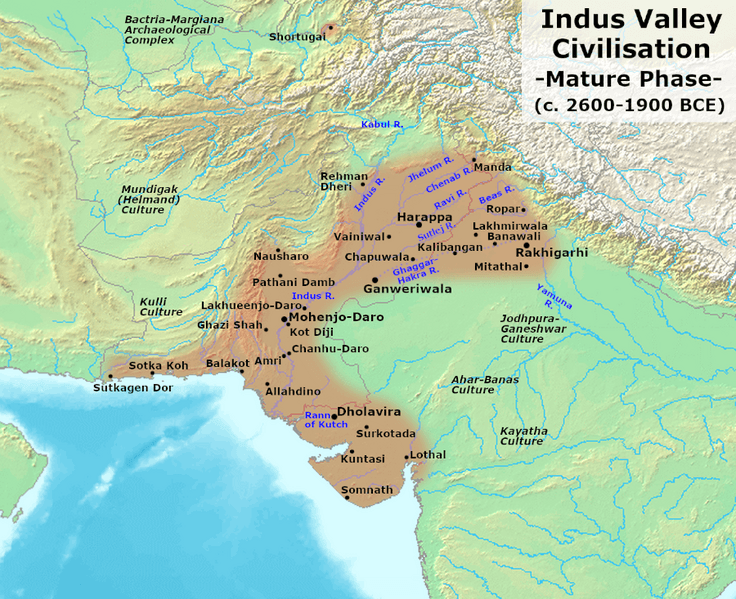
Archaeologists first found signs of this civilization in the 1880s. The first city they dug up was Harappa. Because of this, the civilization is also called the ‘Harappan Civilization’.
The Indus Valley Civilization covered a very large area. It stretched from Balochistan in Pakistan to Gujarat in India. The people were skilled builders. Their cities showed clever design and planning. Buildings often had two or more floors. They even had bathrooms connected to the rooms.
One special thing about their cities was their amazing drainage system. Brick-lined drains ran along every street. Some bricks could be removed. This made it easy to clean and check the drains.
Harappan traders used seals on their goods. These seals helped make sure that packages were not opened during travel. We still don’t know how to read their writing system.
In 1842, Charles Masson wrote about the Indus Valley sites. But few people paid attention. Later, in 1921-22, John Marshall led the first big archaeological dig at Harappa.
Here are some images we have from the work of archaeologists. Make observations.


 articlesforchristians
Leave a comment