Americus Vespucius was born in Florence in 1451. He went into mercantile life at Florence, and afterward removed to Spain a little before Columbus sailed on his first voyage. Vespucius claimed to have made four voyages to the New World, the first in 1497. But it is now believed that this first date is not correct, and that Vespucius was in Spain during all of that year. He undoubtedly went to America several times, both from Spain and Portugal. In 1503 Vespucius built a fort on the coast of what is now Brazil; and he left there a little colony, the first in that part of South America. Ferdinand of Spain made him pilot-major of his kingdom in 1508, and he died in 1512.
A part of the glory of Columbus’s great discovery was taken away from him by accident. An Italian, Amerigo Vespucci [am-a-ree’-go ves-poot’-chee], whose name in Latin was written Amer’icus Vespu’cius, was with an expedition that discovered part of South America in 1499. A false claim was made, indeed, that Americus saw that continent two years earlier, which would be before Columbus discovered it in 1498. Americus Vespucius wrote pleasantly about the new lands which he had seen, and some German geographers were so pleased with his descriptions that they called the country America, in honor of Americus, supposing him to have first seen the continent. When North America came to be placed on the maps, this name was applied to it also. Thus, nearly half the world goes by the name of a man who had no claim to be called its discoverer.

The voyage of Columbus was undertaken, as we have seen, to open a trade with the Spice Islands of Asia, and the failure to find these was disappointing. There was another great Italian navigator living at the same time as Columbus, whose name was Zuan Cab-ot’-o. He is called in English John Cab’-ot. He had been in the city of Mecca, in Arabia, and had there seen the caravans bringing spices from India. He inquired of the people of these caravans where they got their spices. They said that other caravans brought them to their country, and that the people in those caravans said that they bought them from people who lived yet farther away. From all this John Cabot concluded that the spices so much valued in Europe must grow in the most easterly part of Asia, and that he could reach this part of Asia by sailing to the west, as Columbus had done.
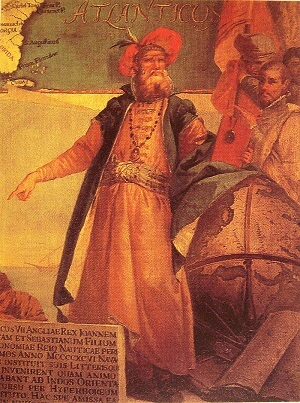
The King of England at this time was Henry VII. While Columbus was trying to persuade Ferdinand and Isabella to send him on a voyage of discovery, he had sent his brother, Bartholomew Columbus, to make a like offer to the English king. When Bartholomew returned to Spain with King Henry VII’s answer, Christopher Columbus had already discovered the New World.
But though Columbus had found what he believed to be a part of Asia, he had not found the region of gold and spices. John Cabot, who was then living in England, believed that he might be more fortunate. He got permission from Henry VII to sail at the expense of certain English merchants, and in May 1497, nearly five years after Columbus had started on his first voyage, Cabot set sail from Bristol with only one small vessel and eighteen persons. He discovered the Continent of North America, which he of course supposed to be a part of Asia. He did not meet any American Indians, but he brought to King Henry one of their traps for catching game, and a needle for making nets. He was received with great honor, and he who had gone away a poor Venetian pilot was now called “the Great Admiral,” and dressed himself in silks, after the manner of great men of that time.
The next year, accompanied by his son Sebastian, he set sail with a much larger expedition, to find his way to Japan or China. After going far to the north, he sailed along what is now the coast of Canada and the United States as far to the south as North Carolina. But, as he did not find the riches of Asia, the English appear to have lost much of their interest in Western voyages.
After both Columbus and John Cabot were dead, people began to suspect that the newly discovered lands were not part of Asia. In 1513 Vasco Nunez de Balboa [vas’-co noon-yeth deh bal-bo’-ah] crossed the Isthmus of Panama [pan-ah-mah’] and discovered the Pacific Ocean at the west of America.
It now became a question of finding a way through or around America, so as to come to the rich trade of the East Indies, which the Portuguese had reached in 1498, when Vasco da Gama [vas’-co dah gah’-mah] sailed there around the Cape of Good Hope. In 1520 Magellan [ma-jel’-lan], a Portuguese in the employ of Spain, sailed through the straits which bear his name, and so into the Pacific. It was not then known that one could pass around Cape Horn. Magellan lost his life in the Philippine Islands, but one of his smallest ships succeeded in making- the circuit of the earth – the first that ever accomplished that feat.
Magellan’s route was too long a course for trade, and many other navigators sailed up and down the American coast, expecting to find some passage by which they could get through the continent to go to China, India, and Japan, They thought America very narrow, and, indeed, they believed that it might prove to be cut through in some places by straits, if they could only find them. Several great English navigators tried to discover what they called the Northwest Passage, by sailing along the coast of Labrador. and into the rivers and bays of America.
For a long time nobody in England thought it worthwhile to send colonies to North America; it was regarded only as a bar to all attempts to reach Asia by the west. The colonists sent from Spain having found gold in great quantities in Mexico and South America, the English at length began to think of settling colonies in North America, to look for gold there also. Frobisher and Sir Humphrey Gilbert, in” the time of Queen Elizabeth, proposed to settle such colonies, but it was not until Sir Walter Raleigh undertook it that a hopeful beginning was made.
JOHN CABOT
John Cabot, or Zuan Caboto, as he was called in the Venetian dialect, was probably born in Genoa, but he was naturalized in Venice. He was living in Bristol, in England, with his wife and three sons, in 1495, when he laid his plans before Henry VII. He received a charter for discovery from that king in 1496, in which his three sons were named, and he sailed on his first voyage in 1497, and the second in 1498. It is probable that his son Sebastian went with him on both voyages. There is no account of John Cabot’s second return, nor do we know any more about him after his sailing to America the second time. His son Sebastian, who was a great geographer, and who lived to be very old, seems to have always spoken of the voyages as though he had made them alone, but we now know that it was John Cabot who discovered North America.
FERNANDO DA MAGALHAENS
Fernando da Magalhaens [mah-gal-yah’-ens], as his name is written and pronounced in Portuguese, but who is known in English as Magellan, was born in Portugal. He served the Portuguese government in the East Indies, and was in the expedition that discovered some of the Spice Islands. Having received a slight from the Portuguese government, he publicly renounced his country and entered the service of the King of Spain. He sailed on his famous voyage in September, 1519, with five ships. On the coast of South America, he lost one of his vessels and suppressed a mutiny. In October, 1520, he entered the straits that bear his name. His men were very reluctant to go on, and one ship turned back out of the channel and sailed home. With the three ships left he entered the Pacific. At the Philippine Islands he was killed in a battle with the natives. Only one of his ships, the Victoria, succeeded in getting around the world, and she had but eighteen men left alive when she got back, and they were sick and almost starving.


 articlesforchristians
Comments on: " Other Discoveries in America" (2)
[…] Other Discoveries in America […]
[…] Other Discoveries in America […]