Psalm 2
- Why do the heathen rage, and the people imagine a vain thing?
- The kings of the earth set themselves, and the rulers take counsel together, against the Lord, and against his anointed, saying,
- Let us break their bands asunder, and cast away their cords from us.
- He that sitteth in the heavens shall laugh: the Lord shall have them in derision.
- Then shall he speak unto them in his wrath, and vex them in his sore displeasure.
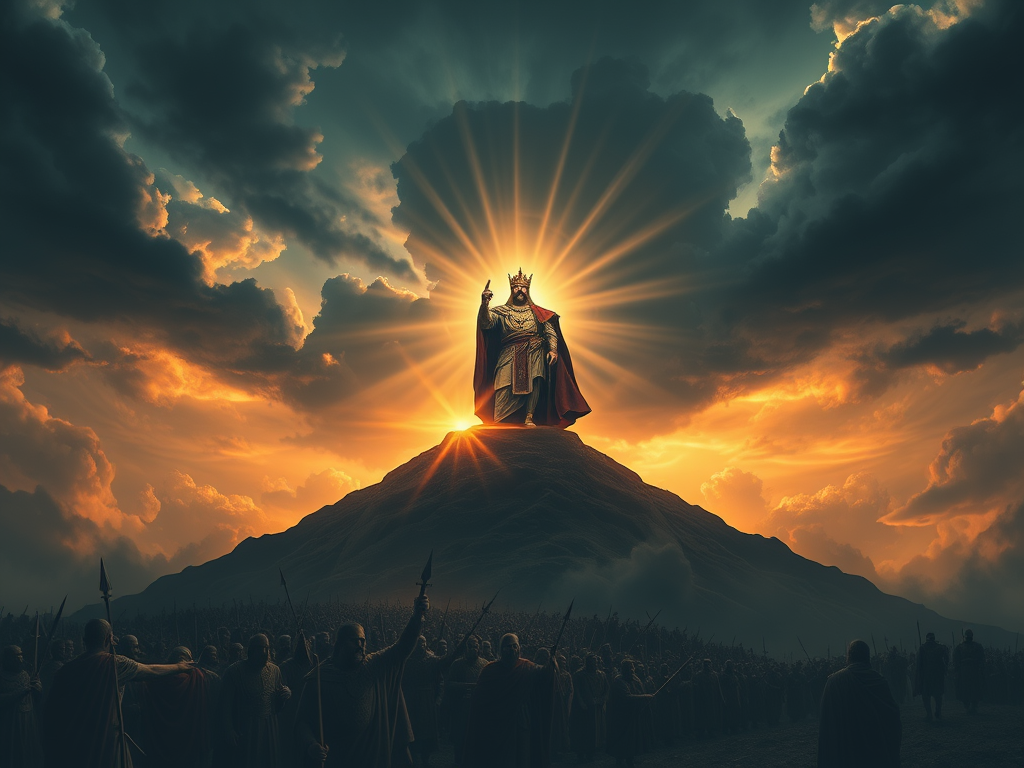
- Yet have I set my king upon my holy hill of Zion.
- I will declare the decree: the Lord hath said unto me, Thou art my Son; this day have I begotten thee.
- Ask of me, and I shall give thee the heathen for thine inheritance, and the uttermost parts of the earth for thy possession.
- Thou shalt break them with a rod of iron; thou shalt dash them in pieces like a potter’s vessel.
- Be wise now therefore, O ye kings: be instructed, ye judges of the earth.
- Serve the Lord with fear, and rejoice with trembling.
- Kiss the Son, lest he be angry, and ye perish from the way, when his wrath is kindled but a little. Blessed are all they that put their trust in him.
Notes:
- The word translated here as “heathen” comes from the Hebrew word goyim and is often referred to as “nations,” especially the non-Jewish nations of the Gentiles that surrounded Israel. Later the word Gentile became synonymous with the word goyim for most Hebrews.
- The word “image” is the Hebrew word hagah. It is the same word that in Psalm 1 that is translated as meditate. The nations around Israel were meditating on how to destroy God’s anointed.
- The word “anointed” is the Hebrew word מָשִׁיחַ māšîaḥ.
- מָשִׁיחַ māšîaḥ
- anointed (one), usually refers to pouring or smearing sacred oil on a person in a ceremony of dedication, possibly symbolizing divine empowering to accomplish the task or office; the Anointed One, the Messiah, God’s ultimate chosen one, identified in the NT as Jesus:
- מָשִׁיחַ māšîaḥ
- Vs 2: Yet have I set my king upon my holy hill of Zion.
- David captured the stronghold of Zion (see 2 Samuel 5:7)
- David later constructed a tent on Mount Zion (see 1 Chron. 15:1). He then brought the Ark of the Covenant their and housed it in the tent (see 1 Chron. 16:1). By this God had set His King upon the “Holy Hill of Zion”.
- 2:7 I will declare the decree: the Lord hath said unto me, Thou art my Son; this day have I begotten thee.
- This verse is quoted from twice:
- Hebrews 1:5
- For unto which of the angels said he at any time, Thou art my Son, this day have I begotten thee? And again, I will be to him a Father, and he shall be to me a Son?
- Hebrews 5:5
- So also Christ glorified not himself to be made an high priest; but he that said unto him, Thou art my Son, to day have I begotten thee.
- Hebrews 1:5
- Notice a few things
- The word Son is used to identify the Messiah as Christ was called the “Son of God” (see Matt. 8:29; 14:33; 27:54; Mark 1:1; 3:11; Luke 1:35).
- The term begotten is also used, from a Hebrew word meaning “to give birth to a child,”
- It is used in the New Testament when Jesus is called the “only begotten of the Father” (John 1:14).
- The phrase “only begotten” refers to an “only born.”
- This verse is quoted from twice:
- 2:8 Ask of me, and I shall give thee the heathen for thine inheritance, and the uttermost parts of the earth for thy possession.
- When Messiah (Jesus) becomes King and sets His throne in Jerusalem, He will be King over all the earth and all nations will be under His dominion; thus, He will inherit the heathen (Gentile) nations.
- 2:9 Thou shalt break them with a rod of iron; thou shalt dash them in pieces like a potter’s vessel.
- The promise of the Messiah ruling with a rod of iron is found in both Testaments.
- Isaiah 11:4 But with righteousness shall he judge the poor, and reprove with equity for the meek of the earth: and he shall smite the earth: with the rod of his mouth, and with the breath of his lips shall he slay the wicked.
- The “rod” is the words of the Messiah’s mouth that slay the wicked.
- This same imagery is used in Revelation 19:15.
- And out of his mouth goeth a sharp sword, that with it he should smite the nations: and he shall rule them with a rod of iron: and he treadeth the winepress of the fierceness and wrath of Almighty God.
- In the above verse it is with His mouth that Christ will smite the nations and rule them with a rod of iron.
- Isaiah 11:4 But with righteousness shall he judge the poor, and reprove with equity for the meek of the earth: and he shall smite the earth: with the rod of his mouth, and with the breath of his lips shall he slay the wicked.
- Here, David says that the Messiah will break them in pieces like a clay vessel that is smashed with a rod. This refers to breaking:
- the power
- the influence
- the will of the nations, causing them to submit to the Messiah.
- The promise of the Messiah ruling with a rod of iron is found in both Testaments.
- 2:10 Be wise now therefore, O ye kings: be instructed, ye judges of the earth.
- Wisdom and instruction should be the basis for all decisions made among leaders.
- It should also be the basis for decisions made by all Christians.
- 2:11 Serve the Lord with fear, and rejoice with trembling.
- The “fear of the Lord is the beginning of wisdom”
- Ps. 111:10
- The fear of the Lord is the beginning of wisdom: a good understanding have all they that do his commandments: his praise endureth for ever.
- Ps. 111:10
- The Hebrew word translated as rejoice here is giyl and means, “to spin around with emotion” or “to spin in a circle.”
- In Hebrew thought, to “rejoice” does not simply mean to be happy in the Lord. Rejoicing is accompanied by a response such as shouting, spinning, or even dancing.
- The “fear of the Lord is the beginning of wisdom”
- 2:12 Kiss the Son, lest he be angry, and ye perish from the way, when his wrath is kindled but a little. Blessed are all they that put their trust in him.
- The “Son” here is the King Messiah (v. 6), the begotten son (v. 7), and the one who rules with a rod of iron (v. 9).
- “Kiss”: It was customary in ancient times to kiss a close friend on the cheek, or to kiss the ring or hand of the king or leader as a sign of great honor.
- Those who will not honor Christ in the Millennium will experience forms of judgments on their nations (see Zech. 14:17-18).

5 responses to “The Prophecy of the Anointed One in Psalm 2”
[…] The Prophecy of the Anointed One in Psalm 2 […]
[…] The Prophecy of the Anointed One in Psalm 2 […]
[…] The Prophecy of the Anointed One in Psalm 2 […]
[…] King, Eternal Priest, & Victorious Warrior THE SUFFERING MESSIAH PROPHECIES IN PSALM 22 The Prophecy of the Anointed One in Psalm 2 Jesus’ Final Prayer: Insights from John 17 The Power of Prayer and Fasting: A Biblical […]
[…] The Prophecy of the Anointed One in Psalm 2 […]