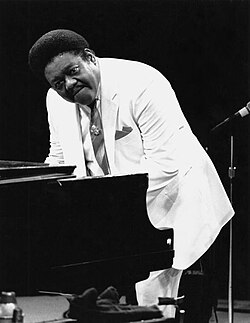
Fats Domino
Antoine Caliste Domino Jr. (February 26, 1928 – October 24, 2017), better known as Fats Domino, was an American singer-songwriter and pianist who helped pioneer rock and roll. Selling over 65 million records, he was born in New Orleans to a French Creole family and signed with Imperial Records in 1949. His debut single, “The Fat Man,” is considered by some historians to be the first rock and roll record and the first to sell more than a million copies. Domino often collaborated with co-writer Dave Bartholomew, adding his signature rolling piano style to hits like Lloyd Price’s “Lawdy Miss Clawdy” (1952) and kicking off a string of successes with “Ain’t That a Shame” (1955). From 1955 to 1960, he scored eleven Top 10 US pop hits, and by 1955, five of his records had already sold over a million copies and earned gold certification.
Domino, naturally shy and humble, left a big mark on the rock and roll scene. Elvis Presley called him a “huge influence” when he was starting out, and after meeting him in 1959, even referred to Domino as “the real king of rock ’n’ roll.” The Beatles also drew significant inspiration from his music.
Four of Domino’s hits earned a spot in the Grammy Hall of Fame for their impact: “Blueberry Hill,” “Ain’t That a Shame,” “Walking to New Orleans,” and “The Fat Man.” In 1986, he joined the inaugural class of the Rock and Roll Hall of Fame. According to the Associated Press, he sold over 110 million records during his career.
Early life and education
Antoine Domino Jr., the youngest of eight siblings, was born and raised in New Orleans, Louisiana, to Antoine Caliste Domino (1879–1964) and Marie-Donatille Gros (1886–1971). The family had French Creole roots, and Louisiana Creole was his first language. Like many families of similar heritage, they practiced Catholicism.
Antoine was born at home with the help of his grandmother, a midwife. His name was mistakenly recorded as Anthony on his birth certificate. His family had just moved to the Lower Ninth Ward from Vacherie, Louisiana. His father played the violin part-time and worked at a racetrack.
He went to the Louis B. Macarty School but left to work as a helper for an ice delivery man. Around 1938, Domino learned to play the piano from his brother-in-law, jazz guitarist Harrison Verrett.
Early career (1940s)
By the time he was 14, Domino was already playing in bars around New Orleans. In 1947, local bandleader Billy Diamond caught his performance at a backyard barbecue and was impressed enough to invite him to join his band, the Solid Senders, at the Hideaway Club. There, Domino earned $3 a week playing piano, and it was Diamond who gave him the nickname “Fats.”
Later career (1980s–2005)

In 1986, Domino was one of the first musicians to be inducted into the Rock and Roll Hall of Fame. He also received the Grammy Lifetime Achievement Award in 1987. Domino’s last album for a major label, Christmas Is a Special Day, was released in 1993.
Domino lived in a mansion in a predominantly working-class neighborhood in the Lower Ninth Ward, where he was a familiar sight in his bright pink Cadillac automobile. He made yearly appearances at the New Orleans Jazz & Heritage Festival and other local events.
In 1995, he went on his final tour in Europe, which lasted three weeks. After falling ill during the trip, Domino chose to stay in the New Orleans area for good, enjoying a steady income from royalties, avoiding the hassles of touring, and insisting he couldn’t find food he liked anywhere else. That same year, he was honored with the Rhythm & Blues Foundation’s Ray Charles Lifetime Achievement Award.
In 1998, President Bill Clinton honored him with the National Medal of Arts, but Domino turned down an invitation to perform at the White House.
In 2004, Rolling Stone magazine ranked him number 25 on its list of the “100 Greatest Artists of All Time” in an essay written by Dr. John.
Domino and Hurricane Katrina

As Hurricane Katrina approached New Orleans in August 2005, Domino chose to stay at home with his family, partly because his wife, Rosemary, was in poor health. His house was in an area that was heavily flooded.
.jpg)
Rumors spread that Domino had died in the hurricane, and his home was vandalized with the spray-painted message, “RIP Fats. You will be missed.” On September 1, talent agent Al Embry said he hadn’t heard from Domino since before the storm hit. Later that day, CNN reported that a Coast Guard helicopter had rescued him. Until then, even his family hadn’t been in contact since before the hurricane. Embry confirmed Domino and his family were safe. They were taken to a shelter in Baton Rouge, then picked up by JaMarcus Russell, LSU’s starting quarterback and boyfriend of Domino’s granddaughter, who let them stay at his apartment. According to The Washington Post, they left on September 2 after three nights sleeping on the couch. “We’ve lost everything,” Domino said.
By January 2006, work to gut and repair Domino’s home and office had begun. In the meantime, the Domino family resided in Harvey, Louisiana.
President George W. Bush made a personal visit and replaced the National Medal of Arts that President Bill Clinton had previously awarded Domino. The gold records were replaced by the RIAA and Capitol Records, which owned the Imperial Records catalogue.
Later life
Domino was scheduled to perform at the 2006 Jazz & Heritage Festival in New Orleans. However, he was suffering from anxiety and was forced to cancel the performance, but he did appear to offer the audience an on-stage greeting.
In 2006 Domino’s album Alive and Kickin’ was released to benefit the Tipitina’s Foundation, which supports indigent local musicians and helps preserve the New Orleans sound. The album consists of unreleased recordings from the 1990s and received great critical acclaim.

On January 12, 2007, Domino was honored with OffBeat magazine’s Lifetime Achievement Award at the annual Best of the Beat Awards, held at the House of Blues in New Orleans. New Orleans Mayor Ray Nagin declared the day “Fats Domino Day in New Orleans” and presented him with a signed declaration. Domino returned to stage on May 19, 2007, at Tipitina’s at New Orleans, performing to a full house. This was his last public performance. The concert was recorded for a 2008 TV presentation entitled Fats Domino: Walkin’ Back to New Orleans. This was a fund-raising concert, featuring a number of artists. Domino donated his fee to the cause. Later that year, a Vanguard record was released, Goin’ Home: A Tribute to Fats Domino featuring his songs as recorded by Elton John, Neil Young, Tom Petty, Robert Plant, Willie Nelson, Norah Jones, Lenny Kravitz, and Lucinda Williams. A portion of the proceeds was to be used by the Foundation to help restore Domino’s publishing office which had been damaged by the hurricane.
In September 2007, Domino was inducted into the Louisiana Music Hall of Fame.
In May 2009, Domino made an unexpected appearance in the audience for the Domino Effect, a concert featuring Little Richard and other artists, aimed at raising funds to help rebuild schools and playgrounds damaged by Hurricane Katrina.
In October 2012, Domino appeared as himself in season three of the TV series Treme. On August 21, 2016, he was into the National Rhythm and Blues Hall of Fame in Detroit, Michigan, alongside Dionne Warwick, Cathy Hughes, Smokey Robinson, Prince, and the Supremes. Back in 1995, he received the Rhythm & Blues Foundation’s Ray Charles Lifetime Achievement Award, and in 2015, his hit “The Fat Man” was added to the Grammy Hall of Fame.
Death
Domino died on October 24, 2017, at his home in Harvey, Louisiana, at the age of 89, from natural causes, according to the coroner’s office.

2 responses to “Fats Domino’s Life: From New Orleans to Stardom”
[…] Fats Domino’s Life: From New Orleans to Stardom […]
[…] Fats Domino’s Life: From New Orleans to Stardom […]