1. URSA MINOR (The Little Bear)
The Lesser Sheepfold.
Here we come to another grievous mistake, or ignorant perversion of primitive truth, as shown in the ancient names of these two constellations.
It is sufficient to point to the fact that no Bear is found in any Chaldean, Egyptian, Persian, or Indian Zodiacs, and that no bear was ever seen with such a tail! No one who had ever seen a bear would have called attention to a tail, such as no bear ever had, by placing in its very tip the most important, wondrous, and mysterious Polar Star, the central star of the heavens, round which all others revolve. The patriarchal astronomers, we may be sure, committed no such folly as this.[pg 151]
The primitive truth that there were two, or a pair of constellations is preserved; and that of these two, one is larger, and the other smaller. But what were they? We have the clue to the answer in the name of the brightest star of the larger constellation, which is called Dubheh. Now Dubheh means a herd of animals. In Arabic, Dubah means cattle. In Hebrew, דֹּבֶר, Dōhver, is a fold; and hence in Chaldee it meant wealth. The Hebrew דֹּבֶא, Dōhveh, means rest or security; and certainly there is not much of either to be found or enjoyed with bears! The word occurs in Deut. xxxiii. 25: “As thy days so shall thy strength be.” The Revised Version gives in the margin, “So shall thy rest or security be.” This accords with what we have already seen under “Cancer”: “Couching down between the sheepfolds,71 he saw a resting-place that it was good.”
Here are the two Sheepfolds, then; the Greater fold, and Lesser; and here is the rest and security which the flocks will find therein.
But in Hebrew there is a word very similar in sound, though not in spelling—דֹּב or דּוֹב, dōhv, which means a bear! So we find in Arabic dub; Persian, deeb and dob. We can see, therefore, how the Hebrew Dōhver, a fold, and Dōhv, a bear, were confused; and how the Arabic Dubah, cattle, might easily have been mistaken by the Greeks, and understood as a bear.
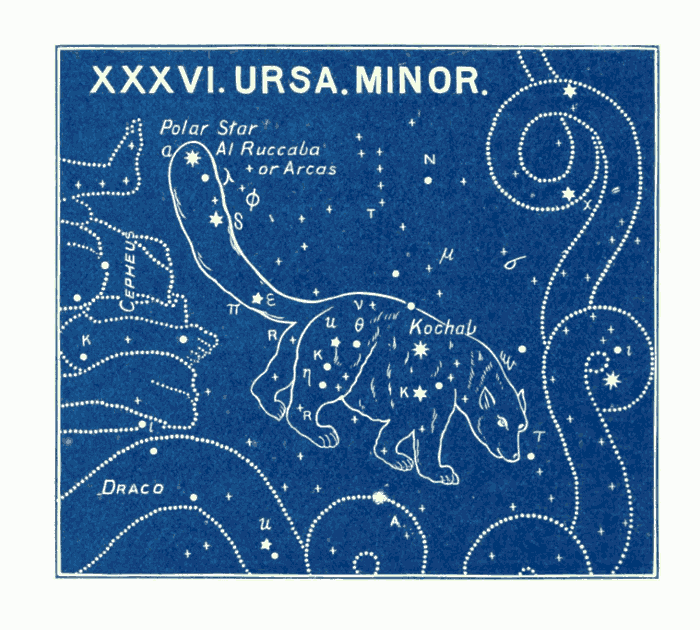
The constellation, which we must therefore call the lesser sheepfold, contains 24 stars, viz., one of the 2nd magnitude, two of the 3rd, four of the 4th, etc.
The brightest star, α (at the point of the tail), is the most important in the whole heavens. It is named Al Ruccaba, which means the turned or ridden on, and is to-day the Polar or central star, which does not revolve in a circle as does every other star, but remains, apparently, fixed in its position. But though the star does not revolve like the others, the central point in the heavens is very slowly but steadily moving. When these constellations were formed the Dragon possessed this important point, and the star α, in Draco, marked this central point. But, by its gradual recession, that point is sufficiently near this star Ruccaba, in the Lesser Sheepfold, for it to be what is called “the Polar Star.” But, how could this have been known five or six thousand years ago? How could it have been known when it received its name, which means the turned or ridden on? That it was known is clear: so likewise was it made known in the written Word that the original blessing included not merely the multiplication of the seed of faithful Abraham, but it was then added, “And thy seed shall possess the gate of his enemies” (Gen. xxii. 17).
This star was called by the Greeks Κυνόσουρα, the “Cynosure.” Aratus seems to apply this term to the whole of the seven stars of the Lesser Bear. Mr. Robert Brown, Junr., shows that Κυνόσουρα, once supposed to be Hellenic, is non-Hellenic, and possibly Euphratean in origin, from a word which he transliterates An-nas-sur-ra, and renders it, “as it literally means, high in rising, i.e., in heavenly position.” Is not this the primitive truth of the Revelation? Will not this Lesser Fold be high, yea, the highest in heavenly position?
The Polar Star has been removed from the Dragon, and is now in the Lesser Fold; and when the Dragon shall be cast down from the heavens, the heavenly seed will be safely folded there. But this is the Lesser Sheepfold. These are they who all through the ages have been “partakers of the heavenly calling,” who desired a better country, that is, a heavenly; wherefore God “hath prepared for them a city,” the city for which Abraham himself “looked.” This was no earthly city, but a city “whose builder and maker is God” (Heb. xi. 10-16). These have always been a smaller company, a “little flock,” but the kingdom shall be theirs, even the kingdom of God, for which they now look and wait. They have not yet “received the promises; but, having seen them afar off” by faith, they “were persuaded of them, and embraced them, and confessed that they were strangers and pilgrims on the earth” (Heb. xi. 13). Their Messiah has accomplished “the redemption of the purchased possession,” and in due time the redeemed will inherit it, “unto the praise of His glory” (Eph. i. 13).
The bright star β is named Kochab, which means waiting Him who cometh. Other stars, not identified, are named Al Pherkadain (Arabic), which means the calves, or the young (as in Deut. xxii. 6), the redeemed assembly. Another, Al Gedi, means the kid. Another is Al Kaid, the assembled; while Arcas, or Arctos (from which we derive the term Arctic regions), means, according to one interpreter, a travelling company; or, according to another, the stronghold of the saved.
But there is not only the heavenly seed, which is compared “to the stars of heaven,” but there is the seed that is compared to “the sand of the sea”—the larger flock or company, who will enjoy the earthly blessing.
This brings us to— URSA MAJOR (The Great Bear).

 articlesforchristians
Comments on: "Witness of the Stars: URSA MINOR (The Little Bear)" (1)
[…] URSA MINOR (The Little Bear) […]