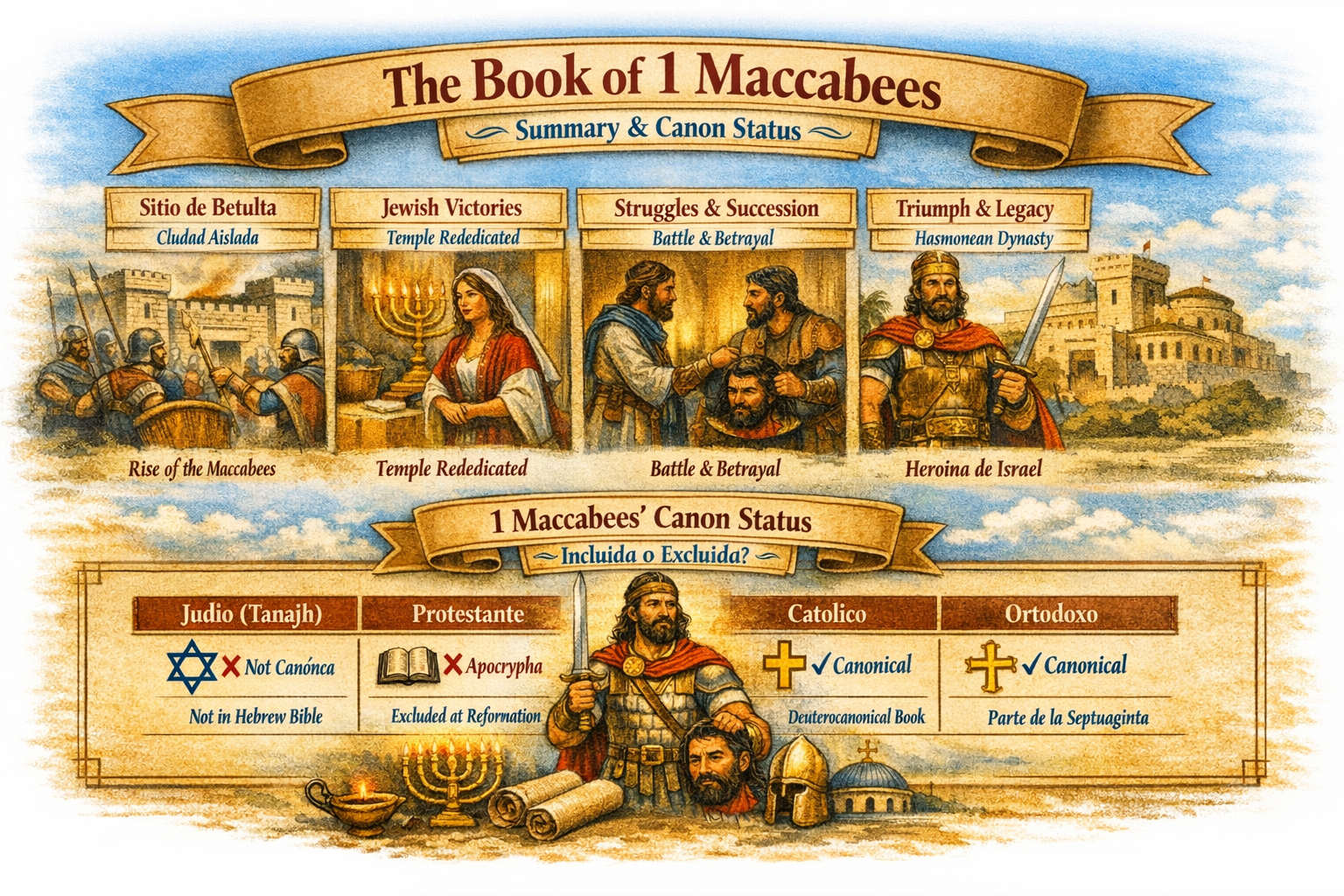
📘 Outline of the Book of 1 Maccabees (16 Chapters)
Setting: Judea under Seleucid rule, 175–134 BCE
Themes: Covenant Faithfulness, Armed Resistance, Divine Providence
I. Persecution and Revolt (Ch. 1–2)
- King Antiochus IV Epiphanes bans Jewish practices and desecrates the Temple
- Mattathias, a priest, refuses to sacrifice to idols and sparks a revolt
- His son Judas Maccabeus takes leadership after Mattathias’s death
II. Victories and Temple Rededication (Ch. 3–4)
- Judas wins battles against larger Seleucid forces
- He cleanses and rededicates the Temple — origin of Hanukkah
- Key verse: “We fight for our lives and our laws.” — 1 Maccabees 3:21
III. Continued Struggles and Diplomacy (Ch. 5–9)
- Judas defends Jewish communities and seeks alliances (Rome, Sparta)
- He dies in battle; his brother Jonathan succeeds him
- Jonathan combines military leadership with diplomacy
IV. Rise of Simon and Jewish Independence (Ch. 10–13)
- Simon, the third brother, becomes High Priest and ruler
- Judea gains political independence under the Hasmonean dynasty
V. Final Reflections and Legacy (Ch. 14–16)
- Simon’s leadership praised; his son John Hyrcanus succeeds him
- The book ends with a record of victories and treaties
📜 Canon Status: Why 1 Maccabees Is Included or Excluded
✡️ Jewish Canon (Tanakh) — ❌ Not included
- Not part of the final Hebrew Bible
- Considered historically valuable but not inspired
- Possibly excluded due to its pro-Hasmonean tone and lack of prophetic or theological depth
- Rabbinic Judaism later distanced itself from the Hasmonean dynasty
✝️ Protestant Canon — ❌ Not included
- Considered Apocrypha: historically valuable but not inspired
- Excluded during the Reformation, which returned to the Hebrew canon
- Often printed in a separate section in older Protestant Bibles
✝️ Catholic Canon — ✔️ Included
- Recognized as Deuterocanonical, affirmed at the Council of Trent (1546)
- Celebrated for its historical reliability and witness to Jewish faithfulness
- Used in liturgy and teaching, especially around Hanukkah
✝️ Eastern Orthodox Canon — ✔️ Included
- Included in the Septuagint, the Greek Bible used by early Christians
- Accepted as Scripture, often alongside 2–4 Maccabees
- Honored for its historical and spiritual significance
🕊️ Summary Chart
| Tradition | 1 Maccabees Status | Reason |
|---|---|---|
| Jewish | ❌ Not Canon | Not in Hebrew Bible; pro-Hasmonean |
| Protestant | ❌ Apocrypha | Excluded at Reformation |
| Catholic | ✔️ Canonical | Deuterocanonical; affirmed at Trent |
| Orthodox | ✔️ Canonical | Part of Septuagint tradition |
