What was the Treaty of Versailles?
Big idea:
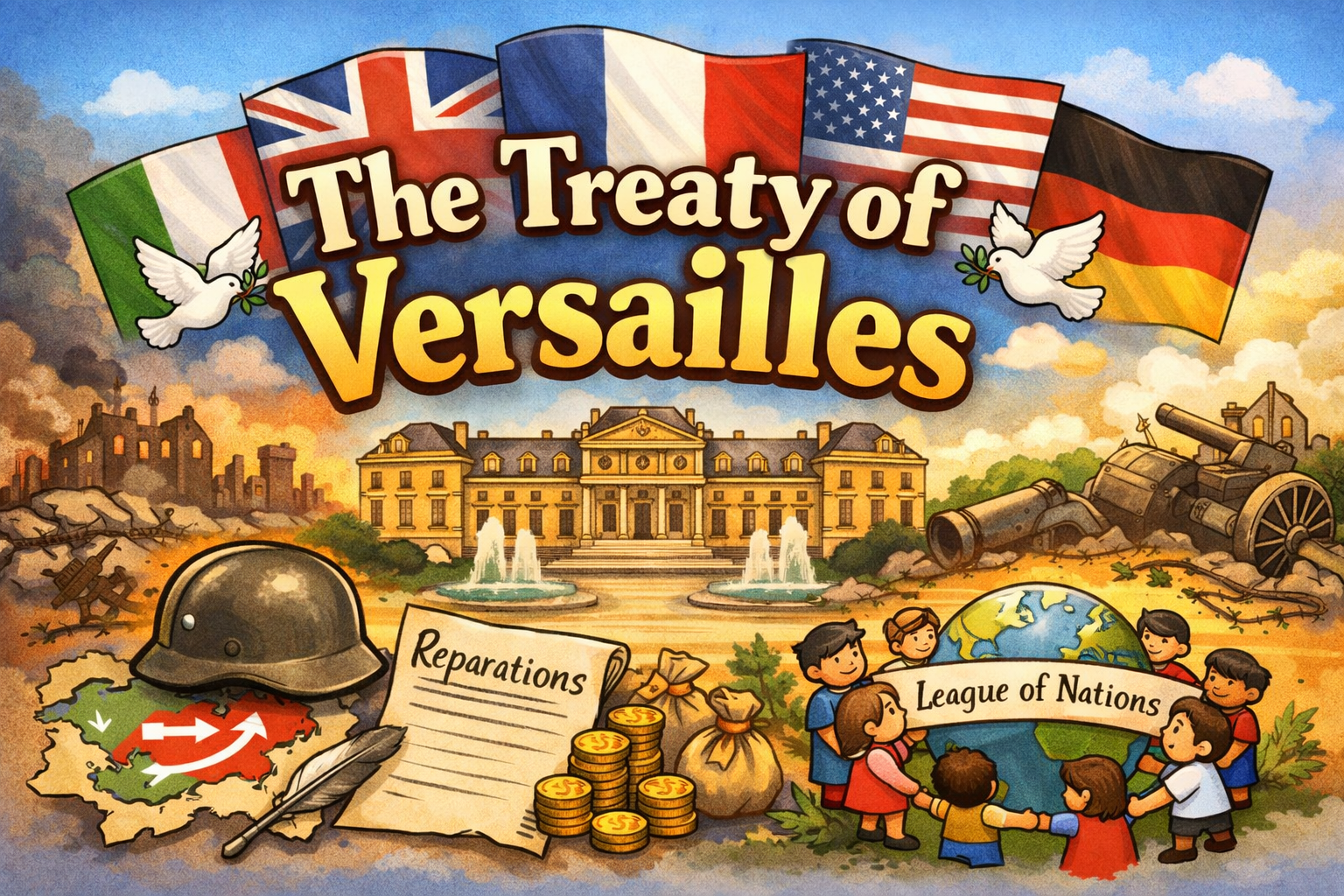
The Treaty of Versailles was a peace agreement made after World War I. It was signed on June 28, 1919, at the Palace of Versailles in France. It officially ended the war between Germany and the countries that had fought against it.
What it did to Germany (in simple terms):
- Less land:
Germany had to give some of its land to other countries, like France and a newly re-formed Poland. It also lost all its colonies far away in Africa and the Pacific. - Smaller army:
Germany’s army and navy were made much smaller. It was not allowed to have certain weapons or soldiers in some areas near France (a “demilitarized zone” in the Rhineland). - Paying money (reparations):
Germany had to pay a lot of money to the winning countries to help repair the damage from the war. - Blamed for the war:
A part of the treaty, called the “war guilt clause,” said that Germany had to accept responsibility for causing the war and the damage it brought. - New world group:
The treaty also helped create a group of countries called the League of Nations, which was supposed to help prevent future wars.
Who made the treaty?
People sometimes talk about the “Big Four” leaders at the peace meeting:
- France: Georges Clemenceau
- Britain: David Lloyd George
- United States: Woodrow Wilson
- Italy: Vittorio Orlando (he was there, but had less power in the final decisions)
They did not let Germany help write the treaty. Germany was only invited to sign it at the end.
How did different countries feel about the treaty?
Think of it like this: after a huge, terrible fight, everyone wanted peace—but they did not agree on what “fair” looked like.
Germany
- Feelings:
Germany felt angry, embarrassed, and hurt. Many Germans thought the treaty was unfair and too harsh. They called it a “diktat,” meaning a peace forced on them without a real choice. - Why they were upset:
- They lost land and colonies.
- Their army was cut down.
- They had to pay a lot of money.
- They were blamed for the whole war.
For many Germans, it felt like being punished in a way that would be hard to recover from.
France
- Feelings:
France was mostly pleased that the treaty was tough on Germany. France had suffered terribly in the war—many battles were fought on French land, and many French people died. - What France wanted:
- To make sure Germany could not attack France again.
- To get back land it had lost before (like Alsace-Lorraine).
- To get money and coal to help rebuild.
So, France liked the strong limits on Germany’s army and the parts of the treaty that gave France land and resources.
Britain
- Feelings:
Britain had mixed feelings. At first, many British people wanted Germany to “pay” for the war. But some leaders worried that if the treaty was too harsh, it might cause problems later. History Hit - What Britain wanted:
- To keep peace in Europe.
- To protect its own empire and trade.
- To make sure Germany was not too strong—but also not so weak that Europe became unstable.
Over time, some British leaders began to think the treaty might have been too strict on Germany.
United States
- Feelings:
The U.S. president, Woodrow Wilson, wanted a “fair and lasting peace.” He had ideas called the “Fourteen Points,” which were meant to make the world more peaceful and fair. He liked the idea of the League of Nations. - What happened in the U.S.:
Even though Wilson helped write the treaty, the U.S. Senate (the group that must approve treaties) refused to accept it. Many Americans did not want to be tied into European problems through the League of Nations. So the United States never officially joined the League and made its own separate peace with Germany later.
So, the U.S. helped design the treaty but did not fully agree with how it turned out or with joining the new world organization.
Italy
- Feelings:
Italy fought on the winning side and expected to gain a lot of land as a reward. But at the peace conference, Italy did not get as much territory as it had hoped. Its leader, Vittorio Orlando, felt ignored by the other big powers. - Result:
Many Italians felt disappointed and angry, thinking their sacrifices in the war were not properly rewarded.
Japan
- Feelings:
Japan was also on the winning side and gained some of Germany’s colonies in Asia and the Pacific. However, Japan wanted more recognition and tried to include a “racial equality” clause in the League of Nations rules, which was not accepted. - Result:
Japan felt partly satisfied (it got some land) but also frustrated that it was not treated as equal to the European powers.
Why does the Treaty of Versailles matter?
- Short-term:
It ended World War I and tried to set up a new world system with the League of Nations. - Long-term:
Because Germany felt so angry and hurt by the treaty, and because some countries were disappointed or disagreed with parts of it, the peace did not last. Many historians believe that the anger and problems caused by the treaty helped create the conditions that later led to World War II.
A simple way to picture it
Imagine a classroom fight where:
- One student (Germany) is blamed for starting it.
- The teacher (the winning countries) takes away that student’s toys (land and colonies), makes them pay for broken things (reparations), and says they can’t bring certain things to school anymore (weapons and a big army).
- Some classmates (France) feel safer and think, “Good, now they can’t hurt us again.”
- Others (Britain and the U.S.) worry, “If we punish them too much, they might get really angry later.”
- A couple of students who helped stop the fight (Italy and Japan) feel like they didn’t get enough thanks or rewards.
The Treaty of Versailles was like that: it ended the fight, but it left a lot of hurt feelings that didn’t just disappear.
