A Teaching Article
Introduction: The God Who Calls His People to Remember
From Genesis to Revelation, God repeatedly commands His people to remember.
Not to remember heroes, not to remember human achievements, but to remember His works, His covenant, His warnings, and His Son.
This theme reaches a beautiful climax in Hebrews 12:1, where the writer calls us to run our race “surrounded by so great a cloud of witnesses.”
This is not a call to memorialize people — it is a call to remember their testimony so that we can walk faithfully with God.
1. Remembering God’s Works
Deuteronomy 8:2
“And thou shalt remember all the way which the LORD thy God led thee…”
God commands His people to remember His actions — His leading, His provision, His discipline.
Why? Because forgetfulness leads to pride, and pride leads to wandering.
Remembering God’s works keeps the heart soft, humble, and grateful.
2. Remembering God’s Deliverance
Exodus 12:14
“This day shall be unto you for a memorial…”
Passover was not a memorial to Moses or to Israel’s bravery.
It was a memorial to God’s saving power — the night He redeemed His people with an outstretched arm.
Biblical remembering always points upward, never sideways.
3. Remembering God’s Miracles
Joshua 4:6–7
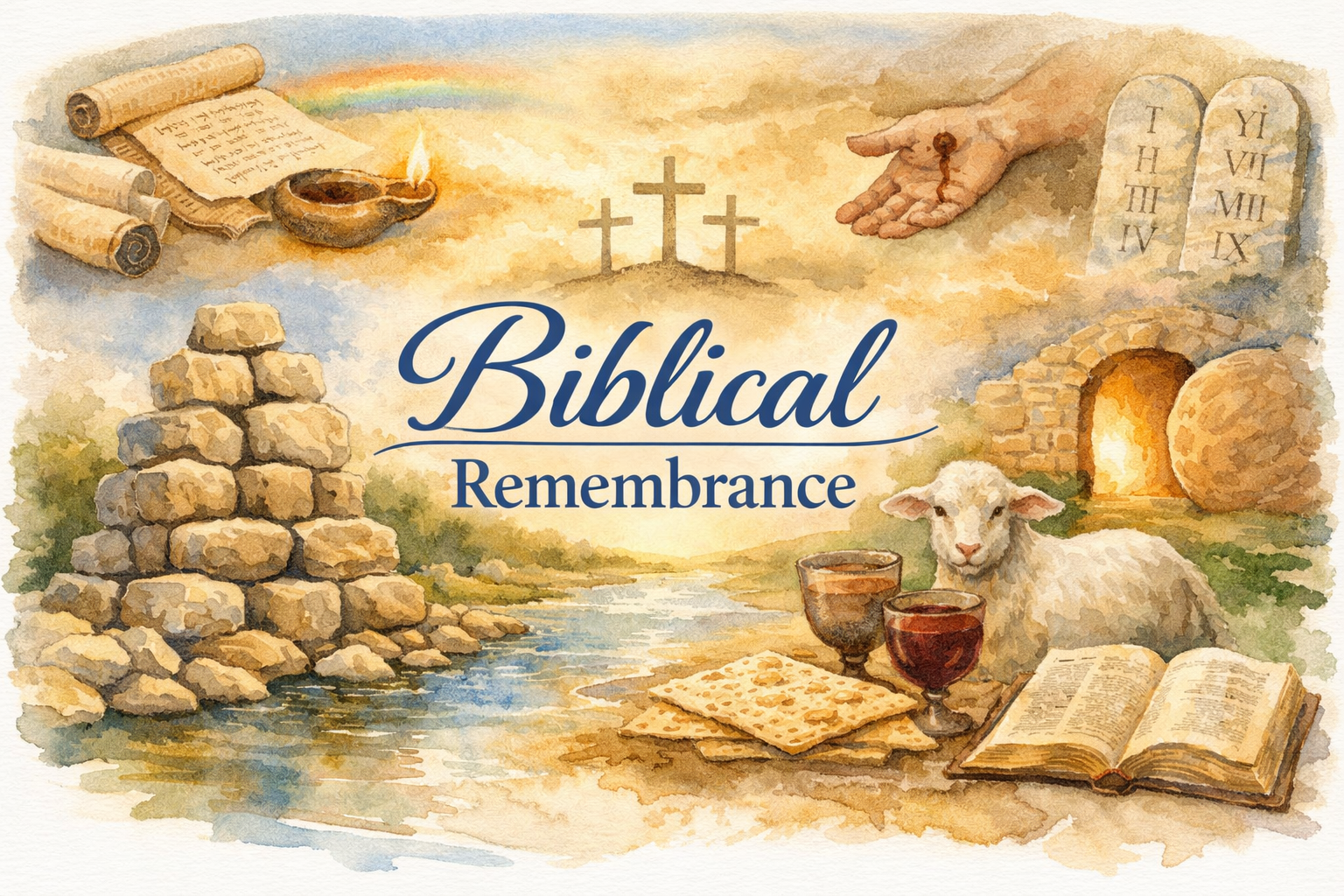
The twelve stones taken from the Jordan River were a physical reminder of God’s miracle.
They were designed to provoke questions:
“What mean ye by these stones?”
And the answer was always:
“The LORD cut off the waters.”
The stones testified to God, not to the people who walked through.
4. Remembering God’s Covenant
Leviticus 26:42
“Then will I remember my covenant…”
When Scripture says God “remembers,” it means He acts faithfully toward His promises.
This teaches us to remember His covenant faithfulness, not human achievement.
God’s remembering is always tied to His mercy.
5. Remembering God’s Warnings
Luke 17:32
“Remember Lot’s wife.”
This is not a memorial to her — it is a warning against divided hearts.
Her story becomes a spiritual caution sign.
Remembering protects us from repeating destructive choices.
6. Remembering Jesus Christ
2 Timothy 2:8
“Remember that Jesus Christ… was raised from the dead.”
This is the center of Christian remembering — the risen Christ, the heart of the gospel.
All biblical remembering ultimately leads to Him.
7. Remembering Christ’s Sacrifice
Luke 22:19
“This do in remembrance of Me.”
The Lord’s Supper is the only remembrance Jesus Himself instituted.
It is Christ-centered, cross-centered, resurrection-centered.
It is not a remembrance of apostles, saints, or heroes — only of Christ.
8. Hebrews 12:1 — The Cloud of Witnesses and the Race of Faith
Hebrews 12:1
“Wherefore seeing we also are compassed about with so great a cloud of witnesses…”
This verse does not teach that people in heaven are watching us.
The Greek word martys (“witness”) means one who testifies — not one who observes.
The “cloud of witnesses” refers to the faithful men and women listed in Hebrews 11.
Their lives bear witness to God’s faithfulness.
They are like the memorial stones in Joshua 4 —
living testimonies that remind us:
- God keeps His promises
- Faith is worth it
- Endurance is possible
- The race can be finished
The verse then gives three commands:
1. Lay aside every weight
Anything that slows spiritual progress — distractions, habits, fears.
2. Lay aside the sin that clings so closely
Sin entangles; remembering God’s faithfulness frees.
3. Run with endurance the race set before us
The witnesses do not watch us —
they inspire us.
Their stories are memorials of God’s power, urging us to keep going.
What All Biblical Remembering Has in Common
Across Scripture, God commands His people to remember:
- His works
- His deliverance
- His covenant
- His warnings
- His Son
But never does God command His people to create memorial days for human figures.
The remembering God commands is always:
- God-centered
- Faith-strengthening
- Testimony-building
- Generational
- Christ-focused
Hebrews 12:1 fits perfectly into this pattern:
We remember the faith of those who came before — not to honor their names, but to imitate their trust in God.
Conclusion: Remembering That Leads to Faithfulness
Biblical remembering is not nostalgia.
It is not human-centered.
It is not ritualistic.
It is spiritual fuel.
It anchors us in God’s character, God’s works, and God’s promises.
It strengthens us to run the race with endurance.
It keeps our eyes fixed on Jesus — the Author and Finisher of our faith.
