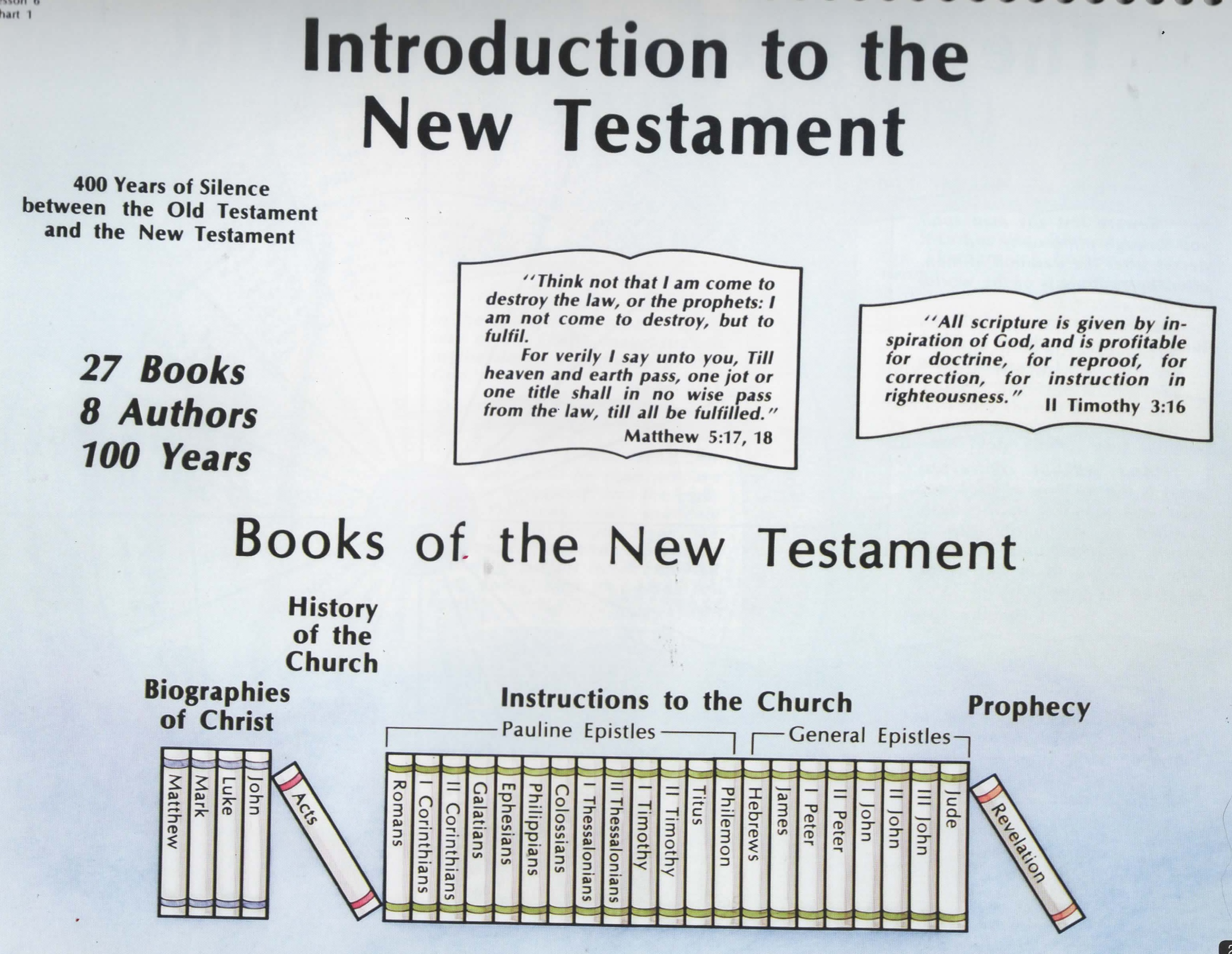
Introduction to the New Testament
- The books from Matthew through Revelation are called the New Testament because they represent the new covenant that Jesus made.
- There are twenty-seven books in the New Testament
- These books were written by eight authors over a period of about 50 years and cover about
100 years of history. - The New Testament is divided into five sections: The four Gospels, one book of history, the
thirteen Pauline Epistles, the eight General Epistles, and one book of prophecy
It is vitally important to recognize the purpose of each book and to whom it was originally
addressed. This helps to interpret scripture. - The first four books: Matthew, Mark, Luke, and John describe the death burial, and resurrection of Jesus Christ.
MATTHEW
- The book of Matthew addresses the Jewish readers foremost.
- It strongly emphasizes Jesus Christ as the Messiah and king predicted in the Old Testament prophets.
MARK
- Mark was written for the gentile readers in mind.
- It presents Jesus as a servant who ministered to the needs of the people.
- It stresses the supernatural power of Jesus, demonstrating His deity by the miracles he performed.
- It emphasizes the things Jesus said by the things He did.
LUKE
- Luke presents Jesus as the Son of God.
- It focuses especially on the humanity of Jesus, featuring His compassion for the weak, the suffering and outcast.
THE SYNOPTIC GOSPELS
- syn-op-tic also syn-op-ti-cal adj. 1. Of or constituting a synopsis: presenting a summary of the principal parts or a general view of the whole.
- The first three gospels are sometimes called the Synoptic Gospels, meaning that they take a
common view of the order of events surrounding the life of Christ.- Matthew had the Jews in mind
- Mark the Romans
- Luke the Greek
- Matthew and Scripture
- The Jews were diligently indoctrinated in the Scriptures.
- They were taught to view everything from the scripture perspective.
- Matthew quotes from the Old Testament again and again in support of the claim that Jesus is the Messiah.
- Mark and Authority
- The Roman mind focused on government authority and power.
- Mark stresses the miracles of Christ, emphasizing His supernatural authority over all things.
- Luke and the Glorious Perfection of Jesus
- The Greek mind was attracted to culture, philosophy, wisdom, reason, beauty, and education.
- Luke presents a complete, orderly, and classical story in what has been called, “the most beautiful book ever written.”
- The Gospel of Luke reveals the glorious beauty and perfection of the ideal man, the Lord Jesus Christ.
JOHN AND THE DEITY OF JESUS
- John balances the other three Gospels by its special emphasis on the deity of Jesus.
- The book begins in much the same way as the Book of Genesis. It reveals that Jesus Christ is the Word made flesh and that He was from the very beginning God, the Creator of all
things- Timothy 3:16 (KJV) And without controversy great is the mystery of godliness: God was
manifest in the flesh, justified in the Spirit, seen of angels, preached unto the
Gentiles, believed on in the world, received up into glory, - Colossians 1:12-20 (KJV) Giving thanks unto the Father, which hath made us meet to be partakers of the inheritance of the saints in light: Who hath delivered us from the power of darkness, and hath translated us into the kingdom of his dear Son: In whom we have redemption through his blood, even the forgiveness of sins: Who is the image of the invisible God, the firstborn of every creature: 16 For by him were all things created, that are in heaven, and that are in earth, visible and invisible. whether they be thrones, or dominions, or principalities, or powers: all things were created by him, and for him: And he is before all things, and by him all things consist. And he is the head of the body, the church: who is the beginning, the firstborn from the dead; that in all things he might have the preeminence. 19 For it pleased the Father that in him should all fulness dwell; And, having made peace through the blood of his cross, by him to reconcile all things unto himself; by him, I say, whether they be things in earth, or things in heaven.
- Matthew 22:32 (KJV) I am the God of Abraham, and the God of Isaac, and the God of Jacob? God is not the God of the dead, but of the living.
- John 14:9 (KJV) Jesus saith unto him. Have I been so long time with you, and yet hast thou not known me, Philip? he that hath seen me hath seen the Father, and how sayest thou then, Show us the Father?
- James 2:19 (KJV) Thou believest that there is one God; thou doest well: the devils also believe, and tremble.
- Mark 12:29 (KJV) And Jesus answered him, The first of all the commandments is, Hear, O Israel; The Lord our God is one Lord:
- Timothy 3:16 (KJV) And without controversy great is the mystery of godliness: God was
ACTS HISTORY OF THE EARLY CHURCH
- The book of Acts provides a historical account of the early church.
- The first chapter continues with the last moments of Christ while He remained on earth and
then records the establishment of the New Testament church in Jerusalem.
There the promise of the Holy Ghost was poured out upon the waiting. - To understand how the church was founded and how the people entered into the early
church it is necessary to study the Book of Acts.
THE EPISTLES
- The next twenty-one books (Romans – Jude) are epistles (formal letters) telling the new
Christians how to live the victorious life. - The epistles are not written to tell one how to be saved; they are written to people who are
already saved. They teach how to stay saved and how to grow in the grace and knowledge
of the Lord Jesus Christ. - The Pauline Epistles
- Paul wrote thirteen of the twenty-one epistles. They are called the Pauline Epistles.
- He wrote a letter to the church at Rome, two letters to the church of Corinth, one letter to the churches of Galatia, one to the church of Ephesus, and so forth.
- Within the Pauline Epistles are three books commonly called the Pastoral Epistles – 1 Timothy, 2 Timothy, and Titus so called because they offer instructions concerning leadership in the churches.
- The General Epistles
- The next eight books- Hebrews, James, 1 Peter, 2 Peter, 1 John, 2 John, 3 John, and Jude –
- are called the General Epistles because they were written to the church at large.
- The next eight books- Hebrews, James, 1 Peter, 2 Peter, 1 John, 2 John, 3 John, and Jude –
PROPHECY BOOK OF REVELATION
- The Book of Revelation stands in a class by itself.
- It is largely prophetic in nature, although it begins with letters to seven churches in Asia Minor:
- Asia Minor is a peninsula of western Asia between the Black Sea and the Mediterranean Sea.
- It then goes on to tell what will happen in the end times. People are still in disagreement over many areas of the Book of Revelation. Many different beliefs exist as to how exactly the prophecies will be fulfilled.
- Anyone reading and studying this book, should do so carefully and with an abundance of prayer asking the Holy Ghost to help you understand the meaning of the book.
- John 16:13 But when He, the Spirit of Truth, comes, He will guide you into all the truth [full and complete truth]. For He will not speak on His own initiative, but He will speak whatever He hears [from the Father—the message regarding the Son], and He will disclose to you what is to come [in the future].
- The Spirit of Truth is the Holy Ghost.

One response to “Understanding the New Testament: Key Books and Authors”
[…] Introduction to the New Testament […]