A place to grow your relationship with God

Posts tagged ‘Jesus’

Por qué celebramos la Pascua: Reflexiones sobre el sacrificio de Jesús

Cada año celebramos la Pascua. Al pensar en la Pascua, nos vienen a la mente muchas cosas. Sin embargo, me pregunto si la razón más importante para celebrar la Pascua ocupa el primer lugar en su lista. La Pascua debería ser un tiempo de reflexión. Deberíamos pensar en lo que Jesús hizo antes, durante y después de la crucifixión. Algunas de sus obras más importantes se realizaron durante este período.
  1. Él cumplió con el requisito de la Pascua.
    • Se requería un cordero sin mancha para expiar el pecado. Él pagó el precio de forma permanente. Juan 1:29 “Al día siguiente, vio a Jesús que venía hacia él, y dijo: «¡He aquí el Cordero de Dios, que quita el pecado del mundo!»”
  2. Él cambió la forma en que se celebra la Pascua.
    • 1 Corintios 11:24-26 “y habiendo dado gracias, lo partió y dijo: «Tomad, comed; esto es mi cuerpo que por vosotros es partido; haced esto en memoria de mí». Asimismo, tomó también la copa después de haber cenado, diciendo: «Esta copa es el nuevo pacto en mi sangre; haced esto todas las veces que la bebáis, en memoria de mí». Porque todas las veces que comáis este pan y bebáis esta copa, anunciáis la muerte del Señor hasta que él venga.”
  3. Él quitó el miedo a la muerte.
    • 1 Corintios 15:54-57 “Cuando esto corruptible se haya vestido de incorruptibilidad, y esto mortal se haya vestido de inmortalidad, entonces se cumplirá la palabra que está escrita: «La muerte ha sido devorada por la victoria». «¿Dónde está, oh muerte, tu aguijón? ¿Dónde, oh sepulcro, tu victoria?» El aguijón de la muerte es el pecado, y el poder del pecado es la ley. Pero gracias sean dadas a Dios, que nos da la victoria por medio de nuestro Señor Jesucristo.”
  4. Por sus llagas (golpes), somos sanados.
    • 1 Pedro 2:24 “quien llevó él mismo nuestros pecados en su cuerpo sobre el madero, para que nosotros, estando muertos a los pecados, vivamos a la justicia; y por cuyas llagas fuisteis sanados.”
    • Isaías 53:5 “Mas él fue herido por nuestras rebeliones, molido por nuestros pecados; el castigo de nuestra paz fue sobre él, y por su llaga fuimos nosotros curados.”
  5. A través de él, podemos acercarnos con confianza al trono de la gracia.
    • Hebreos 4:16 “Acerquémonos, pues, confiadamente al trono de la gracia, para alcanzar misericordia y hallar gracia para el oportuno socorro.”
  6. En la mañana de la resurrección, él resucitó. Ahora podemos tener vida eterna a través de él.
    • Juan 3:16: “Porque de tal manera amó Dios al mundo, que ha dado a su Hijo unigénito, para que todo aquel que en él cree, no se pierda, mas tenga vida eterna.”

Mientras preparan las celebraciones de Pascua, recuerden que no habría Pascua sin la obra de Jesús. Guiemos a otros hacia Jesús, poniéndolo en primer lugar en todas nuestras celebraciones.
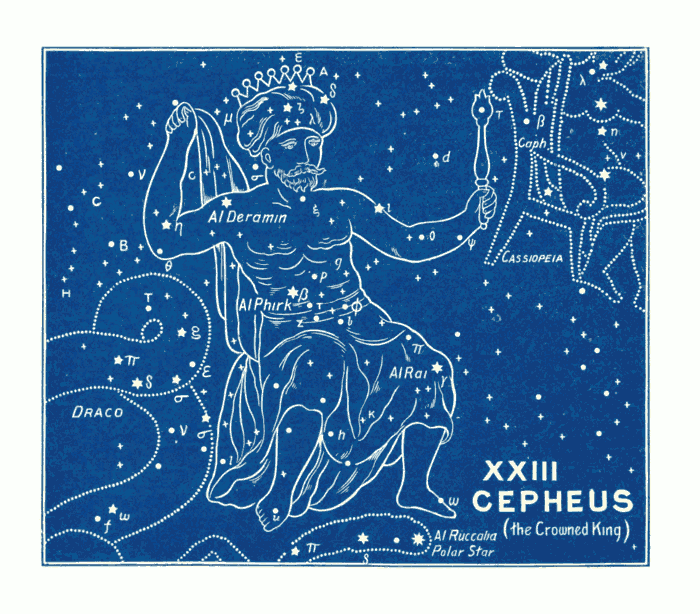

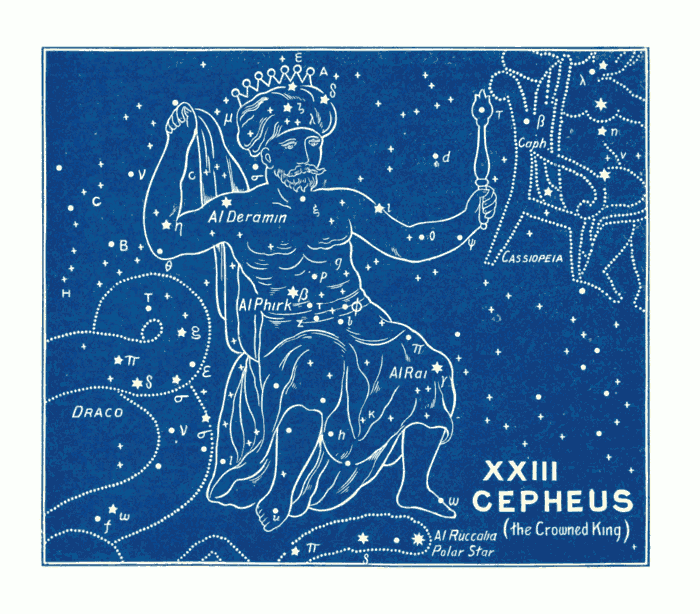
Witness of the Stars: CEPHEUS (The King)

3. CEPHEUS (The King)

Their Redeemer Coming to Rule.

Here we have the presentation of a glorious king, crowned, and enthroned in the highest heaven, with a sceptre in his hand, and his foot planted on the very Polar Star itself.

His name in the Denderah Zodiac is Pe-ku-hor, which means this one cometh to rule.

Plate 23: CEPHEUS (the Crowned King)

The Greek name by which he is now known, Cepheus, is from the Hebrew, and means the branch, and is called by Euripides the king.

An old Ethiopian name was Hyka king.

There are 35 stars, viz., three of the 3rd magnitude, seven of the 4th, etc.

The brightest star, α (in the left shoulder), is called Al Deramin, which means coming quickly. The next, β (in the girdle), is named Al Phirk (Arabic), the Redeemer. The next, γ (in the left knee), is called Al Rai, which means who bruises or breaks.

It is impossible to mistake the truth which these names teach. The Greeks, though they had lost it, yet preserved a trace of it, even in their perversion of it; for they held that Cepheus was the father of Andromeda, and that Perseus was her husband.

Yes; this is the glorious King of Israel, the “King of kings, and Lord of lords.” It is He who calls Israel His “son,” and will yet manifest it to all the world.

In Jer. xxxi., after speaking of Israel’s restoration, Jehovah says (v. 1):—

“At the same time, saith the Lord, will I be the God of all the families of Israel,

And they shall be My people….

For I am a father to Israel,

And Ephraim is My firstborn”

(v. 9).

As He said to Moses: “Thus saith the Lord, Israel is my son, even my firstborn” (Exod. iv. 22).

Here is the foundation of Israel’s blessing. True, it is now in abeyance, but “the Lord reigneth,” and will in due time make good His Word, for

“The counsel of the Lord standeth for ever.

The thoughts of His heart to all generations.”

(Ps. xxxiii. 11.)

This leads us up to the last chapter of the Second Book, which shows us the fulfilment of all the prophecies concerning the Redeemed and the sure foundation on which their great hope of glory is based.

Understanding Biblical Warnings Against Superstitions

One of the commandments in the Old Testament is a command telling us not to be superstitious.

Leviticus 19:26

  • KJV
    • Ye shall not eat anything with the blood: neither shall ye use enchantment, nor observe times.
  • Amp version
    • ‘You shall not eat anything with the blood, nor practice divination [using omens or witchcraft] or soothsaying.
  • Complete Jewish Bible
    •  “‘Do not eat anything with blood. Do not practice divination or fortune-telling.
  •  Christian Standard Bible
    • “You are not to eat anything with blood in it. You are not to practice divination or witchcraft.

Vocabulary words:

  • superstitious
    • of, relating to, or swayed by superstition
    • superstitious ritual
  • observe tmes
    • עָנַן ʻânan, aw-nan’; a primitive root; to cover; used only as a denominative from H6051, to cloud over; figuratively, to act covertly, i.e. practise magic:—× bring, enchanter, Meonemin, observe(-r of) times, soothsayer, sorcerer.
  • enchantment
    • נָחַשׁ nâchash, naw-khash’; a primitive root; properly, to hiss, i.e. whisper a (magic) spell; generally, to prognosticate:—× certainly, divine, enchanter, (use) × enchantment, learn by experience, × indeed, diligently observe.

Here are some more verses about superstitions.

  • 1 Timothy 4:7 ESV
    • Have nothing to do with irreverent, silly myths. Rather train yourself for godliness;
  • Deuteronomy 18:10-12 ESV
    • There shall not be found among you anyone who burns his son or his daughter as an offering, anyone who practices divination or tells fortunes or interprets omens, or a sorcerer or a charmer or a medium or a necromancer or one who inquires of the dead, for whoever does these things is an abomination to the Lord. And because of these abominations the Lord your God is driving them out before you.
  • Leviticus 19:31 ESV
    • “Do not turn to mediums or necromancers; do not seek them out, and so make yourselves unclean by them: I am the Lord your God.
  • Colossians 2:8-10 ESV
    • See to it that no one takes you captive by philosophy and empty deceit, according to human tradition, according to the elemental spirits of the world, and not according to Christ. For in him the whole fullness of deity dwells bodily, and you have been filled in him, who is the head of all rule and authority.
  • 1 Timothy 1:3-4 ESV
    • As I urged you when I was going to Macedonia, remain at Ephesus so that you may charge certain persons not to teach any different doctrine, nor to devote themselves to myths and endless genealogies, which promote speculations rather than the stewardship from God that is by faith.

We are called to walk by faith in the knowledge of our savior Jesus Christ. We are commanded in both the Old and New Testament to avoid all things connected with superstition. Superstitious actions are connected with witchcraft and idolatry. When you put your trust in anything or ritual you are not fully trusting in God.


Common superstitions include beliefs like avoiding black cats, not walking under ladders, and throwing salt over your shoulder, often rooted in cultural traditions and historical fears.


Popular Superstitions

  • Walking Under a Ladder: Considered bad luck, this superstition stems from the triangular shape formed by a ladder against a wall, which was seen as sacred in ancient cultures. Breaking this triangle was thought to invite misfortune.
  • Black Cats: In many Western cultures, a black cat crossing your path is seen as a sign of bad luck, often associated with witchcraft. However, in some cultures, black cats are considered good luck.
  • Breaking a Mirror: This superstition suggests that breaking a mirror brings seven years of bad luck, as mirrors were once believed to reflect not just one’s image but also one’s soul.
  • Throwing Salt Over Your Shoulder: Spilling salt is thought to bring bad luck, but tossing a pinch over your left shoulder is believed to ward off evil spirits lurking there.
  • Opening an Umbrella Indoors: This is considered bad luck, possibly due to the practical dangers of opening an umbrella in a confined space, which could cause accidents.
  • Friday the 13th: Many people consider this day to be unlucky, stemming from various historical and cultural beliefs about the number 13 and its associations with misfortune.
  • Avoiding the Number 13: Many buildings skip the 13th floor, and some people avoid the number altogether due to its negative connotations in various cultures.
  • Never Stick Chopsticks Upright: In China and Japan, sticking chopsticks upright in rice is a taboo, as it resembles incense sticks used at funerals, inviting death.
  • Beginner’s Luck is a “Thing”: “Beginner’s luck” is the idea that people new to a sport or game are likely to win when they try it out for the first time. It could very well be that beginners simply do better because they aren’t as stressed out about winning. Experts say that too much anxiety can hamper performance.
  • Knock on Wood or “Touch Wood” To Prevent Bad Luck
    • Druids and Pagan cultures believed that knocking on wood would enlist the help of tree gods.
    • You have probably performed this ritual a thousand times: You just finished the sentence that you never get sick, or that your car never breaks down, then you immediately search for something that’s made of wood so you can give it a few taps with your knuckles.
    • There are several theories of where this originated, but most agree that this belief started with the Druids. Their idea of divinity involved nature and the trees were their gods. Knocking on wood was considered a form of physical contact with them, which brought along good fortune. Most Pagan cultures around the ancient world also believed that trees were inhabited by spirits, so it was thought that by simply knocking on the bark of a tree, you could stir the aid of the nature spirit residing within. It’s unlikely that knocking on wood does little more than send people to the front door looking for the pizza guy.
  • Crossing Your Fingers Brings Good Luck
    • Ever wish or hope for something and then cross your fingers? The reason for this was that it is believed that bad luck is trapped at the point where the two fingers meet so when we cross our fingers, we stop the bad luck from escaping and allow our wishes to come true. Not very likely, but it’s still one we almost all practice.


If you are guilty of any of these, repent today. We are called to follow God not superstitions.

Explorando los nueve atributos del fruto del Espíritu

El fruto del Espíritu no se refiere a frutas literales, sino a nuestras acciones y comportamiento.

Galatians 5:22-23 

Mas el fruto del Espíritu es amor, gozo, paz, paciencia, benignidad, bondad, fe, mansedumbre, templanza; contra tales cosas no hay ley.

  • Amor: Debemos mostrar amor a todos, incluyendo a nuestros enemigos. Mateo 5:43-48 – Habéis oído que se dijo: Amarás a tu prójimo y aborrecerás a tu enemigo. Pero yo os digo: Amad a vuestros enemigos, bendecid a los que os maldicen, haced bien a los que os aborrecen, y orad por los que os ultrajan y os persiguen; para que seáis hijos de vuestro Padre que está en los cielos; porque él hace salir su sol sobre malos y buenos, y hace llover sobre justos e injustos. Porque si amáis a los que os aman, ¿qué recompensa tenéis? ¿No hacen también lo mismo los publicanos? Y si saludáis solamente a vuestros hermanos, ¿qué hacéis de más que los demás? ¿No hacen también lo mismo los publicanos? Sed, pues, perfectos, como vuestro Padre que está en los cielos es perfecto.
  • Gozo: Esto no significa que estemos felices todo el tiempo. Se refiere a tener una buena actitud ante la situación. Hebreos 12:2 – Puestos los ojos en Jesús, el autor y consumador de la fe, el cual por el gozo puesto delante de él sufrió la cruz, menospreciando la vergüenza, y se sentó a la diestra del trono de Dios.
  • Paz: Esfuérzate por mantener la paz. Romanos 12:17-19 – No paguéis a nadie mal por mal. Procurad lo bueno delante de todos los hombres. Si es posible, en cuanto dependa de vosotros, vivid en paz con todos los hombres. Amados, no os venguéis vosotros mismos, sino dejad lugar a la ira de Dios; porque escrito está: «Mía es la venganza, yo pagaré, dice el Señor».
  • Paciencia: Respira hondo antes de enfadarte. Muestra amor y bondad a quienes te hacen daño. Efesios 4:2 – Con toda humildad y mansedumbre, con paciencia, soportándoos unos a otros en amor;
  • Mansedumbre: Sé amable; no seas tan brusco con todo. La mansedumbre no significa debilidad. Se necesita una persona fuerte para saber cuándo ceder. Está bien sonreír y mostrar emociones cuando algo es bonito, hermoso, dulce o bueno. Es bueno decir “Te quiero” a tu familia.
  • Bondad: Sé bueno y practica buenas obras.
  • Fe: Mantén la fe en Jesús. Hebreos 11:1: Ahora bien, la fe es la certeza de lo que se espera, la convicción de lo que no se ve.
  • Mansedumbre: Sé humilde, no te atribuyas méritos por ser mejor de lo que eres. Colosenses 3:12: Vestíos, pues, como escogidos de Dios, santos y amados, de entrañable misericordia, de benignidad, de humildad, de mansedumbre, de paciencia;
  • Templanza: Mantén la calma. Definición de templanza: 1: moderación en la acción, el pensamiento o el sentimiento: moderación 2a: moderación habitual en la satisfacción de los apetitos o las pasiones b: moderación o abstinencia en el consumo de bebidas alcohólicas

Elijah and Enoch are the two Witnesses in Revelation

Elijah and Enoch are the two Witnesses in Revelation.
There is little question that Elijah the Old Testament prophet was caught up alive to heaven and is one of the two witnesses. The second witness is regarded as either Moses or Enoch. Since it is appointed once for every man to die, the other witness must be Enoch.

  • Hebrews 9:27 And as it is appointed unto men once to die, but after this the judgment:

Enoch was the only other man in history that has never died physically. He was caught up to God at age 365 (Gen. 5:23-24).

Here is the evidence for these two being the witnesses.

Both are Old Testament Prophets
* Jude 1:14 And Enoch also, the seventh from Adam, prophesied of these, saying, Behold, the Lord cometh with ten thousands of his saints,
* 2 Chronicles 21:12 And there came a writing to him from Elijah the prophet, saying, Thus saith the Lord God of David thy father, Because thou hast not walked in the ways of Jehoshaphat thy father, nor in the ways of Asa king of Judah,
Rev. 11:10 And they that dwell upon the earth shall rejoice over them, and make merry, and shall send gifts one to another; because these two prophets tormented them that dwelt on the earth.
Both have never died physically.
Gen 5:23-24 And Enoch walked with God after he begat Methuselah three hundred years, and begat sons and daughters: And all the days of Enoch were three hundred sixty and five years:
2 Kings 2:1 And it came to pass, when the Lord would take up Elijah into heaven by a whirlwind, that Elijah went with Elisha from Gilgal.
Hebrews 9:27 And as it is appointed unto men once to die, but after this the judgment:
Elijah called fire down from heaven
2 Kings 1:10  And Elijah answered and said to the captain of fifty, If I be a man of God, then let fire come down from heaven, and consume thee and thy fifty. And there came down fire from heaven, and consumed him and his fifty.
Rev. 11:5 And if any man will hurt them, fire proceedeth out of their mouth, and devoureth their enemies: and if any man will hurt them, he must in this manner be killed.
Elijah closed the heavens for 42 months
James 5:17 (ESV) Elijah was a man with a nature like ours, and he prayed fervently that it might not rain, and for three years and six months it did not rain on the earth.
Rev. 11:3, 6 And I will give power unto my two witnesses, and they shall prophesy a thousand two hundred and threescore days, clothed in sackcloth. These have power to shut heaven, that it rain not in the days of their prophecy: and have power over waters to turn them to blood, and to smite the earth with all plagues, as often as they will.
Enoch prophesied about the Lord returning.
Jude 1:14 And Enoch also, the seventh from Adam, prophesied of these, saying, Behold, the Lord cometh with ten thousands of his saints, 
Enoch spoke about God’s Judgement
Jude 1:15 To execute judgment upon all, and to convince all that are ungodly among them of all their ungodly deeds which they have ungodly committed, and of all their hard speeches which ungodly sinners have spoken against him.
Malachi said Elijah would return.
Behold, I will send you Elijah the prophet before the coming of the great and dreadful day of the Lord:
Elijah comes before the day of the Lord.

Christ taught that Elijah must reappear and restore all things.

  • Matthew 17:11
    • And Jesus answered and said unto them, Elias truly shall first come, and restore all things.

In Jewish tradition, Elijah is expected to appear during Passover, announcing the Messiah and revealing each Jew’s tribal lineage. Today, devout Jews believe Elijah will come before the Messiah’s arrival. Alongside another prophet, he will wield great power—sending plagues, stopping rain, and calling down fire from heaven on those who reject their mission.

  • Rev. 11:6
    • These have power to shut heaven, that it rain not in the days of their prophecy: and have power over waters to turn them to blood, and to smite the earth with all plagues, as often as they will.

For forty-two months, no one can harm them, but after 1,200 days, the Antichrist will kill them.

  • Rev. 11:7
    • And when they shall have finished their testimony, the beast that ascendeth out of the bottomless pit shall make war against them, and shall overcome them, and kill them.

This takes place around the middle of the Tribulation, leading the Antichrist to halt Temple offerings

  • Dan. 9:27
    • And he shall confirm the covenant with many for one week: and in the midst of the week he shall cause the sacrifice and the oblation to cease, and for the overspreading of abominations he shall make it desolate, even until the consummation, and that determined shall be poured upon the desolate.

He seizes control of half of Jerusalem (likely Arab East Jerusalem) and forces the Jewish section into captivity, where his followers loot homes and commit atrocities.

  • Zech 14:2
    •  For I will gather all nations against Jerusalem to battle; and the city shall be taken, and the houses rifled, and the women ravished; and half of the city shall go forth into captivity, and the residue of the people shall not be cut off from the city.

The Lukewarm Church: A Warning

To the Church at Laodicea

Revelation 3:14-11

  • And unto the angel of the church of the Laodiceans write; These things saith the Amen, the faithful and true witness, the beginning of the creation of God;
  • I know thy works, that thou art neither cold nor hot: I would thou wert cold or hot.
  • So then because thou art lukewarm, and neither cold nor hot, I will spue thee out of my mouth.
  • Because thou sayest, I am rich, and increased with goods, and have need of nothing; and knowest not that thou art wretched, and miserable, and poor, and blind, and naked:
  • I counsel thee to buy of me gold tried in the fire, that thou mayest be rich; and white raiment, that thou mayest be clothed, and that the shame of thy nakedness do not appear; and anoint thine eyes with eyesalve, that thou mayest see.
  • As many as I love, I rebuke and chasten: be zealous therefore, and repent.
  • Behold, I stand at the door, and knock: if any man hear my voice, and open the door, I will come in to him, and will sup with him, and he with me.
  • To him that overcometh will I grant to sit with me in my throne, even as I also overcame, and am set down with my Father in his throne.
  • He that hath an ear, let him hear what the Spirit saith unto the churches.

History

Laodicea was located about 50 miles southeast of Philadelphia, in the Lycus River
valley near Colossae and Hierapolis (cf. Col. 4:13-16). It was also located forty miles from Ephesus and was steeped in Greek culture. The city (and region) had experienced many earthquakes over the years.

The city was a cultural center with schools, libraries, and a banking center that brought strong economic and financial resources.
Two widely used eye and ear salves were produced in the city, as it was also a well-known medical center of its day. Its name means “People Ruling,” and represents the unbelieving, materialistic church of all ages.

Notes

  • Christ is the beginning of the creation of God in the sense that He is the origin and source of God’s creation
    • Col. 1:15-18
      •  Who is the image of the invisible God, the firstborn of every creature:
      • For by him were all things created, that are in heaven, and that are in earth, visible and invisible, whether they be thrones, or dominions, or principalities, or powers: all things were created by him, and for him:
      • And he is before all things, and by him all things consist.
      • And he is the head of the body, the church: who is the beginning, the firstborn from the dead; that in all things he might have the preeminence.
  • Christ is the head of the new creation
    • 2 Cor. 5:17
      • Therefore if any man be in Christ, he is a new creature: old things are passed away; behold, all things are become new.
  • The church is likened to lukewarm water, or as being virtually worthless, Christ says He will “spew them out,” or eject them from His company.
    • The hot waters of nearby Hierapolis were known for their medicinal qualities
    • Colossae was known for its cold, pure water.
    • Laodicea was forced to receive water by aqueduct from other areas. By the time it arrived at Laodicea it was lukewarm and provoked nausea.
      • The works of the Laodicean church were as worthless as the city’s lukewarm water.
        • The description does not refer to a backslidden condition, but rather to their lack of genuine faith.
  • Laodicea was famous for its wealth, its bankers, its medical school, its popular eye salve, and its textile industry.
    • Christ says that spiritually the people of the church are poor, blind, and naked.
    • True wealth is found only in God’s grace. This church had no spiritual value (gold), virtue (white raiment), or vision (eye salve).
      • He urges the Laodiceans to repent of their lack of genuine faith and of spiritual understanding.
  • In light of the spiritual condition of the Laodiceans described in verses 17, 18, the invitation of verse 20 seems to be evangelistically addressed to individual members of an apostate church, so they might receive Christ genuinely as Savior and Lord.
    • To sup (dine) means to have fellowship (cf. ; ) and to enjoy Christ’s blessings.
      • Luke 22:30
        • That ye may eat and drink at my table in my kingdom, and sit on thrones judging the twelve tribes of Israel.
      • John 14:23
        • Jesus answered and said unto him, If a man love me, he will keep my words: and my Father will love him, and we will come unto him, and make our abode with him.
    • The promise to sit with Christ in His throne refers to reigning with Christ in His kingdom.
      • Matt. 19:28
        • And Jesus said unto them, Verily I say unto you, That ye which have followed me, in the regeneration when the Son of man shall sit in the throne of his glory, ye also shall sit upon twelve thrones, judging the twelve tribes of Israel.
      • Rev. 20:4
        • And I saw thrones, and they sat upon them, and judgment was given unto them: and I saw the souls of them that were beheaded for the witness of Jesus, and for the word of God, and which had not worshipped the beast, neither his image, neither had received his mark upon their foreheads, or in their hands; and they lived and reigned with Christ a thousand years.

Comprender la paloma como representación del Espíritu Santo

LA PALOMA: UNA IMAGEN DEL ESPÍRITU SANTO

La palomaCaracterísticas de una palomaParalelismos con el Espíritu Santo
BlancoExpresa el color de la pureza.El Espíritu Santo trae pureza.
Levítico 20:26: «Seréis santos para mí, porque yo, el Señor, soy santo, y os he apartado de las naciones para que seáis míos».
1 Tesalonicenses 4:7: «Porque Dios no nos llamó a la impureza, sino a la santidad».
CariñosoExpresa afecto acariciando y emitiendo arrullos.El Espíritu Santo trae amor y afecto.
Gálatas 5:22 Pero el fruto del Espíritu es amor, gozo, paz, paciencia, benignidad, bondad, fe,
benévoloNunca toma represalias contra sus enemigos,
cuando atacan a sus crías, no
lucha, sino que emite gritos de angustia.
No debemos vengarnos de nuestros enemigos; el Espíritu intercede en tiempos de dificultad.
Romanos 8:26 Asimismo, el Espíritu nos ayuda en nuestra debilidad; pues no sabemos orar como es debido, pero el Espíritu mismo intercede por nosotros con gemidos indecibles.
Al escuchar ruidos extrañosNo volverá después de estar asustadoEl Espíritu no contenderá siempre con los hombres.
Génesis 6:3 Y dijo Jehová: Mi espíritu no contenderá para siempre con el hombre, porque ciertamente él es carne; mas vivirán ciento veinte años.
Efesios 4:30 Y no entristezcáis al Espíritu Santo de Dios, con el cual fuisteis sellados para el día de la redención.
Lucas 12:10 Y a cualquiera que hable contra el Hijo del Hombre, le será perdonado; pero al que blasfeme contra el Espíritu Santo, no le será perdonado.
Al pasar el cursor por encimaLas alas apuntan hacia la cabeza y no hacia la cola.El Espíritu siempre guía a las personas hacia Cristo.
Juan 15:26 Pero cuando venga el Consolador, a quien yo os enviaré del Padre, el Espíritu de verdad, que procede del Padre, él dará testimonio de mí.
Plumas de las alasTiene nueve plumas principales en sus alas izquierda y derecha.Existen nueve dones (1 Corintios 12:8-10) y nueve frutos (Gálatas 5:22-23) del Espíritu Santo.
Plumas de la colaTiene cinco plumas principales en la cola.La iglesia cuenta con un ministerio quíntuple.
Efesios 4:11-12 Y él constituyó a unos, apóstoles; a otros, profetas; a otros, evangelistas; a otros, pastores y maestros; a fin de perfeccionar a los santos para la obra del ministerio, para la edificación del cuerpo de Cristo.

Strength in God: Armor of Faith

I love you O Lord, you are my strength.  You are my rock and my deliverer. You are my light and my saver, who should I fear?

You, God, set my feet on the rock. You Shield me with love; I put my faith in you; So, I may quench all the fiery darts
of the wicked one.

You help me. Stand with the belt of truth, and the breast plate of righteousness.

I stand in your word, I hid it in my heart, I will stand ready to tell others of you, God. You help me put on the shoes of the Gospel of peace.


I will call upon your name God for your name is worthy to be praised
I will stand for you, for you, are my saver, I will put on the helmet of salvation.

And I will stand with the sword of the spirit, which is your word, that I have hid in my heart.


That I may stand in your light and love.

Bible verses:

  • Psalm 18:1
    • I will love thee, O Lord, my strength.
    • The Lord is my rock, and my fortress, and my deliverer; my God, my strength, in whom I will trust; my buckler, and the horn of my salvation, and my high tower
  • Psalm 27:1
    •  The Lord is my light and my salvation; whom shall I fear? the Lord is the strength of my life; of whom shall I be afraid?
  • Ephesians 6:16
    • Above all, taking the shield of faith, wherewith ye shall be able to quench all the fiery darts of the wicked.
  • Ephesians 6:14
    •  Stand therefore, having your loins girt about with truth, and having on the breastplate of righteousness.
  • Psalm 119:11
    • Thy word have I hid in mine heart, that I might not sin against thee.
  • 2 Timothy 4:2
    • Preach the word; be instant in season, out of season; reprove, rebuke, exhort with all long suffering and doctrine.
  • 1 Peter 18:3
    •  But sanctify the Lord God in your hearts: and be ready always to give an answer to every man that asketh you a reason of the hope that is in you with meekness and fear:

By Bell

Weekly Recap of Articles for Christians Jan 25th to Jan 31st

Bible

Education

Cooking/ House Keeping

Estudio Bíblico en Español

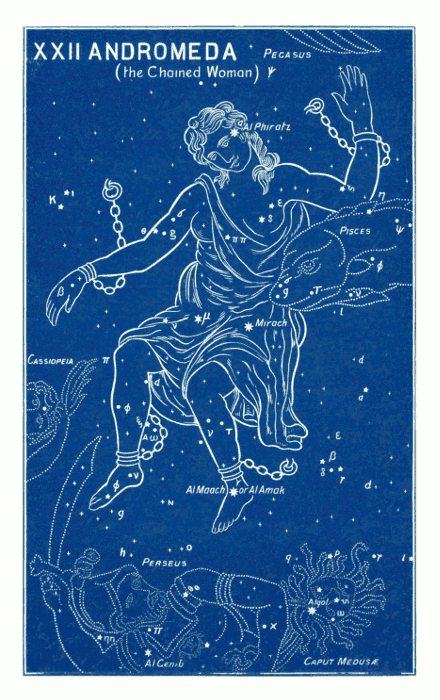
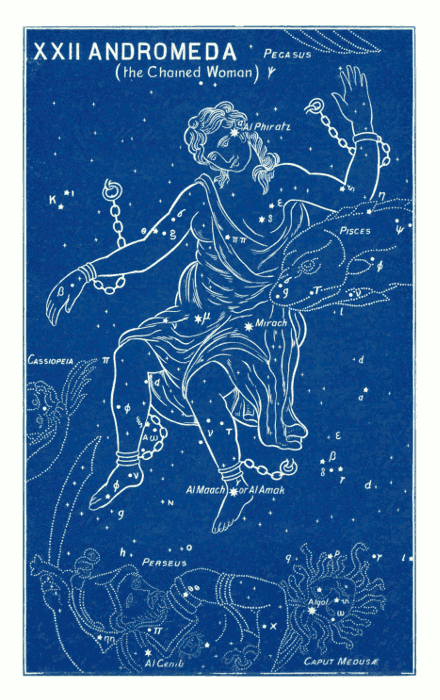
Witness of the Star: ANDROMEDA (The Chained Woman)

2. ANDROMEDA (The Chained Woman)

The Redeemed in their Bondage and Affliction.

This is a peculiar picture to set in the heavens. A woman with chains fastened to her feet and arms, in misery and trouble; and bound, helpless, to the sky. Yet this is the ancient foreshowing of the truth.

In the Denderah Zodiac her name is Set, which means setset up as a queen. In Hebrew it is Sirrathe chained, and Perseathe stretched out.

Plate 22: ANDROMEDA (the Chained Woman)

There are 63 stars in this constellation, three of which are of the 2nd magnitude, two of the 3rd, twelve of the 4th, etc.

The brightest star, α (in the head), is called Al Phiratz (Arabic), the broken down. The star β (in the body) is called Mirach (Hebrew), the weak. The star γ (in the left foot) is called Al Maach, or Al Amak (Arabic), struck down.

The names of other stars, not identified, are Adhilthe afflictedMizarthe weakAl Mara (Arabic), the afflicted. Aratus speaks of Desma, which means the bound, and says—

“Her feet point to her bridegroom

Perseus, on whose shoulder they rest.”

Thus, with one voice, the stars of Andromeda speak to us of the captive daughter of Zion. And her coming Deliverer thus addresses her:—

“O thou afflicted, tossed with tempest, and not comforted,

Behold, … in righteousness shalt thou be established:

Thou shalt be far from oppression; for thou shalt not fear:

And from terror; for it shall not come nigh thee.”

(Isa. liv. 11-14.)

“Hear now this, thou afflicted….

Awake, awake; put on thy strength, O Zion;

Put on thy beautiful garments, O Jerusalem….

Shake thyself from the dust;

Arise, and sit down, O Jerusalem:

Loose thyself from the bands of thy neck, O captive daughter of Zion.

For thus saith the Lord, Ye have sold yourselves for nought;

And ye shall be redeemed without money.”

(Isa. li. 21-lii. 3.)

“The virgin daughter of My people is broken with a great breach, with a very grievous blow” (Jer. xiv. 17).

The picture which sets forth her deliverance is reserved for the next chapter (or Sign), where it comes in its proper place and order. We are first shown her glorious Deliverer; for we never, in the heavens or in the Word, have a reference to the sufferings without an immediate reference to the glory.