A place to grow your relationship with God

Archive for the ‘Bible Study’ Category

Witness of the Stars: Chapter II. The Sign AQUARIUS (The Water Bearer) & PISCIS AUSTRALIS (The Southern Fish)

Chapter II. The Sign AQUARIUS (The Water Bearer)

Their Blessings Ensured, or the Living Waters of Blessing Poured Forth for the Redeemed.

The Atonement being made, the blessings have been procured, and now they can be bestowed and poured forth upon the Redeemed. This is the truth, whether we think of Abel’s lamb, of patriarchal sacrifices, the offerings under the Law, or of that great Sacrifice of which they all testified. They all with one voice tell us that atonement made is the only foundation of blessing.

This was pictured and foreshown in the heavens from the beginning, by a man pouring forth water from an urn which seems to have an inexhaustible supply, and which flows forth downwards into the mouth of a fish, which receives it and drinks it all up.

In the ancient Zodiac of Denderah it is the same idea, though the man holds two urns, and the fish below seems to have come out of the urn. The [pg 085]man is called Hupei Tirion, which means the place of him coming down or poured forth.

In some eastern Zodiacs the Urn alone appears.
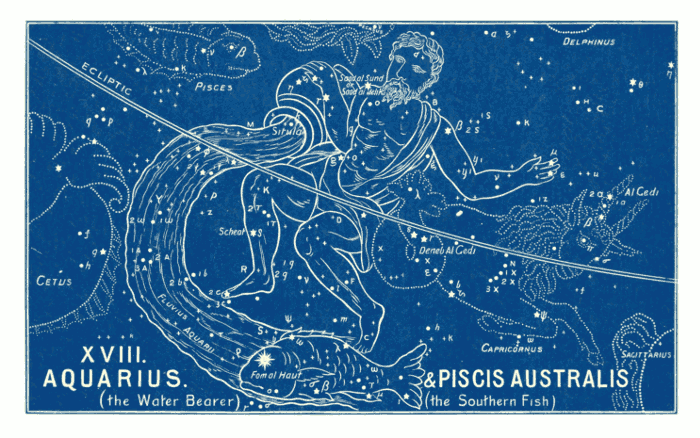
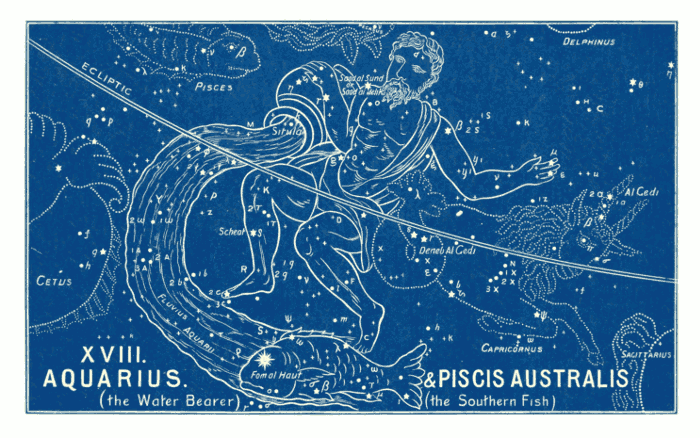
Plate 18: AQUARIUS (the Water Bearer) & PISCIS AUSTRALIS (the Southern Fish)

This agrees with its other names—Hebrew, Delithe water-urn, or bucket (as in Num. xxiv. 7); the Arabic Delu is the same.

There are 108 stars in this Sign, four of which are of the 3rd magnitude. Their names, as far as they have come down to us, are significant.

The star α (in the right shoulder) is called Sa’ad al Melik, which means the record of the pouring forth.

The star β (in the other shoulder) is called Saad al Sundwho goeth and returneth, or the pourer out.

The bright star δ (in the lower part of the right leg) is well-known to-day by its Hebrew name Scheat, which means who goeth and returneth.

The bright star in the urn has an Egyptian name—Mon or Meon, which means simply an urn.

Aquarius is the modern Latin name by which the sign is known. It has the same meaning, the pourer forth of water.

Can we doubt what is the interpretation of this sign? The Greeks, not knowing Him of whom it testified, were, like the woman of Samaria, destitute of that living water which He alone can give. They therefore invented some story about Deucalion, the son of Prometheus; and another, saying he is Ganymede, Jove’s cup-bearer! But, as an astronomer says, “We must account otherwise for the origin of this name; for it is not possible to reconcile the [pg 086]symbols of the eleventh49 sign with Grecian mythology.” No! we must go further back than that, and not cramp our vision, and distort the Scriptures, by confining our thoughts to “the Church.” The Church is nowhere seen in these Signs, as she is nowhere revealed in the Old Testament. This we shall enlarge on when we come to the sign Pisces. Meanwhile we must read the witness of the stars as if there had been no Church!

Christ is first. Yea, He is all in all. The Scriptures testify of Him; and the very stars in this Sign tell of His going away and His coming again. These prophetic signs have to do with Him, with the Atonement He wrought, with the conflict He endured, with the blessings He secured, with the victory He shall win, and the triumph He shall have. For it is written:

“He shall pour the water out of His buckets,

And His seed shall be in many waters,

And His king shall be higher than Agag,

And His kingdom shall be exalted.”

(Num. xxiv. 7.)

It tells of that glorious day when

“A King shall reign in righteousness;

And princes shall rule in judgment;

And a MAN shall be as an hiding place

from the wind,

And a covert from the tempest;

As RIVERS of WATER in a dry place.”

(Isa. xxxii. 1, 2)

It speaks of that glorious time when Israel shall be restored, and their “eyes shall see the King in His beauty”; when the peace of Zion shall be no more disturbed, “but there the glorious Lord will be unto us a place of broad rivers and streams” (Isa. xxxiii. 17, 20, 21). Then

“The wilderness and the solitary place shall be glad for them;

And the desert shall rejoice, and blossom as the rose,

For in the wilderness shall waters break out,

And streams in the desert.”

(Isa. xxxv. 1, 6.)

“I will open rivers in high places,

And fountains in the midst of the valleys;

I will make the wilderness a pool of water,

And the dry land springs of water.”

(Isa. xli. 18.)

“Fear not, O Jacob, My servant;

And thou, Jesurun, whom I have chosen,

For I will POUR WATER upon him that is thirsty,

And floods upon the dry ground;

I will pour My Spirit upon thy seed,

And My blessing upon thy offspring.

Thus saith the Lord the King of Israel,

And his Redeemer the Lord of hosts.”

(Isa. xliv. 2, 3, 6.)

This is the meaning of the Sign. The MAN Christ Jesus, who was humbled in death will yet be seen to be the pourer forth of every blessing. Physically pouring forth literal waters, removing the curse, and turning this world into a paradise:

“Making her wilderness like Eden,

And her desert like the garden of the Lord.”

(Isa. li. 3.)

And morally pouring forth His Spirit in such abundance as to fill the whole earth with peace, and blessing, and glory, “as the waters cover the sea.”

Upon Israel restored He will pour out His blessing. They will be sprinkled with clean water, and possess a new heart and a new spirit (Ezek. xxxvi. 24-28; Joel ii. 28-32).

Such are some of the Scriptures which tell of this glorious Water-pourer. We need not rob Christ of His glory, or Israel of her blessing, in order to see in all this Pentecost or the Church. These are quite independent of the great line of prophetic truth. They are parenthetical, and distinct, and true, quite apart from the glorious prophecies of Israel’s scattering and gathering. The physical marvels referred to in the texts above can never be satisfied or exhausted by any spiritual fulfilment. We may make an application of them as far as is consistent with the teaching of the epistles; but the interpretation of them belongs to the Person of Christ, and the nation of Israel. That interpretation is pictured for us in the Sign, and in its three constellations.

1. PISCIS AUSTRALIS (The Southern Fish).

The Blessings Bestowed.

This first constellation is one of high antiquity, and its brilliant star of the first magnitude was a subject of great study by the Egyptians and Ethiopians. It is named in Arabic Fom al Hautthe mouth of the fish. There are 22 other stars.

The constellation is inseparable from Aquarius, in connection with which we have shown it in Plate XVIII (above). In the Denderah Zodiac it is called Aara stream.

It sets forth the simple truth that the blessings procured by the MAN—the coming Seed of the woman, will be surely bestowed and received by those for whom they are intended. There will be no failure in their communication, or in their reception. What has been purchased shall be secured and possessed.
Chronological Events in the Life of Jesus and John the Baptist

This timeline goes from the Birth of John the Baptist to the Ascension of Jesus. It includes other historic events that were happening during this same time frame. There are some secular resources that links to other websites.

All Dates are Approximate.

  • 6 BC Birth of John the Baptist
    • Luke 1
    • John 1:6
  • 6 BC Augustus Taxes the Roman Empire
    • Luke 2
  • 5 BC Birth of Jesus
  • 5 BC Visit of the Magi
  • 5 BC Escape to Egypt
    • Matthew 2:13
  • 4 BC Slaughter of Infants
    • Matthew 2:16
  • 4 BC Return to Nazareth
    • Matthew 2:23
  • 4 AD Adoption of Tiberius as heir to Augustus after the deaths of Gaius and Lucius Caesar.
  • 5 AD Tiberius campaigns in Germania.
  • 6 AD Revolts in Pannonia and Illyricum.
  • 8 AD The future emperor Claudius is appointed an augur, his only official post under Augustus.
  • 8 AD The Boy Jesus at the Temple
    • Luke 2:41
  • 9 AD Birth of the Emperor Vespasian in the town of Reate.
  • 9 AD The Battle of Teutoburg Forest between P. Quintilius ending in a complete route (including the destruction of 3 legions) for Rome.
  • 9 AD The Ara Pacis (Altar of Peace) is completed by Augustus in Rome.
  • 14 AD Death of the Emperor Augustus, in the city of Nola in Italy. Ascension of Tiberius
  • 14 AD Mutiny of the Rhine legions upon the news of the death of Augustus which is quelled by Germanicus Caesar.
  • 14 – 16 AD Germanicus Caesar campaigns against the Germanic tribes.
  • 14 AD L. Aelius Sejanus is appointed as Praetorian Prefect.
  • 14 AD Death of the Roman historian Livy, in the city of Patavium, Italy.
  • 14 AD The aqueduct, the Pont du Gard, is completed near modern Nimes in Gaul.
  • 15 AD Emperor Tiberius transfers the elections from the popular assemblies to the Senate.
  • 15 AD Birth of the Emperor Vitellius.
  • 17 AD Death of the Roman writer Ovid, who died in Tomis, Moesia while exile, apparantly because of offenses to Augustus’ moral code.
  • 19 AD Death of Germanicus, possibly but not necessarily by the direct order of Tiberius.
  • 22 AD Construction of the Castra Praetoria (Praetorian barracks) by Sejanus is completed and the Praetorians are forever changed into a political force.
  • 23 AD Birth of the Roman historian Pliny the Elder, in the town of Novum Comum, in Italy.
  • 26 AD Pontius Pilate is appointed as the prefect of Judaea.
  • 26 AD Tiberius retires to his estate on Capri, effectively giving Sejanus unlimited imperial authority.
  • 26 AD John the Baptist Prepares the Way
    • Matthew 3
    • Mark 1:4
    • Luke 3
    • John 1:15
  • 26 AD The Baptism of Jesus
    • Matthew 3:13
    • Mark 1:9,
    • Luke 3:21
  • 27 AD Temptation of Jesus
    • Matthew 4,
    • Mark 1:12,
    • Luke 4
  • 27 AD Jesus Calls his First Disciples
    • Matthew 4:18,
    • Mark 1:16,
    • Luke 5
  • 27 AD Wedding at Cana
    • John 2
  • 27 AD Jesus Teaches Nicodemus
    • John 3
  • 27 AD Jesus Testifies to the Samaritan Woman
    • John 4
  • 27 AD Sermon on the Mount
    • Matthew 5 – 7
  • 28 AD Instructions on Prayer
    • Luke 11
  • 28 AD Jesus Ministers in Galilee
    • Matthew 8
    • Mark 2,
    • Luke 4:14
  • 28 AD The Pool of Bethesda
    • John 5
  • 28 AD Jesus Lord of the Sabbath
    • Matthew 12,
    • Mark 3,
    • Luke 6
  • 28 AD Jesus Answers John’s Disciples
    • Matthew 11,
    • Luke 7
  • 28 AD Jesus Speaks Many Parables
    • Matthew 13,
    • Mark 4,
    • Luke 8
  • 28 AD Jesus Heals a Demoniac
    • Matthew 8:28,
    • Mark 5,
    • Luke 8:26
  • 28 AD Jesus Heals a Paralytic
    • Matthew 9
  • 28 AD John the Baptist is executed by Herod Antipas, son of King Herod in Judaea.
    • Matthew 14,
    • Mark 6:14
  • 29 AD Livia, the wife of Augustus, dies in Rome at the age of 86.
  • 29 AD Jesus Sends out His Twelve Apostles
    • Matthew 10,
    • Mark 6
  • 29 AD Jesus Feeds the 5,000
    • Matthew 14:15,
    • Mark 6:30,
    • Luke 9,
    • John 6
  • 29 AD Teachings on Clean and Unclean
    • Matthew 15,
    • Mark 7
  • 29 AD Peter’s Confession of Christ
    • Matthew 16,
    • Mark 8,
    • Luke 9:18
  • 29 AD The Transfiguration
    • Matthew 17,
    • Mark 9,
    • Luke 9:28
  • 29 AD Greatest and Least in the Kingdom
    • Matthew 18
  • 29 AD Jesus Sends out the Seventy-two
    • Luke 10
  • 29 AD Jesus Teaches at the Feast of Tabernacles
    • John 7
  • 29 AD The Woman Caught in Adultery
    • John 8
  • 29 AD Jesus Affirms He is the Son of God
    • John 9
  • 29 AD The Shepherd and His Flock
    • John 10
  • 30 AD Birth of the Emperor Nerva in the city of Narnia.
  • 30 AD Jesus Speaks More Parables
    • Luke 12 – 16
  • 30 AD Jesus Cleanses the Ten Lepers
    • Luke 17
  • 30 AD Jesus Raises Lazarus
    • John 11
  • 30 AD Estimated date of the crucifixion of Jesus Christ.
    • 30 AD Final Journey to Jerusalem
      • Matthew 19, 20,
      • Mark 10,
      • Luke 18
    • 30 AD The Triumphal Entry
      • Matthew 21,
      • Mark 11,
      • Luke 19,
      • John 12
    • 30 AD Closing Ministry in Jerusalem
      • Matthew 22 – 25,
      • Mark 12, 13,
      • Luke 20, 21
    • 30 AD Thursday Before Passover
      • Matthew 26,
      • Mark 14,
      • Luke 22,
      • John 13
    • 30 AD Jesus Comforts His Disciples
      • John 14
    • 30 AD Jesus the True Vine
      • John 15
    • 30 AD Jesus Promises the Holy Spirit
      • John 16
    • 30 AD Jesus’ Intercessory prayers
      • John 17
    • 30 AD Jesus’ Betrayal, Trial, Crucifixion
      • Matthew 27,
      • Mark 15,
      • Luke 23,
      • John 18, 19
    • 30 AD Jesus’ Resurrection
      • Matthew 28,
      • Mark 16,
      • Luke 24,
      • John 20, 21
    • 30 AD The Ascension
      • Acts 1

Witness of the Stars: Aquila (the Eagle) and DELPHINUS (The Dolphin)

2. AQUILA (The Eagle)

The Smitten One Falling.

Here we have an additional picture of the effect of this arrow, in the pierced, wounded, and falling Eagle, gasping in its dying struggle. And that pierced, wounded, and dying Saviour whom it represents, after saying, in Ps. xxxviii. 2, “Thine arrows stick fast in Me,” added, in verse 10:

“My heart panteth, My strength faileth Me,

As for the light of Mine eyes it is gone from Me.”

(See also Zech. xiii. 6.)

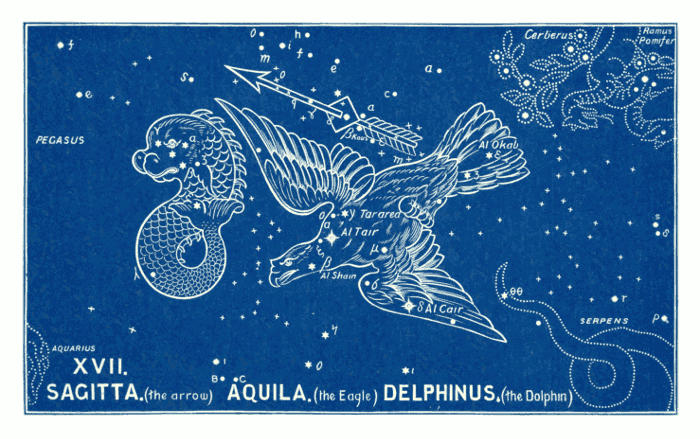
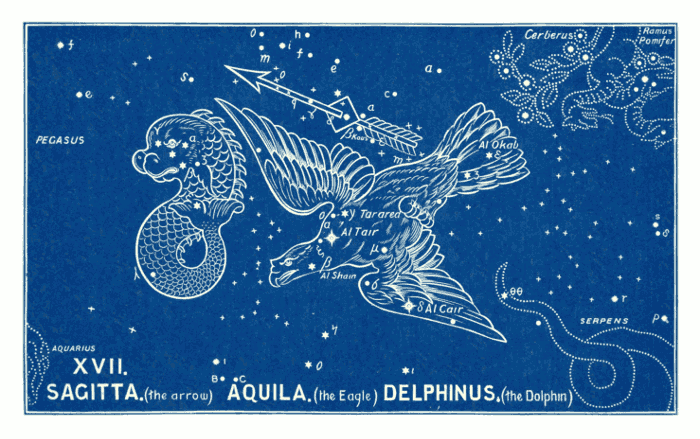
The names of the stars, all of them, bear out this representation. The constellation contains 74 stars. The brightest of them, α (in the Eagle’s neck), is a notable star of the 1st magnitude, called Al Tair (Arabic), the wounding. The star β (in the throat) is called Al Shain (Arabic), the bright, from a Hebrew root meaning scarlet coloured, as in Josh. ii. 18. The star γ (in the back) is called Tararedwounded, or torn. δ (in the lower wing) is named Alcair, which means the piercing, and ε (in the tail), Al Okal, has the significant meaning wounded in the heel.

How can the united testimony of these names be explained except by acknowledging a Divine origin? even that of Him who afterwards foretold of the bruising of the Virgin’s Son in the written Word; yea, of Him “who telleth the number of the stars and giveth them all their names.”

3. DELPHINUS (The Dolphin).

The Dead One Rising again.

This is a bright cluster of 18 stars, five of which are of the 3rd magnitude. It is easily distinguished by the four brightest, which are in the head.

It is always figured as a fish full of life, and always with the head upwards, just as the eagle is always with the head downwards. The great peculiar characteristic of the dolphin is its rising up, leaping, and springing out of the sea.

When we compare this with the dying goat and falling eagle, what conclusion can we come to but that we have here the filling in of the picture, and the completion of the whole truth set forth in Capricornus?

Jesus “died and rose again.” Apart from His resurrection His death is without result. In His conflict with the enemy it is only His coming again in glory which is shown forth. But here, in connection with His people, with the multitudes of His redeemed, Resurrection is the great and important truth. He is “the first-fruits of them that slept”; then He, too, is here represented as a fish. He who went down into the waters of death for His people; He who could say “All thy waves and thy billows are gone over me” (Ps. xlii. 7), He it is who rises up again from the dead, having died on account of the sins of His redeemed, and risen again on account of their justification (Rom. iv. 25).

This is the picture here. In the Persian planisphere there seems to be a fish and a stream of water. The Egyptian has a vessel pouring out water.

The ancient names connected with this constellation are Dalaph (Hebrew), pouring out of water; [pg 083]Dalaph (Arabic), coming quickly; Scalooin (Arabic), swift (as the flow of water); Rotaneb or Rotaneu (Syriac and Chaldee), swiftly running.

Thus, in this first chapter of the Second Book we see the great truth of Revelation set forth; and we learn how the great Blessings of Redemption were procured. This truth cannot be more eloquently or powerfully presented than in the language of Dr. Seiss:—

“This strange goat-fish, dying in its head, but living in its afterpart—falling as an eagle pierced and wounded by the arrow of death, but springing up from the dark waves with the matchless vigour and beauty of the dolphin—sinking under sin’s condemnation, but rising again as sin’s conqueror—developing new life out of death, and heralding a new springtime out of December’s long drear nights—was framed by no blind chance of man. The story which it tells is the old, old story on which hangs the only availing hope that ever came, or ever can come, to Adam’s race. To what it signifies we are for ever shut up as the only saving faith. In that dying Seed of the woman we must see our sin-bearer and the atonement for our guilt, or die ourselves unpardoned and unsanctified. Through His death and bloodshedding we must find our life, or the true life, which alone is life, we never can have.”

“Complete atonement Thou hast made,

And to the utmost farthing paid

Whate’er Thy people owed:

Nor can His wrath on me take place,

If sheltered in His righteousness,

And sprinkled with the blood.

If my discharge Thou hast procured,

And freely in my room endured

The whole of wrath divine,

Payment God cannot twice demand,

First at my bleeding Surety’s hand,

And then again at mine.

Turn, then, my soul, unto Thy rest;

The merits of Thy great High Priest

Have bought thy liberty;

Trust in His efficacious blood,

Nor fear thy banishment from God,

Since Jesus died for thee.”

TIMOTHY AND HIS MOTHER EUNICE

TIMOTHY AND HIS MOTHER EUNICE

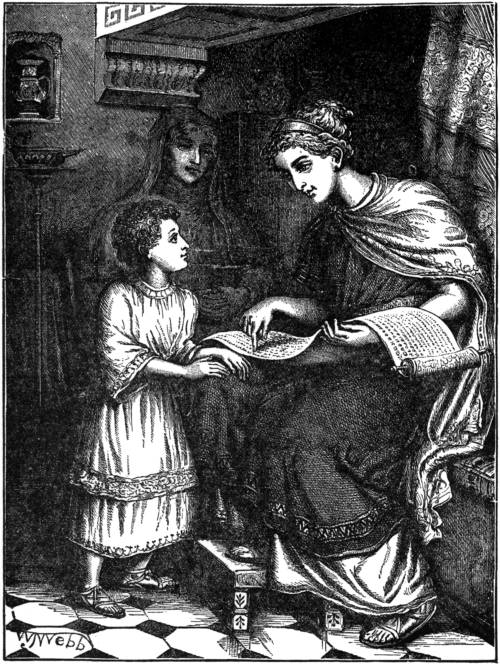
Timothy was a youthful and earnest disciple of Jesus Christ, whom Paul loved dearly. Paul had found him during one of his missionary journeys, and, discovering how highly he was esteemed as a Christian, had selected him as his assistant. Afterward Timothy became Paul’s companion in travel, and the first bishop of Ephesus. While Timothy was at Ephesus, Paul wrote two letters to him. They are contained in the Bible, and are called the Epistles to Timothy. In them Paul says many kind and wise things, giving Timothy directions how to act in his high Christian office. But Paul also speaks of Timothy’s early days, and of his mother and grandmother. These were both good women, who loved God, and diligently studied the Holy Scriptures. The mother’s name was Eunice. She was a Jewess. The grandmother’s name was Lois. Both loved the little boy Timothy, or Timotheus as he was called, and they sought to instil into his young mind and heart the love of God and the knowledge of His holy Word. In our picture we see Eunice teaching her son. She has not a bound Bible, but a manuscript, wound round small rollers. From this she reads to Timothy; while Lois, the aged grandmother, sits by.

Paul warned Timothy not to forget the teaching of his good mother and grandmother; and especially to value his knowledge of the Scriptures. Because, said Paul, “they are able to make thee wise unto salvation.” Many young folks have good mothers and grandmothers, who love to teach them about Jesus. Are they receiving this teaching as Timothy did, and being made wise unto salvation?

LOIS, EUNICE AND TIMOTHY

Witness of the Stars: SAGITTA (The Arrow)

1. SAGITTA (The Arrow)

The Arrow of God sent forth.

It is not the Arrow of Sagittarius, for that has not left his bow. That arrow is for the enemies of God. This is for the Son of God. It was of this that He spoke when He said, in Ps. xxxviii. 2:

“Thine arrows stick fast in me,

And Thy hand presseth me sore.”

He was “stricken, smitten of God, and afflicted, He was wounded for our transgressions” (Isa. liii. 4, 5). He was “pierced,” when He could say with Job, “The arrows of the Almighty are within me” (vi. 4).

Plate 17: SAGITTA (the Arrow), AQUILA (the Eagle), DELPHINUS (the Dolphin)

Here the arrow is pictured to us in mid-heaven, alone, as having been shot forth by an invisible hand. It is seen in its flight through the heavens. It is the arrow of God, showing that Redemption is all of God. It was “the will of God” which Jesus came to do. Not a mere work of mercy for miserable sinners, but a work ordained in eternity past, for the glory of God in eternity future.

This is the record of the Word, and this is what is pictured for us here. The work which the arrow accomplishes is seen in the dying Goat, and in the falling Eagle.

There are many other stars in the heavens in a straighter line, which would better serve for an arrow. Why are these stars chosen? Why is the arrow placed here? What explanation can be given, except that the Revelation in the stars and in the Book are both from the inspiration of the same Spirit?

There are about 18 stars, of which four are of the 4th magnitude. Only γ and δ are in the same line, while the shaft passes between α and β.

The Hebrew name is Shamdestroying, or desolate.

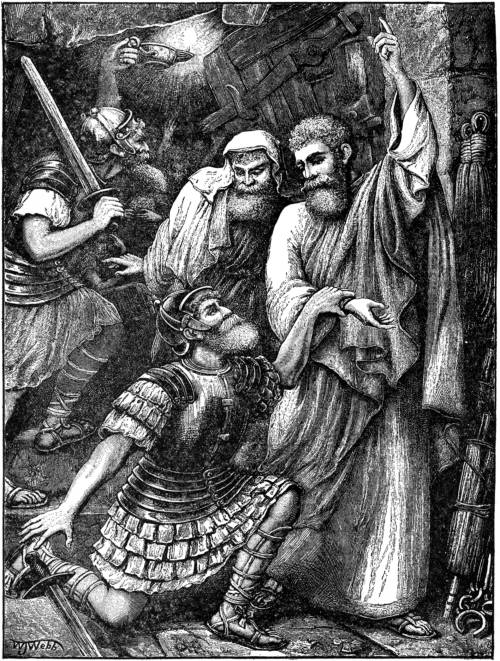
THE PHILIPPIAN JAILER

THE PHILIPPIAN JAILER

Paul and Silas were in prison. They had done no wrong, but wicked men had taken them before the magistrates; and the magistrates had caused them to be severely beaten, and afterwards had sent them to prison, where they were securely fastened in an inner dungeon, and their feet made fast in the stocks. This was a most painful position for Paul and Silas. But they were not unhappy. They prayed to God, and sang praises to Him; and they sang so heartily that the other prisoners heard them. It was midnight, and all was dark in the prison. But suddenly there was an earthquake; so that the foundations of the prison were shaken, all the doors were opened, and every one’s bonds were loosed. All the prisoners might have run away had they been minded to do so.

The keeper of the prison had been sleeping, but the earthquake awoke him. When he saw the doors open, he supposed that all the prisoners had fled; and knowing how severely he would be punished on that account, he drew his sword to kill himself. Paul knew this, and called out loudly, “Do thyself no harm, for we are all here.” Then the keeper, who but a little while before had cruelly treated Paul and Silas, came trembling, and fell down before them, and said, “Sirs, what must I do to be saved?” He was afraid because of his sins; and wanted to know how he might be saved from the fearful consequences of sin. Paul’s answer was, “Believe on the Lord Jesus Christ and thou shalt be saved.” Then Paul and Silas spoke to him about Jesus. He believed, and was baptized; and the next morning the two disciples were set at liberty.

THE PHILIPPIAN JAILOR BEFORE PAUL AND SILAS

The Witness of the Stars book 2 Chapter 1: The Sign CAPRICORNUS (The Sea Goat)

The Second Book. The Redeemed

The Result of the Redeemer’s Sufferings.

In the First Book we have had before us the work of the Redeemer set forth as it concerned His own glorious person. In this Second Book it is presented to us as it affects others. Here we see the results of His humiliation, and conflict, and victory—“The sufferings of Christ” and the blessings they procured for His redeemed people.

In Chapter I. we have the Blessings procured.

In Chapter II. their Blessings ensured.

In Chapter III. their Blessings in abeyance.

In Chapter IV. their Blessings enjoyed.

Chapter I. The Sign CAPRICORNUS (The Sea Goat)

The Goat of Atonement Slain for the Redeemed.

It is most noteworthy that this Second Book opens with the Goat and closes with the Ram: two animals of sacrifice; while the two middle chapters are both connected with fishes. The reason for this we shall see as we proceed.

Both are combined in the first chapter, or “Sign” of Capricornus.

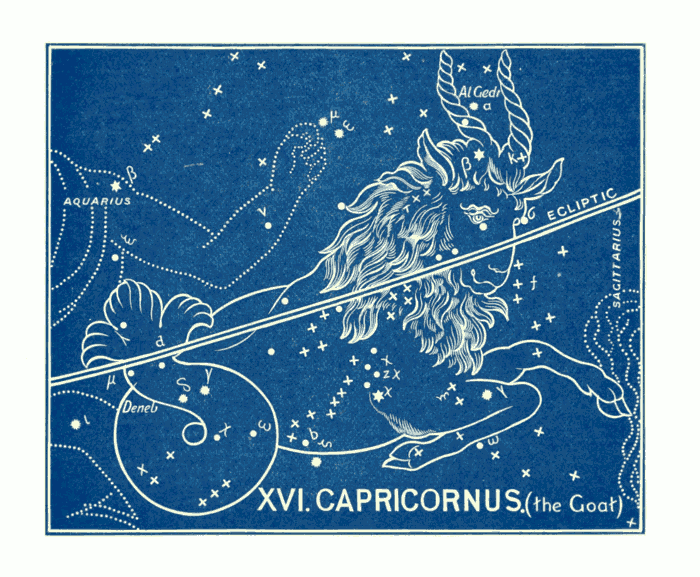
In all the ancient Zodiacs, or Planispheres, we find a goat with a fish’s tail. In the Zodiacs of Denderah and Esneh, in Egypt, it is half-goat and half-fish, and it is there called Hu-penius, which means the place of the sacrifice.

In the Indian Zodiac it is a goat passant traversed by a fish.

There can be no doubt as to the significance of this sign.

In the Goat we have the Atoning Sacrifice, in the Fish we have the people for whom the atonement is made. When we come to the sign “Pisces” we shall see more clearly that it points to the multitudes of the redeemed host.

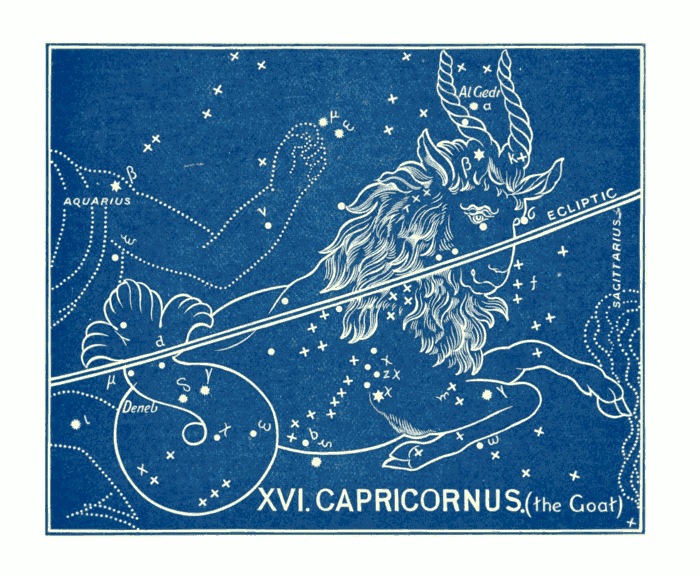
The Goat is bowing its head as though falling down in death. The right leg is folded underneath the body, and he seems unable to rise with the left. The tail of the fish, on the other hand, seems to be full of vigour and life.

The Hebrew name of the sign is Gedithe kid or cut off, the same as the Arabic Al Gedi. Capricornus is merely the modern (Latin) name of the sign and means goat.

Plate 16: CAPRICORNUS (the Goat)

There are 51 stars in the sign, three of which are of the 3rd magnitude, three of the 4th, etc. Five are remarkable stars, α and β in the horn and head, and the remaining three, γ, δ, and ε, in the fishy tail. The star α is named Al Gedithe kid or goat, while the star δ is called Deneb Al Gedithe sacrifice cometh.

Other star-names in the sign, not identified, are Dabih (Syriac), the sacrifice slainAl Dabik and Al Dehabeh (Arabic) have the same meaning; Ma’asadthe slayingSa’ad al Naschirathe record of the cutting off.

Is not this exactly in accord with the Scriptures of truth? There were two goats! Of “the goat of the sin-offering” it is written, “God hath given it to you to bear the iniquity of the congregation, to make atonement for them before the Lord” (Lev. x. 16, 17): of the other goat, which was not slain, “he shall let it go into the wilderness” (Lev. xvi. 22). Here is death and resurrection. Christ was “wounded for our transgressions, and bruised for our iniquities.” “For the transgression of MY PEOPLE was He stricken” (Isa. liii.). He laid down His life for the sheep.

In the first chapter of the First Book, we had the same Blessed One presented as “a corn of wheat.” Here we see Him come to “die,” and hence not abiding alone, but bringing forth “much fruit” (John xii. 24). The living fish proceeds from the dying goat, and yet they form only one body. That picture, which has no parallel in nature, has a perfectly true counterpart in grace; and “a great multitude, which no man can number,” have been redeemed and shall obtain eternal life through the death of their Redeemer.

It is, however, not merely the actual death which is set before us here. The first chapter in each book has for its great subject the Person of the Redeemer in prophecy and promise. The last chapter in each book has for its subject the fulfilment of that prophecy in victory and triumph, in the Person of the Redeemer: while the two central chapters in each book are occupied with the work which is the accomplishment of the promise, presented in two aspects—the former connected with grace, the latter with conflict.

Thus, the structure of each of the three books is an epanodos, having for its first and last members the Person of the Redeemer (in “A” in Prophecy; in “A” in Fulfilment), while in the two central members we have the work and its accomplishment (in “B” in grace; and in “B” in conflict).

It may be thus presented to the eye:—

The First Book.

A | Virgo. The Prophecy of the Bruised Seed.

B | Libra. The work accomplished (in grace).

B | Scorpio. The work accomplished (in conflict.)

A | Sagittarius. The fulfillment of the promised victory.

The Second Book.

C | Capricornus. The Prophecy of the Promised Deliverance.

D | Aquarius. Results of the work bestowed (in grace).

D | Pisces. Results of the work enjoyed (in conflict).

C | Aries. The Fulfilment of the Promised Deliverance.

The Third Book.

E | Taurus. The Prophecy of the coming Judge of all the earth.

F | Gemini. The Redeemer’s reign. (Grace and Glory).

F | Cancer. The Redeemer’s possession (safe from all conflict).

E | Leo. The fulfilment of the promised Triumph.

Hence in Capricornus we must look for the prophecy of this Coming Sacrifice. As a matter of fact it did actually point out the time when the Sun of Righteousness should arise, and “the Light of the World” appear. For when this Promised Seed was born the Sun was actually in this sign of Capricornus! “The fulness of time was come,” and “God sent forth His Son TO REDEEM them that were under the Law” (Gal. iv. 4). The Sun was really amongst those very stars—Al Gedithe kid, and Deneb Al Gedithe sacrifice cometh—when this willing Sacrifice said, “Lo I come to do Thy will, O God.” The nights were at their darkest and their longest when Jesus was born. The days began immediately to lengthen when He, “the true light,” had come into the world.

Astronomers confess that the perverted legends of the Greeks give but “a lame account” of this sign, “and it offers no illustration of its ancient origin.”

Its ancient origin reveals a prophetic knowledge, which only He possessed who knew that in “the fulness of time” He would send forth His Son.

We now come to the three constellations which give us three pictures setting forth the death of this Sacrifice and of His living again.

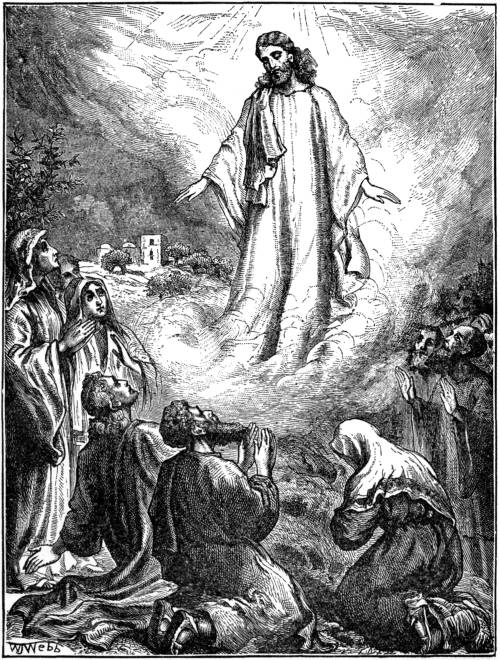
JESUS ASCENDS TO HEAVEN

JESUS ASCENDS TO HEAVEN

Jesus had been cruelly put to death. His hands, which had been placed on the heads of little children when He blessed them, had been nailed to a cross of wood; and cruel nails had been driven through his feet. And hanging on the cross, Jesus had died. But on the third day He had risen from the tomb, and for forty days He had remained upon the earth, meeting frequently with His disciples. At the end of that time Jesus led the eleven apostles from Jerusalem towards Bethany; and when near that village, and away from the multitude, He spoke to them, promising that they should be made bold by the Holy Spirit, and receive power to witness for Him both to the Jews and Gentiles. Then, the Bible tells us, “He lifted up His hands and blessed them. And it came to pass, while He blessed them, He was parted from them, and carried up into heaven.” And as He went up, a cloud received Him out of their sight.

The apostles fell down and worshipped Jesus, looking steadfastly after Him as He went up; and as they did so, two angels in white garments stood by them, and said, “Ye men of Galilee, why stand ye gazing up into heaven? This same Jesus, which is taken up from you into heaven, shall so come in like manner as ye have seen Him go into heaven.” Then the apostles returned to Jerusalem.

Yes, Jesus has ascended to heaven, and now He sits at the right hand of God; but He tells us that He will come again, and take those that love Him to dwell with Him in His glorious home for ever and ever. “I go to prepare a place for you,” Jesus says.

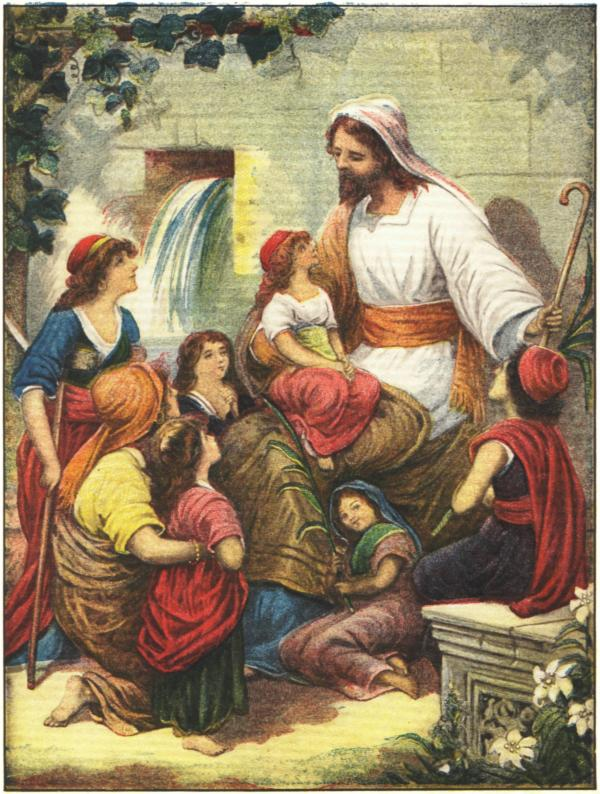
CHRIST BLESSING THE CHILDREN

Jesus had left Galilee, and was journeying toward Jerusalem, where He was to be put to death. He was in the country beyond Jordan, called Peræa, and had been speaking some very wise words to the Pharisees, and also to His disciples, when some women came to Him, bringing infants and young children that He might put His hands upon them and pray for them. The disciples thinking probably that Jesus, who had so many important things to attend to, would not wish to be troubled by women bringing their children, rebuked them for so doing. But Jesus loved children. So, when He saw the disciples about to send them away, He was displeased; and, calling the disciples to Him, He said, “Suffer little children to come unto Me, and forbid them not: for of such is the kingdom of God.” Then, we are told, Jesus “took them up in His arms, put His hands upon them, and blessed them.” How kind was Jesus! and how willing that the little ones should be brought to Him! And He is the same now. May all our young readers learn to love Him, and find for themselves how willing He is to love and bless them.

The Prophecy of the Anointed One in Psalm 2

Psalm 2

  • Why do the heathen rage, and the people imagine a vain thing?
  • The kings of the earth set themselves, and the rulers take counsel together, against the Lord, and against his anointed, saying,
  • Let us break their bands asunder, and cast away their cords from us.
  • He that sitteth in the heavens shall laugh: the Lord shall have them in derision.
  • Then shall he speak unto them in his wrath, and vex them in his sore displeasure.
  • Yet have I set my king upon my holy hill of Zion.
  • I will declare the decree: the Lord hath said unto me, Thou art my Son; this day have I begotten thee.
  • Ask of me, and I shall give thee the heathen for thine inheritance, and the uttermost parts of the earth for thy possession.
  • Thou shalt break them with a rod of iron; thou shalt dash them in pieces like a potter’s vessel.
  • Be wise now therefore, O ye kings: be instructed, ye judges of the earth.
  • Serve the Lord with fear, and rejoice with trembling.
  • Kiss the Son, lest he be angry, and ye perish from the way, when his wrath is kindled but a little. Blessed are all they that put their trust in him.

Notes:

  • The word translated here as “heathen” comes from the Hebrew word goyim and is often referred to as “nations,” especially the non-Jewish nations of the Gentiles that surrounded Israel. Later the word Gentile became synonymous with the word goyim for most Hebrews.
  • The word “image” is the Hebrew word hagah. It is the same word that in Psalm 1 that is translated as meditate. The nations around Israel were meditating on how to destroy God’s anointed.
  • The word “anointed” is the Hebrew word מָשִׁיחַ māšîaḥ.
    • מָשִׁיחַ māšîaḥ
      • anointed (one), usually refers to pouring or smearing sacred oil on a person in a ceremony of dedication, possibly symbolizing divine empowering to accomplish the task or office; the Anointed One, the Messiah, God’s ultimate chosen one, identified in the NT as Jesus:
  • Vs 2: Yet have I set my king upon my holy hill of Zion.
    • David captured the stronghold of Zion (see 2 Samuel 5:7)
    • David later constructed a tent on Mount Zion (see 1 Chron. 15:1). He then brought the Ark of the Covenant their and housed it in the tent (see 1 Chron. 16:1). By this God had set His King upon the “Holy Hill of Zion”.
  • 2:7 I will declare the decree: the Lord hath said unto me, Thou art my Son; this day have I begotten thee.
    • This verse is quoted from twice:
      • Hebrews 1:5
        • For unto which of the angels said he at any time, Thou art my Son, this day have I begotten thee? And again, I will be to him a Father, and he shall be to me a Son?
      • Hebrews 5:5
        • So also Christ glorified not himself to be made an high priest; but he that said unto him, Thou art my Son, to day have I begotten thee.
    • Notice a few things
      • The word Son is used to identify the Messiah as Christ was called the “Son of God” (see Matt. 8:29; 14:33; 27:54; Mark 1:1; 3:11; Luke 1:35).
      • The term begotten is also used, from a Hebrew word meaning “to give birth to a child,”
        • It is used in the New Testament when Jesus is called the “only begotten of the Father” (John 1:14).
        • The phrase “only begotten” refers to an “only born.”
  • 2:8 Ask of me, and I shall give thee the heathen for thine inheritance, and the uttermost parts of the earth for thy possession.
    • When Messiah (Jesus) becomes King and sets His throne in Jerusalem, He will be King over all the earth and all nations will be under His dominion; thus, He will inherit the heathen (Gentile) nations.
  • 2:9 Thou shalt break them with a rod of iron; thou shalt dash them in pieces like a potter’s vessel.
    • The promise of the Messiah ruling with a rod of iron is found in both Testaments.
      • Isaiah 11:4 But with righteousness shall he judge the poor, and reprove with equity for the meek of the earth: and he shall smite the earth: with the rod of his mouth, and with the breath of his lips shall he slay the wicked.
        • The “rod” is the words of the Messiah’s mouth that slay the wicked.
      • This same imagery is used in Revelation 19:15.
        • And out of his mouth goeth a sharp sword, that with it he should smite the nations: and he shall rule them with a rod of iron: and he treadeth the winepress of the fierceness and wrath of Almighty God.
      • In the above verse it is with His mouth that Christ will smite the nations and rule them with a rod of iron.
    • Here, David says that the Messiah will break them in pieces like a clay vessel that is smashed with a rod. This refers to breaking:
      • the power
      • the influence
      • the will of the nations, causing them to submit to the Messiah.
  • 2:10 Be wise now therefore, O ye kings: be instructed, ye judges of the earth.
    • Wisdom and instruction should be the basis for all decisions made among leaders.
    • It should also be the basis for decisions made by all Christians.
  • 2:11 Serve the Lord with fear, and rejoice with trembling.
    • The “fear of the Lord is the beginning of wisdom”
      • Ps. 111:10
        • The fear of the Lord is the beginning of wisdom: a good understanding have all they that do his commandments: his praise endureth for ever.
    • The Hebrew word translated as rejoice here is giyl and means, “to spin around with emotion” or “to spin in a circle.”
      • In Hebrew thought, to “rejoice” does not simply mean to be happy in the Lord. Rejoicing is accompanied by a response such as shouting, spinning, or even dancing.
  • 2:12 Kiss the Son, lest he be angry, and ye perish from the way, when his wrath is kindled but a little. Blessed are all they that put their trust in him.
    • The “Son” here is the King Messiah (v. 6), the begotten son (v. 7), and the one who rules with a rod of iron (v. 9).
    • “Kiss”: It was customary in ancient times to kiss a close friend on the cheek, or to kiss the ring or hand of the king or leader as a sign of great honor.
      • Those who will not honor Christ in the Millennium will experience forms of judgments on their nations (see Zech. 14:17-18).