A place to grow your relationship with God

Archive for the ‘Christian Living’ Category

Letting Go of the Past: A Guide to Philippians 3:13-14

Philippians 3:13-14 Brethren, I count not myself to have apprehended: but this one thing I do, forgetting those things which are behind, and reaching forth unto those things which are before, I press toward the mark for the prize of the high calling of God in Christ Jesus.

This is often times a difficult passage to understand especially the “forgetting those things which as behind” part. It is not possible to forget completely. I don’t believe that we are meant as human beings to completely forget. However, it is possible to learn from past mistakes.

Many years ago, I was having problems. My mom explained this verse to me. She explained that if you stay focused on the past you can’t reach what is in front of you. Jesus has plans for you. You will never accomplish His plans for you if you stay focused on the past. She used a demonstration to explain this to me. Here is the demonstration:

  • Pretend that 1 spot in your home is the past. (We used the front door.)
  • Pretend that an area in front of that 1st spot is what Jesus wants for you. (We used the living room).
  • Now start at the past. Start walking towards the future.
  • Now look back at the past and try to walk towards the future. (It is not possible.)
  • Now set your eyes where Jesus is (the future) and try to walk towards the future. (It is now possible.)

Remember the time when Jesus walked on the water and Peter asked to come out on the water to Jesus. Matthew 14:28-30 And Peter answered him and said, Lord, if it be thou, bid me come unto thee on the water. And he said, Come. And when Peter was come down out of the ship, he walked on the water, to go to Jesus. But when he saw the wind boisterous, he was afraid; and beginning to sink, he cried, saying, Lord, save me.

Notice that as long as Peter kept his eyes on Jesus, he was able to walk towards Jesus, but when he took his eyes off of Jesus, he started sinking. It is the same way with us. We can only go forward to Jesus when we keep our eyes on Jesus and stop worrying about our past (forgetting those things which are behind). This sometimes takes many hours of prayer, but it is more than worth the time in prayer.
Think Before You Speak: Biblical Lessons on Words

Be careful what you say. Remember life and death is in the Power of the tongue (Proverbs 18:21)
Jesus said, “But I say unto you, That every idle word that men shall speak, they shall give account thereof in the day of judgment. For by thy words thou shalt be justified, and by thy words thou shalt be condemned.” (Matthew 12:36-37).

Sometimes God will give you exactly what you say. That is not always a good thing. God hears everything that you say. So, think before you speak. Ask yourself, “Do I really want God to hear my say this?”

The Israelites learned this the hard way. They complained and frequently said, “Would that God that we had died in the land of Egypt or would God that we had died in the wilderness.” (Numbers 14:2)

On the journey to the promise land, they kept complaining and talking about dyeing. So, in Numbers 14:27-32 God says, “How long shall I bear with this evil congregation, which murmur against me? I have heard the murmurings of the children of Israel, which they murmur against me. Say unto them, As truly as I live, saith the Lord, as ye have spoken in mine ears, so will I do to you: Your carcases shall fall in this wilderness; and all that were numbered of you, according to your whole number, from twenty years old and upward which have murmured against me. Doubtless ye shall not come into the land, concerning which I sware to make you dwell therein, save Caleb the son of Jephunneh, and Joshua the son of Nun. But your little ones, which ye said should be a prey, them will I bring in, and they shall know the land which ye have despised. But as for you, your carcases, they shall fall in this wilderness.” Thankful he had mercy on the children. The children did not receiver that which the parents said that they would.

Be careful what you wish for and speak.

Remember the old song that has a verse in it saying Be careful little tongue what you say.

Understanding the Fruit of the Spirit

But the fruit of the Spirit is love, joy, peace, longsuffering, gentleness, goodness, faith, Meekness, temperance: against such there is no law. Galatians 5:22-23

Vocabulary

  • Spirit: G415
    • ἀνελεήμων aneleḗmōn, an-eleh-ay’-mone; from G1 (as a negative particle) and G1655; merciless:—unmerciful.
  • Longsuffering: G3115
    • μακροθυμία makrothymía, mak-roth-oo-mee’-ah; from the same as G3116; longanimity, i.e. (objectively) forbearance or (subjectively) fortitude:—longsuffering, patience.
  • Gentleness: G5544
    • χρηστότης chrēstótēs, khray-stot’-ace; from G5543; usefulness, i.e. morally, excellence (in character or demeanor):—gentleness, good(-ness), kindness.
  • Temperance: G1466 
    • ἐγκράτεια enkráteia, eng-krat’-i-ah; from G1468; self-control (especially continence):—temperance.
  • Law: G3551
    • νόμος nómos, nom’-os; from a primary νέμω némō (to parcel out, especially food or grazing to animals); law (through the idea of prescriptive usage), genitive case (regulation), specially, (of Moses (including the volume); also of the Gospel), or figuratively (a principle):—law

Context

Author:Paul
Audience: Church of Galatia
When was it wrote: Around A.D. 49
Style:Epistle
PurposeInstruction

What does it say ?

It talks about the fruit of the spirit.

What Does it mean?

These fruits are the evidence of a developing Christian life; you can tell if someone is truly trying to walk with God by their being fruit.

Cross references:

King James Version

  • Acts 24:25 And as he reasoned of righteousness, temperance, and judgment to come, Felix trembled, and answered, go thy way for this time; when I have a convenient season, I will call for thee.

  • Ephesians 5:9 For the fruit of the Spirit is in all goodness and righteousness and truth

  • 1Timothy 1:9 Knowing this, that the law is not made for a righteous man, but for the lawless and disobedient, for the ungodly and for sinners, for unholy and profane, for murderers of fathers and murderers of mothers, for manslayers,

  • James 3:17-18 But the wisdom that is from above is first pure, then peaceable, gentle, and easy to be intreated, full of mercy and good fruits, without partiality, and without hypocrisy. And the fruit of righteousness is sown in peace of them that make peace.

  • Colossians 3:12-14 Put on therefore, as the elect of God, holy and beloved, bowels of mercies, kindness, humbleness of mind, meekness, longsuffering; Forbearing one another, and forgiving one another, if any man have a quarrel against any: even as Christ forgave you, so also do ye. And above all these things put on charity, which is the bond of perfectness.

Other translations

  • Amplified Holy Bible
    • Galatians 5:22-23 But the fruit of the Spirit [the result of His presence within us] is love [unselfish concern for others], joy, [inner] peace, patience [not the ability to wait, but how we act while waiting], kindness, goodness, faithfulness, 23 gentleness, self-control. Against such things there is no law.
  • Holman Bible
    •  Galatians 5:22-23 But the fruit of the Spirit is love, joy, peace, patience, kindness, goodness, faith, gentleness, self-control. Against such things there is no law
  • New revised Standard Version
    • Galatians 5:22-23 By contrast, the fruit of the Spirit is love, joy, peace, patience, kindness, generosity, faithfulness gentleness, and self-control. There is no law against such things.

What should We do?

We all should try to grow in the fruit of the spirit by praying and reading our Bibles.

Should We Call God by His Hebrew Name?

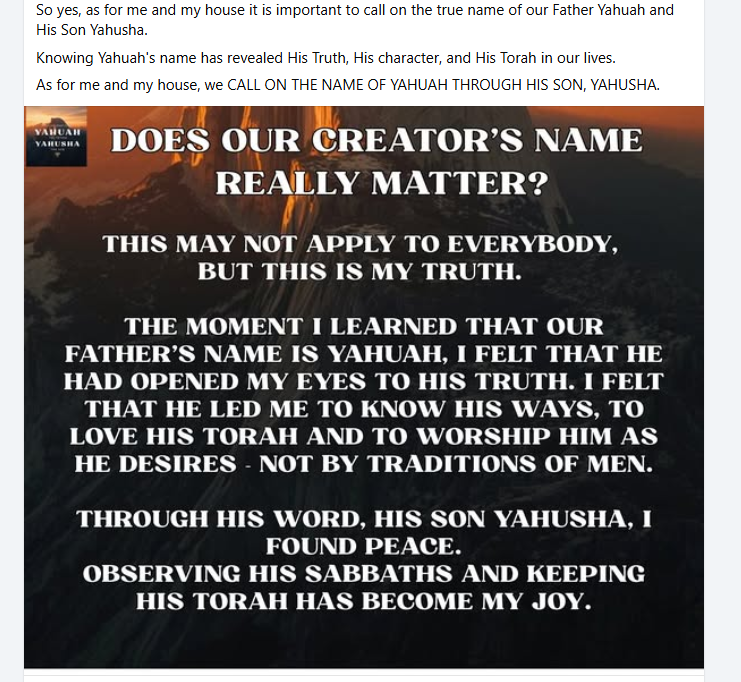
It has been making the rounds for quite some time that we need to call God and Jesus by the Hebrew names. Some say that this may not apply to everybody. Others declare that you are worshiping an idol by not calling God by His Hebrew name. I am addressing those that make this a salvation issue.

Now I want you to think about this carefully. Yes, we are supposed to worship God as he desires and not by the traditions of men. However, I want you to answer two very important questions.

  1. Who created the languages?
  2. Who knows man’s heart?

The answer to question can be found in Genesis 11:9. Therefore, is the name of it called Babel; because the Lord did there confound the language of all the earth: and from thence did the Lord scatter them abroad upon the face of all the earth. God created the languages when he confounded the language of all the earth. Therefore, isn’t logical that since he created the languages that he also understands the languages. I am not getting into the argument that says the words were mistranslated (that is for linguistics to figure out). God knows that those that speak English use the words that are English. Learning the Bible is hard enough without having to learn a new language just to pray. Remember that on the Day of Pentecost, God poured out His Spirit.

  • Acts 2:4-11 And they were all filled with the Holy Ghost, and began to speak with other tongues, as the Spirit gave them utterance. And there were dwelling at Jerusalem Jews, devout men, out of every nation under heaven. Now when this was noised abroad, the multitude came together, and were confounded, because that every man heard them speak in his own language. And they were all amazed and marvelled, saying one to another, Behold, are not all these which speak Galilaeans? And how hear we every man in our own tongue, wherein we were born? Parthians, and Medes, and Elamites, and the dwellers in Mesopotamia, and in Judaea, and Cappadocia, in Pontus, and Asia, Phrygia, and Pamphylia, in Egypt, and in the parts of Libya about Cyrene, and strangers of Rome, Jews and proselytes, Cretes and Arabians, we do hear them speak in our tongues the wonderful works of God.

Notice how that God started the church by translating the wonderful works of God into many different languages.

The answer to question can be found in 1 Samuel 16:7 But the Lord said unto Samuel, Look not on his countenance, or on the height of his stature; because I have refused him: for the Lord seeth not as man seeth; for man looketh on the outward appearance, but the Lord looketh on the heart. If what is in your heart is correct, then your actions will be correct. Thankfully God is all knowing. He knows what you are trying to say. He knows the intent of your heart.

Now if you have a heart’s desire to learn Hebrew, by all means learn it, but don’t make others feel bad by acting like they are dishonoring God by not learning Hebrew. I would rather that people pray in whatever language that they know and seek God with all their heart, soul, and mind than get discouraged by not knowing how to pray in Hebrew.

It is good to learn Hebrew and Greek for studying the Bible, but when it is time to witness to others, even God on the Day of Pentecost translated it into their language. He started the church by translating what needed to be translated and it wasn’t just Hebrew that he translated the words into.

Overcoming Worry: Biblical Insights and Prayer

Worrying about anything is the least productive thing you can do. Worry and stressing about things can cause health problems. Look at what the bible says about worrying, stressing, and being anxious.

Philippians 4:6 (amp) Do not be anxious or worried about anything, but in everything [every circumstance and situation] by prayer and petition with thanksgiving, continue to make your [specific] requests known to God.

Jesus says it like this:

Matthew 6: 25-34 “Therefore I tell you, stop being worried or anxious (perpetually uneasy, distracted) about your life, as to what you will eat or what you will drink; nor about your body, as to what you will wear. Is life not more than food, and the body more than clothing? Look at the birds of the air; they neither sow [seed] nor reap [the harvest] nor gather [the crops] into barns, and yet your heavenly Father keeps feeding them. Are you not worth much more than they? And who of you by worrying can add one hour to [the length of] his life? And why are you worried about clothes? See how the lilies and wildflowers of the field grow; they do not labor nor do they spin [wool to make clothing], yet I say to you that not even Solomon in all his glory and splendor dressed himself like one of these. But if God so clothes the grass of the field, which is alive and green today and tomorrow is [cut and] thrown [as fuel] into the furnace, will He not much more clothe you? You of little faith!  Therefore, do not worry or be anxious (perpetually uneasy, distracted), saying, ‘What are we going to eat?’ or ‘What are we going to drink?’ or ‘What are we going to wear?’ For the [pagan] Gentiles eagerly seek all these things; [but do not worry,] for your heavenly Father knows that you need them. But first and most importantly seek (aim at, strive after) His kingdom and His righteousness [His way of doing and being right—the attitude and character of God], and all these things will be given to you also. “So do not worry about tomorrow; for tomorrow will worry about itself. Each day has enough trouble of its own.”

So instead of worrying do something much more productive and healthier, Pray. Take you problems to Jesus. Whatever you are concerned about, worried about, or anxious about take it to the Lord in Prayer. There is an old song that talked about what to do with your distress and grief. Here is verse 1:

Sweet hour of prayer! sweet hour of prayer!

That calls me from a world of care,

And bids me at my Father’s throne

Make all my wants and wishes known.

In seasons of distress and grief,

My soul has often found relief,

And oft escaped the tempter’s snare

By thy return, sweet hour of prayer!

Here is the whole song. Why not listen to it and then pray.

Finding Wisdom in a Misinformation World

Information is being shared faster than at any other time in history. News, opinions, religious doctrine, and other such information is being shared. The question is how you can tell what is true and what is misinformation? With the rise of AI, it is getting even harder to tell the difference between truth and fiction.

Wisdom is needed to be able to recognize truth from fiction. This wisdom can only come from God. Thankfully, we can just ask God. Look at what James 1:5 says, “If any of you lack wisdom, let him ask of God, that giveth to all men liberally, and upbraideth not; and it shall be given him.” So, pray and ask God. Then continue praying and reading God’s Word.

While you are waiting on the Lord and learning to trust God continue reading your Bible. Remember John 16:13 Howbeit when he, the Spirit of truth, is come, he will guide you into all truth: for he shall not speak of himself; but whatsoever he shall hear, that shall he speak: and he will shew you things to come.

As I see various problems with that become popular, I will post about why it is a problem and put the links here.

  • The Books of Enoch: The Book of Enoch, potentially preserved by Noah, raises questions about authenticity and why it was not canonized in the Hebrew Bible amid multiple authorship.
  • Should We Call God by His Hebrew Name?: The content discusses the importance of understanding God’s language and heart rather than strictly using Hebrew names in worship.

Why Was the Book of Enoch Never Canonized?

The books of Enoch

The Book of Enoch was written before the flood. Yet there is all of this that is supposed to be the book of Enoch. Yes, James did quote from the book of Enoch. However, he lived a lot closer to the time of Enoch. Yes, it is more than possible that Noah took the book of Enoch on the Ark with him. Yes, it is possible that it was mostly preserved down through the years as the children of Israel was put into exile. However, look at how many different options that there is for this one book. This is just a scene shot of a few of the options. How can anyone be sure that the option that is picked is really the true translation of the real book of Enoch? There are reasons why it was never canonized.

Reasons why it was never canonized.

  1. It had already been rejected by the Hebrew Bible. Generally speaking, the books in the Hebrew Bible were canonized. Those books became the Old Testament in either the Catholic Bible or the Protestant Bible.
  2. Scholars generally agree that the Book of Enoch was composed by multiple authors over several centuries, which raises questions about its authenticity and credibility.
  3. The Book of Enoch is often regarded as an apocryphal or pseudepigraphal text, terms used to describe works with uncertain authorship or questionable origins.
  4. Jeremiah 1:12 (Amplified Bible) Then the Lord said to me, “You have seen well, for I am [actively] watching over My word to fulfill. Since God watches over his word, don’t you think that God would make sure that the books that are needed would be canonized. Canonization means that it is considered the inspired Word of God.

The Origins of Halloween: From Samhain to Modern Celebration

Halloween is an interesting time. There are many traditions that come with that time of the year. However, have you ever thought about where those traditions came from. What is the origin of Halloween? This article will explore where Halloween came from and seek to discover what the Bible says about celebrating it.

Halloween as we know it began in England, Ireland, and Northern France over 1900 years ago. It was a Celtic celebration of the New Year called Samhain. Samhain is the Celtic word for November. It was on this day that according to the Celtic druids that the souls of the dead could mingle with the living. For the Celtic druids, it was the biggest holiday of the year. Bonfires were traditionally lit. The Celtic druids also believed that during the night before November 1st witches, demons, and evil spirits freely roam the earth with great joy to welcome the arrival of their season, the time of the year with longer nights. On this night the evil spirits and demons would terrorize the mortals. The only two ways for the mortals to escape the persecution of the demons and evil spirits was to offer them offers of sweet treats or dress in disguise as an evil spirit, demon, or witch.

Before it came to the Celtic druids, there was a similar celebration held in the Roman empire. It was a celebration for the Roman goddess, Pomona. This celebration was held on November 1. Pomona was a goddess to whom the gardens and orchards were dedicated. Therefore, they celebrated by eating or giving away fruit. This is possibly where the tradition of dunking for apples came from.

As the Catholic Church moved into the area controlled by the Celtic druids, they sought ways of connecting with the people. Instead of getting rid of these pagan practices completely, they gave the day a new name. The name “Halloween” reflects its Catholic roots, derived from “All Hallow’s Eve,” the evening before All Saints’ Day on November 1st. This day is dedicated to honoring all the saints in heaven, both known and unknown, who lived holy lives but do not have their own feast day on the liturgical calendar. The word “hallow” means “holy,” so Halloween originally marked the eve of this sacred celebration. However, All Saint’s Day was traditionally on May 13th until Pope Gregory III moved the feast to November 1st. This move was made in the 9th century.

Now the question is can a pagan celebration be made into a Holy Day?

Some people say yes it can be redeemed. Others say no it cannot be redeemed. What does the Bible say?

  • Deuteronomy 12:1-5 (NLT) “These are the decrees and regulations you must be careful to obey when you live in the land that the Lord, the God of your ancestors, is giving you. You must obey them as long as you live. “When you drive out the nations that live there, you must destroy all the places where they worship their gods—high on the mountains, up on the hills, and under every green tree. Break down their altars and smash their sacred pillars. Burn their Asherah poles and cut down their carved idols. Completely erase the names of their gods! “Do not worship the Lord your God in the way these pagan peoples worship their gods. Rather, you must seek the Lord your God at the place of worship he himself will choose from among all the tribes—the place where his name will be honored. 
  • 2 Corinthians 6:14 (KJV) Be ye not unequally yoked together with unbelievers: for what fellowship hath righteousness with unrighteousness? and what communion hath light with darkness?
  • Philippians 4:8 (KJV) Finally, brethren, whatsoever things are true, whatsoever things are honest, whatsoever things are just, whatsoever things are pure, whatsoever things are lovely, whatsoever things are of good report; if there be any virtue, and if there be any praise, think on these things.
    • Ask yourself it there anything pure, lovely, or good about how Halloween is celebrated.
  •  Leviticus 20:27 (KJV) A man also or woman that hath a familiar spirit, or that is a wizard, shall surely be put to death: they shall stone them with stones: their blood shall be upon them.
  • Deuteronomy 18:9-14 (KJV) When thou art come into the land which the Lord thy God giveth thee, thou shalt not learn to do after the abominations of those nations. There shall not be found among you any one that maketh his son or his daughter to pass through the fire, or that useth divination, or an observer of times, or an enchanter, or a witch. Or a charmer, or a consulter with familiar spirits, or a wizard, or a necromancer. For all that do these things are an abomination unto the Lord: and because of these abominations the Lord thy God doth drive them out from before thee. Thou shalt be perfect with the Lord thy God. For these nations, which thou shalt possess, hearkened unto observers of times, and unto diviners: but as for thee, the Lord thy God hath not suffered thee so to do.
    • Even today, Halloween comes with an appearance of witchcraft.
  • 1 Thessalonians 5:22 (KJV) Abstain from all appearance of evil.

Think about theses scriptures. Is it really possible to redeem a day that has for hundreds of years been a celebration of evil? Pray and ask the Lord to give you direction for you and your family.

The Meaning of Tattoos: History and Beliefs

Meaning of the word:

  • The word tattoo comes from the Tahitian word tautau, meaning “to mark”. Tattoo means “pigment design inlaid under the skin,” 1769 (noun and verb, both first attested in writing of Capt. Cook), from a Polynesian noun (such as Tahitian and Samoan tatau, Marquesan tatu “puncture, mark made on skin”).

Leviticus 19:28 Ye shall not make any cuttings in your flesh for the dead, nor print any marks upon you: I am the Lord.

  • marks: Strong’s H7085 – qaʿăqaʿfrom the same as H6970; an incision or gash:— mark.

What Satanic people say:

  • Anton Szandor LaVey, the founder of the Church of Satan took a stance on this subject – “Tattooing and piercing are basically forbidden by the Bible in the book of Leviticus, and most of the world is ruled by Biblical religious beliefs—even Africa now. I want to encourage anything that’s a statement against Christianity, because over the last 500 years Christian missionaries systematically destroyed virtually all of the world’s diverse cultures, making the world a much less interesting place.” (Modern Primitives: An Investigation of Contemporary Adornment and Ritual by V. Vale)
    • Anton LaVey, founder of the Church of Satan and author of The Satanic Bible, called tattoos a “statement against Christianity” and, as far back as 1990 claimed that Satanism is behind every tattoo – be it a rose or a dragon.
  • There are 7 Fundamental Tenets in the Satanic Religion. They are shown below.

Take a look at Tenet 3. Notice how it goes directly against the Word of God. According to the Bible your body is the temple of the Holy Spirit

  • 1 Corinthians 6:19-20 What? know ye not that your body is the temple of the Holy Ghost which is in you, which ye have of God, and ye are not your own? For ye are bought with a price: therefore glorify God in your body, and in your spirit, which are God’s.

What others say:

  • Steve Gilbert’s book, A Tattoo History: A Source Book, notes that in ancient times,
    “The actual tattooing process, which involved complex ritual and taboos, could only be done by priests and was associated with beliefs which were secrets known only to members of the priestly caste. …

The Bible tells in 1 Thessalonians 5:22 Abstain from all appearance of evil. Tattoos have the appearance of evil.

How tattooing is Done:

Tattooing involves placing ink into the dermis layer of the skin with a needle. If a tattoo artist does not follow appropriate safety guidelines, there is the possibility of transmitting bloodborne viruses, such as hepatitis C. Below is a video about tattoos that is interesting to say the least.

Do you really think it is a good idea to purposely damage your body?

Do you think that getting a tattoo is pleasing to God?

Do you really think that tattoos can be redeemed and made good?

Balancing Screen Time: A Guide to Mindful Usage

Screens can be good, and screens can be bad. Back when the television was the main screened device, my mother used to say, I know where the knob is, and I know how to turn it off. Today with screens being everywhere, it is getting harder and harder to simply turn it off. However, everyone including me needs time away from screens. Here are some scriptures to consider when thinking about what you are seeing on your cell phone, tablet, Televison, computer, laptop, smart watches, computerized notepad, and gaming devices.

  • Psalm 119:37 ESV Turn my eyes from looking at worthless things; and give me life in your ways.
  • Psalm 101:3 ESV I will not set before my eyes anything that is worthless. I hate the work of those who fall away; it shall not cling to me.
  • 1 Corinthians 6:12 ESV “All things are lawful for me,” but not all things are helpful. “All things are lawful for me,” but I will not be dominated by anything.
  • Ephesians 5:15-17 ESV Look carefully then how you walk, not as unwise but as wise, making the best use of the time, because the days are evil. Therefore do not be foolish, but understand what the will of the Lord is.
  • Ephesians 5:11 ESV Take no part in the unfruitful works of darkness, but instead expose them.
  • Philippians 4:8-9 ESV Finally, brothers, whatever is true, whatever is honorable, whatever is just, whatever is pure, whatever is lovely, whatever is commendable, if there is any excellence, if there is anything worthy of praise, think about these things. What you have learned and received and heard and seen in me—practice these things, and the God of peace will be with you.
  • 1 Corinthians 15:33 KJV Be not deceived: evil communications corrupt good manners.
  • 1 John 2:15 KJV Love not the world, neither the things that are in the world. If any man love the world, the love of the Father is not in him.

Here are some things to think about.

  • Are you really making good use of your time?
  • Do you really need all of those apps?
  • Are the apps/ subscriptions really worth the money?
  • Are the apps really worth the space that they take up?
  • Is there anything good about what you are seeing?
  • Is there anything useful about what you are seeing?

Here is a list of apps that can be helpful on your phone. Not all are useful for everyone. Some apps not on the list may still be useful because are your job. Don’t uninstall any app from your phone unless you are sure it is not needed for the phone to work. Some apps can only be disabled not completely removed because of factory settings.

  • phone/ Contacts list/ voice mail
  • text messaging / email
  • calulator
  • camera/ photo gallery
  • clock / stopwatch
  • Calendar / day planner
  • phone functions (this is what makes the phone work to begin with. phone functions can be more than 1 app.)