A place to grow your relationship with God

Archive for the ‘From the New Testament’ Category

TIMOTHY AND HIS MOTHER EUNICE

TIMOTHY AND HIS MOTHER EUNICE

Timothy was a youthful and earnest disciple of Jesus Christ, whom Paul loved dearly. Paul had found him during one of his missionary journeys, and, discovering how highly he was esteemed as a Christian, had selected him as his assistant. Afterward Timothy became Paul’s companion in travel, and the first bishop of Ephesus. While Timothy was at Ephesus, Paul wrote two letters to him. They are contained in the Bible, and are called the Epistles to Timothy. In them Paul says many kind and wise things, giving Timothy directions how to act in his high Christian office. But Paul also speaks of Timothy’s early days, and of his mother and grandmother. These were both good women, who loved God, and diligently studied the Holy Scriptures. The mother’s name was Eunice. She was a Jewess. The grandmother’s name was Lois. Both loved the little boy Timothy, or Timotheus as he was called, and they sought to instil into his young mind and heart the love of God and the knowledge of His holy Word. In our picture we see Eunice teaching her son. She has not a bound Bible, but a manuscript, wound round small rollers. From this she reads to Timothy; while Lois, the aged grandmother, sits by.

Paul warned Timothy not to forget the teaching of his good mother and grandmother; and especially to value his knowledge of the Scriptures. Because, said Paul, “they are able to make thee wise unto salvation.” Many young folks have good mothers and grandmothers, who love to teach them about Jesus. Are they receiving this teaching as Timothy did, and being made wise unto salvation?
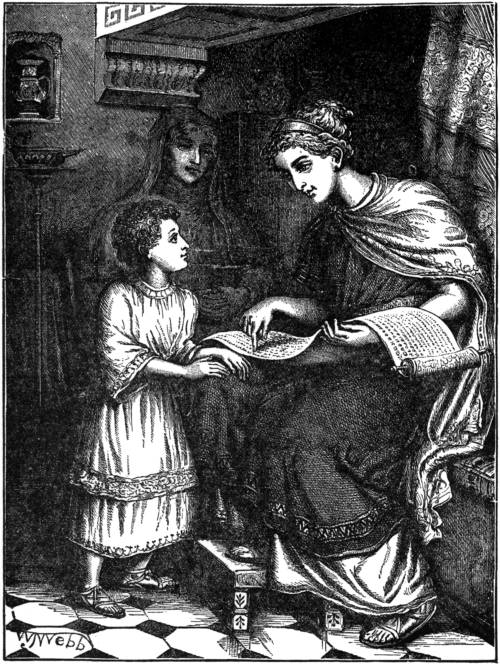
LOIS, EUNICE AND TIMOTHY

THE PHILIPPIAN JAILER

THE PHILIPPIAN JAILER

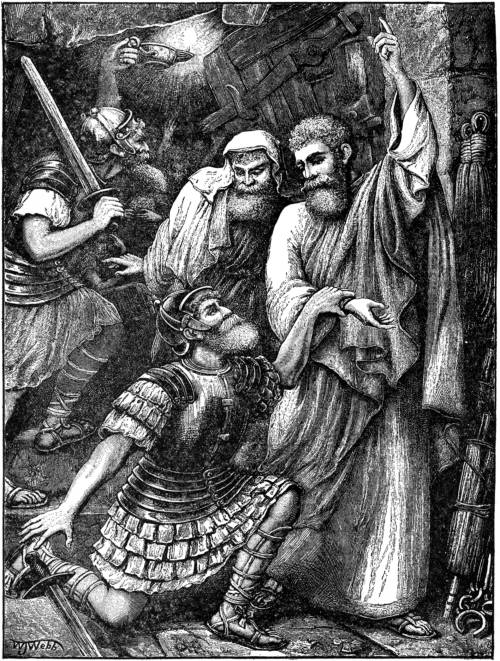
Paul and Silas were in prison. They had done no wrong, but wicked men had taken them before the magistrates; and the magistrates had caused them to be severely beaten, and afterwards had sent them to prison, where they were securely fastened in an inner dungeon, and their feet made fast in the stocks. This was a most painful position for Paul and Silas. But they were not unhappy. They prayed to God, and sang praises to Him; and they sang so heartily that the other prisoners heard them. It was midnight, and all was dark in the prison. But suddenly there was an earthquake; so that the foundations of the prison were shaken, all the doors were opened, and every one’s bonds were loosed. All the prisoners might have run away had they been minded to do so.

The keeper of the prison had been sleeping, but the earthquake awoke him. When he saw the doors open, he supposed that all the prisoners had fled; and knowing how severely he would be punished on that account, he drew his sword to kill himself. Paul knew this, and called out loudly, “Do thyself no harm, for we are all here.” Then the keeper, who but a little while before had cruelly treated Paul and Silas, came trembling, and fell down before them, and said, “Sirs, what must I do to be saved?” He was afraid because of his sins; and wanted to know how he might be saved from the fearful consequences of sin. Paul’s answer was, “Believe on the Lord Jesus Christ and thou shalt be saved.” Then Paul and Silas spoke to him about Jesus. He believed, and was baptized; and the next morning the two disciples were set at liberty.

THE PHILIPPIAN JAILOR BEFORE PAUL AND SILAS

JESUS ASCENDS TO HEAVEN

JESUS ASCENDS TO HEAVEN

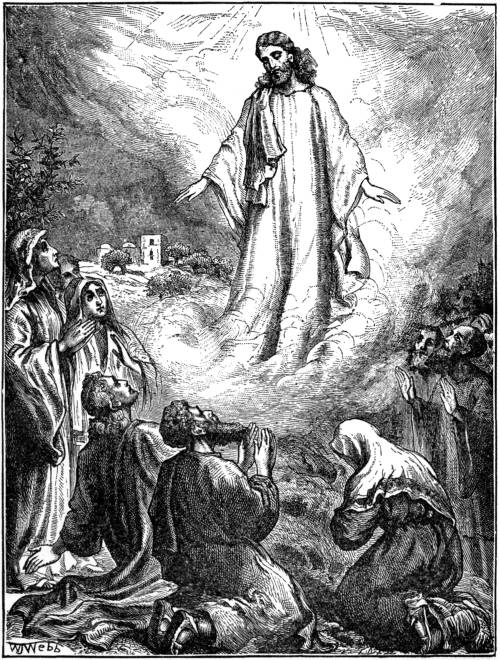
Jesus had been cruelly put to death. His hands, which had been placed on the heads of little children when He blessed them, had been nailed to a cross of wood; and cruel nails had been driven through his feet. And hanging on the cross, Jesus had died. But on the third day He had risen from the tomb, and for forty days He had remained upon the earth, meeting frequently with His disciples. At the end of that time Jesus led the eleven apostles from Jerusalem towards Bethany; and when near that village, and away from the multitude, He spoke to them, promising that they should be made bold by the Holy Spirit, and receive power to witness for Him both to the Jews and Gentiles. Then, the Bible tells us, “He lifted up His hands and blessed them. And it came to pass, while He blessed them, He was parted from them, and carried up into heaven.” And as He went up, a cloud received Him out of their sight.

The apostles fell down and worshipped Jesus, looking steadfastly after Him as He went up; and as they did so, two angels in white garments stood by them, and said, “Ye men of Galilee, why stand ye gazing up into heaven? This same Jesus, which is taken up from you into heaven, shall so come in like manner as ye have seen Him go into heaven.” Then the apostles returned to Jerusalem.

Yes, Jesus has ascended to heaven, and now He sits at the right hand of God; but He tells us that He will come again, and take those that love Him to dwell with Him in His glorious home for ever and ever. “I go to prepare a place for you,” Jesus says.

CHRIST BLESSING THE CHILDREN

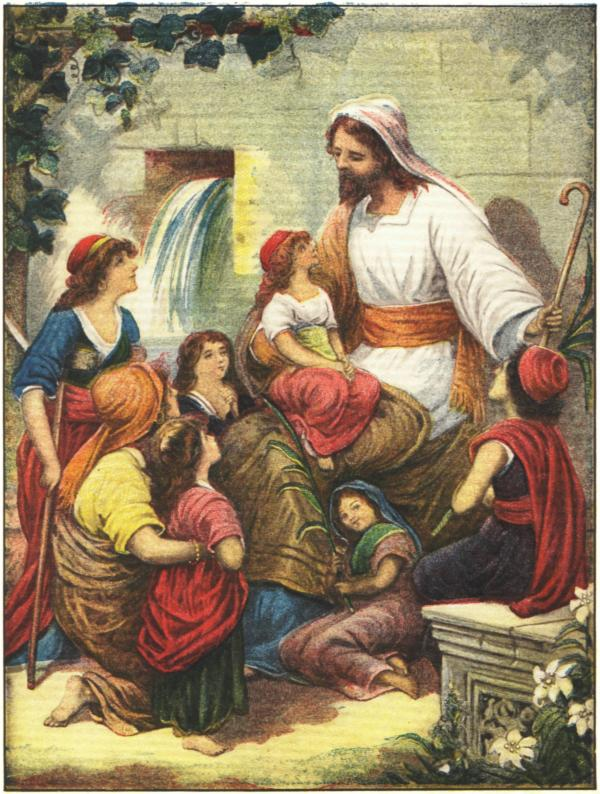
Jesus had left Galilee, and was journeying toward Jerusalem, where He was to be put to death. He was in the country beyond Jordan, called Peræa, and had been speaking some very wise words to the Pharisees, and also to His disciples, when some women came to Him, bringing infants and young children that He might put His hands upon them and pray for them. The disciples thinking probably that Jesus, who had so many important things to attend to, would not wish to be troubled by women bringing their children, rebuked them for so doing. But Jesus loved children. So, when He saw the disciples about to send them away, He was displeased; and, calling the disciples to Him, He said, “Suffer little children to come unto Me, and forbid them not: for of such is the kingdom of God.” Then, we are told, Jesus “took them up in His arms, put His hands upon them, and blessed them.” How kind was Jesus! and how willing that the little ones should be brought to Him! And He is the same now. May all our young readers learn to love Him, and find for themselves how willing He is to love and bless them.

The Parable of the Talents

THE PARABLE OF THE TALENTS

One day Jesus told His disciples this parable or story.

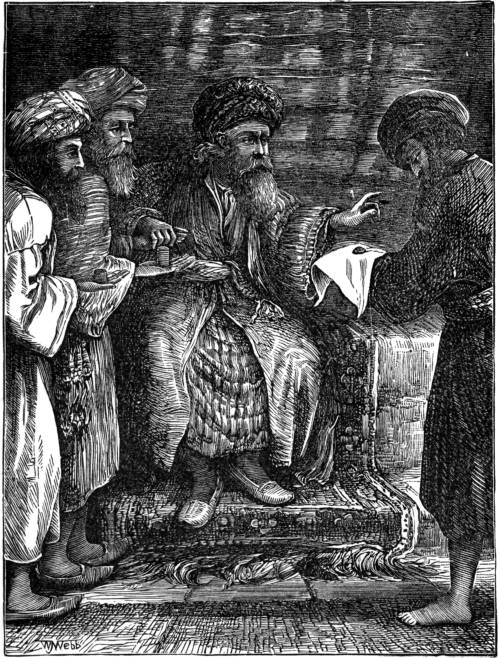
A certain nobleman was called away to a far country to be appointed king of it, and to return after a time. And he called his servants unto him, and charged them with the care of his goods and treasure, giving to each man according to his ability to use the same. To one servant he gave five talents, to another two, and to another only one. And straightway he left them, and departed upon his journey. Then the man that had five talents went and traded with them, and did so well that in time the profits amounted to five talents more, making ten altogether. And he that had received two talents, also traded with his, and added two other talents to them by way of profit. But he that had had but one talent went away and covered it up in a cloth and hid it away.

After a long time the nobleman came back and called his servants to him, and asked them for the treasure he had entrusted to their keeping. And he that had received five talents, brought ten, and said, “Lord, behold, I have gained five other talents beside them.” And his lord said, “Well done, good and faithful servant; thou hast been faithful over a few things, I will make thee ruler over many things. Enter thou into the joy of thy lord.” And to him that had two talents, and brought back four, the lord said the same words. Then came he that had received but one talent and had hid it; and he said, “Lord, I knew thee that thou art a hard man, reaping where thou hast not sown, and I was afraid, and went and hid thy talent, and lo, here thou hast that which is thine.” His lord said unto him, “Thou wicked and slothful servant. Thou knewest that I reaped where I had not sown; thou oughtest therefore to have put my money in the bank, that I might have received mine own with interest for its use. Take therefore the talent from him, and give it unto him that hath ten; and take the unprofitable servant and cast him into the outer darkness.”

Now the talent here mentioned was an eastern sum of money (nearly one thousand dollars), but it really means the powers and opportunities for doing good that God has given to all of us. One day we shall all be called upon to give an account of the talents entrusted to our keeping, and woe be to those who have abused their stewardship by hiding their talent away. But those who have done good, according to the power and opportunity given to them, shall be received into everlasting joy by Christ the Lord.

The Foolish Virgins

THE FOOLISH VIRGINS

In certain parts of the East it is the custom for a man when he is married to bring home his bride at night, and for his relatives and friends to go out with lamps and torches and music to meet him.

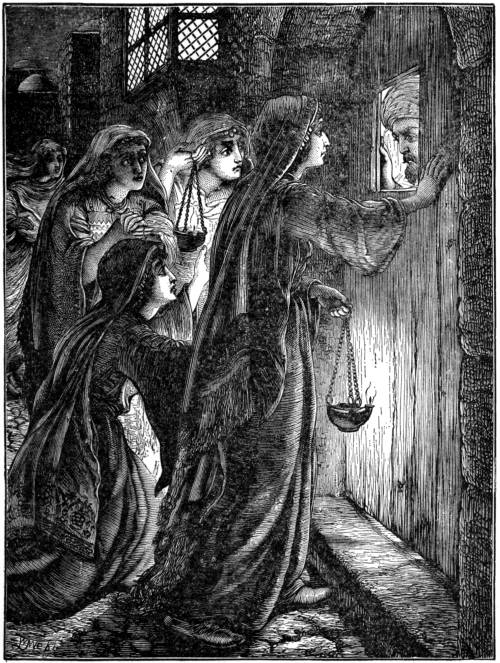
Ten young women had been invited to meet the bridegroom with their lamps burning and to sit down with him at the wedding-feast. Five of them were wise and five were foolish. The wise ones took a supply of oil in case their lamps should burn out before the bridegroom arrived; the foolish five took no oil but what was in their lamps. But before the bridegroom came they all fell asleep.

At midnight there was a cry, “Behold, the bridegroom cometh; go ye out to meet him.” But five lamps had almost burnt out, and the foolish virgins said unto the wise, “Give us of your oil, for our lamps are gone out.” But the wise ones answered, “Not so; lest there be not enough for us and for you. Go ye, rather, to them that sell, and buy for yourselves.” And while they went to buy, the bridegroom came, and they that were ready went in with him to the marriage-feast, and the door was shut.

Afterwards, came also the other virgins, saying, “Lord, Lord, open the door to us.” But he answered and said, “Verily I say unto you, I know you not,” and would not open the door to them.

In this parable the bridegroom means Jesus returning to earth, on the Day of Judgment. The ten virgins are the people of this world, some of whom have their hearts full of the love of God and keep their lamps burning with a steady and bright light; that is, they fulfil God’s commandments and obey the teachings of Christ. The others have not this love in their hearts and are not prepared for Christ’s coming. Their lamps give out a feeble light and soon will go out.

The Wedding Garment

THE WEDDING GARMENT

There was a certain King who gave a great feast upon the occasion of his son’s wedding. And he sent out his servants to bring in those that had been invited, but they would not come. Then he sent forth other servants, saying, “Tell them which were bidden, ‘Behold, I have prepared my dinner; my oxen and my fatlings are killed, and all things are ready. Come unto the feast.'” But they made light of the message and went their ways, one to his farm, another to his warehouse; others took the servants and slew them.

When the King heard what had been done, he was very angry, and sent out his army to destroy the murderers, and burn up their city. Then said he to the servants, “The wedding is ready, but they which were bidden were not worthy. Go ye therefore into the highways, and all ye shall find, bid them come to the marriage.” So they gathered together as many as they could find. And upon each one, as he entered the house, was put a beautiful marriage garment, which the King had prepared. But when the people were all seated, and the King had entered the house, he saw there a man that had not on a wedding garment, and he said unto him, “Friend, how camest thou in hither without a wedding garment?” And the man was speechless, for the garment had been offered to him at first, but he had refused it. Then said the King to the servants, “Bind him hand and foot, and take him away and cast him into outer darkness.”

In this parable, the King means God, who gave the feast for His Son, Jesus Christ. Those who were first asked were the Jews, who refused to believe in Christ. Those who were afterwards brought in, signify the people who have since listened to His Word, and believed in Him. The one without the wedding garment is anyone that pretends to accept the invitation to be one of God’s people, but in his heart does not believe in Christ.

The Wicked Husbandmen

THE WICKED HUSBANDMEN

One day when the priests and elders of the Temple were asking questions of Jesus, He told them this parable.

There was a certain man who had a vineyard which was hedged or walled round, and had a tower. But he was going away into a country far off, so he let the vineyard to a number of husbandmen, or labourers, who were to give him part of the fruit of the vines. When the time had come that the fruit was ripe, he sent his servants to the husbandmen that he might receive his share. But the wicked husbandmen took his servants, and slew one, and beat another, and stoned the third. Then he sent other servants, more than before, but the husbandmen served them as they had done the others. Last of all he sent his own son, saying, “They will reverence my son.” But when those wicked men saw him coming, they said among themselves, “This is the heir to all the vineyard; come, let us kill him and seize on his inheritance.” So they caught him, and cast him out of the vineyard, and slew him.

Then Jesus said to the priests and elders, “When the Lord of the vineyard cometh, what will he do unto these husbandmen?” And they answered, “He will miserably destroy those wicked men, and will let out his vineyard to others, who shall render him the fruits in their season.”

In this parable the owner of the vineyard means God; the vineyard Canaan, and the husbandmen are the Jews, who had promised to obey Him, but had not done so. He had sent His prophets among them, to warn them, but these had been killed. At last, He sent His only Son, but they would not own Him as such, and soon they would kill Him. When the priests heard this, they knew it referred to them, and they were very angry and would have taken Him and killed Him, but they were afraid of the people, who took Jesus to be a prophet.

The Barren Fig-Tree

THE BARREN FIG-TREE

In the morning, when Jesus had left Bethany and was coming towards Jerusalem, He was hungry. Seeing a fig-tree afar off, covered with leaves, He came to it, hoping to find some fruit on it. But the tree was a young one, and had not yet commenced to bear fruit. And He found thereon nothing but leaves. Then He said unto it, “Let no fruit grow on thee henceforward for ever.” And the fig-tree withered away and was dead from the roots. When the disciples saw it, they marvelled, saying, “How soon the fig-tree is withered away!”

Jesus answered, and said unto them, “Verily I say unto you, if ye have faith and doubt not, ye shall not only do as I have done to this fig-tree, but, also, if ye shall say unto this mountain, ‘Be thou removed and be cast into the sea,’ it shall be done. And all things, whatsoever ye shall ask in prayer, believe that ye will receive them, and ye shall have them. And when ye are praying, forgive any that have injured you, that your Father also which is in heaven may forgive you your trespasses against Him. But if ye do not forgive, neither will your Father which is in heaven forgive your trespasses.”

How strange it seems that Jesus, who was gentle and kind, should pronounce a curse on this fig-tree, and cause it to wither away. Why did He do so? Because He wished to impress upon His disciples the terrible danger of unfruitfulness. If we are the disciples of Jesus, we must bear good fruit; we must be loving, kind, and gentle, and try, like Him, to be always doing good.

The Labors in the Vineyard

THE LABOURERS IN THE VINEYARD

“Go, work within my vineyard’s bound,

At eve your ‘penny’ shall be found:

“So spake the vineyard’s lord, and they

Began to toil at break of day.

For hours the sun had shown his face,

When idlers in the market-place

Once and again were sent within

The vineyard’s wall their wage to win.

Nay, when but one short hour remains

Before the sun its goal attains,

More loiterers hear the Lord’s command

And set to work with willing hand.

The steward came at close of day

Their wage to reckon and to pay;

And they whose toil could scarcely tire,

Received a penny for their hire.

But they who the day’s burden bore

And noonday heat, expected more:

And murmur’d that the generous lord

To all one penny should accord.

But he replied, “I wrong not you;

I give you the full wages due;

And why should you my bounty blame,

In paying these beyond their claim?”

Lord, to Thy vineyard Thou dost call

The least, the youngest of us all:

To each Thou dost assign a task,

From each some service Thou dost ask.

How kind such feeble hands to use;

Such pleasant work I needs must choose:

I ask no wages, Lord, from thee,

For Thou hast given Thyself for me.

When I remember all Thy grace,

I cannot loiter in my place:

And when I think of all my sin,

What wages can I hope to win?

Thanks, Lord, if yet my years are few,

And I retain the early dew:

Oh, keep me through the noonday heat,

And cheer me with Thy presence sweet.

For if I have Thy presence, Lord,

‘Tis an exceeding great reward;

And if at last I see Thy face,

‘Tis not of merit, but of grace.

And, oh, what will that “penny” be

Which Thou wilt then bestow on me?

A glorious image it will bear,

Thy own dear Self, Lord, will be there!

Richard Wilton, M.A.

FOOTNOTES:

The penny, or denarius, was a silver coin, stamped with the image of the Roman Emperor, and worth about 16 cents of our money. It was a full ordinary day’s wage at that time.