A place to grow your relationship with God

Archive for the ‘From the New Testament’ Category

THE UNMERCIFUL SERVANT

THE UNMERCIFUL SERVANT

A certain King took account of his servants and began to reckon what they owed him. And there was brought to him one that owed him nearly ten million dollars. But as he had not the money to pay, the King commanded that he should be sold, together with his wife and children and everything that he had, that payment might be made. Then the servant fell down before the King and worshipped him, saying, “Lord, have patience with me, and I will pay thee all.” Then the King had compassion on his servant, and loosed him, and forgave him his debt.

But when that servant had gone out from the presence of the King, he found a fellow-servant who owed him a little over fifteen dollars, and he laid hands on him and seized him by the throat, saying, “Pay me that which thou owest.” And his fellow-servant fell down at his feet and implored him, saying, “Have patience with me, and I will pay thee all.” And he would not have patience, but cast his fellow-servant into prison till he should pay the debt.

When his other fellow-servants saw what had been done they were very sorry, and came to their King to tell him all about it. Then the King called the unmerciful servant to him, and said, “O thou wicked servant; I forgave thee all that debt, because thou desiredst me. Shouldest not thou also have had compassion on thy fellow-servant, even as I had pity on thee?”

And the King was wroth, and delivered him up to the tormentors, till he should pay all that was due unto him.

So likewise, says Christ, shall our Heavenly Father do also unto us if from our hearts we forgive not every one that trespasses against us.

“Forgive us our trespasses, as we forgive them that trespass against us.”

IMPORTUNITY REWARDED

IMPORTUNITY REWARDED

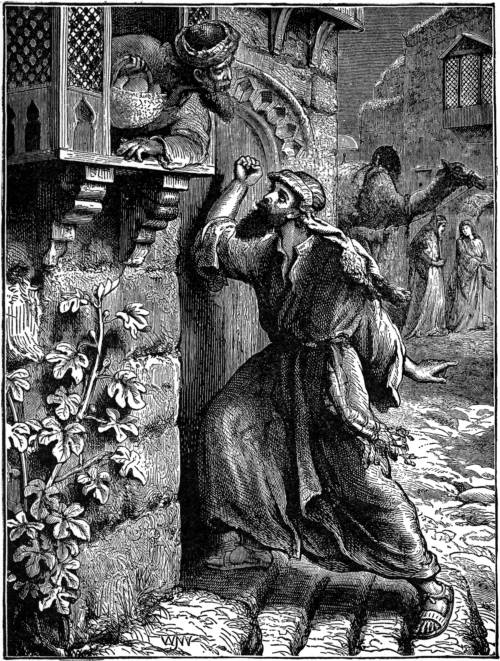
One day Jesus was asked by His disciples to teach them to pray. So Jesus taught them the prayer we all know so well, beginning with “Our Father, which art in Heaven, hallowed be Thy name.” But Jesus told them it was not enough to pray: they must not get tired of praying, even if they failed to receive quickly the things they asked for. They must keep on asking, until God in His own time and manner should grant them what He saw to be good. This great lesson Jesus taught them by the following parable:—

“Which of you shall have a friend,” said Jesus, “and shall go unto him at midnight, and say unto him, Friend, lend me three loaves, for a friend of mine in his journey is come to me, and I have nothing to set before him? And he from within shall answer and say, Trouble me not, the door is now shut, and my children are with me in bed; I cannot rise and give thee. I say unto you,” said Jesus, “though he will not rise and give him because he is his friend, yet because of his importunity (continued asking) he will rise and give him as many as he needeth.”

Then Jesus told His disciples, and He tells us too, “Ask, and it shall be given you; seek, and ye shall find; knock, and it shall be opened unto you.” For, said He, “every one that asketh receiveth; and he that seeketh findeth; and to him that knocketh it shall be opened.” If we ask for those things that God sees to be good for us, we may certainly expect to receive them. Let us ask God to keep us every day; and to give us such things as He knows will be for our good.

THE GOOD SAMARITAN

THE GOOD SAMARITAN

As Jesus was talking to His disciples, a certain lawyer stood up and asked, “Who is my neighbour?” And Jesus answered by telling them this story:—

A certain man went down from Jerusalem to Jericho, and fell among thieves, who robbed him, stripped him of his clothes, and, wounding him, left him on the road half dead. By chance there came a priest that way, and, as a teacher of religion to men, he should have stopped to help the poor man. Instead of this, he pretended not to see, and passed by on the other side of the road. Then there came by a Levite, who also, as an official of the church, should have given help. But he merely came and looked on the injured man, and passed on the other side as the priest had done.

Afterwards there came by a Samaritan, and, when he caught sight of the wounded Jew, he went over to him and was very sorry for him. Now the Jews hated the Samaritans, and were their enemies, so that it would not have been surprising if he, also, had done as the priest and the Levite did. But, no! Though it was his enemy, he could not pass him by and leave him on the road, perhaps to die. He examined his wounds and bound them up; doing all that he could to soothe them. Then he lifted him carefully on his own beast, and brought him to the nearest inn, and took care of him through the night. The next day, when the Samaritan departed, he paid the man who kept the inn, and said to him, “Take care of this poor man until he is well, and whatever it may cost for his lodging and food, that I will pay thee when I come again.”

“Which of these three, thinkest thou, was neighbour unto him that fell among thieves?” The lawyer answered, “He that showed mercy unto him.” Then said Jesus, “Go, and do thou likewise.”

Peter and the Tribue Money

PETER AND THE TRIBUTE-MONEY

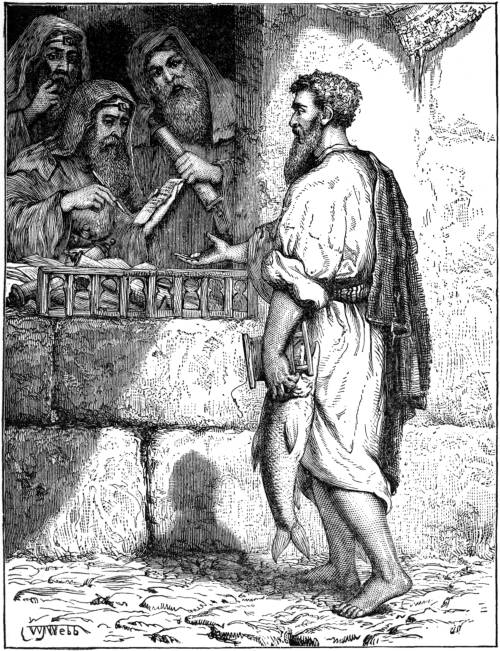
It was a part of the Jewish law that all strangers passing among the Jews should pay to the priests of the Temple an offering to the Lord, or tribute-money as it was called.

Soon after our Lord’s Transfiguration He came to Capernaum, together with His disciples. When they had entered the city, there came to them the priests who usually collected this tribute-money, and they said unto Peter, “Doth not thy Master pay tribute?” And he answered, “Yes.” But when they had come to the house, Jesus said to Peter, “What thinkest thou, Simon? Of whom do they take tribute; of their own people or of strangers?” And Peter answered Him, “Of strangers.”

Jesus saith unto him, “Then their own people are free; but lest we should offend them by not paying, go thou down to the sea, and cast in thy hook and line, and take up the first fish that taketh the hook into his mouth. And when thou hast opened his mouth, thou shalt find a piece of money there. Take it and give it unto the priests as tribute for Me and for thee.” And Peter went down to the sea and cast in his line, and took a big fish. And when he had opened its mouth he found the piece of silver, and took it to the men in payment of the tribute.

This tribute was collected to pay the expenses of the Temple worship. Jesus sought to show that, as He himself was the Son of God, the King for whose service the tribute was paid, He might justly be exempted from paying it; yet to save giving offence He miraculously provided the piece of money to pay tribute for Himself and Peter.

THE WOMAN OF CANAAN

THE WOMAN OF CANAAN

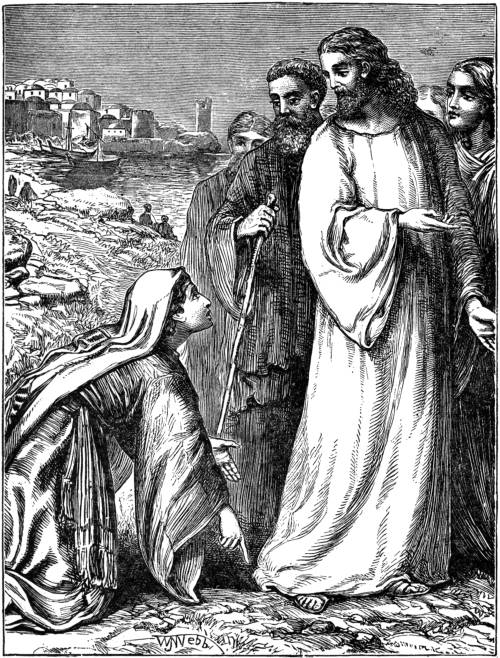
Jesus came unto the borders of Tyre and Sidon, where the people were not Jews, but Gentiles. And there came to Him a woman of Canaan, who cried out to Him, saying, “Have mercy on me, O Lord, Thou son of David; my daughter is grievously vexed with a devil.” She besought Him to cast out this evil spirit from her daughter. But He answered not a word, and His disciples counselled Him to send her away. Then He told her He was not sent unto the Gentiles, but unto the lost sheep of Israel; meaning the Jews. This was said to try her faith. Then she came and worshipped Him, saying, “Lord, help me.” But He said, “It is not meet to take the children’s food and to cast it to dogs;” meaning that His help was due rather to the Jews than to the Gentiles. And she said, “Truth, Lord, yet the dogs sometimes eat of the crumbs which fall from their masters’ table;” meaning that, though she was a Gentile, she believed in Him as the Son of God.

Then Jesus answered, and said unto her, “O woman, great is thy faith; be it unto thee even as thou desirest. Go thy way; the devil has gone out of thy daughter.” And when she was come to her house she found her daughter made whole and laid upon the bed.

Jesus, with His knowledge of our hearts, knew the faith this poor woman had, and tried it so that it might shine the brighter. Then He granted her the blessing she had asked Him for; and how she must have rejoiced when she reached home and found her daughter quite well and restored to her right mind.

CHRIST WALKING ON THE SEA

CHRIST WALKING ON THE SEA

When the people had seen the miracle that Christ did in feeding so many with so few loaves, they felt sure that He was one of the old prophets that had come again, and they would have taken Him by force to make Him king. So, He sent His disciples by boat towards Capernaum, and He went, alone, up into a mountain to pray.

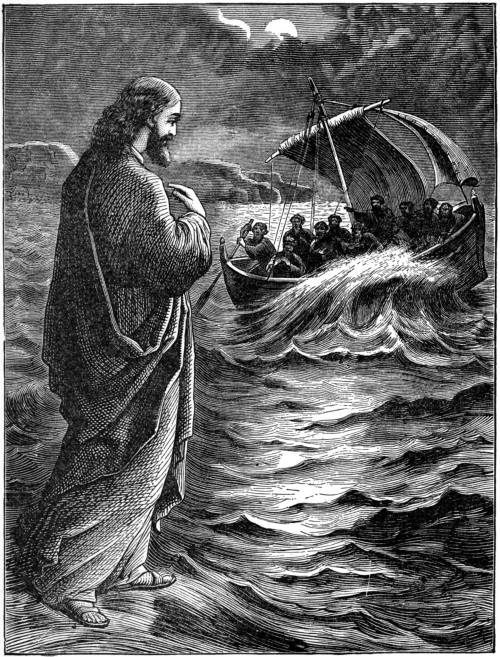
When it was dark, the disciples found themselves alone upon the sea, opposed to strong winds, which tossed the boat upon high waves. Then Jesus went out to them, walking upon the waves; but when the disciples saw Him they thought it was a spirit, and cried out with fear. But Jesus said, “Be of good cheer: it is I; be not afraid.” Peter answered Him, saying, “Lord, if it be Thou, bid me come unto Thee on the water.” And He said, “Come,” and Peter stepped over the boat’s side and walked on the water towards Christ. But when he saw the angry waves around him and heard the roaring of the winds, Peter was afraid and began to sink. He cried out, “Lord, save me.” And Jesus, stretching out His hand, caught him, and said, “O thou of little faith, why didst thou fear?”

When Jesus and Peter had got into the boat, the wind dropped, the sea became calm and the waves still, and immediately they were at the place where they wanted to land. Then they worshipped him, saying, “Truly Thou art the Son of God.” And they came into the land of Gennesaret, where the people knew Him and brought to Him all that were sick, or blind, or lame, that they might touch His garment and be made well.

Feeding Five Thousand

FEEDING FIVE THOUSAND

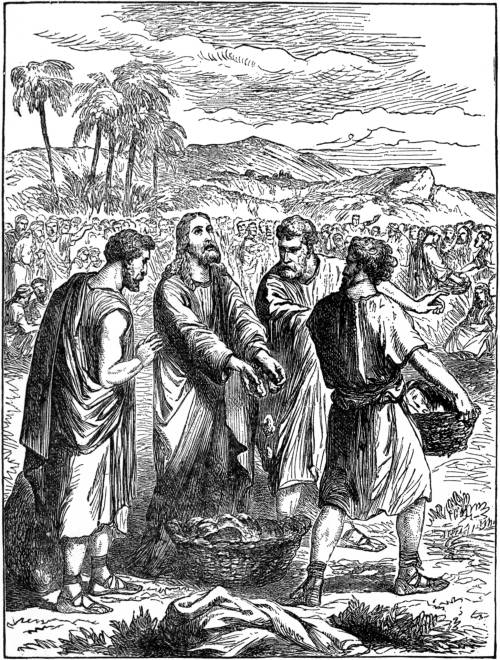
One day Jesus went on board a ship and sailed to another part of the coast, where He and His disciples might have rest. For the people in the cities crowded them so closely that they did not even have time to eat. They landed and went into a desert place; but the people had seen them depart and marked which way the ship sailed. Then they all flocked out of the cities and came on foot to the place where Jesus was. When Jesus saw what a great number of people had come, He had compassion on them, and spoke to them, and healed their sick. But in the evening the disciples came to Jesus and said, “This is a desert place, and the day has gone; send the people away, that they may go into the villages and buy food.”

Jesus was too kind to send them away hungry like that. He said, “They need not depart; give ye them food to eat.” But they said to Him, “We have here but five loaves and two fishes, which we have just purchased of a lad.” He said, “Bring them to Me.” Then He told the people to sit down on the grass; and He took the five loaves and the two fishes, and looking up to heaven, blessed them and broke them into pieces. The disciples carried the bread and fish to the people, and they all ate and had plenty, although there were about five thousand men, besides women and children. And yet, when the disciples took up the fragments that were left, these fragments filled twelve baskets. How kind was Jesus! He not only taught the people and healed their sick, but He fed them when out in the desert place and hungry.

The Two Blind Men

THE TWO BLIND MEN

When Jesus had left the house of the ruler Jairus, there followed Him two blind men. They called out to Him, “Thou Son of David, have mercy upon us.”

Then Jesus looked at them, and asked if they really believed that He had power to cure them and give them back their sight. And they said unto Him, “Yea, Lord.” Then He touched their eyes, and said unto them, “According to your faith, so be it unto you.” And immediately they opened their eyes and were able to see. Jesus charged them to let no man know what He had done. But when they were departed they spread His fame abroad over all that country.

Another time Christ and His disciples were coming away from Jericho, followed by a large crowd of people. And there was sitting by the wayside a blind beggar, Bartimeus by name; and when he heard the noise of the multitude, he asked what it meant. They answered him, “Jesus of Nazareth passeth by.” Then he cried out in a loud voice, saying, “Jesus, Thou Son of David, have mercy on me.” The people tried to keep him from calling out, but he would not be quiet. He was determined that Christ should see him. And Jesus stood still and commanded them to call him. So, he arose and cast away his outer garment and came to Jesus. When Jesus asked what he would have done to him, he answered, “Lord, that I might receive my sight.” And Jesus said unto him, “Go thy way; thy faith hath made thee whole.” And he received his sight at once, and followed Jesus, praising Him.

Jairus’ Daughter

JAIRUS’ DAUGHTER

Jairus was one of the rulers of the Jewish church, or synagogue, and he had a daughter who had been very ill and was now at the point of death. She was an only daughter, and was twelve years of age. So hearing that Jesus was near, he came to Him, and, falling down before Him, implored Jesus to come and see her.

And Jesus arose, and followed him, and so did His disciples. Soon there came running to them a messenger from the ruler’s house, who said to Jairus, “Thy daughter is already dead; do not trouble the master.” But when Jesus heard it He turned to Jairus and said, “Fear not. Only believe, and she shall be restored to life.”

When they came to the ruler’s house they saw the minstrels and many people who were making much noise and lamentation for the dead girl, as was the custom. Jesus said unto them, “Make way; weep not, for the maiden is not dead, but sleepeth;” but they laughed Him to scorn, knowing that she was dead. And He put them all out of the room, all but Peter and James and John, and the mother and father of the maiden. Then He took her by the hand, and called to her, saying, “Maid, arise.” And her spirit came again, and she arose straightway; and He commanded her parents to give her food.

Her parents were astonished when they saw their daughter raised to life and able to eat, but Jesus charged them that they should tell no man what He had done. But the fame of the miracle He had wrought went abroad unto all that land.

Curing the Incurable

CURING THE INCURABLE

Jesus went into Capernaum, followed by a great crowd of people, and among them was a woman who for twelve years had suffered from a disease which no doctor could cure, though she had consulted many, and spent all her wealth upon them. She had said within herself, “If I could but touch His garment I should be made well.” So she pressed through the crowd, and put out her arm and touched the hem of His garment, and immediately she was made well.

Then Jesus, turning round to His disciples, said, “Who touched Me?” But they all denied that they had done so, and Peter and they that were with him said, “Master, the multitude throng Thee and press Thee, and yet Thou sayest, Who touched Me!” They were surprised that Jesus should make such an enquiry, seeing that so many were crowding round Him, and pressing against Him. But Jesus said, “Somebody hath touched Me, for I perceive that healing virtue hath gone out of Me.”

When the woman saw that Jesus knew what she had done, and that she could not be hidden in the crowd, she came trembling, and, falling down before Him, she declared unto Him before all the people why she had touched Him, and how she had been healed at once. And He said unto her, “Daughter, be of good comfort; thy faith hath made thee whole. Go in peace, and be healed of thy illness.”

Jesus wishes us to trust in Him. We suffer from a terrible disease—the disease of sin, which no doctor can cure; but Jesus will heal us and take away our sin if we trust in Him.