A place to grow your relationship with God

Archive for the ‘From the New Testament’ Category

The Man Possessed by Devils

THE MAN POSSESSED BY DEVILS

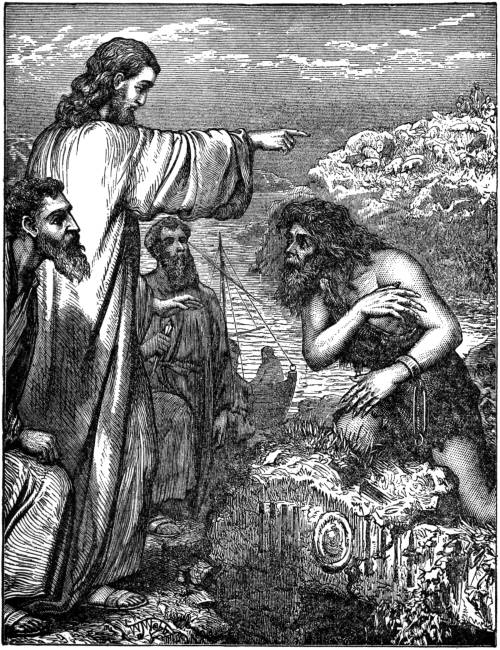
One day Jesus came with His disciples in a boat to the country of the Gadarenes, near Galilee. They landed near the tombs, that is, caverns cut into the rock, where the dead were buried. And there met them a man, who, for a long time, had been possessed by many unclean spirits. He lived in the tombs and wore no clothes. He had been so fierce and wild that his friends had been obliged to chain him up, but he had burst his fetters, and the devils had driven him out to the tombs.

Jesus bade the unclean spirits to come out of the man. And when the man caught sight of Jesus, he cried out, and fell down before Him, saying, “What have I to do with Thee, Jesus, Thou Son of God most high? I beseech Thee to torment me not.”

And Jesus asked him his name. And he said, “Legion,” because many devils were in him. They besought Jesus that He would not make them go into the sea, but would let them enter into a herd of swine that were feeding on the cliffs close by. He suffered them to do so, and the devils went out of the man and entered into the pigs, and the whole herd ran violently over the cliff into the water and were drowned. And when the herdsmen saw what was done, they fled into the city and told all the people. Then the people came out to Jesus, and they saw the man that had been possessed, clothed and in his right mind, sitting at the feet of Jesus. And they that had seen it told them by what means the man had been healed, and they were afraid. The man out of whom the devils had departed, besought Him that he might stay with Jesus, but He sent him away, saying, “Return to thy house, and show what great things God hath done unto thee.” And he went his way and published throughout the city what great things Jesus had done unto him.
The Parable of the Net

THE PARABLE OF THE NET

These fishermen have just returned to shore with their net full of fish. Now this is not a casting-net, which is thrown out from the boat and drawn in again, but a drag-net which is of great length, and which is drawn constantly through the water until it is well filled with fish. It is then hauled up to the shore, and the fishermen sit around it, and take out the fish. Many of these, of course, are unfit for food, or not liked. They cast those into the sea again, but the good fish which they can sell for food are carefully placed in vessels brought for the purpose.

Christ said, “The kingdom of heaven is like unto a net, that was cast into the sea, and gathered every kind (of fish): which, when it was full, they drew to shore, and sat down, and gathered the good into vessels, but cast the bad away. So shall it be at the end of the world: the angels shall come forth, and sever the wicked from among the just, and cast them into the furnace of fire. There shall be wailing and gnashing of teeth.”

At another time Jesus taught His disciples the same truth; when He spake of His coming and of the gathering of all nations before Him, the good entering into eternal life, but the wicked being cast away. “When the Son of Man shall come in His glory,” said Jesus, “and all the holy angels with Him, then shall He sit upon the throne of His glory. And before Him shall be gathered all nations; and He shall separate them one from another, as a shepherd divideth his sheep from the goats. And He shall set the sheep on His right hand, but the goats on the left.”

The Pearl of Great Price

THE PEARL OF GREAT PRICE

Very similar to the parable of the Hidden Treasure is this one of the merchant seeking goodly pearls.

“The kingdom of heaven is like unto a merchantman seeking goodly pearls, who, when he had found one pearl of great price, went and sold all that he had, and bought it.”

In the picture we see the merchant on the sea-shore, where he has waited for the landing of these sailors from another country. He asks them if they have any goodly pearls for sale, and one man opens his box and takes out this “pearl of great price.” It is just the kind of pearl the merchant had been seeking, so he quickly produces his two bags of gold and offers them to the man for his pearl. But the man smiles. “What! part with so large and so beautiful a pearl for two bags of gold?” He could not think of it. The pearl is again placed in its box, and the merchant has to go away disappointed. But the longing to have that pearl is too great. A thought occurs to him. He will go home and sell all that is his, and the money he shall thus obtain, added to his two bags of gold, will surely buy the precious jewel.

And so, it is with men when they seek that pearl of pearls, the forgiveness of God. They will give up a great deal in order to obtain it, but they find that God requires them to give up everything that is sinful or worldly. And if their hearts are really set upon obtaining it, they will do as this merchant did, and part with everything that would hinder them from coming to God or walking in the way that leads to heaven.

SEEKING FOR HIDDEN TREASURE

SEEKING FOR HIDDEN TREASURE

The people of Canaan, both in ancient and modern days, have made a practice of hiding their treasures. This they have done to secure them in times of danger. When invaders flocked into the land, the people buried their gold and jewels and fled. And often they died, or were overtaken by their enemies and killed, so that they were unable to return and regain their buried riches. Earthquakes also have taken place, destroyed towns and villages, and burying all the riches in them beneath their ruins. Thus, there is much hidden treasure in Canaan, and numbers of the inhabitants spend their time seeking diligently and anxiously for it.

Our artist shows us a man who is thus seeking. He has heard that in old times a great treasure was hidden in a particular field. So, he digs away patiently in various places until, at last, he finds out that what he heard is quite true. He is sure the treasure is there; and his desire is to become possessed of the field, so that he may obtain the buried riches. He is willing to sell all that he has if by so doing he may buy that field. So, he hastens home and gathers together the whole of his property and sells it. Then he takes his money to the man who has the land for sale and buys the field of him. Thus, he becomes possessed of the treasure he has sought after. Jesus says that the Kingdom of Heaven is like that treasure. It is so precious, that when a man finds out its value, and knows how it can be obtained, he will be willing to give up everything he has for it—all his companions, pleasures, sins, riches—indeed everything he possesses, in order to gain this great treasure.

The Parable of the Leaven

THE PARABLE OF THE LEAVEN

Christ said that the kingdom of heaven could be likened unto leaven (or yeast), which a woman took and hid in three measures of flour, till the whole was leavened.

Now, this leaven, or yeast, is composed of tiny little plants, each one so small that it cannot possibly be seen by the sharpest eye except through a very powerful microscope. So small are they that it would require three thousand of them, placed close together, side by side, to make up the length of one inch. Like all other plants they require food, and they find this in the dough they are placed in. You know that all things are made up of atoms of chemical substances so wonderfully blended together that only the chemist can separate them, and when he has separated them they appear very different. Well, in flour there are certain things so blended, and the yeast-plant takes one kind of substance as food, and in doing so sets free another substance called carbonic acid gas. This gas bubbles up and makes the heavy dough spongy and light. If it were not for these tiny bubbles of gas your bread would be as heavy and close as suet pudding. This is the reason why yeast is put into dough for making bread or cake. One of the most remarkable things about this yeast is, that when it gets into any substance that contains its food, it at once begins to give off buds, which, in a few moments, become full-sized and break away. So rapid is this increase, that if a single yeast-plant were to be put into a great mass of dough it would very quickly leaven the whole mass.

THE PARABLE OF THE LEAVEN

And so, it is with the love of God. When once it gets into our hearts it will keep on growing until all our life is filled with it, and we try in all things to please Him.

The Enemy Sowing Tares

THE ENEMY SOWING TARES

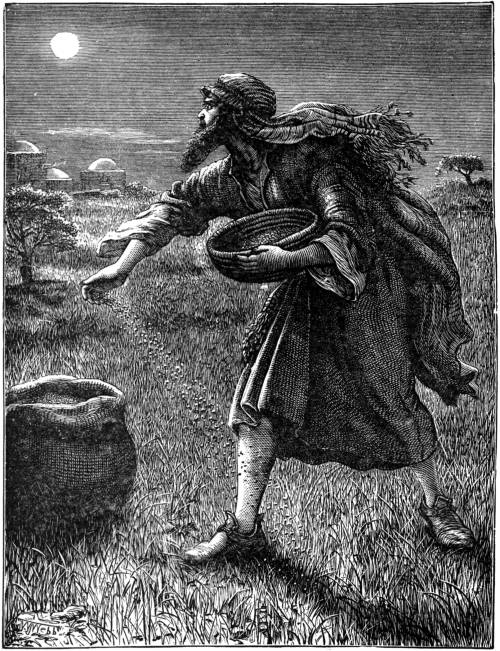
A certain man sowed good seed in his field, but in the night, whilst men slept, his enemy came and sowed tares among the wheat and went his way. When the wheat-blade had sprung up and showed the ear, then appeared the tares also. So, the servants of the householder came to him and said, “Sir, didst not thou sow good seed in thy field? Whence then come these tares?”

He said unto them, “An enemy hath done this.” Then the servants asked, “Shall we go, then, and gather them up?” But he said, “Nay, lest whilst you gather up the tares, you root up the wheat with them. Let both grow together until the harvest, and in that time, I will say to the reapers, ‘Gather ye together first the tares and bind them into bundles to burn them, but gather the wheat into my barn.'”

THE ENEMY SOWING TARES

Jesus’ disciples asked Him to explain this parable to them, and He said: “The field represents the world, and He that sowed the good seed is Christ Himself. The good seed is the Word He preached; the wheat plants are the good people who believe in Christ and do as He teaches. The enemy who sows the bad seed is Satan, and the tares that spring from them are wicked people who follow the promptings of the evil one in their hearts. The harvest is the end of the world, and the reapers are the angels of God. As therefore the tares are gathered and burned in the fire, so shall it be in the end of this world with wicked people. Christ shall send forth His angels, and they shall gather out of His Kingdom all things that offend and them that do evil and shall cast them into a furnace of fire; there shall be wailing and gnashing of teeth. Then shall the righteous shine forth as the sun in the kingdom of their Father.”

“For the Lord our God shall come, and shall take His harvest home; From His field shall in that day All offences purge away.

“Give His angels charge at last in the fire the tares to cast, But the fruitful grain to store In His garner evermore.”

SOWING THE SEED

SOWING THE SEED

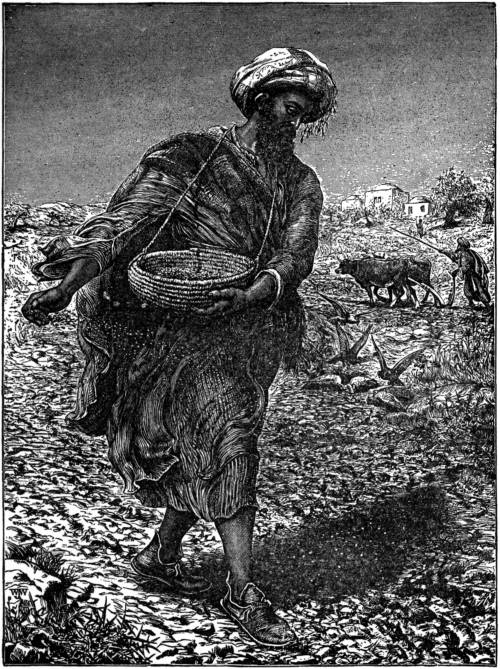
A sower went out to sow his seed, and as he sowed some fell by the wayside and was trodden down, and birds came and devoured it. And some fell upon a rocky place, where there was not much soil, and as soon as it sprang up it withered away, because it lacked moisture. And some fell among thorns and weeds, and they sprang up with it and choked it. But other fell on good ground, and sprang up bearing ears, some with thirty, some sixty, some a hundred seeds.

When Jesus had told this parable, His disciples asked Him to explain it to them. He said that the seed is the Word of God. The wayside signifies the people who hear the Word but do not understand it, and Satan comes and takes all thought of it out of their hearts as quickly as the birds devour the seeds. The rocky places without much earth denote those who, when they hear the Word, receive it with great joy and profession of faith; but it never takes deep root in their hearts, and when they are tempted they fall away and the good seed in their hearts is withered up. The thorns and weeds are the pleasures and riches of this life, which root so deeply and strongly in men’s hearts that the good seed has no chance, and is soon killed off.

But the good ground is the hearts of good people, who remember God’s Word and try, every day of their lives, to do as He wishes us to do, and to live holy and useful lives. The seed falling upon their hearts becomes strongly rooted and grows up vigorously, bearing good fruit.

What shall be said of your heart, my young friend? Is it like the wayside? the rocky place? the thorny ground? or like a good field that has been well prepared for the seed?

SOWING THE SEED

THE UNFRUITFUL TREE

THE UNFRUITFUL TREE

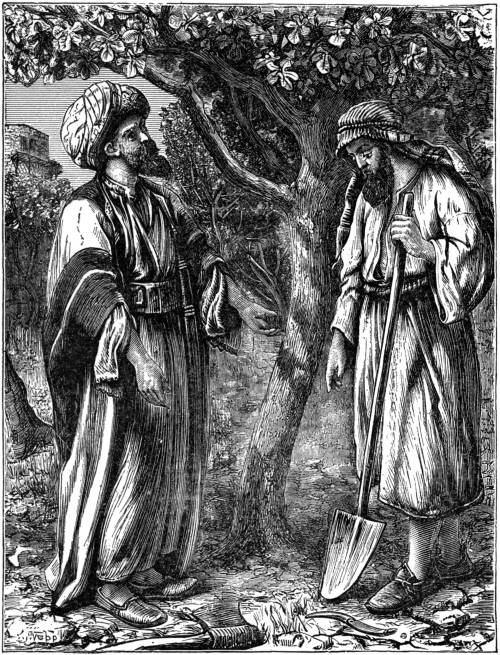
A certain man had a fig-tree planted in his vineyard, and he came and sought fruit thereon, but found none. Then he called to the gardener who attended to his vineyard, and said to him, “Behold these three years I come seeking fruit on this fig-tree, and find none. Cut it down. Why does it encumber the ground?”

The gardener answered him and said, “Lord, let it alone this year also, till I shall dig about it and manure it. And if it bear fruit then, it is well; but if not, then, after that, thou shalt cut it down.”

In this parable the vineyard means the world, and the fig-tree ungodly people whose lives do not produce good works—do not produce fruit in the service of God. The Lord of the vineyard, that is, God, would destroy such people, but Christ intercedes in their behalf, that time for repentance may be given. “He is not willing that any should perish, but that all should come to repentance.” Christ came and sought to change men’s hearts, and make their lives fruitful for God. The warning has been given, and when the Lord of the vineyard comes again to seek good fruit the unfruitful trees shall be destroyed.

Am I a barren tree, dear Lord? A cumberer of the ground. OH! give me grace to fruitful be, And in Thy work abound.

THE UNFRUITFUL TREE

The Rich Fool

THE RICH FOOL

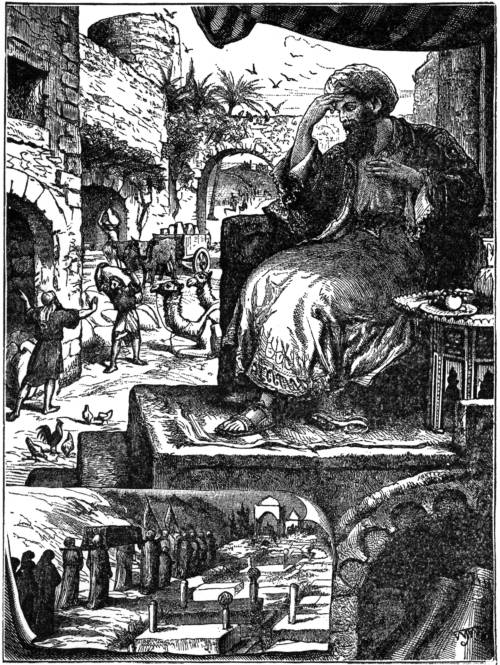
There was a certain rich man who owned much land. And his fields and vineyards were so productive that when the time of harvest came, he had not room enough to store his corn and fruits. So, after much thought he said, “This will I do. I will pull down my barns and build greater ones, and there will I store all my fruits and my goods. Then I can say to myself, ‘I have great store of goods laid up, enough for many years; now I can take mine ease, eat, drink, and be merry.'”

THE RICH FOOL

But God said unto him, “Thou fool, this night thy soul shall be required of thee; then whose shall those things be which thou hast hoarded?”

Jesus says it shall be so with all those who set their minds upon storing up riches in this world, rather than laying up treasures in heaven by pleasing God and working in His service. Death will come when they least expect it, and they will have to leave all their earthly riches, and go where no treasure has been laid up for them.

And He said unto His disciples, “Take no thought for your life, what ye shall eat; neither for the body, what ye shall put on; for the life is more than meat, and the body more than raiment. For all these things do the nations of the world seek after, and your Father knoweth that ye have need of these things. But rather seek ye the kingdom of God; and all these things shall be added unto you. Fear not, for it is the Father’s good pleasure to give you the kingdom. Sell what ye have and give alms; provide yourselves a treasure in the heavens that faileth not, where no thief approacheth, or moth corrupteth.”

ANOINTING THE FEET OF JESUS

ANOINTING THE FEET OF JESUS

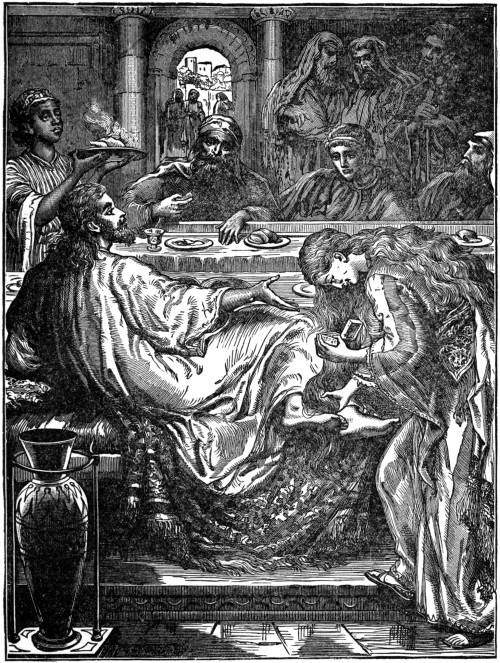
On one occasion, a proud Pharisee, whose name was Simon, invited Jesus to eat with him. But the invitation was a cold one. There was no kiss of welcome, no water to bathe His hot and dusty feet, no perfumed ointment for His head: nothing but a bare admission to a vacant place at the table was granted to Jesus. But there He reclined, His left elbow resting on a cushion, and His feet projecting beyond the edge of the couch.

Now it happened that a poor, sinful woman was passing, who, discovering that Jesus was in the house, timidly entered, and stood behind Him. She had an alabaster box of ointment, and, as she looked on Jesus, she wept. Her tears fell upon His feet; so, stooping down, she tenderly wiped them away with her long hair; then she kissed the Saviour’s feet, and anointed them with the fragrant ointment. This was done as a token of respect and love.

But an evil eye had noted the kindly act; and the proud Pharisee thought within himself, if Jesus were the prophet He professes to be, He would certainly have known that the woman was a great sinner, and would not have allowed her to touch Him. But Jesus came to save sinners. He loves them, though He hates their sins. He rebuked the haughty Simon; and showed him how he had neglected the commonest rites of hospitality towards his guest, while this poor woman had treated Jesus with the greatest reverence. Then Jesus said, “Her sins which are many are forgiven, for she loved much”; and He bade her go in peace.

ANOINTING THE FEET OF JESUS