A place to grow your relationship with God

Archive for the ‘From the Old Testament’ Category

Engaging Children’s Books, Fun Facts and Delicious Recipes

Children’s Bible books

  • For older kids
    • THE CHILDREN’S SIX MINUTES by Bruce S. Wright: The Children’s Six Minutes by Bruce S. Wright features a collection of themes exploring growth, kindness, faith, and life’s lessons through various engaging stories and reflections.
    • The Wonder Book of Bible Stories: “The Wonder Book of Bible Stories” by Logan Marshall shares simplified biblical narratives for children, conveying essential moral lessons through engaging tales from the Bible.

Children’s books

  • For younger kids
    • McGuffey Eclectic Primer: textbook focused on early literacy, teaching reading and writing through simple lessons and moral stories for young children.
    • McGuffey’s First Eclectic Reader: educational textbook for young readers, combining phonics, sight words, moral lessons, and simple narratives to enhance literacy skills.
    • MCGUFFEY’S SECOND ECLECTIC READER: educational book for children, promoting literacy and moral values through engaging prose, poetry, and vocabulary exercises.
    • The Real Mother Goose: a collection of nursery rhymes, reflecting childhood’s whimsical essence through well-known verses and engaging illustrations.
    • THE GREAT BIG TREASURY OF BEATRIX POTTER: The Great Big Treasury of Beatrix Potter features beloved stories like The Tale of Peter Rabbit and The Tale of Jemima Puddle-Duck, celebrating whimsical animal adventures.
    • The Tale of Solomon Owl is a whimsical children’s book by Arthur Scott Bailey, exploring themes of friendship and adventure through Solomon Owl’s humorous encounters with forest animals.
    • THE TALE OF JOLLY ROBIN: follows a young bird’s adventures as he learns life skills, values friendship, and explores youthful curiosity through humorous encounters in the wild.
    • Peter and Polly Series: The content describes a series of stories for 1st graders featuring Peter and Polly, exploring seasonal adventures, imaginative play, nature, family, and interactions with pets and animals.
    • The Adventures of Old Mr. Toad: recounts Old Mr. Toad’s humorous nature-filled journeys, emphasizing lessons on friendship, humility, and personal growth amidst various animal encounters.
    • The Wonderful Wizard of Oz: follows Dorothy’s adventures in Oz as she seeks to return home, meeting memorable friends while exploring themes of courage, friendship, and self-discovery.
  • For older kids
    • Stories of Don Quixote Written Anew for Children retells key adventures from Cervantes’ novel, preserving its spirit while engagingly presenting them for young readers in a cohesive narrative.
    • Heidi by Johanna Spyri follows a young girl adapting to life in the Swiss Alps with her grandfather, highlighting themes of family, love, and the power of nature.
    • Swiss Family Robinson by Johann David Wyss: is a beloved adventure novel by Johann David Wyss about a Swiss family stranded on a deserted island, relying on their creativity and teamwork to survive and build a new life.
    • Rebecca Of Sunnybrook Farm: follows the spirited Rebecca Randall as she navigates life with her aunts in Riverboro, experiencing adventure, growth, and identity exploration.

Children’s history book

  • For younger kids
    • Great Stories for Little Americans: introduces young readers to American history through engaging tales, fostering national pride and knowledge of heritage via accessible storytelling.
    • The Bird-woman of the Lewis and Clark Expedition: A Supplementary Reader for First and Second Grades- tells Sacajawea’s vital role in guiding the explorers, emphasizing her contributions and experiences during this historic journey.
    • The Story of Mankind: chronicles human history from prehistory to the modern era, highlighting key events, cultures, and figures that shaped civilization.
    • A First Book in American History: A first book in American history: with special reference to the lives and deeds of great Americans. This book chronicles pivotal figures in American history, from Columbus and John Smith to Franklin and Lincoln, highlighting their contributions and the nation’s expansion.
  • For older kids

Poem and stories

  • THE PLYMOUTH HARVEST by Governor Bradford
  • The Real Mother Goose Poems Book: a collection of nursery rhymes, reflecting childhood’s whimsical essence through well-known verses and engaging illustrations.
  • Top Poems for Children by Famous Authors: A list of children’s poems organized by author, with future additions anticipated, includes works by notable poets and authors. [Coming soon]
  • Poems and stories by Bell: Bell, a young poet, shares her love for God through inspiring poems and stories centered on nature, love, and faith, aiming to bless and bring joy to readers.
  • Explore Heartfelt Poems and Stories for Inspiration: Poems and stories to warm your heart.
  • Heartfelt Tales of My Beloved Pets: The author shares stories of various animals that have impacted their life, encouraging love for pets and providing comforting Bible verses for grieving pet owners.

Children bible study

Hezekiah and Sennacherib

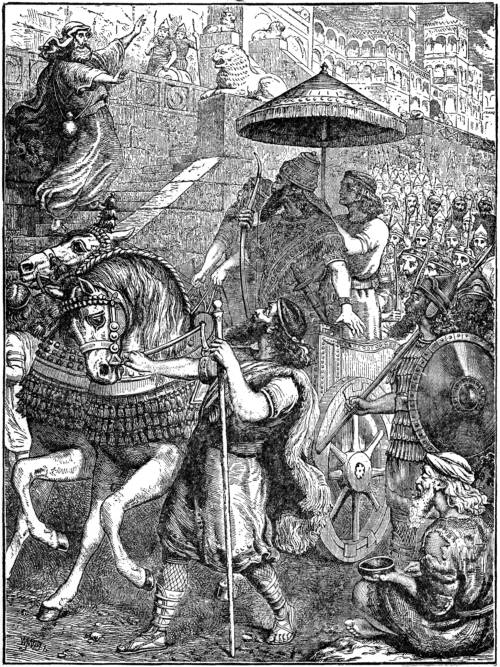
HEZEKIAH AND SENNACHERIB

Sennacherib, the King of Assyria, invaded the land of Judah, and threatened to lay siege to Jerusalem. Then Hezekiah took counsel with his princes and mighty men, and repaired the broken walls, and made them higher. He made many other preparations for the defense of the city, and went among his people, exhorting them to trust in God, and be of good courage. But Sennacherib sent messengers to induce those that guarded the walls of the city to revolt against Hezekiah, saying, “Do not believe this Hezekiah when he tells you that your God will deliver you; hath any of the nations against which I have made war been delivered by their gods?”

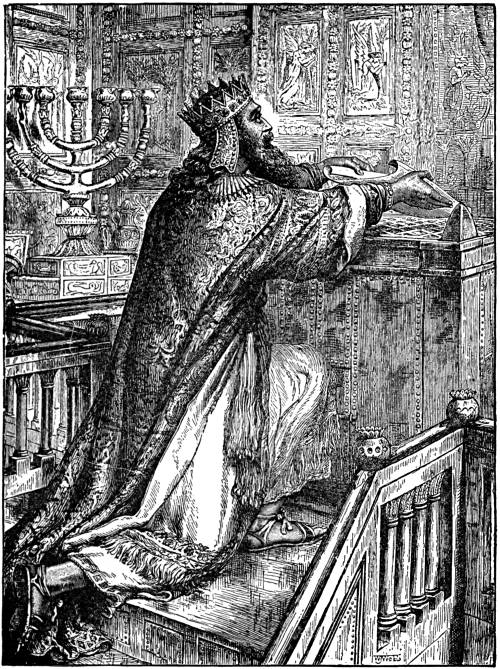
When Hezekiah heard these words he went into the house of the Lord, and sent messengers to Isaiah, asking for his prayers. Isaiah said to them, “Thus saith the Lord, ‘Be not afraid of the words with which the King of Assyria hath blasphemed Me. I will send a blast upon him, and he shall return and shall fall by the sword in his own land.'” Afterwards the King of Assyria sent a letter to Hezekiah, in which he repeated his sneers at the power of God. When Hezekiah read it, he went into the house of the Lord, and spreading the letter before the Lord, prayed for His help. God answered, by the mouth of Isaiah, that the King of Assyria should not enter Jerusalem, nor shoot over it, but be turned back the way he came. And the same night the angel of the Lord went into the camp of the Assyrians, and smote one hundred and eighty-five thousand. Then Sennacherib returned to Nineveh, and as he was worshipping in the house of his god, there came to him two of his sons, who killed him.

HEZEKIAH LAYING THE LETTER BEFORE GOD.

David and Jonathan

DAVID AND JONATHAN

Jonathan was the son of Saul, the king. He loved David greatly, and regretted that his father, through jealousy, sought David’s life. David, after the last attempt of Saul to smite him to the wall by a javelin, fled away, and meeting with Jonathan said: “What have I done? What is mine iniquity, and what is my sin before thy father that he seeketh my life?”

Jonathan sympathised deeply with his friend, and tried to save him. He promised to ascertain whether Saul fully intended to kill David, and, if so, to inform him, that he might escape. Meantime David was to remain in hiding, but on the third day Jonathan was to return with the required information. Before they parted they entered into a solemn covenant, one with the other, to remain firm friends during life; and David promised to show kindness to Jonathan and his children, after God should make him king.

At the time appointed, after ascertaining that Saul still sought David’s life, Jonathan went to the field where David lay concealed. Jonathan took with him his bow and arrows and a little lad. Shooting an arrow beyond the lad, he cried, “Make speed, haste, stay not!” These words were intended as a warning to David to flee quickly. When the lad had gone, David arose from his hiding place and came to Jonathan, bowing three times before him. Then they kissed each other, wept, and again pledged themselves to be faithful; after which David fled, and Jonathan returned to the city.

Esther Before the King

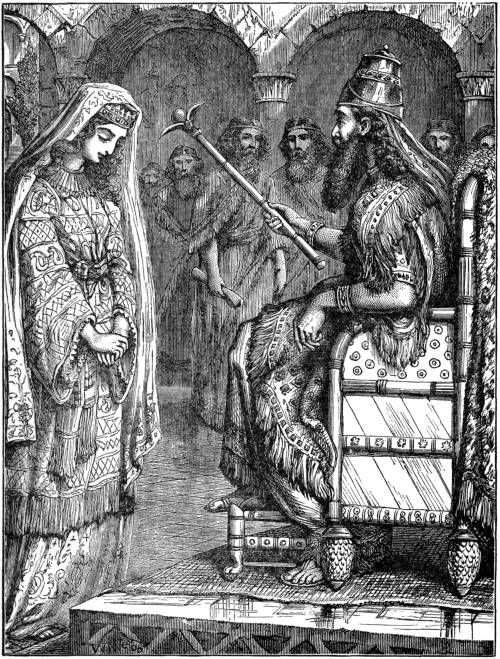
ESTHER BEFORE THE KING

Ahasuerus reigned over the vast empire of Persia, and Esther, the adopted daughter of a Jew named Mordecai, was Queen. None in the palace knew she was a Jewess, for Mordecai had charged her not to make it known. He abode in the king’s palace, and was one of the king’s servants.

Ahasuerus promoted Haman, one of his courtiers, a cruel and wicked man, to be over all his princes and officers; and all bowed down to Haman and did him reverence except Mordecai, the Jew. Then was Haman filled with wrath against Mordecai and his people, and obtained from the king a decree ordering that all the Jews throughout his dominions should be slain. Mordecai informed Queen Esther of this decree, and bade her go to the king and plead for her people. Now it was one of the laws of the palace that no one should approach the king in the inner court unless he had been previously called; the penalty for not obeying this law being death, unless the king should hold out the golden sceptre to the offender so that he might live. Esther knew the danger of approaching the king uncalled for, but she bade Mordecai to gather the Jews so that they might spend three days in fasting and prayer, while she and her maidens did the same, and, said she, “So will I go in unto the king, which is not according to the law, and if I perish, I perish.”

Esther went in. The king graciously held out the golden sceptre to her, accepted her invitation to a banquet, and finally ordered the wicked Haman to be hanged, and measures to be taken to preserve the lives of the Jews.

ESTHER BEFORE THE KING

Daniel and the Lions

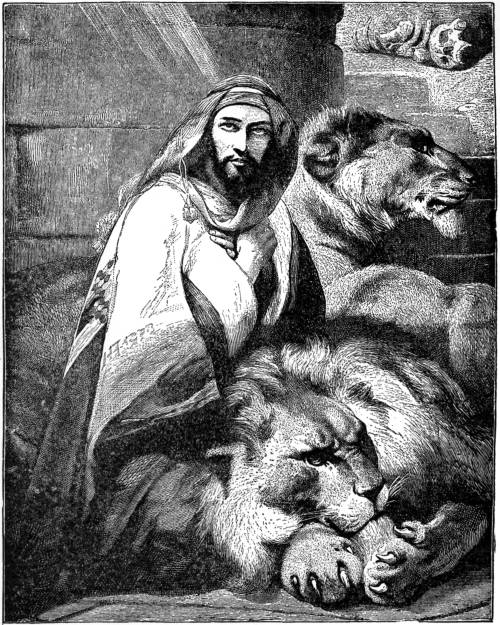
DANIEL AND THE LIONS

When Darius came to the throne, upon the death of Belshazzar, he set over the kingdom a hundred and twenty princes. Over these he appointed three presidents, of whom Daniel was first. Now the princes and other presidents were jealous of Daniel, and sought to find some fault against him; but could not, as he was a faithful servant of the King. Then they tried to injure him because of his praying to God. So they came to the King, and said, “King Darius live for ever: all the great officers of thy kingdom have consulted together to establish a royal law, that whosoever shall ask a petition of any god or man for thirty days, save of thee, O King, he shall be cast into a den of lions.” The King signed the writing and established the law. But Daniel still knelt and prayed three times a day as before.

His enemies saw him praying, and told the King, urging him to carry out the law. But the King was angry with himself that he had agreed to such a law, and tried to think of some way to save Daniel. Then these men urged that the law could not be altered. So Daniel was cast into the den of lions, and a stone was put over the mouth of the den, which was sealed by the King and the lords. But the King had said to Daniel, “Thy God whom thou servest will deliver thee.”

The King passed the night fasting, and could not sleep. In the morning, very early, he arose and went to the den of lions, and cried with a lamentable voice, “O Daniel, servant of the living God, is thy God able to deliver thee from the lions?” Then Daniel said, “O King, live for ever. My God hath sent His angel and shut the lions’ mouths.”

DANIEL AND THE LIONS

Jonah at Nineveh

JONAH AT NINEVEH

Jonah was commanded to go to Nineveh, and cry out that the city should be destroyed on account of the wickedness of its inhabitants. But instead of obeying God’s command he fled in a ship that was bound for Tarshish. Then a great storm arose, and the shipmen cast Jonah into the sea, believing that the storm had been sent through his disobedience. God saved Jonah by means of a large fish, and brought him safely to land again.

A second time God said to Jonah, “Arise, go unto Nineveh, that great city, and preach unto it the preaching that I bid thee.” So Jonah arose and went as God had directed him. Now Nineveh was a very large city, about sixty miles in circumference, and Jonah went some distance inside and then cried out, “Yet forty days and Nineveh shall be overthrown!” It was a strange and terrible cry which sounded throughout the city, and as the Ninevites heard it they feared God, proclaimed a fast, covered themselves with sackcloth, and every man was commanded to forsake evil. So they hoped God would forgive them and spare their city.

God saw what they did and how they turned from their evil ways, therefore He spared their city. When Jonah saw that Nineveh was spared he was very angry, and prayed God to take away his life. He made a booth and sat under it to see what would become of the city. Then God sheltered him from the sun by a gourd, and afterwards taught him by it how wrong he was in being displeased because Nineveh had been spared. Nineveh was afterwards overthrown, and has remained since then but a heap of ruins.

JONAH AT NINEVEH

The Brave Hebrew Boys

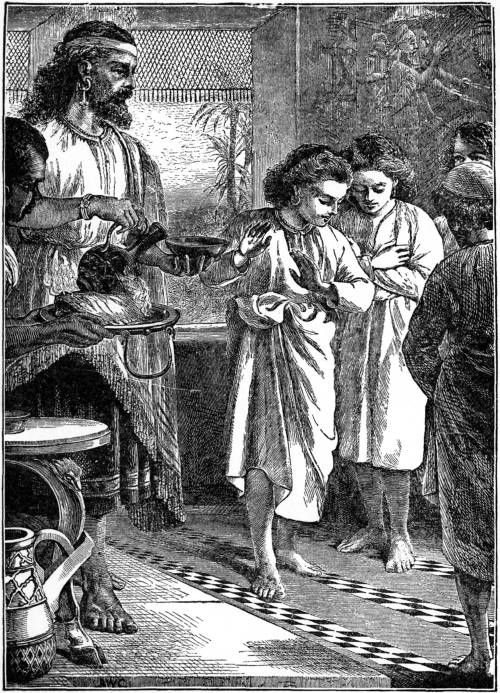
THE BRAVE HEBREW BOYS

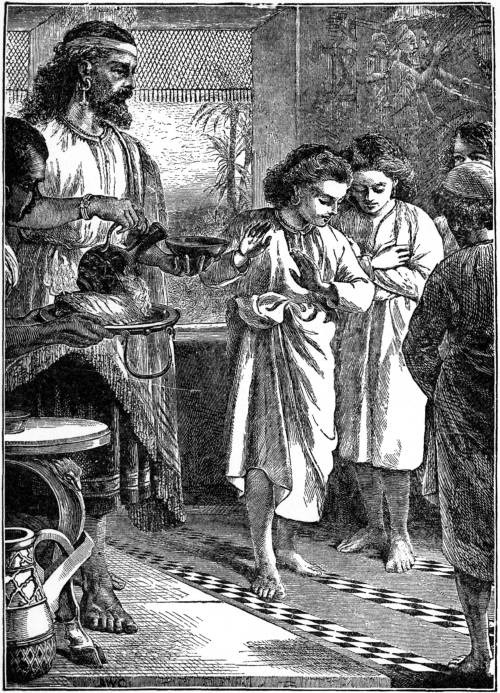
Brave boys and girls! We all wish to be brave, do we not? Then we must learn to say “No,” when tempted to do wrong.

These Hebrew boys were young nobles who had been carried captive from Jerusalem to Babylon; but though in a strange land, subject to the mighty king Nebuchadnezzar, they feared not to refuse his food and wine when they knew that the taking of it would cause them to sin against God. They were well educated Hebrew youths, and the Babylonish king had commanded that they should be taught the learning of the Chaldeans; also, to keep them in health and with beautiful countenances, he had ordered that the meat and wine from his table should be given them. Their names were Daniel, Hananiah, Mishael, and Azariah. Daniel seems to have been their leader. We find “he purposed in his heart that he would not defile himself with the portion of the king’s meat, nor with the wine which he drank.” So he begged the king’s servant the feed him and his three companions on plain food and pure water; but the servant feared to do so, lest the king should find them worse looking than those who ate his meat and drank his wine, and the servant should lose his head in consequence. A trial was made, however, for ten days, at the end of which time they were found to be better looking than the boys fed on rich food and wine. Therefore, the servant let them live plainly according to their request; and at the end of three years, when they stood before the king, we are told that for wisdom and understanding none were found like Daniel, Hananiah, Mishael, and Azariah.

THE BRAVE HEBREW BOYS

Elijah Fed by Ravens

ELIJAH FED BY RAVENS

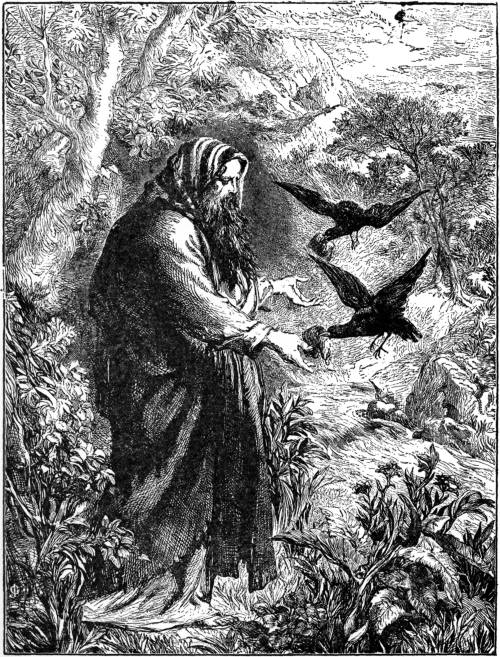
God was displeased with King Ahab, and sent His prophet, Elijah the Tishbite, to say unto him, “As the Lord God of Israel liveth there shall not be dew nor rain for years in all Israel.” God knew that these words would make Ahab angry with Elijah, so He commanded Elijah to get out of Ahab’s way. “Get thee hence, and turn thee eastward, and hide thyself by the brook Cherith, that is before Jordan. And it shall be, that thou shalt drink of the brook; and I have commanded the ravens to feed thee there.”

Elijah went, and the ravens brought him bread and meat, morning and evening, and he drank of the brook. But after many days the brook dried up, and God told him to go to Zarephath, where a widow would sustain him. So he arose and went to Zarephath. When he came to the gate of the city he saw the widow gathering sticks; and called to her, saying, “Bring me, I pray thee, a little water in a vessel, that I may drink, and a morsel of bread in thy hand, that I may eat.”

The widow turned and said, “As the Lord thy God liveth, I have not a cake, but only a handful of meal, and a little oil in a cruse; and, behold, I am gathering a few sticks, that I may go in and bake it for me and my son, that we may eat it before we starve to death.” Elijah told her not to fear, but to make a cake for him, and, afterwards, one for her son and herself, for God had said that neither her handful of meal nor her cruse of oil should fail until He again sent rain upon the earth. So she did as Elijah told her, and there was always enough oil and meal for their daily food, according to the word of the Lord which He spake by Elijah.

ELIJAH FED BY RAVENS

The little Captive Maid

THE LITTLE CAPTIVE MAID

Naaman was a great general in the army of the King of Syria, who esteemed him highly, because it was Naaman that led the Syrians when God gave them victory over the Israelites. But in spite of his bravery and his high position, he was miserable, because he suffered from a terrible disease called leprosy. Now, among the captives whom the Syrians had brought back from war was a little Israelitish maiden, who was appointed to wait upon Naaman’s wife. She had heard of the wonderful things which Elisha did in the name of God; and she told her mistress that if Naaman could only see this prophet, who was in Samaria, he could be cured. And the King was told what the maid had said, and he sent a letter to the King of Israel commanding him to cure Naaman of his leprosy. But the King of Israel was afraid, and thought the King of Syria sought this way to quarrel with him. When Elisha heard of the King’s fear, he sent and desired that Naaman should be brought to him. So Naaman came in his chariot, and stood at Elisha’s door. But the prophet instead of coming to him, sent a message directing Naaman to wash in Jordan seven times, when his leprous flesh would be restored to health. Naaman had thought that Elisha would have received him with much ceremony and touched him, bidding the leprosy to depart; so he was angry and said, “Are not the rivers of Damascus better than all the waters of Israel? May I not wash in them and be clean?” Therefore he went away in a rage. But his servants persuaded him to carry out the prophet’s injunction, and he went and dipped seven times in Jordan, and was made whole.

THE LITTLE CAPTIVE MAID

Ploughing in Canaan

PLOUGHING IN CANAAN

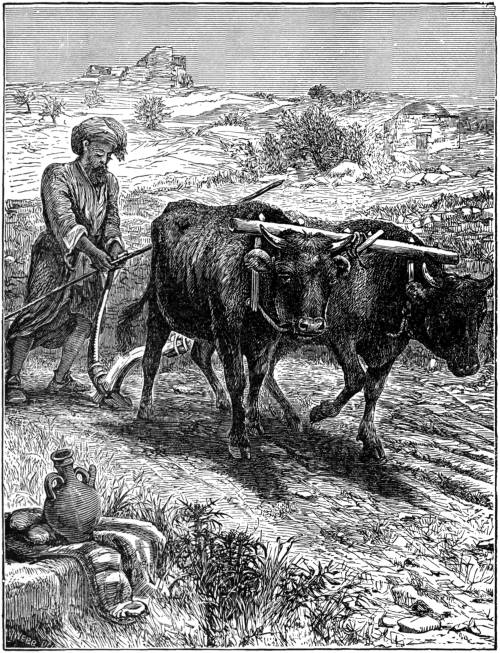
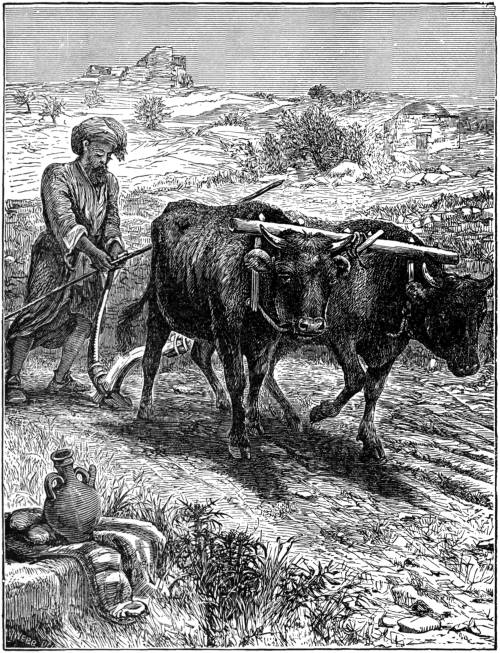
In Scripture frequent mention is made of the husbandman and his work. Ploughing the land, sowing the seed, reaping the harvest, and winnowing the grain are often referred to. Our picture shows an Eastern husbandman ploughing. How different it is to ploughing in our own land! There is no coulter; and instead of the broad steel plough-share we see a pointed piece of wood. And the long handles with which our labourers guide their ploughs—where are they? The strong horses, too, harnessed one behind the other, are missing. Yes! none of these were used in Canaan. Small oxen drew the plough; and the husbandman guided it by means of a single handle, as we see him doing in the picture. Thus their method of ploughing was a slow one, and unless the land had been very good their harvests would have been poor.

Often these husbandmen had to wait until the rain made the ground soft enough for their ploughs to enter it, consequently many had to toil in cold, stormy, winter weather. To this the proverb alludes which says: “The sluggard will not plough by reason of the cold; therefore shall he beg in harvest, and have nothing.” (Prov. xx. 4.)

Perhaps it was just such a plough, drawn by just such oxen as we see in our picture, that Elisha was using when Elijah passed by and cast his mantle upon him; thereby calling Elisha to be his servant and successor. We are told that Elisha “took a yoke of oxen, and slew them, and boiled their flesh with the instruments of the oxen, and gave unto the people, and they did eat. Then he arose, and went after Elijah, and ministered unto him.”

PLOUGHING IN CANAAN