A place to grow your relationship with God

Archive for the ‘From the Old Testament’ Category

The Shunammite’s Son

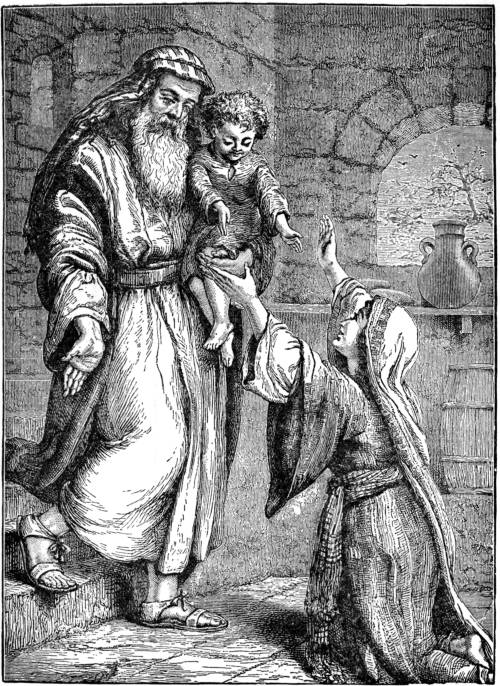
THE SHUNAMMITE’S SON

Many interesting stories are told in the Bible, few of which are more touching than that of Elisha the prophet, and the Shunammite woman. This story we find in the fourth chapter of the Second Book of Kings.

We read of the prophet journeying to and fro, and resting in the little chamber that the kind Shunammite had built for him on the wall of her house. We see its bed, table, stool, and candlestick; and the joy beaming upon the good woman’s face when a tiny infant son was given her. How she loved him! And as he grew up how carefully she watched over him. But a sad time was coming.

The golden corn was in the field ready for reaping, for the harvest time had come. The hot sun shone overhead, and the little lad was out with his father in the field, probably running about among the corn. Suddenly he felt a violent pain, and cried out, “My head, my head!” Then joy was changed to sorrow. The father saw his son was ill, and bade a lad carry the little boy to his mother, on whose knees he sat till noon, and then he died.

Next we see the mother leaving her dead son, and journeying to find the prophet. Elisha sees her coming, and sends Gehazi to inquire if all is well. Then she falls down before the prophet and tells him her trouble; and he sends his servant with his staff to lay it upon the dead child. The story closes by stating how Elisha follows Gehazi, goes to the chamber where the dead boy lay, prays to God that the life may be restored, and finally has the joy of giving the lad, alive and well again, into the arms of his mother.
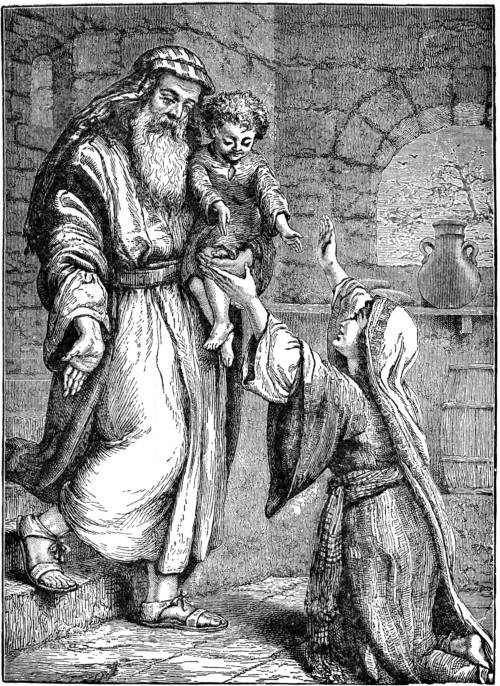
THE SHUNAMMITE’S SON RESTORED

David and Araunah

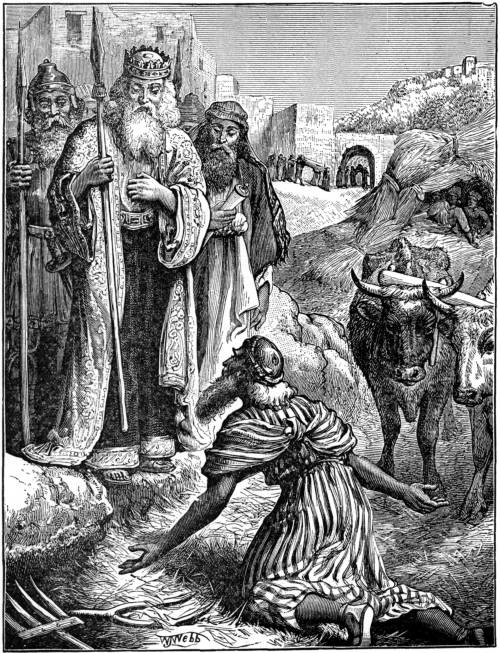
DAVID AND ARAUNAH

After David had reigned may years, he numbered the people of Israel. This was wrong; and God sent a pestilence which destroyed seventy thousand men. David was grieved, and prayed that God would punish him and spare the people. God stayed the hand of the destroying angel; who stood by the threshing-floor of Araunah, whither David was told to go and offer sacrifice. David went. He purchased the threshing-floor of Araunah, also oxen and wood and offered a burnt sacrifice to God. The following verses describe the scene:—

Beside Araunah’s threshing-placeThe awful angel took his stand,When from high heaven came words of grace—”It is enough; stay now thine hand.”

For David’s penitential prayerHad enter’d God’s compassionate ear;And where the angel stood, even thereGod bade the King and altar rear.

Araunah offered ground, and wood,And oxen for the sacrifice:David stood noble wish withstood,And bought them all at full price.

His answer has a royal ring;Its lesson high shall not be lost:”Burnt offerings I will never bringUnto Jehovah without cost.”

The altar rose, the victims died,The plague was stayed, and lo, there fell—Token that Heaven was satisfied—A fire from God, and all was well.

‘Twas like a finger from the skies—That falling fire—to show God’s will,That here the Temple should ariseAnd crown Moriah’s sacred hill.

And still God marks the faithful prayer,The careful work, the costly pains;The Spirit’s fire descendeth there,And there, as in a shrine, remains.

Richard Wilton, M.A.

DAVID AND ARAUNAH

Nathan Reproving the King

NATHAN REPROVING THE KING

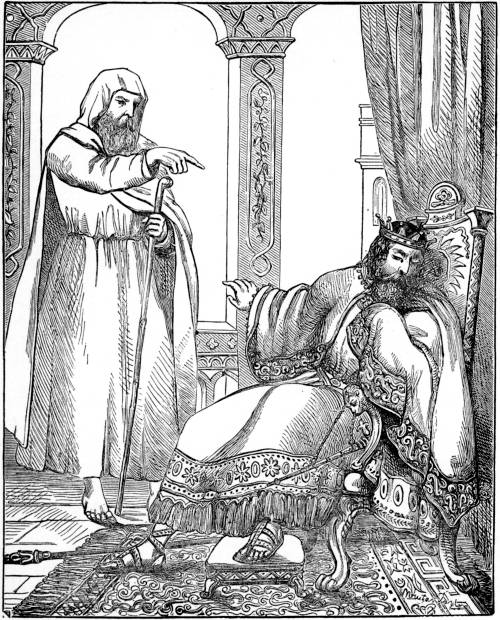
David was now King. He had great riches and honour, and a palace had been built for him. He had brought the ark from Kirjath-jearim, and placed it in the tabernacle prepared for it at Jerusalem, and he now reigned over all the people of Israel and Judah. But David did a very wicked thing. He took the wife of Uriah the Hittite for his wife, and caused Uriah to be slain. God was displeased at what he had done, and sent Nathan the prophet to reprove him.

Nathan’s reproof was given by a parable. It was a story of a poor man who had one dear little lamb. It grew up in his house, played with his children, and was very precious to him. But one day a traveller came to a rich neighbour, who possessed great flocks and herds, and this neighbour, instead of killing one of his own lambs and setting it before his guest, sent and took the poor man’s lamb and killed it.

David heard the story, and was very angry. He said the rich man should die, and the lamb taken away should be restored fourfold. Then Nathan, looking at the King, said: “Thou art the man!” He showed David how greatly he had sinned, and told him that trouble and sorrow would come upon him for what he had done. God had given him riches and honour, and all that he could wish for; yet he had taken the one precious thing of Uriah’s, even his wife, and had caused him to be slain. David was sorely grieved when he saw how wickedly he had acted. He confessed his sin to God, and God forgave it; but great trouble came upon the King afterwards through this crime.

“THOU ART THE MAN”

David and Goliath

DAVID AND GOLIATH

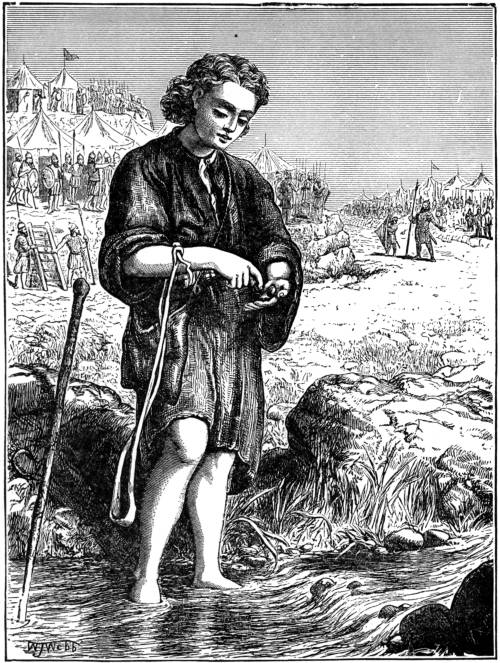
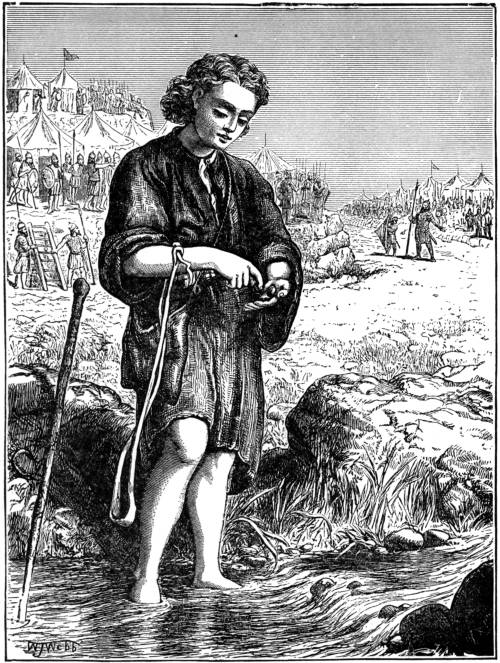
How attentively David looks at the stones in his hand. His sling is on his arm, and his bag by his side. What is he about to do with those stones? And who is that tall man in armour, strutting about with such a long spear in his hand?

Two armies were drawn up in battle array. They were the armies of the Israelites and Philistines. The camp of the Israelites was on one hill, and that of the Philistines was upon another; a valley lying between. For forty days these armies had been facing each other, but yet the battle had been delayed. The Philistines had on their side a giant of great height and strength, encased in armour, who daily came out, challenging the Israelites to send a man from their camp to fight with him. But no man among them dared to go against Goliath, the Philistines’ champion.

Meanwhile Jesse had sent David to the Israelites’ camp to see after his brethren. He heard what the giant said, and offered to go out against him. Saul was informed of David’s offer, and sent for him. Saul told David he was not able to fight the giant, but he boldly replied, “The Lord which delivered me out of the paw of the lion and out of the paw of the bear, He will deliver me out of the hand of this Philistine.” David trusted not in his own power, but in God! Then Saul said, “Go, and the Lord be with thee.”

He went, slung one of the smooth stones he had chosen out of the brook, smote the Philistine in the forehead so that he fell to the earth, and then ran and cut off his head. Thus God enabled this ruddy youth to overcome the giant Philistine, and to slay him with a sling and a stone.

CHOOSING SMOOTH STONES OUT OF THE BROOK

Playing on the Harp Before Saul

PLAYING ON THE HARP BEFORE SAUL

We are not told much in the Bible concerning the early life of David. He was born in Bethlehem. We have seen who his father was, but I do not find that his mother’s name is given. His own name means “beloved.” What a happy name! He must have been much loved by his parents, and we know he was loved by God.

Like many other youths in Canaan, he acted as a shepherd to his father’s flocks. He was a fair, open-faced boy; “ruddy, and of a beautiful countenance, and goodly to look at,” so the Scriptures say. He was a good musician, knew how to sling stones at a mark, and was so brave that when a lion and a bear came to attack the lambs of his flock he went after them and killed them both. One day a strange and most important event happened. Samuel, the prophet, came from Ramah, and pouring some very precious oil upon the head of David, anointed him to be the future King of Israel. Saul was then King, but on account of his wickedness God had rejected him, saying that another should reign in his stead.

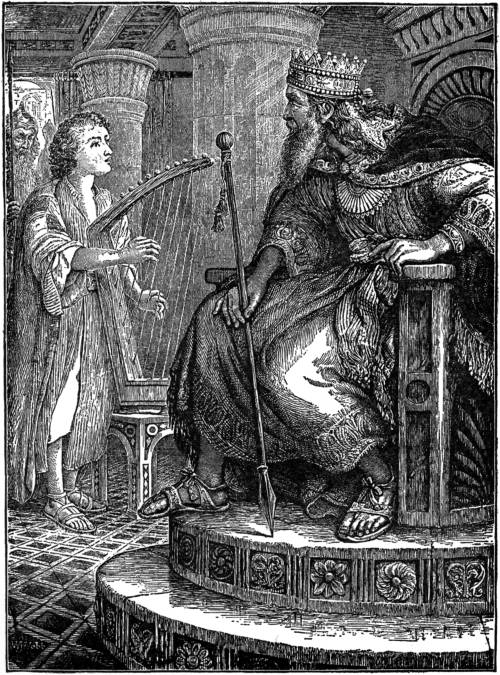
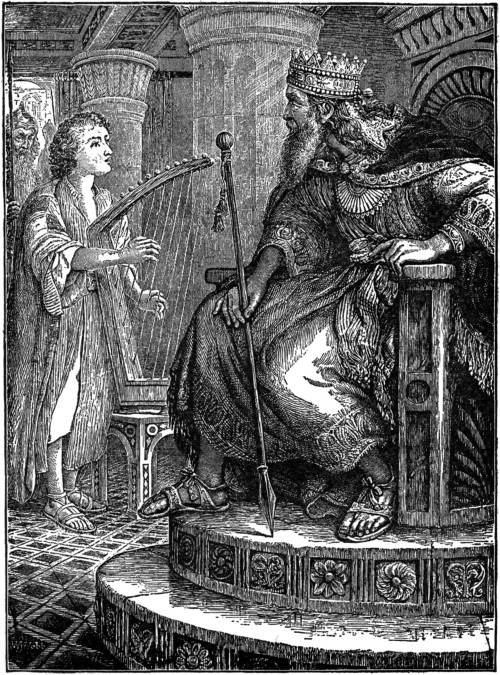
Soon after this event Saul became very wretched. An evil spirit troubled him, we are told. His servants advised him to get a man that could play skilfully upon the harp, so that music might drive away his misery. Some one suggested David; and David was sent for. He brought sweet strains from his harp, and Saul was soothed. Saul was pleased with David. We are told that “he loved him greatly,” and that David became his armour-bearer. But he soon grew jealous, and twice threw a javelin at David, seeking to smite him to the wall and kill him. This, however, he was not able to do.

DAVID PLAYING ON THE HARP BEFORE SAUL

Death of Eli and his sons

DEATH OF ELI AND HIS SONS

In the morning Samuel feared to tell Eli what the Lord had shown him; but Eli bade him do so, saying to Samuel, “God do so to thee, and more also, if thou hide any thing from me of all that He said unto thee.” So Samuel told Eli all God had said, keeping nothing back, and Eli answered, “It is the Lord: let Him do what seemeth Him good.”

Afterwards there was war between the Israelites and the Philistines, and both sides prepared for battle. They fought; the Israelites were defeated, and many of them slain. Then they sent to Shiloh and fetched the ark of the covenant out of the Tabernacle, carrying it to the camp, and thinking that if the ark were with them they would overcome their enemies. But the ark only signified God’s presence in their midst; it was not God Himself, to give them victory. It was very sinful of them thus to use what God had made so holy; and God suffered them again to be defeated. The ark was taken by the Philistines, and many of the Israelites were slain.

Eli, who was then ninety-eight years old, and nearly blind, sat by the wayside, trembling for the safety of the ark, and waiting for messengers to bring news of the battle. Presently a messenger came who told him the Israelites had fled before the Philistines, that his two sons Hophni and Phinehas were slain, and that the ark of God had been taken. When he heard that the ark had been taken, he fell backward from off his seat and died. Thus God’s judgment upon Eli and his sons came to pass. In our picture we see the messenger, who has just come from the field of battle, telling Eli the sad tidings that caused his death.

Eli and Samuel

ELI AND SAMUEL

Elkanah went up to Shiloh yearly to offer sacrifice: and when Samuel was old enough, Hannah went with her husband and took her little boy with her. They came to Eli the high priest, and Hannah said: “Oh, my Lord, I am the woman that stood by thee here praying. For this child I prayed; and the Lord hath given me my petition. Therefore also have I given him to the Lord.” Then she left Samuel with Eli.

Samuel assisted Eli in the Tabernacle service, and wore a linen ephod like a priest. His mother came yearly to see him, when she accompanied Elkanah to the sacrifice at Shiloh, and each time brought with her a little coat, which she had made for her son. Eli was an old man, who had two wicked sons. These he had not restrained as he should have done. So God was displeased with him and them on account of their sins.

One night, while the lamp in the Tabernacle was burning, and Eli was resting, Samuel was sleeping. A voice came to him calling, “Samuel!” He rose, and ran to Eli saying, “Here am I.” But Eli had not called, so Samuel lay down again. A second time the same voice called, “Samuel!” He went to Eli and said, “Here am I; for thou didst call me.” But Eli replied, “I called not, my son; lie down again.” The call was repeated a third time; then Eli told Samuel it was the Lord who called him; and bade him answer if the voice came again, “Speak, Lord, for thy servant heareth.” Again, God called, and Samuel answered as Eli had commanded him. Then God told Samuel what terrible things should befall Eli and his sons through their wickedness.

Hannah Praying Before the Lord

HANNAH PRAYING BEFORE THE LORD

The Tabernacle, which had been set up by the Israelites in the wilderness, was after the conquest of Canaan erected at Shiloh, a city about ten miles south of Shechem. There it remained for more than three hundred years. No Temple was at Jerusalem in those days, so the Jewish priests offered sacrifices to God in the Tabernacle at Shiloh.

One day, Hannah, the wife of a priest named Elkanah, came to the Tabernacle to worship. She was grieved because she had no children; and especially sad because she had no son. So she knelt down and prayed to God, and asked God to remember her sorrow and to give her a son; promising that if God granted her request, she would give that son to Him all the days of his life.

As Hannah prayed, Eli, the high priest, saw her. She did not speak aloud, but prayed in her heart; her lips moved, but no voice was heard; so Eli thought that a drunken woman had come before the Lord. He reproved her saying, “How long wilt thou be drunken? Put away thy wine from thee.” But Hannah had not drunk wine. She answered Eli, “No, my lord, I am a woman of a sorrowful spirit. I have drunk neither wine nor strong drink, but have poured out my soul before the Lord.” Then Eli bade her “Go in peace, and the God of Israel grant thee thy petition that thou hast asked of Him.”

Hannah left the Tabernacle. Her face was no longer sad. She believed God had heard her prayer; and He had done so. In due time a son was given her, whom she named Samuel. Samuel means Heard of God, which name Hannah gave him in remembrance of God’s goodness in hearing her prayer.

HANNAH PRAYING BEFORE THE LORD

Boaz and Ruth

BOAZ AND RUTH

When Naomi returned to Bethlehem she was poor. The poor were allowed at harvest time to follow the reapers; gleaning or gathering up the stray ears of corn. One day, Ruth obtained permission from her mother-in-law to go gleaning, and went to glean in the field of a rich man named Boaz, who happened to be a kinsman, or relative of Elimelech. But Ruth did not know of this relationship.

Boaz saw Ruth gleaning, and asked one of his servants who she was. The servant replied, “It is the Moabitish damsel that came back with Naomi out of the country of Moab.” Then Boaz spoke kindly to Ruth, telling her not to go to any other field to glean, but to stay with his maidens and glean in his field. She fell on her face before him and bowed herself to the ground, and asked, “Why have I found grace in thine eyes, that thou shouldest take knowledge of me, seeing I am a stranger?” Boaz was pleased with her because of her kindness to Naomi, so he replied, “It hath fully been showed me all that thou hast done unto thy mother-in-law since the death of thine husband.” He also bade her to eat and drink with his servants, and told his reapers to let some handfuls of grain fall on purpose for her. So Ruth gleaned that day quite a large quantity of barley, which she took home to Naomi. Then she learned that Boaz was her kinsman.

She continued gleaning until the end of harvest; and afterwards became the wife of Boaz and grandmother of Jesse, the father of David. Jesus Christ descended from David; so, we see what high honour was bestowed upon Ruth for her kindness to her mother-in-law.

BOAZ SHOWING KINDNESS TO RUTH

Ruth and Naomi

RUTH AND NAOMI

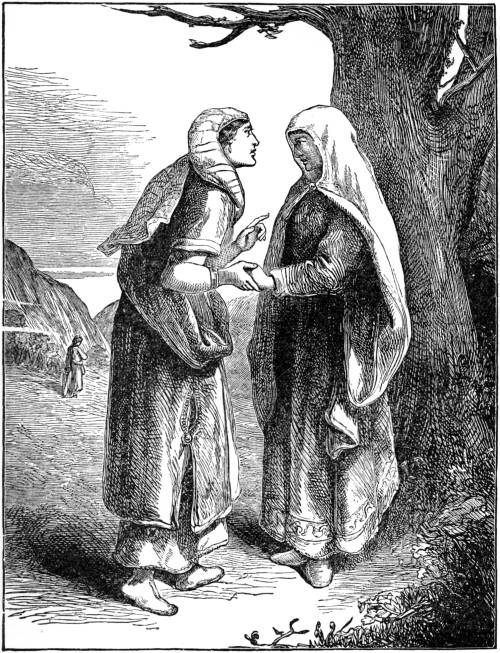
Naomi was the wife of a Jew named Elimelech, who left his own city of Bethlehem to go into the land of Moab, because there was a famine in Canaan. Some time afterwards he died, leaving Naomi a widow with two sons, all dwellers in a strange land. Her sons married two young women belonging to Moab, whose names were Orpah and Ruth. After living there about ten years Naomi’s sons died also, leaving Orpah and Ruth widows, along with their widowed mother-in-law. Then Naomi determined to return to her own land. Orpah and Ruth accompanied Naomi some distance on her journey; then she bade them to leave her, telling each to go back to her mother’s house in Moab, while she would pursue her way alone to the land of Judah. They were unwilling to do so, saying they would go with her to her land and people; but she urged them to depart, assuring them that they would gain nothing by leaving their own country to accompany her, and that they had better return to their own homes. Then the story informs us—you will find it in the Bible, in the Book of Ruth—that Orpah kissed her mother-in-law and departed; but Ruth clave unto her, saying, “Whither thou goest, I will go; and where thou lodgest, I will lodge; thy people shall be my people, and thy God my God; where thou diest, will I die, and there will I be buried: the Lord do so to me and more also, if ought but death part thee and me.”

So, Ruth refused to leave her mother-in-law, and journeyed with her until they reached Canaan. Then they both dwelt in the city of Bethlehem, in the land of Judah, where we shall meet with them again.

RUTH AND NAOMI