This is a peculiar picture to set in the heavens. A woman with chains fastened to her feet and arms, in misery and trouble; and bound, helpless, to the sky. Yet this is the ancient foreshowing of the truth.
In the Denderah Zodiac her name is Set, which means set, set up as a queen. In Hebrew it is Sirra, the chained, and Persea, the stretched out.
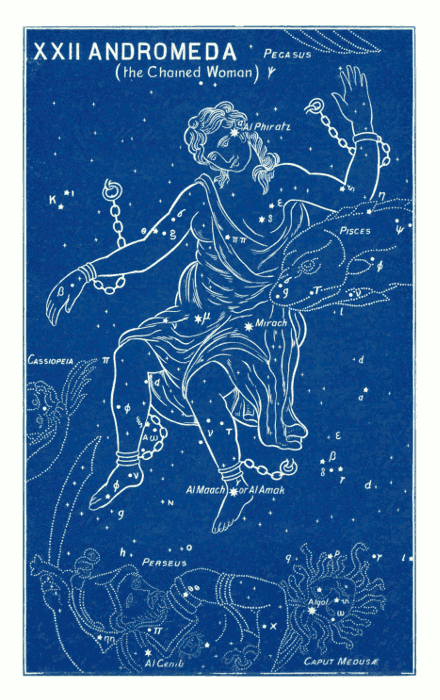
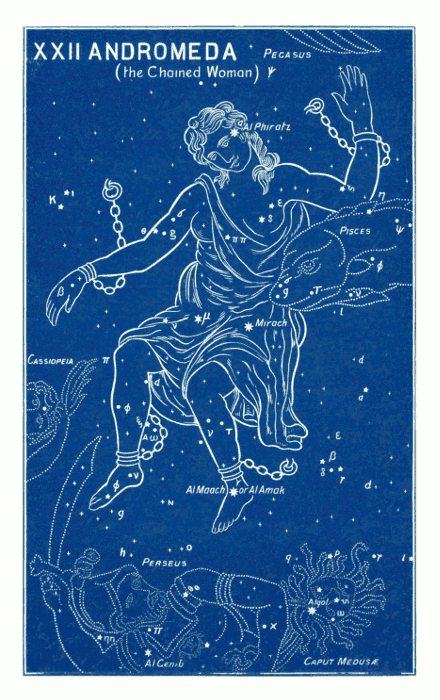
Plate 22: ANDROMEDA (the Chained Woman)
There are 63 stars in this constellation, three of which are of the 2nd magnitude, two of the 3rd, twelve of the 4th, etc.
The brightest star, α (in the head), is called Al Phiratz (Arabic), the broken down. The star β (in the body) is called Mirach (Hebrew), the weak. The star γ (in the left foot) is called Al Maach, or Al Amak (Arabic), struck down.
The names of other stars, not identified, are Adhil, the afflicted; Mizar, the weak; Al Mara (Arabic), the afflicted. Aratus speaks of Desma, which means the bound, and says—
“Her feet point to her bridegroom
Perseus, on whose shoulder they rest.”
Thus, with one voice, the stars of Andromeda speak to us of the captive daughter of Zion. And her coming Deliverer thus addresses her:—
“O thou afflicted, tossed with tempest, and not comforted,
Behold, … in righteousness shalt thou be established:
Thou shalt be far from oppression; for thou shalt not fear:
And from terror; for it shall not come nigh thee.”
(Isa. liv. 11-14.)
“Hear now this, thou afflicted….
Awake, awake; put on thy strength, O Zion;
Put on thy beautiful garments, O Jerusalem….
Shake thyself from the dust;
Arise, and sit down, O Jerusalem:
Loose thyself from the bands of thy neck, O captive daughter of Zion.
For thus saith the Lord, Ye have sold yourselves for nought;
And ye shall be redeemed without money.”
(Isa. li. 21-lii. 3.)
“The virgin daughter of My people is broken with a great breach, with a very grievous blow” (Jer. xiv. 17).
The picture which sets forth her deliverance is reserved for the next chapter (or Sign), where it comes in its proper place and order. We are first shown her glorious Deliverer; for we never, in the heavens or in the Word, have a reference to the sufferings without an immediate reference to the glory.
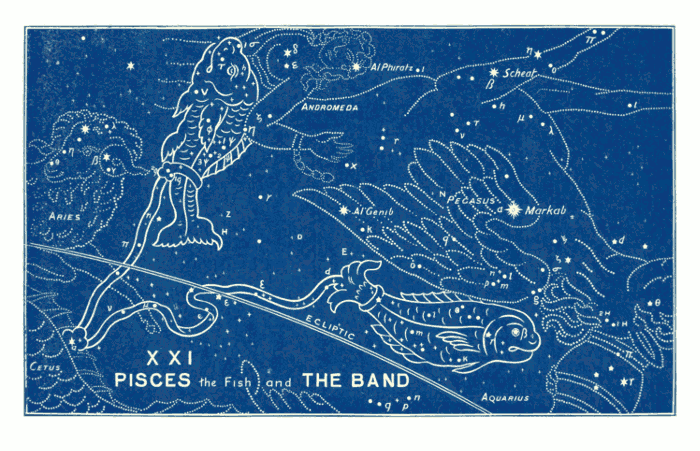
The band that unites these two fishes has always formed a separate constellation. It is shown in Plate XXI. The Arabian poems of Antarah frequently mention it as distinct from the Sign with which it is so closely connected. Antarah was an Arabian poet of the sixth century.
Its ancient Egyptian name was U-or, which means He cometh. Its Arabic name is Al Risha, the band, or bridle.
It speaks of the Coming One, not in His relation to Himself, or to His enemies, but in His relation to the Redeemed. It speaks of Him who says:
“I drew them with cords of a man,
With bands of love;
And I was to them as they that take off the yoke on their jaws.”
(Hosea xi. 4, r.v.)
But it speaks also of His unloosing the bands with which they have been so long bound.
In the picture these fishes are bound. One end of the band is fastened securely round the tail of one fish, and it is the same with the other. Moreover, this band is fastened to the neck of Cetus, the sea monster, while immediately above is seen a woman chained as a captive. These both tell the same story, and, indeed, all are required to set forth the whole truth. The fishes are bound to Cetus; the woman (Andromeda) is chained; but the Deliverer of both is near. Cepheus, the Crowned King, the Redeemer, “the Breaker,” the Branch, is seen coming quickly for the deliverance of His redeemed. These are the three constellations of this sign, and all three are required to set forth the story.
Israel now is bound. The great enemy still oppresses, but deliverance is sure. Aries, the Ram, is seen with his paws on this band, as though about to loosen the bands and set the captives free, and to fast bind their great oppressor.
In this third chapter of the Second Book we come to the results of the Redeemer’s work enjoyed, but in connection with conflict, as is seen in the last of the three sections (the constellation of Andromeda, the chained woman), which leads up to the last chapter of the book, and ends it in triumph over every enemy.
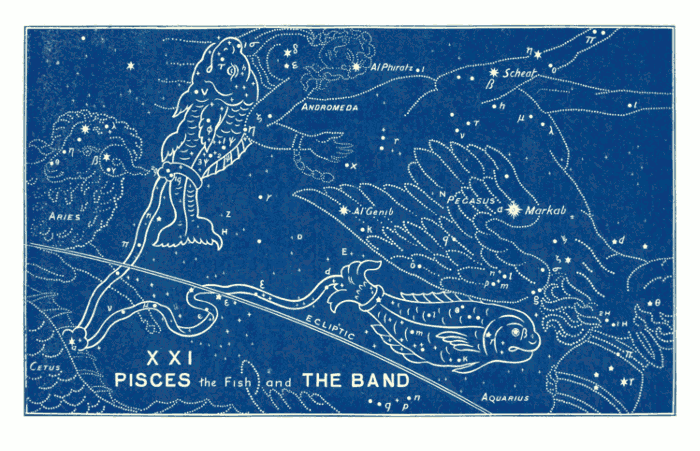
Plate 21: PISCES (the Fish) and the Band
The Sign is pictured as two large fishes bound together by a Band, the ends of which are fastened separately to their tails. One fish is represented with its head pointing upwards towards the North Polar Star, the other is shown at right angles, swimming along the line of the ecliptic, or path of the sun.
The ancient Egyptian name, as shown on the Denderah Zodiac, is Pi-cot Orion, or Pisces Hori, which means the fishes of Him that cometh.
The Hebrew name is Dagim, the Fishes, which is closely connected with multitudes, as in Gen. xlviii. 26, where Jacob blesses Joseph’s sons, and says, “Let them grow into a multitude in the midst of the earth.” The margin says, “Let them grow as fishes do increase.” It refers to the fulfilment of Gen. i. 28, “Be fruitful and multiply.” The multitude of Abraham’s seed is prominent in the pronouncement of the blessings, where God compared his future posterity to the stars of the sky, and the sand upon the sea shore. “A very great multitude of fish,” as in Ezek. xlvii. 9.
The Syriac name is Nuno, the fish, lengthened out (as in posterity).
The sign, then, speaks of the multitudes who should enjoy the blessings of the Redeemer’s work.
And here we must maintain that “the Church,” which is “the Body of Christ,” was a subject that was never revealed to man until it was made known to the Apostle Paul by a special revelation. The Holy Spirit declares (Rom. xvi. 25) that it “was kept secret since the world began.” In Eph. iii. 9 he declares that it “from the beginning of the world hath been hid in God”; and in Col. i. 26, that it “hath been hid from ages and from generations, but now is made manifest to His saints.” In each scripture which speaks of it as “now made manifest,” or “now made known,” it is distinctly stated that it was “a mystery,” i.e., a secret, and had, up to that moment, been hidden from mankind, hidden “in God.” How, then, we ask, can “the Church,” which was a subsequent revelation, be read into the previous prophecies, whether written in the Old Testament Scriptures, or made known in the Heavens? If the Church was revealed in prophecy, then it could not have been said to be hidden or kept secret. If the first revelation of it was made known to Paul, as he distinctly affirms it was, then it could not have been revealed before. Unless we see this very clearly, we cannot “rightly divide the word of truth” (2 Tim. ii. 15). And if we do not rightly divide the word of truth, in its subjects, and times, and dispensations, we must inevitably be landed in confusion and darkness, interpreting of the Church, scriptures which belong only to Israel.
The Church, or Body of Christ, is totally distinct from every class of persons who are made the subject of prophecy. Not that the Church of God was an after-thought. No, it was a Divine secret, kept as only God Himself could keep it. The Bible therefore would have been complete (so far as the Old Testament prophecies are concerned) if the Epistles (which belong only to the Church) were taken out. The Old Testament would then give us the kingdom prophesied; the Gospels and Acts, the King and the kingdom offered and rejected; then the Apocalypse would follow, showing how that promised kingdom will yet be set up with Divine judgment, power, and glory.
If these Signs and these star-pictures be the results of inspired patriarchs, then this Sign of Pisces can refer to “His seed,” prophesied of in Isa. liii.: “He shall see His seed.” It must refer to
“The nation whose God is the Lord,
And the people whom He hath chosen for His own inheritance.”
(Ps. xxxiii. 12.)
“Such as be blessed of Him shall inherit the earth.”
(Ps. xxxvii. 22.)
“The Lord shall increase you more and more,
You and your children,
Ye are blessed of the Lord.”
(Ps. cxv. 14, 15.)
“Their seed shall be known among the Gentiles.
And their offspring among the people;
All that see them shall acknowledge them,
That they are the seed which the Lord hath blessed.”
(Isa. lxi. 9.)
“They are the seed of the blessed of the Lord,
And their offspring with them.”
(Isa. lxv. 23.)
The prophecy of this Sign was afterwards written in the words of Isa. xxvi. 15—the song which shall yet be sung in the land of Judah:
“Thou hast increased the nation, O Lord,
Thou hast increased the nation.”
And in Isa. ix. 3 (r.v.), speaking of the glorious time when the government shall be upon the shoulder of the coming King:
“Thou hast multiplied the nation,
Thou hast increased their joy.”
Of that longed-for day Jeremiah sings (xxx. 19):
“I will multiply them
And they shall not be few;
I will also glorify them,
And they shall not be small.”
Ezekiel also is inspired to say:
“I will multiply men upon you,
All the house of Israel, even all of it:
And the cities shall be inhabited,
And the wastes shall be builded;
And I will multiply upon you man and beast,
And they shall increase and bring fruit.”
(Ezek. xxxvi. 10, 11.)
“Moreover I will make a covenant of peace with them;
It shall be an everlasting covenant with them!
And I will place them, and multiply them,
And will set My sanctuary in the midst of them for evermore.”
(Ezek. xxxvii. 26.)
Indeed, this Sign of Pisces has always been interpreted of Israel. Both Jews and Gentiles have agreed in this. Abarbanel, a Jewish commentator, writing on Daniel, affirms that the Sign Pisces always refers to the people of Israel. He gives five reasons for this belief and also affirms that a conjunction of the planets Jupiter and Saturn always betokens a crisis in the affairs of Israel. Because such a conjunction took place in his day (about 1480 a.d.) he looked for the coming of Messiah.
Certain it is, that when the sun is in Pisces all the constellations which are considered noxious, are seen above the horizon. What is true in astronomical observation is true also in historical fact. When God’s favour is shown to Israel, “the Jew’s enemy” puts forth his malignant powers. When they increased and multiplied in Egypt, he endeavored to compass the destruction of the nation by destroying the male children; but their great Deliverer remembered His covenant, defeated the designs of the enemy, and brought the counsel of the heathen to nought. So it was in Persia; and so, it will yet be again when the hour of Israel’s final deliverance has come.
There can be no doubt that we have in this Sign the foreshowing of the multiplication and blessing of the children of promise, and a token of their coming deliverance from all the power of the enemy.
But why two fishes? and why is one horizontal and the other perpendicular? The answer is that not only in Israel, but in the seed of Seth and Shem there were always those who looked for a heavenly portion and were “partakers of a heavenly calling.” In Heb. xi. we are distinctly told that Abraham “looked for a city which hath foundations, whose builder and maker is God” (v. 10). They were “strangers and pilgrims on the earth” (v. 13). Strangers are those without a home, and pilgrims are those who are journeying home: “they seek a country” (v. 14). They desired “a better country, that is, an HEAVENLY: wherefore God is not ashamed to be called their God; for He hath prepared for them a city” (v. 16). It is clear, therefore, that what are called the “Old Testament Saints” were “partakers of THE HEAVENLY CALLING” (Heb. iii. 1), which included a heavenly portion and a heavenly home; and all through the ages there have been “partakers of the heavenly calling.” This is quite distinct from the calling of the Church, which is from both Jews and Gentiles to form “one body,” a “new man” in Christ (Eph. ii. 15). It must be distinct, for it is expressly stated at the end of that chapter (Heb. xi. 40) that God has “provided (marg. forseen) some better thing for us.” How can this be a “better thing,” if it is the same thing? There must be two separate things if one is “better” than the other! Our calling in Christ is the “better thing.” The Old Testament saints had, and will have, a good thing. They will have a heavenly blessing, and a heavenly portion, for God has “prepared for them a city,” and we see that prepared city, even “the holy city, new Jerusalem, coming down from God out of Heaven, prepared as a bride adorned for her husband” (Rev. xxi. 2). This is the “heavenly” portion of the Old Testament saints, the Bride of Christ. The Church will have a still “better” portion, for “they without us should not be made perfect” (Heb. xi. 40).
The fish, shooting upwards to the Polar Star, exquisitely pictures this “heavenly calling”; while the other fish, keeping on the horizontal line, answers to those who were content with an earthly portion.
But both alike were divinely called, and chosen, and upheld. The names of two of the stars in the sign (not identified) are Okda (Hebrew), the united, and Al Samaca (Arabic), the upheld. These again speak of the redeemed seed, of whom, and to whom, Jehovah speaks in that coming day of glory in Isa. xli. 8-10 (r.v.):—
“But thou, Israel, My servant,
Jacob, whom I have chosen,
The seed of Abraham My friend;
Thou whom I have taken hold of from the ends of the earth,
And called thee from the corners thereof,
And said unto thee, Thou art My servant;
I have chosen thee, and not cast thee away;
Fear thou not, for I am with thee;
Be not dismayed, for I am thy God!
I will strengthen thee;
Yea, I will help thee;
Yea, I will UPHOLD thee with the right hand of My righteousness.”
This is the teaching of the Sign; and the first constellation takes up this thought and emphasizes it.
Not only shall they be received, but they shall be brought near. They will not have to be fetched, but they will be caused to come to those for whom they are procured, and will yet be brought by Him who has procured them.
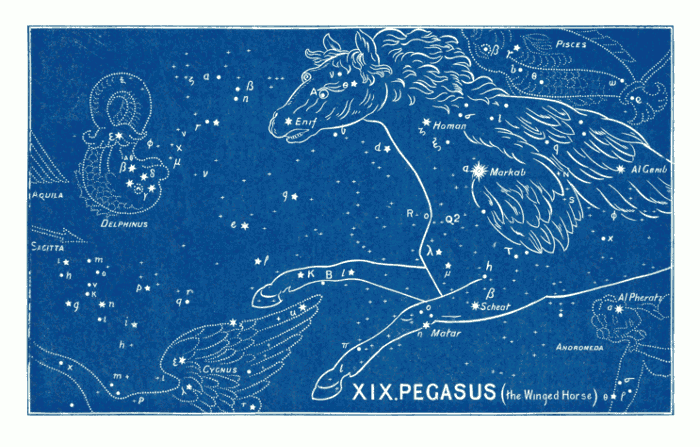
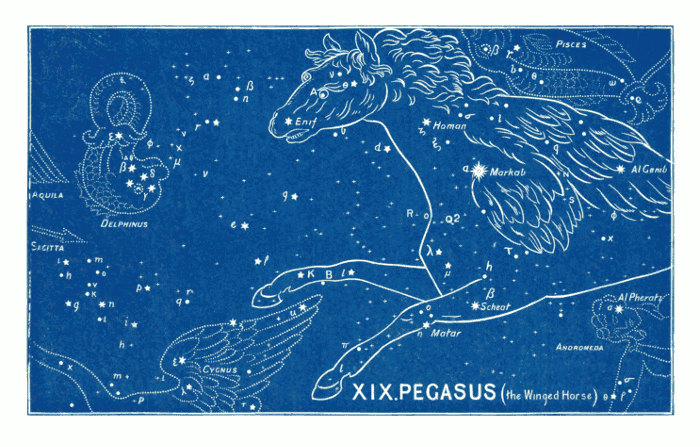
Plate 19: PEGASUS (the Winged Horse)
In the Denderah Zodiac there are two characters immediately below the horse, Pe and ka. Peka or Pega, is in Hebrew the chief, and Sus is horse. So that the very word (Pegasus) has come down to us and has been preserved through all the languages.
The names of the stars in this constellation declare to us its meaning. There are 89 altogether; one of the 1st magnitude, two of the 2nd, three of the 3rd, nine of the 4th, etc. And, as astronomers testify, “they render Pegasus peculiarly remarkable.”
The brightest, α (on the neck of the horse at the junction of the wing), comes down to us with the ancient Hebrew name of Markab, which means returning from afar. The star β (in the near shoulder) is called Scheat, i.e., who goeth and returneth. The star γ (at the tip of the wing) bears an Arabic name—Al Genib, who carries. The star ε (in the nostril) is called Enif (Arabic), the water. The star η (in the near leg) is called Matar (Arabic), who causes to overflow.
These names show us that we have to do with no mere horse. A winged horse is unknown to nature. It must therefore be used as a figure; and it can be a figure only of a person, even of Him who is “the Branch,” as the star Enif shows, who said, “If I go away, I will come again,” as the star Scheat testifies.
He who procured these blessings for the redeemed by His Atonement, is quickly coming to bring them; and is soon returning to pour them forth upon a groaning creation. This is the lesson of Pegasus.
This constellation repeats, emphasises, and affirms this glorious truth. It has to do with the Great Blesser and His speedy return, as is testified by all the ancient names connected with it.
In the Denderah Zodiac it is named Tes-ark, which means this from afar.
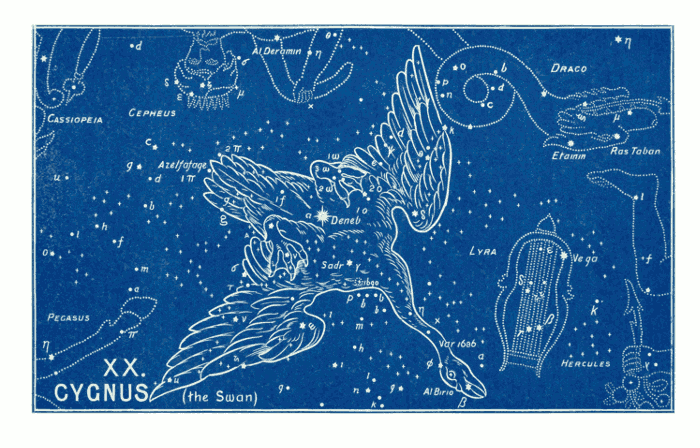
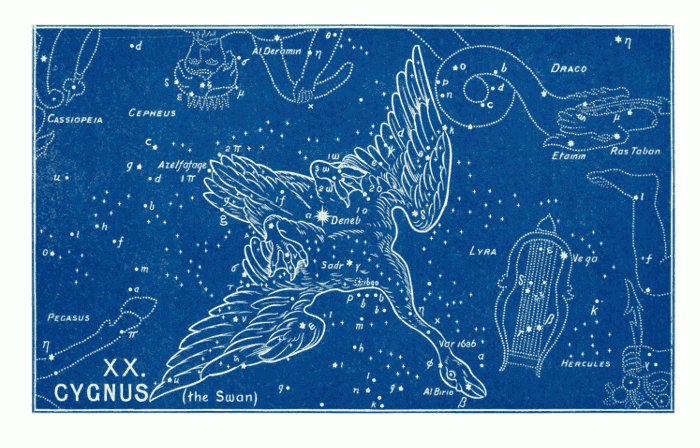
Plate 20: CYGNUS (the Swan)
It is a most brilliant and gorgeous asterism of 81 stars; one of the 1st or 2nd, six of the 3rd, twelve of the 4th magnitude, etc. It contains variable stars, five double stars, and one quadruple. The star marked “61 Cygni” is known as one of the most wonderful in the whole heavens. It consists of two stars which revolve about each other and yet have a progressive motion common to each!
This mighty bird is not falling dead, like Aquila, but it is flying swiftly in mid-heaven. It is coming to the earth, for it is not so much a bird of the air, but a bird peculiarly belonging to both the earth and the waters.
Its brightest star, α (between the body and the tail), is called Deneb (like another in Capricornus), and means the judge. It is also called Adige, flying swiftly, and thus at once it is connected with Him who cometh to judge the earth in righteousness.
The star β (in the beak) is named Al Bireo (Arabic), flying quickly.
The star γ (in the body) is called Sadr (Hebrew), who returns as in a circle.
The two stars in the tail, now marked in the maps as π 1 and π 2, are named Azel, who goes and returns quickly; and Fafage, gloriously shining forth.
The teaching, then, of the whole sign of Aquarius is clear and complete. The names of the stars explain the constellations, and the names of the constellations explain the sign, so that we are left in no doubt.
By His atoning death (as set forth in Capricornus) He has purchased and procured unspeakable blessings for His redeemed. This sign (Aquarius) tells of those blessings being poured forth, and of the speedy return of Him who is to bring “rivers of blessing,” and to fill this earth with blessing and glory “as the waters cover the sea.”
“Then take, Lord, thy kingdom, and come in Thy glory;
Make the scene of Thy sorrows the place of Thy throne,
Their Blessings Ensured, or the Living Waters of Blessing Poured Forth for the Redeemed.
The Atonement being made, the blessings have been procured, and now they can be bestowed and poured forth upon the Redeemed. This is the truth, whether we think of Abel’s lamb, of patriarchal sacrifices, the offerings under the Law, or of that great Sacrifice of which they all testified. They all with one voice tell us that atonement made is the only foundation of blessing.
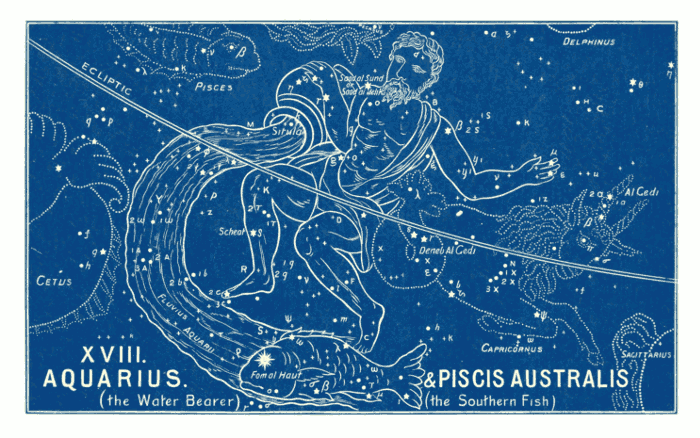
This was pictured and foreshown in the heavens from the beginning, by a man pouring forth water from an urn which seems to have an inexhaustible supply, and which flows forth downwards into the mouth of a fish, which receives it and drinks it all up.
In the ancient Zodiac of Denderah it is the same idea, though the man holds two urns, and the fish below seems to have come out of the urn. The [pg 085]man is called Hupei Tirion, which means the place of him coming down or poured forth.
In some eastern Zodiacs the Urn alone appears.
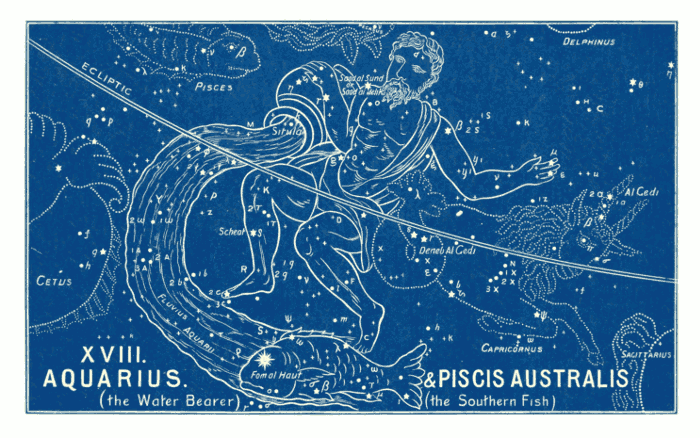
Plate 18: AQUARIUS (the Water Bearer) & PISCIS AUSTRALIS (the Southern Fish)
This agrees with its other names—Hebrew, Deli, the water-urn, or bucket (as in Num. xxiv. 7); the Arabic Delu is the same.
There are 108 stars in this Sign, four of which are of the 3rd magnitude. Their names, as far as they have come down to us, are significant.
The star α (in the right shoulder) is called Sa’ad al Melik, which means the record of the pouring forth.
The star β (in the other shoulder) is called Saad al Sund, who goeth and returneth, or the pourer out.
The bright star δ (in the lower part of the right leg) is well-known to-day by its Hebrew name Scheat, which means who goeth and returneth.
The bright star in the urn has an Egyptian name—Mon or Meon, which means simply an urn.
Aquarius is the modern Latin name by which the sign is known. It has the same meaning, the pourer forth of water.
Can we doubt what is the interpretation of this sign? The Greeks, not knowing Him of whom it testified, were, like the woman of Samaria, destitute of that living water which He alone can give. They therefore invented some story about Deucalion, the son of Prometheus; and another, saying he is Ganymede, Jove’s cup-bearer! But, as an astronomer says, “We must account otherwise for the origin of this name; for it is not possible to reconcile the [pg 086]symbols of the eleventh49 sign with Grecian mythology.” No! we must go further back than that, and not cramp our vision, and distort the Scriptures, by confining our thoughts to “the Church.” The Church is nowhere seen in these Signs, as she is nowhere revealed in the Old Testament. This we shall enlarge on when we come to the sign Pisces. Meanwhile we must read the witness of the stars as if there had been no Church!
Christ is first. Yea, He is all in all. The Scriptures testify of Him; and the very stars in this Sign tell of His going away and His coming again. These prophetic signs have to do with Him, with the Atonement He wrought, with the conflict He endured, with the blessings He secured, with the victory He shall win, and the triumph He shall have. For it is written:
“He shall pour the water out of His buckets,
And His seed shall be in many waters,
And His king shall be higher than Agag,
And His kingdom shall be exalted.”
(Num. xxiv. 7.)
It tells of that glorious day when
“A King shall reign in righteousness;
And princes shall rule in judgment;
And a MAN shall be as an hiding place
from the wind,
And a covert from the tempest;
As RIVERS of WATER in a dry place.”
(Isa. xxxii. 1, 2)
It speaks of that glorious time when Israel shall be restored, and their “eyes shall see the King in His beauty”; when the peace of Zion shall be no more disturbed, “but there the glorious Lord will be unto us a place of broad rivers and streams” (Isa. xxxiii. 17, 20, 21). Then
“The wilderness and the solitary place shall be glad for them;
And the desert shall rejoice, and blossom as the rose,
For in the wilderness shall waters break out,
And streams in the desert.”
(Isa. xxxv. 1, 6.)
“I will open rivers in high places,
And fountains in the midst of the valleys;
I will make the wilderness a pool of water,
And the dry land springs of water.”
(Isa. xli. 18.)
“Fear not, O Jacob, My servant;
And thou, Jesurun, whom I have chosen,
For I will POUR WATER upon him that is thirsty,
And floods upon the dry ground;
I will pour My Spirit upon thy seed,
And My blessing upon thy offspring.
Thus saith the Lord the King of Israel,
And his Redeemer the Lord of hosts.”
(Isa. xliv. 2, 3, 6.)
This is the meaning of the Sign. The MAN Christ Jesus, who was humbled in death will yet be seen to be the pourer forth of every blessing. Physically pouring forth literal waters, removing the curse, and turning this world into a paradise:
“Making her wilderness like Eden,
And her desert like the garden of the Lord.”
(Isa. li. 3.)
And morally pouring forth His Spirit in such abundance as to fill the whole earth with peace, and blessing, and glory, “as the waters cover the sea.”
Upon Israel restored He will pour out His blessing. They will be sprinkled with clean water, and possess a new heart and a new spirit (Ezek. xxxvi. 24-28; Joel ii. 28-32).
Such are some of the Scriptures which tell of this glorious Water-pourer. We need not rob Christ of His glory, or Israel of her blessing, in order to see in all this Pentecost or the Church. These are quite independent of the great line of prophetic truth. They are parenthetical, and distinct, and true, quite apart from the glorious prophecies of Israel’s scattering and gathering. The physical marvels referred to in the texts above can never be satisfied or exhausted by any spiritual fulfilment. We may make an application of them as far as is consistent with the teaching of the epistles; but the interpretation of them belongs to the Person of Christ, and the nation of Israel. That interpretation is pictured for us in the Sign, and in its three constellations.
1. PISCIS AUSTRALIS (The Southern Fish).
The Blessings Bestowed.
This first constellation is one of high antiquity, and its brilliant star of the first magnitude was a subject of great study by the Egyptians and Ethiopians. It is named in Arabic Fom al Haut, the mouth of the fish. There are 22 other stars.
The constellation is inseparable from Aquarius, in connection with which we have shown it in Plate XVIII (above). In the Denderah Zodiac it is called Aar, a stream.
It sets forth the simple truth that the blessings procured by the MAN—the coming Seed of the woman, will be surely bestowed and received by those for whom they are intended. There will be no failure in their communication, or in their reception. What has been purchased shall be secured and possessed.
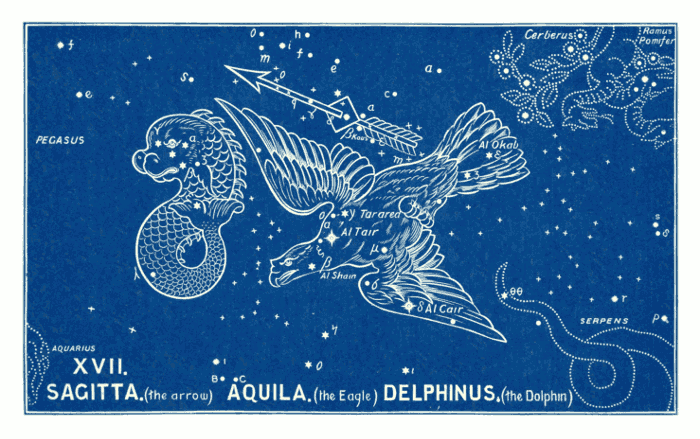
Here we have an additional picture of the effect of this arrow, in the pierced, wounded, and falling Eagle, gasping in its dying struggle. And that pierced, wounded, and dying Saviour whom it represents, after saying, in Ps. xxxviii. 2, “Thine arrows stick fast in Me,” added, in verse 10:
“My heart panteth, My strength faileth Me,
As for the light of Mine eyes it is gone from Me.”
(See also Zech. xiii. 6.)
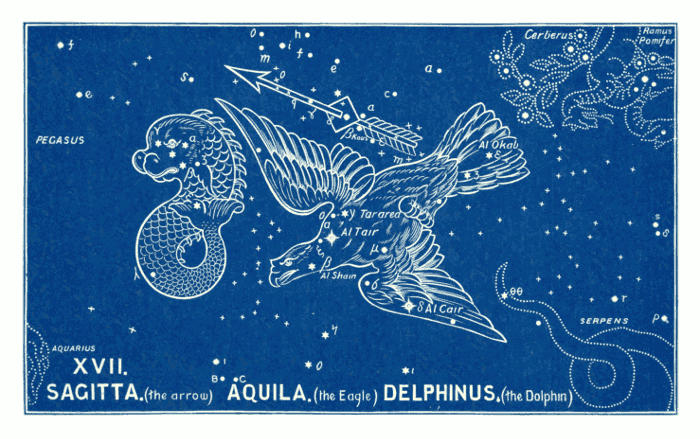
The names of the stars, all of them, bear out this representation. The constellation contains 74 stars. The brightest of them, α (in the Eagle’s neck), is a notable star of the 1st magnitude, called Al Tair (Arabic), the wounding. The star β (in the throat) is called Al Shain (Arabic), the bright, from a Hebrew root meaning scarlet coloured, as in Josh. ii. 18. The star γ (in the back) is called Tarared, wounded, or torn. δ (in the lower wing) is named Alcair, which means the piercing, and ε (in the tail), Al Okal, has the significant meaning wounded in the heel.
How can the united testimony of these names be explained except by acknowledging a Divine origin? even that of Him who afterwards foretold of the bruising of the Virgin’s Son in the written Word; yea, of Him “who telleth the number of the stars and giveth them all their names.”
3. DELPHINUS (The Dolphin).
The Dead One Rising again.
This is a bright cluster of 18 stars, five of which are of the 3rd magnitude. It is easily distinguished by the four brightest, which are in the head.
It is always figured as a fish full of life, and always with the head upwards, just as the eagle is always with the head downwards. The great peculiar characteristic of the dolphin is its rising up, leaping, and springing out of the sea.
When we compare this with the dying goat and falling eagle, what conclusion can we come to but that we have here the filling in of the picture, and the completion of the whole truth set forth in Capricornus?
Jesus “died and rose again.” Apart from His resurrection His death is without result. In His conflict with the enemy it is only His coming again in glory which is shown forth. But here, in connection with His people, with the multitudes of His redeemed, Resurrection is the great and important truth. He is “the first-fruits of them that slept”; then He, too, is here represented as a fish. He who went down into the waters of death for His people; He who could say “All thy waves and thy billows are gone over me” (Ps. xlii. 7), He it is who rises up again from the dead, having died on account of the sins of His redeemed, and risen again on account of their justification (Rom. iv. 25).
This is the picture here. In the Persian planisphere there seems to be a fish and a stream of water. The Egyptian has a vessel pouring out water.
The ancient names connected with this constellation are Dalaph (Hebrew), pouring out of water; [pg 083]Dalaph (Arabic), coming quickly;Scalooin (Arabic), swift (as the flow of water); Rotaneb or Rotaneu (Syriac and Chaldee), swiftly running.
Thus, in this first chapter of the Second Book we see the great truth of Revelation set forth; and we learn how the great Blessings of Redemption were procured. This truth cannot be more eloquently or powerfully presented than in the language of Dr. Seiss:—
“This strange goat-fish, dying in its head, but living in its afterpart—falling as an eagle pierced and wounded by the arrow of death, but springing up from the dark waves with the matchless vigour and beauty of the dolphin—sinking under sin’s condemnation, but rising again as sin’s conqueror—developing new life out of death, and heralding a new springtime out of December’s long drear nights—was framed by no blind chance of man. The story which it tells is the old, old story on which hangs the only availing hope that ever came, or ever can come, to Adam’s race. To what it signifies we are for ever shut up as the only saving faith. In that dying Seed of the woman we must see our sin-bearer and the atonement for our guilt, or die ourselves unpardoned and unsanctified. Through His death and bloodshedding we must find our life, or the true life, which alone is life, we never can have.”
It is not the Arrow of Sagittarius, for that has not left his bow. That arrow is for the enemies of God. This is for the Son of God. It was of this that He spoke when He said, in Ps. xxxviii. 2:
“Thine arrows stick fast in me,
And Thy hand presseth me sore.”
He was “stricken, smitten of God, and afflicted, He was wounded for our transgressions” (Isa. liii. 4, 5). He was “pierced,” when He could say with Job, “The arrows of the Almighty are within me” (vi. 4).
Plate 17: SAGITTA (the Arrow), AQUILA (the Eagle), DELPHINUS (the Dolphin)
Here the arrow is pictured to us in mid-heaven, alone, as having been shot forth by an invisible hand. It is seen in its flight through the heavens. It is the arrow of God, showing that Redemption is all of God. It was “the will of God” which Jesus came to do. Not a mere work of mercy for miserable sinners, but a work ordained in eternity past, for the glory of God in eternity future.
This is the record of the Word, and this is what is pictured for us here. The work which the arrow accomplishes is seen in the dying Goat, and in the falling Eagle.
There are many other stars in the heavens in a straighter line, which would better serve for an arrow. Why are these stars chosen? Why is the arrow placed here? What explanation can be given, except that the Revelation in the stars and in the Book are both from the inspiration of the same Spirit?
There are about 18 stars, of which four are of the 4th magnitude. Only γ and δ are in the same line, while the shaft passes between α and β.
In the First Book we have had before us the work of the Redeemer set forth as it concerned His own glorious person. In this Second Book it is presented to us as it affects others. Here we see the results of His humiliation, and conflict, and victory—“The sufferings of Christ” and the blessings they procured for His redeemed people.
In Chapter I. we have the Blessings procured.
In Chapter II. their Blessings ensured.
In Chapter III. their Blessings in abeyance.
In Chapter IV. their Blessings enjoyed.
Chapter I. The Sign CAPRICORNUS (The Sea Goat)
The Goat of Atonement Slain for the Redeemed.
It is most noteworthy that this Second Book opens with the Goat and closes with the Ram: two animals of sacrifice; while the two middle chapters are both connected with fishes. The reason for this we shall see as we proceed.
Both are combined in the first chapter, or “Sign” of Capricornus.
In all the ancient Zodiacs, or Planispheres, we find a goat with a fish’s tail. In the Zodiacs of Denderah and Esneh, in Egypt, it is half-goat and half-fish, and it is there called Hu-penius, which means the place of the sacrifice.
In the Indian Zodiac it is a goat passant traversed by a fish.
There can be no doubt as to the significance of this sign.
In the Goat we have the Atoning Sacrifice, in the Fish we have the people for whom the atonement is made. When we come to the sign “Pisces” we shall see more clearly that it points to the multitudes of the redeemed host.
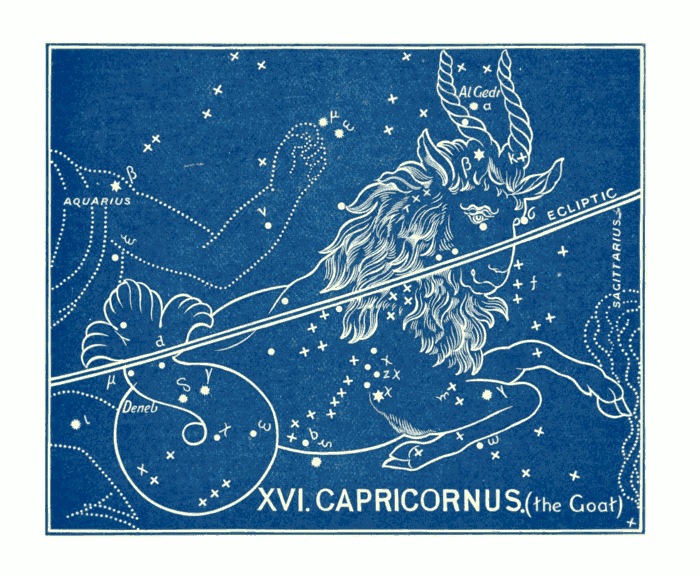
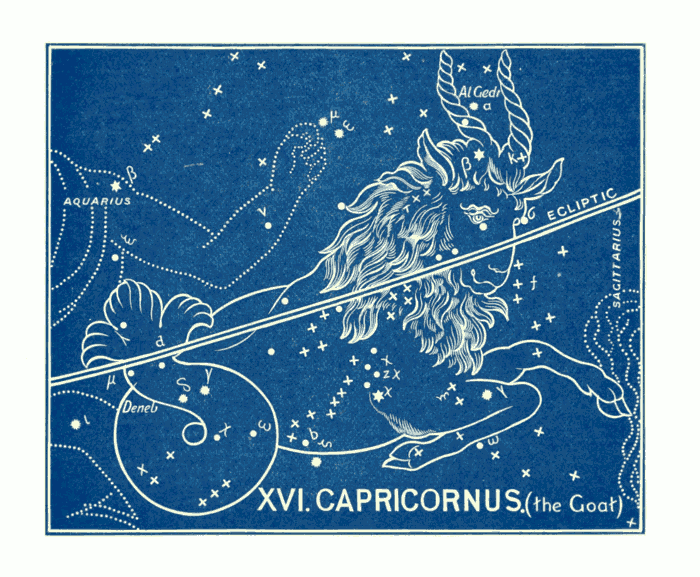
The Goat is bowing its head as though falling down in death. The right leg is folded underneath the body, and he seems unable to rise with the left. The tail of the fish, on the other hand, seems to be full of vigour and life.
The Hebrew name of the sign is Gedi, the kid or cut off, the same as the Arabic Al Gedi. Capricornus is merely the modern (Latin) name of the sign and means goat.
Plate 16: CAPRICORNUS (the Goat)
There are 51 stars in the sign, three of which are of the 3rd magnitude, three of the 4th, etc. Five are remarkable stars, α and β in the horn and head, and the remaining three, γ, δ, and ε, in the fishy tail. The star α is named Al Gedi, the kid or goat, while the star δ is called Deneb Al Gedi, the sacrifice cometh.
Other star-names in the sign, not identified, are Dabih (Syriac), the sacrifice slain; Al Dabik and Al Dehabeh (Arabic) have the same meaning; Ma’asad, the slaying; Sa’ad al Naschira, the record of the cutting off.
Is not this exactly in accord with the Scriptures of truth? There were two goats! Of “the goat of the sin-offering” it is written, “God hath given it to you to bear the iniquity of the congregation, to make atonement for them before the Lord” (Lev. x. 16, 17): of the other goat, which was not slain, “he shall let it go into the wilderness” (Lev. xvi. 22). Here is death and resurrection. Christ was “wounded for our transgressions, and bruised for our iniquities.” “For the transgression of MY PEOPLE was He stricken” (Isa. liii.). He laid down His life for the sheep.
In the first chapter of the First Book, we had the same Blessed One presented as “a corn of wheat.” Here we see Him come to “die,” and hence not abiding alone, but bringing forth “much fruit” (John xii. 24). The living fish proceeds from the dying goat, and yet they form only one body. That picture, which has no parallel in nature, has a perfectly true counterpart in grace; and “a great multitude, which no man can number,” have been redeemed and shall obtain eternal life through the death of their Redeemer.
It is, however, not merely the actual death which is set before us here. The first chapter in each book has for its great subject the Person of the Redeemer in prophecy and promise. The last chapter in each book has for its subject the fulfilment of that prophecy in victory and triumph, in the Person of the Redeemer: while the two central chapters in each book are occupied with the work which is the accomplishment of the promise, presented in two aspects—the former connected with grace, the latter with conflict.
Thus, the structure of each of the three books is an epanodos, having for its first and last members the Person of the Redeemer (in “A” in Prophecy; in “A” in Fulfilment), while in the two central members we have the work and its accomplishment (in “B” in grace; and in “B” in conflict).
It may be thus presented to the eye:—
The First Book.
A | Virgo. The Prophecy of the Bruised Seed.
B | Libra. The work accomplished (in grace).
B | Scorpio. The work accomplished (in conflict.)
A | Sagittarius. The fulfillment of the promised victory.
The Second Book.
C | Capricornus. The Prophecy of the Promised Deliverance.
D | Aquarius. Results of the work bestowed (in grace).
D | Pisces. Results of the work enjoyed (in conflict).
C | Aries. The Fulfilment of the Promised Deliverance.
The Third Book.
E | Taurus. The Prophecy of the coming Judge of all the earth.
F | Gemini. The Redeemer’s reign. (Grace and Glory).
F | Cancer. The Redeemer’s possession (safe from all conflict).
E | Leo. The fulfilment of the promised Triumph.
Hence in Capricornus we must look for the prophecy of this Coming Sacrifice. As a matter of fact it did actually point out the time when the Sun of Righteousness should arise, and “the Light of the World” appear. For when this Promised Seed was born the Sun was actually in this sign of Capricornus! “The fulness of time was come,” and “God sent forth His Son TO REDEEM them that were under the Law” (Gal. iv. 4). The Sun was really amongst those very stars—Al Gedi, the kid, and Deneb Al Gedi, the sacrifice cometh—when this willing Sacrifice said, “Lo I come to do Thy will, O God.” The nights were at their darkest and their longest when Jesus was born. The days began immediately to lengthen when He, “the true light,” had come into the world.
Astronomers confess that the perverted legends of the Greeks give but “a lame account” of this sign, “and it offers no illustration of its ancient origin.”
Its ancient origin reveals a prophetic knowledge, which only He possessed who knew that in “the fulness of time” He would send forth His Son.
We now come to the three constellations which give us three pictures setting forth the death of this Sacrifice and of His living again.
The Old Serpent, or the Devil, cast down from Heaven.
Each of the three great books concludes with this same foreshowing of Apocalyptic truth. The same great enemy is referred to in all these pictures. He is the Serpent; he is the Dragon; “the great dragon, that old serpent, called the Devil and Satan” (Rev. xii. 9). The Serpent represents him as the Deceiver; the Dragon, as the Destroyer.
This First Book concludes with the Dragon being cast down from heaven.
The Second Book concludes with Cetus, the Sea Monster, Leviathan, bound.
The Third Book concludes with Hydra, the Old Serpent, destroyed.
Here, at the close of the First Book, we see not merely a dragon, but the Dragon cast down! That is the point of this great star-picture.
No one has ever seen a dragon; but among all nations (especially in China and Japan), and in all ages, we find it described and depicted in legend and in art. Both Old and New Testaments refer to it, and all unite in connecting with it one and the same great enemy of God and man.
It is against him that the God-Man— “the Son of God—goes forth to war.” It is for him that the eternal fires are prepared. It is he who shall shortly be cast down from the heavens preparatory to his completed judgment. It is of him we read, “The great dragon was cast out, that old serpent, called the Devil, and Satan, which deceiveth the whole world: he was cast out and his angels with him. And I heard a loud voice saying in heaven, Now is come salvation, and strength, and the kingdom of our God, and the power of His Christ; for the accuser of our brethren is cast down” (Rev. xii. 9, 10).
It is of him that David sings: —
“God is my king of old,
Working salvation in the midst of the earth …
Thou brakest the heads of the dragons in the waters.
Thou brakest the heads of leviathan in pieces.”
(Ps. lxxiv. 12-14.)
Of him also the Spirit causes Isaiah to say, “In that day, shall this song be sung in the land of Judah”; —
“In that day the Lord, with his sore, and great, and strong sword,
Shall punish leviathan the piercing (r.v. swift) serpent,
Even leviathan that crooked serpent;
And he shall slay the dragon that is in the sea.”
(Isa. xxvi. 1; xxvii. 1.)
This is exactly what is foreshadowed by this constellation of Draco. Its name is from the Greek, and means trodden on, as in the Septuagint of Ps. xci. 13: “The dragon shalt thou trample under feet,” from the Hebrew דָּרַךְ, Dahrach, to tread.
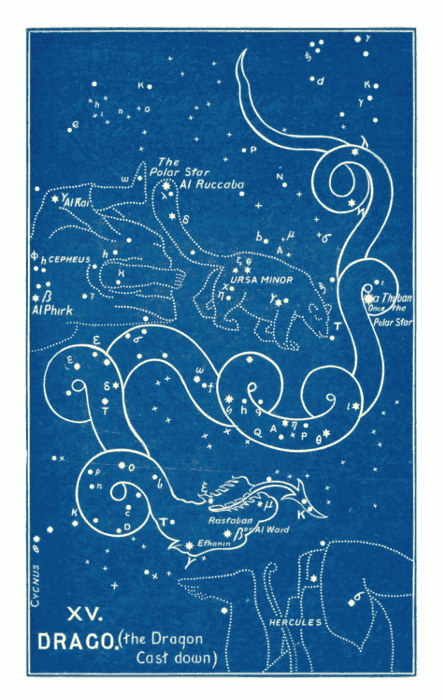
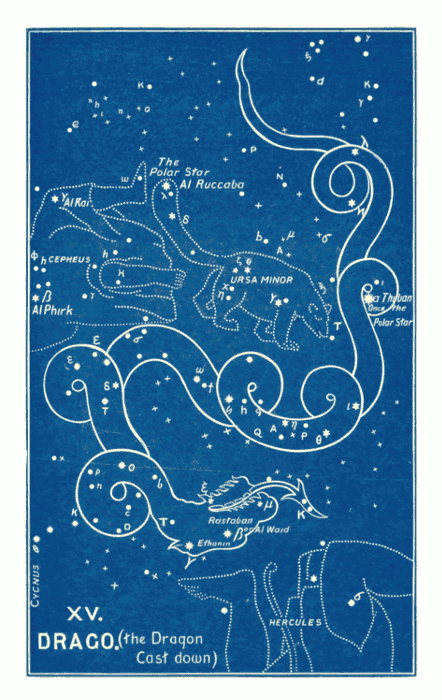
Plate 15: DRACO (the Dragon Cast down)
In the Zodiac of Denderah it is shown as a serpent under the fore-feet of Sagittarius, and is named Her-fent, which means the serpent accursed!
There are 80 stars in the constellation; four of the 2nd magnitude, seven of the 3rd magnitude, ten of the 4th, etc.
The brightest star, α (in one of the latter coils), is named Thuban (Heb.), the subtle. Some 4,620 years ago it was the Polar Star. It is manifest, therefore, that the Greeks could not have invented this constellation, as is confessed by all modern astronomers. It is still a very important star in nautical reckonings, guiding the commerce of the seas, and thus “the god of this world” is represented as winding in his contortions round the pole of the world, as if to indicate his subtle influence in all worldly affairs.
The next star, β (in the head), is called by the Hebrew name Rastaban, and means the head of the subtle (serpent). In the Arabic it is still called Al Waid, which means who is to be destroyed.
The next star, γ (also in the head), is called Ethanin, i.e., the long serpent, or dragon.
The Hebrew names of other stars, not identified, are Grumian, the subtle; Giansar, the punished enemy. Other (Arabic) names are Al Dib, the reptile; El Athik, the fraudful; El Asieh, the bowed down.
And thus the combined testimony of every star (without a single exception) of each constellation, and the constellations of each sign, accords with the testimony of the Word of God concerning the coming Seed of the woman, the bruising of His heel, the crushing of the serpent’s head, “the sufferings of Christ, and the glory which should follow.”

 articlesforchristians