A place to grow your relationship with God

Archive for the ‘Peter and Polly Series’ Category

The Geography Lesson

Polly liked to go to school. She had wished to go for a long time. She thought that she should like it. And, sure enough, she did.

Father had taught Polly to read. So she did not begin with the very easiest book. She began with the second reader.

It was just the same with the number work. She knew all about eight and eight, and nine and nine.

She could tell Miss Barnes, her teacher, the answer to six times four, and seven times three.

Besides, she could tell how much things cost at her father’s store. And she knew how much sugar you could buy for thirty cents, if it cost ten cents a pound.

One day, Miss Barnes said, “Now we will have our geography lesson. We will talk about our village. You may tell all the things that you have seen when I have taken you walking. Who will talk first? “

“I will,” said Polly. “I know things about our village. It is called East Village. It is in a valley. The hills are high all around it. They make good sliding places.
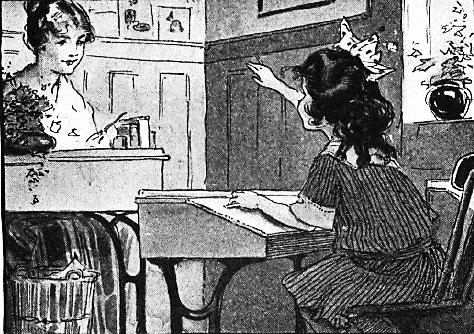
“There is one store and it is my father’s. The post office is in it. There is one church. It is white. I go to church.

“There is a railroad station. Peter and I have to watch for trains when we cross the tracks.”

“Where does the railroad go?” asked Miss Barnes.

“It goes to Large Village,” said Polly. “And when you get there, you can travel to many other places. I am not sure where it goes the other way.”

“I know,” said a big boy. “It goes through the White Mountains. If you ride far enough, you will reach the ocean. Once I did.”

“Good,” said Miss Barnes. “Can you tell more, Polly? “

“Oh, yes,” answered Polly. “I know about the blacksmith’s shop. I go there. The blacksmith is my friend. Next to his shop is the creamery. Some of the butter they make goes far away. I have seen boxes of it at the station.”

“They send it to Boston,” said another girl.

“There is a sawmill,” said Polly. “They make butter boxes there. Besides, they saw up big logs. I have seen them.

“I have been inside the grain shop. That is where Tim’s father buys all the grain for his Jersey cows. We get ours there, too. But we do not buy so much.”

“Have we a river?” asked Miss Barnes.

“Yes, it is the Moose River,” said Polly. “Last winter I saw men cutting ice on it. I saw them putting the cakes into the big ice house. The boys fish in the river in the summer. So does Blacky.

“It turns the wheels of the sawmill. I have seen three brooks that run into it. One goes under the road just a little way from here. Lots of other brooks must help to make it, too.”

“Where do the brooks come from?” asked Miss Barnes. “Perhaps you do not know that, Polly.”

“Oh, yes, I know,” said Polly. “Peter and I went to the boiling spring the other day. A brook comes from that. It is the one that goes under the road.”

“Can you tell us anything about our trees?” asked Miss Barnes.

“We have elm trees in our yard,” said Polly. “Our swing is in one of them. We can swing way up in the branches. The leaves are all gone now.

“We have maple trees in front of our house. They go all the way up to Tim’s. Peter and I made wreaths of their leaves. They were red and yellow.

“I know something more, too. Next spring my father will tap those trees. We can get maple sugar from their sap.

“Peter and I know where to find butter nut trees. The squirrels take most of the butternuts.

“We know where to find beech trees, too. Once Tim hunted for beechnuts under a maple.

“One of the big boys gave me some acorns and some oak leaves. I do not know where the oak trees are.”

“That is a good geography lesson, Polly,” said Miss Barnes. “Your father must have shown you a great many things. I did not show you all that you told us about. Now I have thought of something.

“I am going to give a box to each child in my room. We will call them ‘Keepsake Boxes.’

“You may put into these boxes anything about this geography lesson that you can find. I will look at your boxes next week. Do you think that will be fun?”

“Oh, yes, Miss Barnes!” shouted all the children.

And Polly said, “I can think of lots of things for my Keepsake Box this very minute. I can think of butternuts, and beechnuts, and corn from the grain shop, and a stamp from the post office. Oh, I am in a hurry to go home so that I can begin.”
Polly Goes to a Wedding Part II

Oh, goody, goody!” Peter cried, when he saw the sawdust. “I am sure that we shall have ice cream. I shall not get back into the carriage. It is nicer here. I am going to see what is around that corner.”

Peter was gone a long, long time. Polly called to him. He did not answer. At last she jumped down, too. She ran around the corner to find him.

There he was, looking through a fence.

“What do you think that is?” he asked. “Don’t you see? Over there back of the big rock. I have watched and watched.”

“I see it now,” said Polly. “I am going to climb the fence and see what it is.”

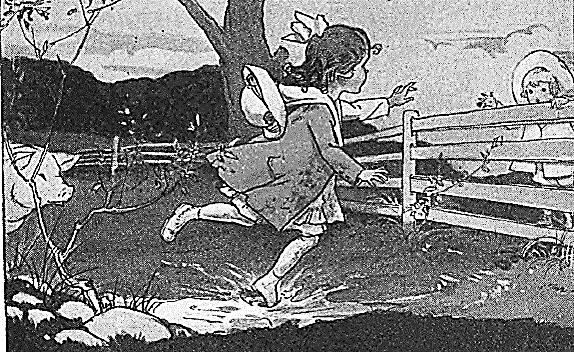
Over she climbed. There was a puddle near the fence. But she took care not to step into it. She ran to the rock. She peeped on the other side.

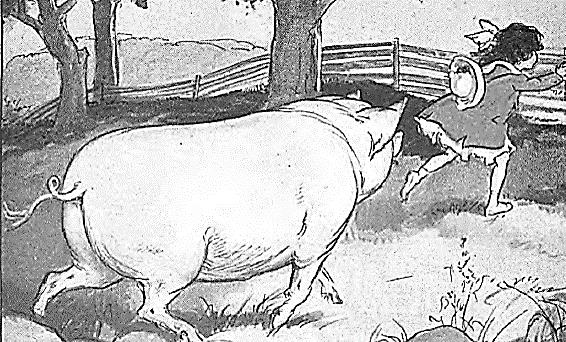
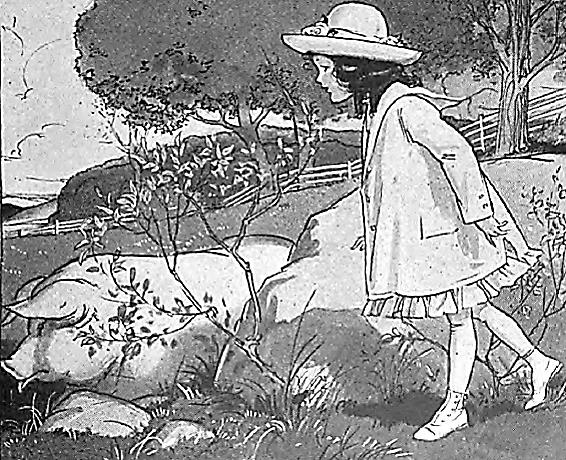
It was an ear that Peter had been watching. The ear belonged to the largest pig that Polly ever saw. He was so large that she just looked and looked.

By and by the pig saw her. He began to get up. Then Polly felt sure that he was as large as an elephant, at least.

He was so large that she would rather see him from the other side of the fence. So she turned and began to run.

Peter saw the pig come from behind the rock. He saw the pig begin to trot after Polly. Perhaps the pig wished to be fed. Perhaps he wished to look at his visitor.

Polly did not stop to look around. She just ran toward the fence as fast as she could. Peter screamed to her, “Run, Polly! He will get you! Run! Run!”

Polly heard Peter. She thought that the pig must be very near. She was close to the puddle. Should she go around it? If she did, the pig might catch her.

So, she jumped into it and scrambled up on the fence. The muddy water splashed over her. It spoiled her shoes and stockings. It spoiled her dress, too.

She looked back. The pig had stopped before it reached the puddle. It was poking the ground with its snout.

“Oh Peter!” cried Polly. “Look at me! Why did you shout, ‘Run, run’? I thought that the pig was close to me. I thought that I did not have time to go around the puddle. Look at my clothes!”

Just then Polly heard father say, “‘Handsome is that handsome does,’ Polly. Are you handsome now?”

“Why didn’t you stay in the carriage? The wedding is over. I went out to get you, but you were gone, and I could not stop to look for you.

“Come now, both of you. You may have ice cream and other things to eat.”

“Oh, oh, oh!” cried Polly. “I have missed the wedding. Oh, dear! Oh, dear! And I cannot even go in. I am too dirty.”

“Well, climb into the carriage then,” said father. “I will bring you out something to eat. Peter may come in.”

“No,” said Peter. “I must stay with Polly. She went over the fence for me. And I made her jump into the puddle. So I must stay out with her.”

“Very well,” said father. “That is only fair. Now I will go and tell why you cannot come in.” And he walked toward the house.

“Tell them that it is the very biggest pig in the world,” shouted Peter.

When Polly heard the people laugh she said, “There! Father has told them. I shall remember this wedding for a long time. And I shall remember, ‘Handsome is that handsome does,’ too.”

Polly Goes to a Wedding Part I

Polly was very much excited. She was going to a wedding. So was Peter. But he did not care so much about it. Father and mother were going, too.

Every morning at breakfast Polly talked about that wedding.

“Now there are only five days to wait. Now there are only four days to wait,” she would say.

And at last she said, “Oh, goody, goody! It is tomorrow!”

Mother said, “Yesterday I bought some new ribbon for your hair, Polly. See, here it is.”

“It is wide, isn’t it, mother? Thank you very much. And I am going to wear my white dress and my white shoes and stockings.”

“Yes,” said mother, “and your coat is all clean. You may wear that.”

“I think that I shall look very well,” said Polly.

“Perhaps you will,” father said. “But remember, ‘Handsome is that handsome does.’ It means that if you behave well, you will look well. And if you do not behave well, you will not look well.”

The day of the wedding came. Mother dressed Peter and Polly. Both had on their best clothes. How well they did look!

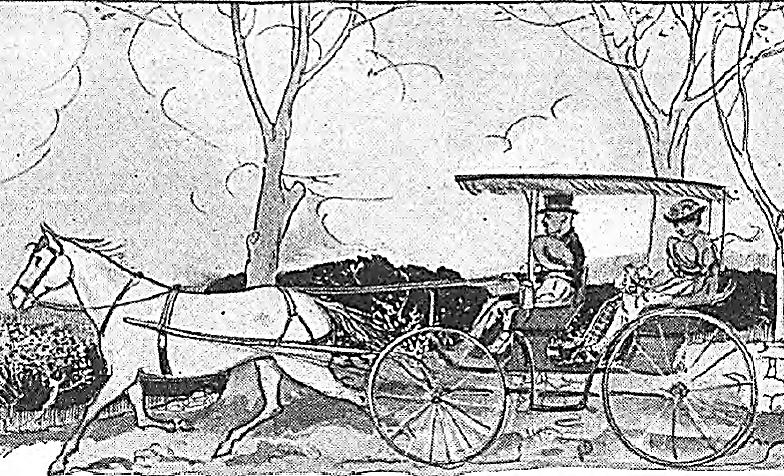
Father harnessed Mary to the two-seated carriage. Then off they went.

It was not many miles to the house. Soon they were there.

“I am glad that we are early,” said mother. “I promised to help see to the things in the dining room.”

“Oh, are there things to eat?” asked Peter. “I am hungry now.”

“Yes, there are things to eat,” said mother. “But they come after the wedding. So you must wait.”

“I will unharness the horse,” said father. “Then I will see if I can help. What shall Peter and Polly do? We must not let them get in the way.”

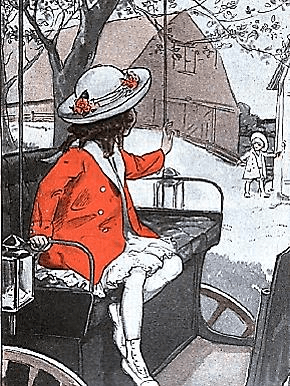
“Let me see,” said mother. “Why, Peter and Polly may sit right here in the carriage. By and by we will come out for them.”

“Goodbye, children,” said father. “‘Handsome is that handsome does,’ you know, Polly.”

Peter and Polly sat in the carriage. At first, they played that they were driving. But, after a short time, they wished to do something else.

Then they looked around. They saw the barn, the henhouses, and another small building.

“Maybe that is the icehouse,” said Polly.

“Do you think that they will have ice cream?” asked Peter. “Oh, I hope so! I hope so!”

“Perhaps they will, if that is really an ice house,” said Polly.

“Then I must see if it is, Polly. Mother will not care.” And down he jumped.

He ran to the little house. A padlock was on the door. He could not open it. But he saw sawdust about. So he felt sure that it was an icehouse.

How Peter Catches Fish

One morning Peter went fishing. He went all alone. He did not take Tim. He did not take Polly.

He said to himself, “Blacky went fishing all alone and she caught a fish. I shall try that way, too.”

Father had given Peter a real fishing pole. He had given him a real line and a real hook.

Peter had wished for these very much. He asked father for them.

He said, “Tim does not have to fish with a pin anymore. His father has given him a hook. I would be careful, if you gave me one.”

“Is a hook all that you need, Peter?” asked father.

“No, father. I need a line and a fishing pole, too.”

“Very well, Peter,” father said. “I will get these things for you. But you must do something for me.”

“Oh, yes,” said Peter. “I will do something for you. What is it?”

“I will show you two places where you may fish. You may go to those places all alone. And you may take other children with you. But, unless I am with you, you must always fish at those places. Will you?”

“Yes, I will, father. But why?”

“Because those are safe places. If you fall in, it will not matter much. Now remember, my son.”

“I will remember, father. And I will remember more, when I have my fishing pole and hook and line.”

He was very much pleased when his father brought these home. He said, “They are just like the ones that the big boys have. When may I go fishing?”

“Any time mother says that you may, Peter. Do you remember where the fishing places are?

“Oh, yes,” said Peter. “Yesterday I saw a sucker near one place. Perhaps I can catch it. Oh father! you forgot something.”

“What did I forget, Peter?”

“You forgot the bait. I thought that you would give me a whole box of worms. Then I should have some whenever I wished to fish.”

Father laughed. He said, “That is not just the way we do it, Peter. You cannot keep your worms very long. If you do, they are not good for bait. You must dig fresh ones every time you go fishing.”

Peter liked to fish. He liked it best of all the things that he could do in the summer. So he went often.

He never caught a fish. But he did not care about that. Every time he went, he thought that he surely should.

After Blacky brought home her fish, he said to himself, “If Blacky can catch fish, so can I. I shall go again and try.”

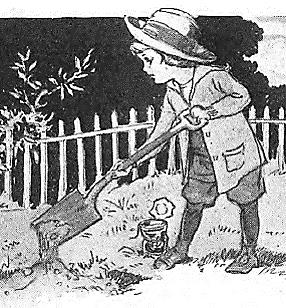
He went out into the garden. He dug one worm, he dug another. He did not like very well to put them on the hook.

So, sometimes, he took only one. But today he felt sure that he should need more. He put them carefully into a large tin can.

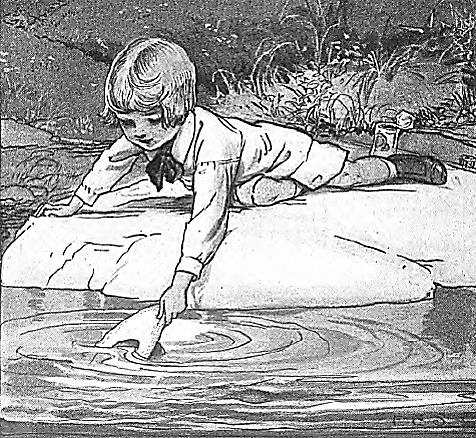
Then he went to a flat rock. It stuck out into the river. He put a fat worm on his hook. He dropped the hook into the water. He sat down and waited.

It was hot on the rock. The sun was very bright. Peter sat still a long, long time. He did not have a single bite.

At last he said to himself, “I will see if there are any fish here.”

He crawled to the edge of the rock. He looked over. Yes, there were many little fish. Some were still. Some were swimming about.

He tried to catch one in his hand. But he could not. He tried to catch one in his hat. But he could not. Then he poked them with the end of his pole. This made them all swim away.

So Peter put his hook back into the water. He waited a long, long time again.

At last he lay down on the hot rock. He fell fast asleep. He slept until nearly dinner time.

What do you think woke him? Why, Blacky. She mewed and rubbed up against his face.

Perhaps she had come fishing again. Perhaps she said to him, “I can catch fish and you cannot. I am smarter than you.”

Peter got up. He started to go home. Then he remembered his fishing pole. He took it up. He pulled on the line. It felt heavy.

“Oh Blacky!” cried Peter. “I think that I have caught a fish, too!”

He pulled more on the line. In another minute, there, on the flat rock, lay a small sucker.

“I have! I have! Oh, I have!” shouted Peter.

He quickly filled his can with water. Then he took his little fish off the hook. He put it in his can. And he and Blacky went home.

On the way up the hill Peter said, “I know how to do it now, old Blacky. Just go to sleep, and the fish will bite.”

Fisherman’s Luck by Caroline M. Griswold

This morning I went fishing all alone,

And sat for ‘most a day upon a stone;

I dropped my line with care into the brook,

And watched the little fish swim round my hook.

I said, “Kind fish, do bite without a worm;

I have one, but I hate to feel him squirm.

If you will only please me in this way,

I’ll give my wiggly worm to you for pay.”

But there, I never had a single bite;

It seems to me they did not treat me right.

If I were just a fishie in a brook,

To please a little boy, I’d bite his hook.

— Caroline M. Griswold.

Engaging Children’s Books, Fun Facts and Delicious Recipes

Children’s Bible books

  • For older kids
    • THE CHILDREN’S SIX MINUTES by Bruce S. Wright: The Children’s Six Minutes by Bruce S. Wright features a collection of themes exploring growth, kindness, faith, and life’s lessons through various engaging stories and reflections.
    • The Wonder Book of Bible Stories: “The Wonder Book of Bible Stories” by Logan Marshall shares simplified biblical narratives for children, conveying essential moral lessons through engaging tales from the Bible.

Children’s books

  • For younger kids
    • McGuffey Eclectic Primer: textbook focused on early literacy, teaching reading and writing through simple lessons and moral stories for young children.
    • McGuffey’s First Eclectic Reader: educational textbook for young readers, combining phonics, sight words, moral lessons, and simple narratives to enhance literacy skills.
    • MCGUFFEY’S SECOND ECLECTIC READER: educational book for children, promoting literacy and moral values through engaging prose, poetry, and vocabulary exercises.
    • The Real Mother Goose: a collection of nursery rhymes, reflecting childhood’s whimsical essence through well-known verses and engaging illustrations.
    • THE GREAT BIG TREASURY OF BEATRIX POTTER: The Great Big Treasury of Beatrix Potter features beloved stories like The Tale of Peter Rabbit and The Tale of Jemima Puddle-Duck, celebrating whimsical animal adventures.
    • The Tale of Solomon Owl is a whimsical children’s book by Arthur Scott Bailey, exploring themes of friendship and adventure through Solomon Owl’s humorous encounters with forest animals.
    • THE TALE OF JOLLY ROBIN: follows a young bird’s adventures as he learns life skills, values friendship, and explores youthful curiosity through humorous encounters in the wild.
    • Peter and Polly Series: The content describes a series of stories for 1st graders featuring Peter and Polly, exploring seasonal adventures, imaginative play, nature, family, and interactions with pets and animals.
    • The Adventures of Old Mr. Toad: recounts Old Mr. Toad’s humorous nature-filled journeys, emphasizing lessons on friendship, humility, and personal growth amidst various animal encounters.
    • The Wonderful Wizard of Oz: follows Dorothy’s adventures in Oz as she seeks to return home, meeting memorable friends while exploring themes of courage, friendship, and self-discovery.
  • For older kids
    • Stories of Don Quixote Written Anew for Children retells key adventures from Cervantes’ novel, preserving its spirit while engagingly presenting them for young readers in a cohesive narrative.
    • Heidi by Johanna Spyri follows a young girl adapting to life in the Swiss Alps with her grandfather, highlighting themes of family, love, and the power of nature.
    • Swiss Family Robinson by Johann David Wyss: is a beloved adventure novel by Johann David Wyss about a Swiss family stranded on a deserted island, relying on their creativity and teamwork to survive and build a new life.
    • Rebecca Of Sunnybrook Farm: follows the spirited Rebecca Randall as she navigates life with her aunts in Riverboro, experiencing adventure, growth, and identity exploration.

Children’s history book

  • For younger kids
    • Great Stories for Little Americans: introduces young readers to American history through engaging tales, fostering national pride and knowledge of heritage via accessible storytelling.
    • The Bird-woman of the Lewis and Clark Expedition: A Supplementary Reader for First and Second Grades- tells Sacajawea’s vital role in guiding the explorers, emphasizing her contributions and experiences during this historic journey.
    • The Story of Mankind: chronicles human history from prehistory to the modern era, highlighting key events, cultures, and figures that shaped civilization.
    • A First Book in American History: A first book in American history: with special reference to the lives and deeds of great Americans. This book chronicles pivotal figures in American history, from Columbus and John Smith to Franklin and Lincoln, highlighting their contributions and the nation’s expansion.
  • For older kids

Poem and stories

  • THE PLYMOUTH HARVEST by Governor Bradford
  • The Real Mother Goose Poems Book: a collection of nursery rhymes, reflecting childhood’s whimsical essence through well-known verses and engaging illustrations.
  • Top Poems for Children by Famous Authors: A list of children’s poems organized by author, with future additions anticipated, includes works by notable poets and authors. [Coming soon]
  • Poems and stories by Bell: Bell, a young poet, shares her love for God through inspiring poems and stories centered on nature, love, and faith, aiming to bless and bring joy to readers.
  • Explore Heartfelt Poems and Stories for Inspiration: Poems and stories to warm your heart.
  • Heartfelt Tales of My Beloved Pets: The author shares stories of various animals that have impacted their life, encouraging love for pets and providing comforting Bible verses for grieving pet owners.

Children bible study

Peter and Polly Series: Blacky’s Fish

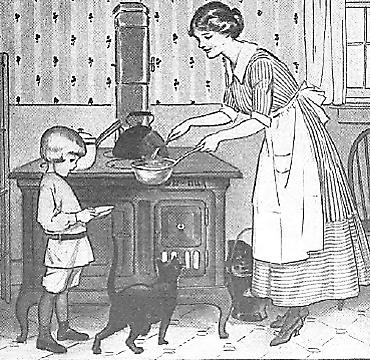
Blacky is a wise old cat. She likes milk very well. She likes potato very well.

Better than these she likes corn. She will gnaw it off the cob. Of course, she is fond of meat. But best of all she likes fish.

Blacky will beg a long time for cooked fish. Once, she even stole a piece. After that mother never left fish where Blacky could get it. Then she could not be naughty.

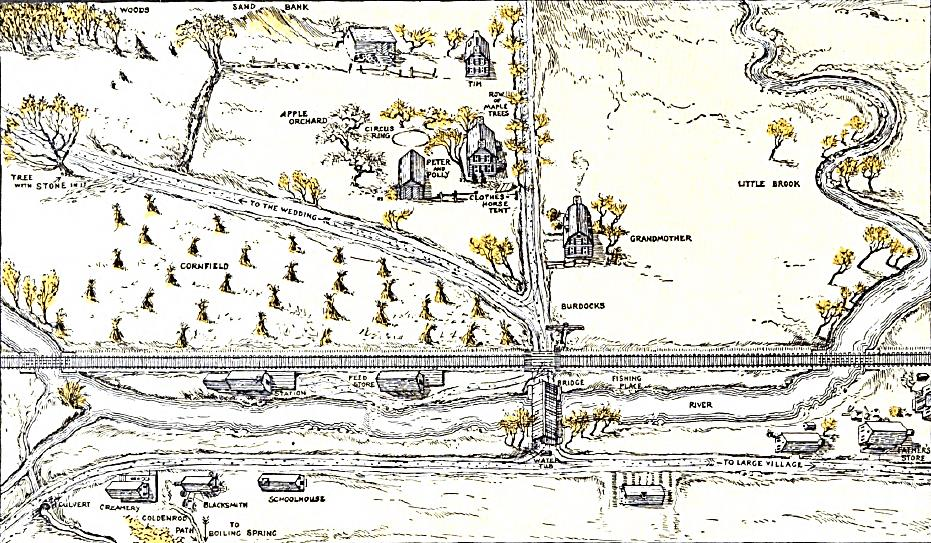
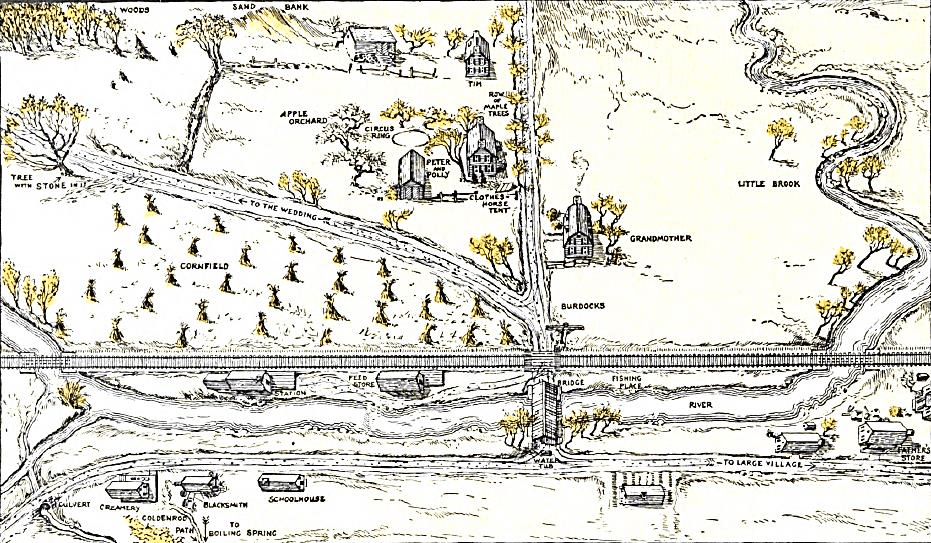
One day Polly and Peter were playing in the yard. Tim was playing with them. Tim is Peter’s little friend. He lives in the very next house. You can find it on the map shown at the bottom of the page.

Polly said to Peter, “What has Blacky there?”

“Where?” asked Peter.

“In her mouth, Peter. Now she has dropped it. I saw her coming up the road with it.”

“I’ll see what it is,” said Peter.

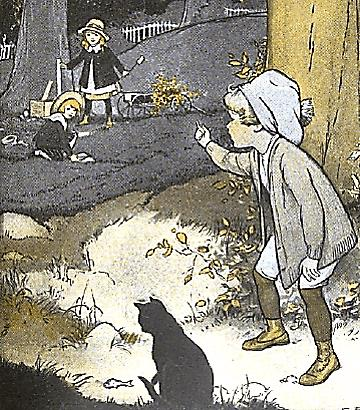
He ran to Blacky. She was sitting down watching what she had dropped.

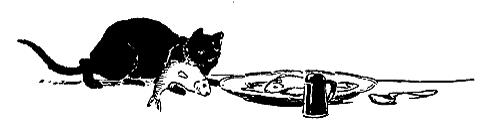
“Oh Polly” called Peter. “Come here, come here! It is a fish. It is alive. It wiggles. Where did she get it?”

“I don’t know,” said Polly.

“Perhaps she stole it out of somebody’s kitchen,” said Tim.

“People do not have live fish in their kitchens. Do they, Polly?” said Peter.

“No, I guess not,” said Polly. “It looks like a sucker. What is she going to do with it?”

“Eat it, of course,” said Peter.

But Blacky did not eat it. Instead, she picked it up again. She carried it to the kitchen door.

There she dropped the fish and mewed. Mrs. Howe came to the door. She opened it for Blacky.

Blacky took up the fish once more. She carried it into the kitchen. She put it down where her dish of food was put three times a day.

Peter and Polly and Tim had followed her.

“Where did Blacky get this fish, children?” asked mother. “Did you give it to her?”

“No, mother. We do not know where she got it. It was alive when we first saw it.”

“Perhaps one of the big boys gave it to her. Have any of them been fishing, Peter?”

“I do not know, mother. Maybe Blacky caught it herself.”

“Of course she did not, Peter,” said Polly. “Do not be so silly. Cats cannot fish.”

“She has been in the water,” said mother.” See! Her fur is all wet in front. And underneath it is wet, too.

“I wonder if she could have caught that fish. I have heard of such things. Blacky is a wise old cat. Perhaps she is wise enough to go fishing.”

“If the sucker was close to the bank, she could catch it with her claws,” said Polly.

“Maybe Peter is right, after all. Tell us about it, old Blacky.”

Blacky only purred and rubbed up against mother.

“She wishes something,” said mother. “And I think that I know what it is. She does not like raw fish. Most cats do, but she does not. She is asking me to cook it for her. And so I will.

“Here comes father. He will clean Blacky’s fish. You may tell him about it while he does so.”

In a few minutes, father brought it in to mother.

“I do believe that Blacky is a fisherman,” he said. “I should like to see just how she did it. Perhaps we can catch her at it sometime.”

Then mother boiled the fish and Blacky ate it for supper. She did not offer anyone a bite. But that was just as well. Suckers are not good for us to eat late in the summer.

Peter and Polly Series: The Broken Show Case

Before long, father found mother and Polly and Peter. He saw the children’s balloons. He heard the story of the bunch that went up in the air.


Then he said, “Now, before we have our luncheon, I will take you to the merry-go-round. Have you heard the music? Do you wish a ride?”

“Oh, yes, yes!” cried Polly and Peter dancing up and down.

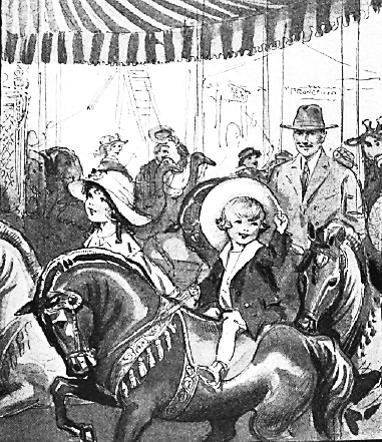
Do you know what a merry-go-round is? If you do not, look at the picture. It will show you.

Peter and Polly had ridden on one just twice before. Then they had liked it very much.

Peter chose a black horse and Polly chose a gray one. They were side by side. Father sat on one behind these two. Many other people sat on other horses.

At last the music started. The horses started, too. All moved around in a circle. It was quite a large circle, but not so large as a circus ring.

Faster and faster the horses went. Polly and Peter held on with both hands. Around and around the circle they flew. Oh, what fun it was!

Then the music stopped. The horses slowed down. The people climbed off the horses, and it was over.

“I should like to ride again,” said Peter. “Does it cost much?”

“Five cents apiece,” said father. “Perhaps we can have one more ride after luncheon. Come now, it is time to eat.”

The luncheon was taken to a shady place and opened. How good everything looked! How good everything tasted!

Father said, “While we eat, I will tell you a story. Then we shall not hurry. This is a true story. It happened to me, when I was a little boy.

“One day my father took me to the fair. He showed me the same things that I have shown you. He let me ride on the horses. He gave me a drink of lemonade.”

“Oh,” said Peter, “I wish that you would get us some lemonade.”

“The kind that Polly sells is better than any we can buy at the fair,” said father.

“Let us wait until we get home. Here is plenty of cold water.”

“Please go on, father,” said Polly. “What else did you do at the fair? Were there horse races?”

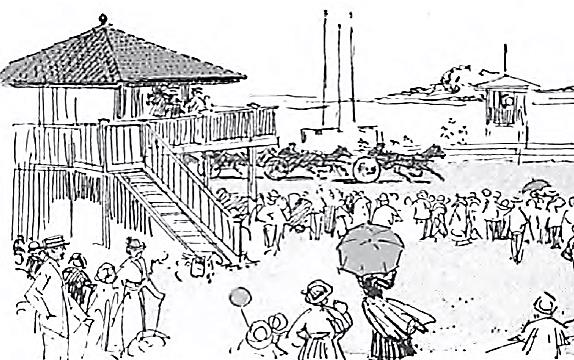
“Yes,” said father. “After luncheon, we shall see horse races just like them. We will sit in the grandstand. Then we can see very well. Yes, when my father took me to the fair, I saw horse races.

“I was about as old as Peter, then. In the afternoon, I began to be very tired. My father said that he would take me home. But first he wished to go into one more place.

“This was a very large building. In it were all kinds of things. These had been made by different people. There were bedspreads and quilts hanging up. There were all kinds of fancy work.

“The only things which pleased me were the things to eat. There were many counters and show cases filled with bread, cookies, cake, pies, and candy.

“My father lifted me up in his arms so that I could look into one showcase. He began to talk with the woman who stood behind the case. He did not see what I was doing.

“I told you that I was very tired. I just leaned out of my father’s arms and rested my arms on the glass at the top of the case.

“Crack, crack, crack went that glass. I had leaned so hard that I had broken it.

“The woman who owned it was very angry. She was quite cross to me. But my father told her that he would pay for it at once. As soon as he did, she cut a cake and gave me a large piece.

“When we got home, I heard my father telling your Grandmother Howe about it. He told her that he thought he had paid for the cake the woman gave us, because she had charged him so much for the glass.”

“That is a good story, father,” said Polly. “I like stories about when you were a little boy. I am sorry that you broke the case. I hope you were not frightened.”

“I was a little, Polly,” said father. “Now, if you have finished your luncheon, we will have another ride on the merry-go-round. Then we must get good seats in the grandstand for the races.”

Peter and Polly: A Bunch of Balloons

A Bunch of Balloons

See all the people!” cried Polly. “I did not know that there were so many except at a circus.”

“Father, where did you put Mary?” asked Peter.

“Over there by the fence. Here is a ticket for her. No one can take her without this ticket. She will wait for us.”

“Let us go into that place,” said Polly. “See all the people going in there.”

“That is a place in which to eat,” father said. “We do not wish to eat yet. Besides, we brought our food with us.”

“Let us go to see the cattle,” said mother.

Father took them to a large building. It was full of sheep. There were many different kinds.

“Farmer Brown has some of his sheep here,” said father.

“Are his two pet lambs here?” asked Peter. “I mean the ones that came to our party on his piazza last summer. I hope that they will get a blue ribbon.”

After they had seen the sheep, they went into the building where the cows were kept.

“Some of Tim’s Jersey cows are here,” said father. “Perhaps we can find them.”

There were hundreds of cows. The children grew tired of looking at so many. At last they found Tim’s Jersey cows standing side by side.

“Let us look at the horses now,” said father. “Perhaps we can find the blacksmith’s.”

“Perhaps you can find a pony for us,” said Peter. “I wish that you would try.”

“Now,” said father, “you have seen enough of the horses. There are the pigs left to see. Does anybody wish to look at the pigs?”

“Suppose you go alone,” said mother. “The children and I will stay outside this building and wait for you. We are a little tired.”

“Look for the little black pig! “Polly shouted.

Mother and Polly and Peter found a bench on which to sit.

Then mother said, “Now let us look for interesting things. You first, Polly. What do you see that is interesting?”

“All the automobiles standing over there. And all the wagons. And all the people.”

“Yes,” said mother. “There are hundreds of automobiles and wagons. Peter, what do you see?”

“All the people going into that place to eat. And all the people coming out.”

“Oh, oh!” cried Polly. “Look, look! See the men leading the ponies, Peter!”

“Oh Polly!” cried Peter. “See the men leading the dogs! “

“Those dogs are going to race,” said mother.

“Where, where? Let us go,” said Polly.

“We will see them this afternoon, Polly,” said mother.” They do not race until then.”

“Oh, I wish that we had brought Wag-wag,” said Polly.” I am sure that he could beat.”

“Perhaps he could not,” said mother. “Those dogs are trained to race. Wag-wag is not.”

“Oh mother, mother!” cried Peter.

“There is a boy with some balloons! See them! See them! Red ones and white ones and blue ones. May we have some?”

“Yes, you may. Here is a dime for you, Peter. Here is a dime for you, Polly. Run and buy.”

“Stop, stop” called Peter to the boy. “I will buy a red balloon.”

“I will buy a blue one,” said Polly. “Here is the money.”

The boy untied a blue and a red balloon. He gave them to Polly and to Peter.

A crowd of people had gathered around him. Somebody pushed against him. He dropped Polly’s money.

He stooped to pick it up. His bunch of balloons slipped from his hand. He jumped up and caught at them. But he only pushed them farther away.

Other people tried to get them. But the crowd was thick. People bumped against one another. Nobody caught the balloons. Up into the air they sailed.

The boy looked ready to cry. But he did not. He said, “Oh, dear! Oh, dear! I shall be punished for losing my balloons. I wish I could get them.”

“It is too bad,” said one man. “Perhaps we can help you. Here! Give me your cap.

“Now, ladies and gentlemen,” he said, “let us put into this boy’s cap the money for his balloons. Then he will not be punished for losing them.

It is too nice a day for anybody to be punished. Now walk right up and help.” And he dropped in a large piece of silver money.

Mrs. Howe gave Peter and Polly each five cents. They put the money into the cap. The man who passed the cap smiled at Polly.

Many, many people put money into the cap. The boy had enough to pay for his balloons.

Then the crowd went away. Polly and Peter watched the bunch of balloons up in the air.

At last Polly said to her mother, “That was a homely man who held the cap. But he looked handsome to me. I think that he is kind.

“You see I remember, ‘Handsome is that handsome does.'”

Peter and Polly: Starting for the Fair

Starting for the Fair

Polly ran into the house from school one day. She banged all the doors.

“Next week is fair week! Next week is fair week!” she shouted.

Peter was in the house. He heard Polly. “Next week is fair week! Next week is fair week!” he shouted, too.

“How do you know, Peter?” asked Polly.

“Because you said so,” answered Peter. “Besides, the blacksmith said so. His horses are going to the fair to get blue ribbons. Do horses like to go to the fair? If we go, shall we get blue ribbons?”

Father laughed. “You certainly are a prize,” he said. “You ought to get a blue ribbon.”

“Then will you take us so that we can?” asked Peter.

And Polly said, “Oh, will you take us? School closes for two days so that all the children can go.”

“Yes,” said father. “I mean to take you. Mother is going, too. If it does not rain, we shall have a good time.”

“Goody, goody!” cried both children.

“Shall we drive Mary?” asked Polly. “Tim is going on the train.”

“I think so,” said father. “But we may go on the train. That will be just as mother says. You must ask her.”

“Are you going on the train, mother?” asked Peter. “I wish to go on the train.”

“If we do, you will have to help carry the luncheon,” said mother.

“Oh, shall we take things to eat?” shouted Peter. “Goody, goody! Then let us go in our carriage.”

“I think that will be easier,” said mother.

The day of the fair was warm and bright. Mother and father were up early. So were Peter and Polly.

Mother got the breakfast, and washed the dishes, and put up the luncheon. Father fed the horse, and milked the cow, and fed the hens.

Polly made the beds. She was in a great hurry to get them done.

She smoothed out all the wrinkles in mother’s bed. She smoothed out all the wrinkles in father’s bed. She smoothed out all the wrinkles in Peter’s bed.

When she came to her own bed she said, “I shall not smooth out all my wrinkles. It takes too long. I wish to be downstairs and know what is going on.”

You see that mother and father and Polly were all busy. And Peter was busy, too. He was busy getting into everybody’s way.

He stood just where mother wished to walk. Then he went upstairs and stood just where Polly wished to walk. But he did not mean to do so.

At last mother said, “Peter, why don’t you run out and sit in the carriage? In a few minutes, father will harness Mary. I am almost ready now.”

“I will,” said Peter. He got his hat and his coat. Father had drawn the two-seated carriage out of the barn. Peter climbed into it.

He waited a long, long time. He thought that he had waited all the morning. But it was really only half an hour.

At last Polly came. Then father brought out the luncheon basket. He harnessed Mary. Mother came out of the side door. She was ready, too.

Mother and Polly sat on the back seat. Father and Peter sat in front.

Down the hill they went. Past the store and through the woods, past Farmer Brown’s and on, on, on to Large Village the road ran.

“I never was so happy before in all my life,” said Polly. “Just think! We are going to the fair, and we are going to have a picnic, too. I must jump up and down.”

“Jump then,” said mother. “But remember the blacksmith’s pig. Do not jump out.”

Through Large Village they went. Then the road became crowded. There were many carriages. There were more automobiles.

They had to drive very slowly. But at last they came in sight of the Fair Grounds.