A place to grow your relationship with God

Archive for the ‘In Autumn’ Category

Polly Goes to a Wedding Part II

Oh, goody, goody!” Peter cried, when he saw the sawdust. “I am sure that we shall have ice cream. I shall not get back into the carriage. It is nicer here. I am going to see what is around that corner.”

Peter was gone a long, long time. Polly called to him. He did not answer. At last she jumped down, too. She ran around the corner to find him.

There he was, looking through a fence.

“What do you think that is?” he asked. “Don’t you see? Over there back of the big rock. I have watched and watched.”

“I see it now,” said Polly. “I am going to climb the fence and see what it is.”

Over she climbed. There was a puddle near the fence. But she took care not to step into it. She ran to the rock. She peeped on the other side.

It was an ear that Peter had been watching. The ear belonged to the largest pig that Polly ever saw. He was so large that she just looked and looked.
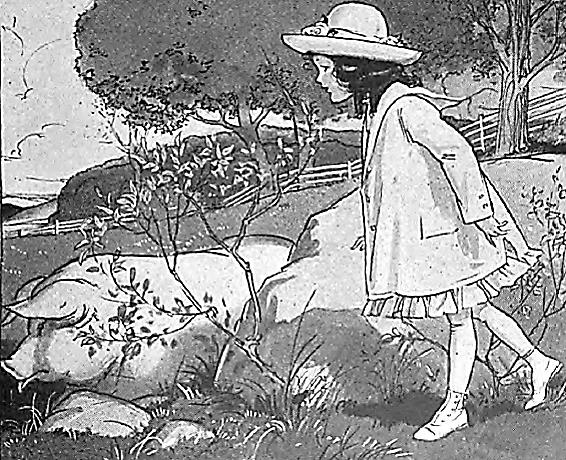
By and by the pig saw her. He began to get up. Then Polly felt sure that he was as large as an elephant, at least.

He was so large that she would rather see him from the other side of the fence. So she turned and began to run.

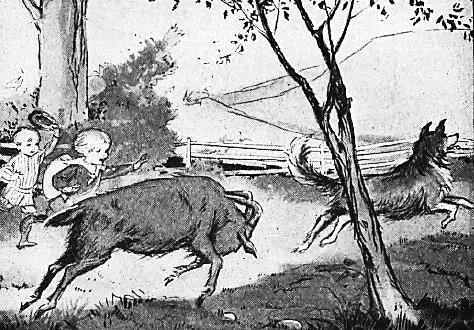
Peter saw the pig come from behind the rock. He saw the pig begin to trot after Polly. Perhaps the pig wished to be fed. Perhaps he wished to look at his visitor.

Polly did not stop to look around. She just ran toward the fence as fast as she could. Peter screamed to her, “Run, Polly! He will get you! Run! Run!”
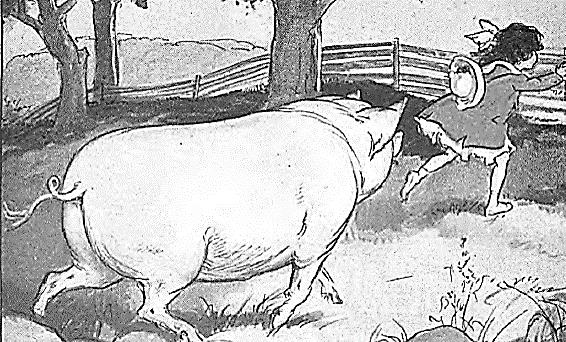
Polly heard Peter. She thought that the pig must be very near. She was close to the puddle. Should she go around it? If she did, the pig might catch her.

So, she jumped into it and scrambled up on the fence. The muddy water splashed over her. It spoiled her shoes and stockings. It spoiled her dress, too.
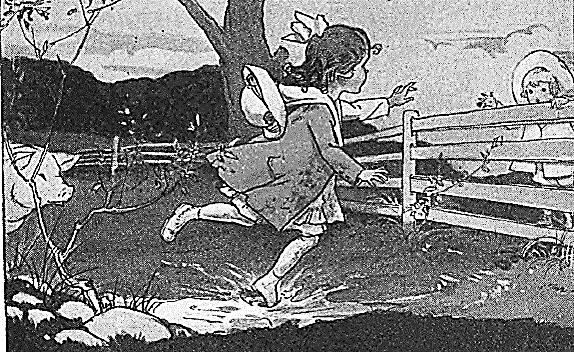
She looked back. The pig had stopped before it reached the puddle. It was poking the ground with its snout.

“Oh Peter!” cried Polly. “Look at me! Why did you shout, ‘Run, run’? I thought that the pig was close to me. I thought that I did not have time to go around the puddle. Look at my clothes!”

Just then Polly heard father say, “‘Handsome is that handsome does,’ Polly. Are you handsome now?”

“Why didn’t you stay in the carriage? The wedding is over. I went out to get you, but you were gone, and I could not stop to look for you.

“Come now, both of you. You may have ice cream and other things to eat.”

“Oh, oh, oh!” cried Polly. “I have missed the wedding. Oh, dear! Oh, dear! And I cannot even go in. I am too dirty.”

“Well, climb into the carriage then,” said father. “I will bring you out something to eat. Peter may come in.”

“No,” said Peter. “I must stay with Polly. She went over the fence for me. And I made her jump into the puddle. So I must stay out with her.”

“Very well,” said father. “That is only fair. Now I will go and tell why you cannot come in.” And he walked toward the house.

“Tell them that it is the very biggest pig in the world,” shouted Peter.

When Polly heard the people laugh she said, “There! Father has told them. I shall remember this wedding for a long time. And I shall remember, ‘Handsome is that handsome does,’ too.”
Peter and Polly Series: Blacky’s Fish

Blacky is a wise old cat. She likes milk very well. She likes potato very well.

Better than these she likes corn. She will gnaw it off the cob. Of course, she is fond of meat. But best of all she likes fish.

Blacky will beg a long time for cooked fish. Once, she even stole a piece. After that mother never left fish where Blacky could get it. Then she could not be naughty.

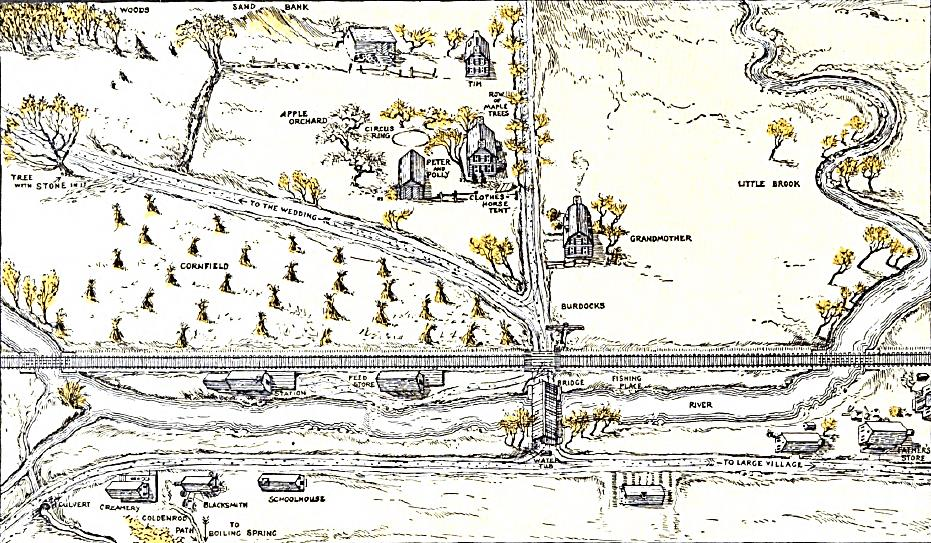
One day Polly and Peter were playing in the yard. Tim was playing with them. Tim is Peter’s little friend. He lives in the very next house. You can find it on the map shown at the bottom of the page.

Polly said to Peter, “What has Blacky there?”

“Where?” asked Peter.

“In her mouth, Peter. Now she has dropped it. I saw her coming up the road with it.”

“I’ll see what it is,” said Peter.

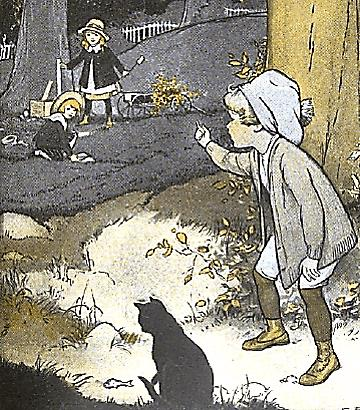
He ran to Blacky. She was sitting down watching what she had dropped.

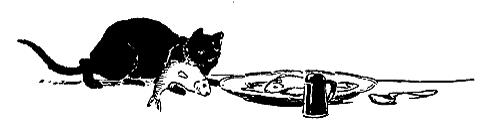
“Oh Polly” called Peter. “Come here, come here! It is a fish. It is alive. It wiggles. Where did she get it?”

“I don’t know,” said Polly.

“Perhaps she stole it out of somebody’s kitchen,” said Tim.

“People do not have live fish in their kitchens. Do they, Polly?” said Peter.

“No, I guess not,” said Polly. “It looks like a sucker. What is she going to do with it?”

“Eat it, of course,” said Peter.

But Blacky did not eat it. Instead, she picked it up again. She carried it to the kitchen door.

There she dropped the fish and mewed. Mrs. Howe came to the door. She opened it for Blacky.

Blacky took up the fish once more. She carried it into the kitchen. She put it down where her dish of food was put three times a day.

Peter and Polly and Tim had followed her.

“Where did Blacky get this fish, children?” asked mother. “Did you give it to her?”

“No, mother. We do not know where she got it. It was alive when we first saw it.”

“Perhaps one of the big boys gave it to her. Have any of them been fishing, Peter?”

“I do not know, mother. Maybe Blacky caught it herself.”

“Of course she did not, Peter,” said Polly. “Do not be so silly. Cats cannot fish.”

“She has been in the water,” said mother.” See! Her fur is all wet in front. And underneath it is wet, too.

“I wonder if she could have caught that fish. I have heard of such things. Blacky is a wise old cat. Perhaps she is wise enough to go fishing.”

“If the sucker was close to the bank, she could catch it with her claws,” said Polly.

“Maybe Peter is right, after all. Tell us about it, old Blacky.”

Blacky only purred and rubbed up against mother.

“She wishes something,” said mother. “And I think that I know what it is. She does not like raw fish. Most cats do, but she does not. She is asking me to cook it for her. And so I will.

“Here comes father. He will clean Blacky’s fish. You may tell him about it while he does so.”

In a few minutes, father brought it in to mother.

“I do believe that Blacky is a fisherman,” he said. “I should like to see just how she did it. Perhaps we can catch her at it sometime.”

Then mother boiled the fish and Blacky ate it for supper. She did not offer anyone a bite. But that was just as well. Suckers are not good for us to eat late in the summer.

Peter and Polly Series: The Broken Show Case

Before long, father found mother and Polly and Peter. He saw the children’s balloons. He heard the story of the bunch that went up in the air.


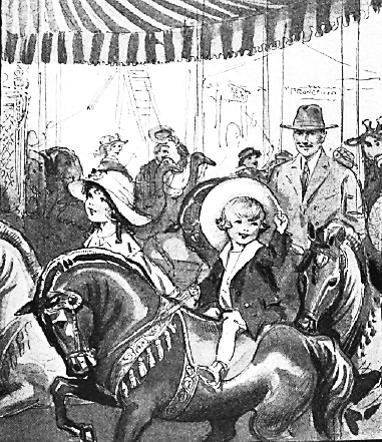
Then he said, “Now, before we have our luncheon, I will take you to the merry-go-round. Have you heard the music? Do you wish a ride?”

“Oh, yes, yes!” cried Polly and Peter dancing up and down.

Do you know what a merry-go-round is? If you do not, look at the picture. It will show you.

Peter and Polly had ridden on one just twice before. Then they had liked it very much.

Peter chose a black horse and Polly chose a gray one. They were side by side. Father sat on one behind these two. Many other people sat on other horses.

At last the music started. The horses started, too. All moved around in a circle. It was quite a large circle, but not so large as a circus ring.

Faster and faster the horses went. Polly and Peter held on with both hands. Around and around the circle they flew. Oh, what fun it was!

Then the music stopped. The horses slowed down. The people climbed off the horses, and it was over.

“I should like to ride again,” said Peter. “Does it cost much?”

“Five cents apiece,” said father. “Perhaps we can have one more ride after luncheon. Come now, it is time to eat.”

The luncheon was taken to a shady place and opened. How good everything looked! How good everything tasted!

Father said, “While we eat, I will tell you a story. Then we shall not hurry. This is a true story. It happened to me, when I was a little boy.

“One day my father took me to the fair. He showed me the same things that I have shown you. He let me ride on the horses. He gave me a drink of lemonade.”

“Oh,” said Peter, “I wish that you would get us some lemonade.”

“The kind that Polly sells is better than any we can buy at the fair,” said father.

“Let us wait until we get home. Here is plenty of cold water.”

“Please go on, father,” said Polly. “What else did you do at the fair? Were there horse races?”

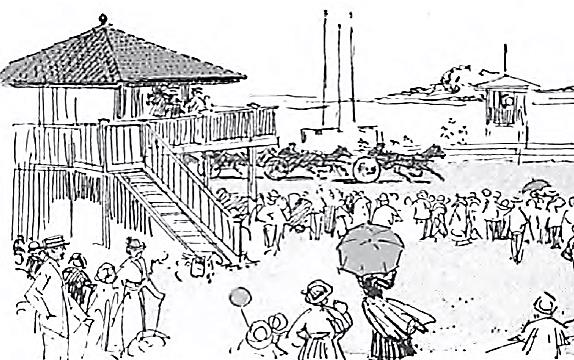
“Yes,” said father. “After luncheon, we shall see horse races just like them. We will sit in the grandstand. Then we can see very well. Yes, when my father took me to the fair, I saw horse races.

“I was about as old as Peter, then. In the afternoon, I began to be very tired. My father said that he would take me home. But first he wished to go into one more place.

“This was a very large building. In it were all kinds of things. These had been made by different people. There were bedspreads and quilts hanging up. There were all kinds of fancy work.

“The only things which pleased me were the things to eat. There were many counters and show cases filled with bread, cookies, cake, pies, and candy.

“My father lifted me up in his arms so that I could look into one showcase. He began to talk with the woman who stood behind the case. He did not see what I was doing.

“I told you that I was very tired. I just leaned out of my father’s arms and rested my arms on the glass at the top of the case.

“Crack, crack, crack went that glass. I had leaned so hard that I had broken it.

“The woman who owned it was very angry. She was quite cross to me. But my father told her that he would pay for it at once. As soon as he did, she cut a cake and gave me a large piece.

“When we got home, I heard my father telling your Grandmother Howe about it. He told her that he thought he had paid for the cake the woman gave us, because she had charged him so much for the glass.”

“That is a good story, father,” said Polly. “I like stories about when you were a little boy. I am sorry that you broke the case. I hope you were not frightened.”

“I was a little, Polly,” said father. “Now, if you have finished your luncheon, we will have another ride on the merry-go-round. Then we must get good seats in the grandstand for the races.”

Peter and Polly: A Bunch of Balloons

A Bunch of Balloons

See all the people!” cried Polly. “I did not know that there were so many except at a circus.”

“Father, where did you put Mary?” asked Peter.

“Over there by the fence. Here is a ticket for her. No one can take her without this ticket. She will wait for us.”

“Let us go into that place,” said Polly. “See all the people going in there.”

“That is a place in which to eat,” father said. “We do not wish to eat yet. Besides, we brought our food with us.”

“Let us go to see the cattle,” said mother.

Father took them to a large building. It was full of sheep. There were many different kinds.

“Farmer Brown has some of his sheep here,” said father.

“Are his two pet lambs here?” asked Peter. “I mean the ones that came to our party on his piazza last summer. I hope that they will get a blue ribbon.”

After they had seen the sheep, they went into the building where the cows were kept.

“Some of Tim’s Jersey cows are here,” said father. “Perhaps we can find them.”

There were hundreds of cows. The children grew tired of looking at so many. At last they found Tim’s Jersey cows standing side by side.

“Let us look at the horses now,” said father. “Perhaps we can find the blacksmith’s.”

“Perhaps you can find a pony for us,” said Peter. “I wish that you would try.”

“Now,” said father, “you have seen enough of the horses. There are the pigs left to see. Does anybody wish to look at the pigs?”

“Suppose you go alone,” said mother. “The children and I will stay outside this building and wait for you. We are a little tired.”

“Look for the little black pig! “Polly shouted.

Mother and Polly and Peter found a bench on which to sit.

Then mother said, “Now let us look for interesting things. You first, Polly. What do you see that is interesting?”

“All the automobiles standing over there. And all the wagons. And all the people.”

“Yes,” said mother. “There are hundreds of automobiles and wagons. Peter, what do you see?”

“All the people going into that place to eat. And all the people coming out.”

“Oh, oh!” cried Polly. “Look, look! See the men leading the ponies, Peter!”

“Oh Polly!” cried Peter. “See the men leading the dogs! “

“Those dogs are going to race,” said mother.

“Where, where? Let us go,” said Polly.

“We will see them this afternoon, Polly,” said mother.” They do not race until then.”

“Oh, I wish that we had brought Wag-wag,” said Polly.” I am sure that he could beat.”

“Perhaps he could not,” said mother. “Those dogs are trained to race. Wag-wag is not.”

“Oh mother, mother!” cried Peter.

“There is a boy with some balloons! See them! See them! Red ones and white ones and blue ones. May we have some?”

“Yes, you may. Here is a dime for you, Peter. Here is a dime for you, Polly. Run and buy.”

“Stop, stop” called Peter to the boy. “I will buy a red balloon.”

“I will buy a blue one,” said Polly. “Here is the money.”

The boy untied a blue and a red balloon. He gave them to Polly and to Peter.

A crowd of people had gathered around him. Somebody pushed against him. He dropped Polly’s money.

He stooped to pick it up. His bunch of balloons slipped from his hand. He jumped up and caught at them. But he only pushed them farther away.

Other people tried to get them. But the crowd was thick. People bumped against one another. Nobody caught the balloons. Up into the air they sailed.

The boy looked ready to cry. But he did not. He said, “Oh, dear! Oh, dear! I shall be punished for losing my balloons. I wish I could get them.”

“It is too bad,” said one man. “Perhaps we can help you. Here! Give me your cap.

“Now, ladies and gentlemen,” he said, “let us put into this boy’s cap the money for his balloons. Then he will not be punished for losing them.

It is too nice a day for anybody to be punished. Now walk right up and help.” And he dropped in a large piece of silver money.

Mrs. Howe gave Peter and Polly each five cents. They put the money into the cap. The man who passed the cap smiled at Polly.

Many, many people put money into the cap. The boy had enough to pay for his balloons.

Then the crowd went away. Polly and Peter watched the bunch of balloons up in the air.

At last Polly said to her mother, “That was a homely man who held the cap. But he looked handsome to me. I think that he is kind.

“You see I remember, ‘Handsome is that handsome does.'”

Peter and Polly: Starting for the Fair

Starting for the Fair

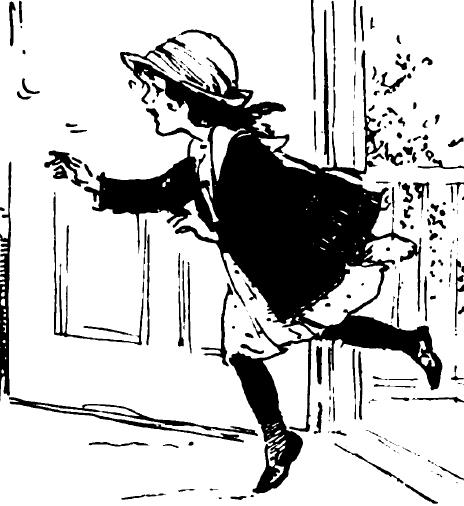
Polly ran into the house from school one day. She banged all the doors.

“Next week is fair week! Next week is fair week!” she shouted.

Peter was in the house. He heard Polly. “Next week is fair week! Next week is fair week!” he shouted, too.

“How do you know, Peter?” asked Polly.

“Because you said so,” answered Peter. “Besides, the blacksmith said so. His horses are going to the fair to get blue ribbons. Do horses like to go to the fair? If we go, shall we get blue ribbons?”

Father laughed. “You certainly are a prize,” he said. “You ought to get a blue ribbon.”

“Then will you take us so that we can?” asked Peter.

And Polly said, “Oh, will you take us? School closes for two days so that all the children can go.”

“Yes,” said father. “I mean to take you. Mother is going, too. If it does not rain, we shall have a good time.”

“Goody, goody!” cried both children.

“Shall we drive Mary?” asked Polly. “Tim is going on the train.”

“I think so,” said father. “But we may go on the train. That will be just as mother says. You must ask her.”

“Are you going on the train, mother?” asked Peter. “I wish to go on the train.”

“If we do, you will have to help carry the luncheon,” said mother.

“Oh, shall we take things to eat?” shouted Peter. “Goody, goody! Then let us go in our carriage.”

“I think that will be easier,” said mother.

The day of the fair was warm and bright. Mother and father were up early. So were Peter and Polly.

Mother got the breakfast, and washed the dishes, and put up the luncheon. Father fed the horse, and milked the cow, and fed the hens.

Polly made the beds. She was in a great hurry to get them done.

She smoothed out all the wrinkles in mother’s bed. She smoothed out all the wrinkles in father’s bed. She smoothed out all the wrinkles in Peter’s bed.

When she came to her own bed she said, “I shall not smooth out all my wrinkles. It takes too long. I wish to be downstairs and know what is going on.”

You see that mother and father and Polly were all busy. And Peter was busy, too. He was busy getting into everybody’s way.

He stood just where mother wished to walk. Then he went upstairs and stood just where Polly wished to walk. But he did not mean to do so.

At last mother said, “Peter, why don’t you run out and sit in the carriage? In a few minutes, father will harness Mary. I am almost ready now.”

“I will,” said Peter. He got his hat and his coat. Father had drawn the two-seated carriage out of the barn. Peter climbed into it.

He waited a long, long time. He thought that he had waited all the morning. But it was really only half an hour.

At last Polly came. Then father brought out the luncheon basket. He harnessed Mary. Mother came out of the side door. She was ready, too.

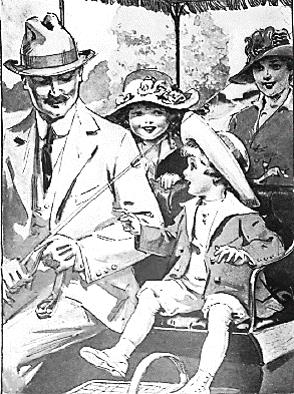
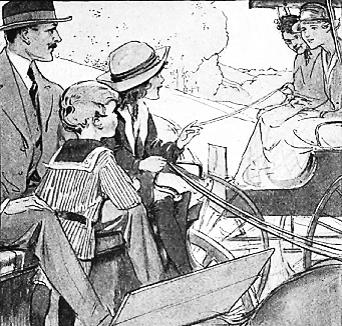
Mother and Polly sat on the back seat. Father and Peter sat in front.

Down the hill they went. Past the store and through the woods, past Farmer Brown’s and on, on, on to Large Village the road ran.

“I never was so happy before in all my life,” said Polly. “Just think! We are going to the fair, and we are going to have a picnic, too. I must jump up and down.”

“Jump then,” said mother. “But remember the blacksmith’s pig. Do not jump out.”

Through Large Village they went. Then the road became crowded. There were many carriages. There were more automobiles.

They had to drive very slowly. But at last they came in sight of the Fair Grounds.

Peter and Polly: The Circus

The Circus

“Boys,” said Polly, “I know just how to have a circus. First, we must make a ring. We will use sticks of wood from the wood pile. I asked father if we might.

“We will lay them down in a circle. You can each bring two sticks at a time. I will bring three.”

It took some minutes to make the circus ring large enough. But, at last, it was done. The sticks of wood were laid end to end in a circle.

“Now let us have the circus,” said Peter.

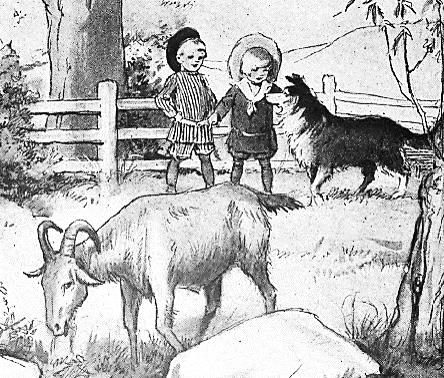
“First, Tim must go home and get Billy, his goat,” said Polly. “Billy is to be one of the performers. Bring Collie, too, Tim.”

Collie is Tim’s dog. He is a wise and beautiful sheep dog.

Tim and Peter went up the bill. They found Hilly out by the barn.

“Come along, Billy,” said Peter. “We need you in the circus.”

Billy would not stir. He did not know what fun a circus is.

“I know how to get him,” said Tim. “There is Collie. He will get Billy for us. He knows how to drive cows. I think that he can drive old Billy.”

Tim called to Collie. At last Collie understood what he was to do. He ran behind Billy and nipped at his heels. This made Billy turn around. He put down his head. He chased Collie. He tried to butt him.

Peter and Tim started out of the yard. Collie followed them. Billy followed Collie. At last they were at Peter’s. Polly was waiting in the ring with Wag-wag.

When Billy saw Wag-wag, he started after him. Wag-wag ran around in a circle. Billy chased him.

“Oh, look, look!” shouted Peter. “That is the first part of our circus. It is a race between a goat and a dog.”

“That is all Billy needs to do,” said Tim. “He must not work too hard. He may go home now. What will come next?”

“I have two things to come next,” said Polly. “I fixed them while you were up after Billy. Here is the first. We will draw it around the ring.”

Polly drew Peter’s cart out from one of the tents. On the cart, there was a box. It had a cover. It had slats across both sides. Some kind of fruit had come in it.

There was no fruit in it now. Instead, there was a fierce, wild panther. It was the fiercest kind of panther, for it was black.

“Mew, mew, mew,” cried that panther. And she walked around and around the cage trying to get out.

Polly said, “Be quiet, panther. You are a very wild animal. I must draw your cage around the circus ring. Everybody wishes to see you. In a little while I shall give you a whole sheep to eat.”

“Mew, mew, mew,” still cried the panther. Perhaps that meant, “I am not a panther. I am Blacky.”

“I like animals,” said Tim. “I wish that we had more.”

“I have two more,” said Polly. “I will show one to you in Peter’s tent. Come now.”

She took the wild panther out of the cage. She carried her to the tent.

She said, “Ladies and gentlemen, here is the most wonderful cat in the world. She can catch fish. None of you have cats that can do such a smart thing.”

“Maybe that is so,” said Tim. “But we can catch fish ourselves. What comes next?”

“You do,” said Polly. “You must jump down from the very top of the cage. Go and get one of the back-kitchen chairs. We shall put the cage on top of it. You can jump from that.”

Tim jumped several times. Then Peter jumped several times. Then they both turned somersaults.

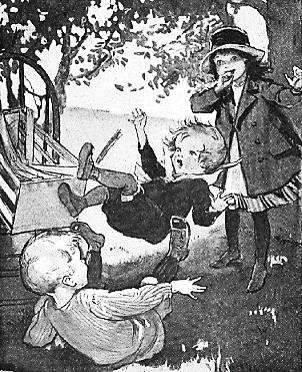
At last they thought they would jump from the top of the cage together. They climbed up on the cage. But it was not strong enough to hold them.

The top smashed in. Off the chair they both tumbled, while Polly laughed and laughed.

She said, “I forgot to have any clowns. You are very good ones. Come into the other tent now. That is a side show. I have something wonderful there.”

When they came to the other tent she said, “Ladies and gentlemen, here is the most wonderful thing in the world. It is a dwarf. This dwarf will never grow any larger. She will always stay just the size that she is now.”

“Oh,” said Tim, “that is Blacky’s little kitten — the one that never grew up. Is she a dwarf?”

“Yes,” said Polly. “Just think! Isn’t it wonderful? How should you like to stay always just as little as you are now? “

“I should not like it,” said Tim. “Why don’t you feed her? I have to eat lots of things to make me grow.”

“Feeding her doesn’t make her grow,” said Polly. “We have tried everything. She is just a dwarf. She will always stay a dwarf. Come out now. I have one more thing to show you. It is a dancing bear.”

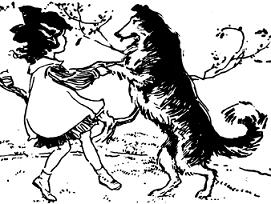
Polly went to the circus ring. She called to Collie. She took his forepaws in her hands. She made him stand up straight.

Then she said, “Come, dancing bear, come and dance.” And she pulled Collie after her around the ring.

Peter and Tim clapped their hands.

Tim said, “I used to call Collie, Jersey cow. Perhaps I shall call him the dancing bear, now.”

“That is all the circus today,” said Polly. “But we need not put the ring back tonight. I asked father.

“Tomorrow we can have the same circus and ask the other children to come. We will charge ten pins for each child.”

“All right,” said Tim and Peter. “That will be fun. We will be better clowns tomorrow.”

Peter and Polly Series: The Lost Pig

The Lost Pig

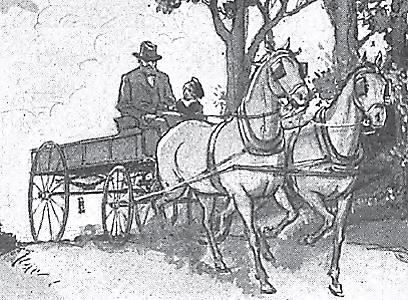
One day the blacksmith drove to Large Village. He drove in his high wagon. It was filled with many things. Some of these things were iron and rattled.

But the funniest noise in the wagon was, “Grunt, grunt.” This noise was made by a little black pig.

The blacksmith had said to him, “Little pig, I am going to take you for a drive. You shall go with me to Large Village.”

“Grunt, grunt, grunt,” said the little pig.

“There is a man at Large Village who wants you. He will feed you well. You will grow fat. Then he will make pork of you.”

“Grunt, grunt, grunt, grunt,” said the little pig.

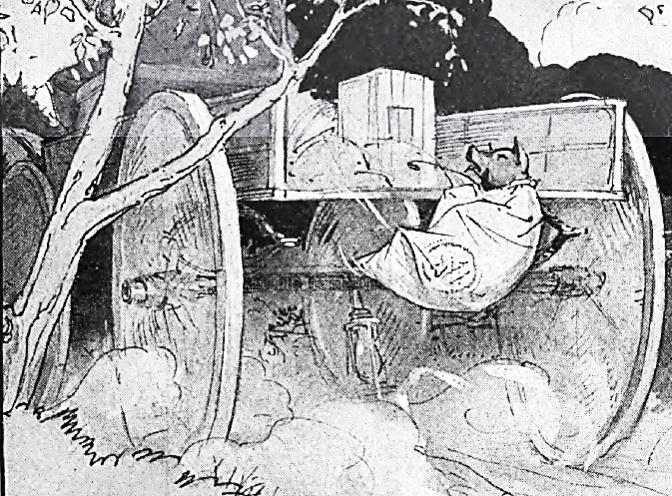
“Now I will put you into this bag. I will tie the bag around your neck, so. Your head will be out of the bag. You can look about and enjoy your ride.

“But the bag will be around your feet. It will keep them still. So you cannot jump out of the wagon.”

“Grunt, grunt,” said the little pig.

“Now in you go! Be a good little pig. You may talk to me, if you wish. But do not try to roll out.”

The little pig did talk. He said over and over, “Grunt, grunt, grunt.”

Perhaps this meant, “I do not like to be tied up in a bag. I do not wish to be made into pork. I will roll out, if I can.”

By and by, the blacksmith overtook a man who was walking. He gave the man a ride.

Then he forgot about the little pig. He did not hear the little pig’s grunts. Instead, he talked to the man.

The little pig did not lie still. He wiggled and wiggled. At last he had wiggled to the end of the wagon.

The very next minute, out he rolled. He fell on the road, bump! But the dust was deep and soft and he was not hurt.

The blacksmith did not hear him fall. The iron in the wagon made too much noise for that. So he drove on to Large Village.

The little pig did not like the road. He did not like the bag. So he began to kick again.

Before you could think, he had rolled himself down the bank by the side of the road. There he lay.

That very same day Peter and Polly drove to Large Village. Their father took them.

Polly was driving. She was going very slowly. All at once she said, “What is that?”

“Stop and see,” said father.

“Grunt, grunt, grunt,” came from the side of the road.

“I can hear a pig,” said Peter. “But where is he?”

“I see him,” said father. And down he jumped. “Well, I never!” he said. “Somebody must have lost him out of a wagon. I call that a good joke.”

“I wonder whose pig he is,” said Polly.

“I don’t know,” said father. “But, if you like, you may ask the people we meet if they have lost him. Somebody may come back to look for him.”

So Polly asked the very next man they met.

“Lost a pig?” he said. “No, I haven’t. What do you mean?”

When they showed him the little pig he laughed. Then he drove on.

Next, they met two ladies. Polly was sure that they were driving back to look for the little pig.

So she called, “We have your pig.”

“Our pig?” said the ladies. “We have no pig.”

Then Mr. Howe told them about the pig. They smiled at Polly.

One of them said, “We have no little girl either. And I wish that we had.”

“Don’t you wish for a little boy, too?” asked Peter.

“We should very much like a little girl, a little boy, and a little black pig,” said the lady.

“Perhaps you may have the pig,” said Polly. “Perhaps we cannot find the owner.”

The ladies laughed. Then one said, “If we cannot have the girl and the boy, we will not have the pig.” And they drove on.

Soon Polly saw the blacksmith driving along. When he came near, she began to call, “We’ve found a pig! We’ve found a pig!”

At the same time the blacksmith began to call, “I’ve lost my little black pig! I’ve lost my little black pig!”

At that everybody laughed but the pig. He only said, “Grunt, grunt.”

The blacksmith took him and took Peter, too. Then they all drove to Large Village.

Peter and Polly Series: Peter’s Haircut

Peter must have his hair cut soon,” said mother. “It is growing very long.”

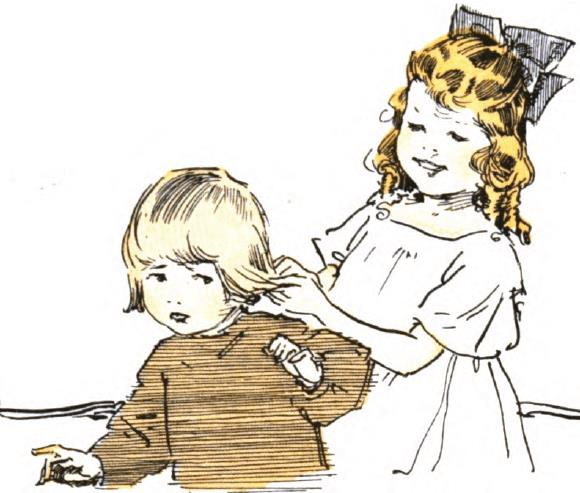
“Yes, it is,” said Polly. “I shall have to braid it.”


“That will hardly do, Polly. Boys do not have their hair braided. They have it cut.”

“I cannot take him to the barber’s today,” said father. “I cannot take him tomorrow. The next day is Sunday. And Monday is a holiday.”

“Oh, dear!” said Peter. “Can’t you ever take me?”

“That is only four days, Peter,” said Polly.

“I know it, Polly. But my hair will grow very long. I do not wish it braided. Oh, dear! Oh, dear!”

“I will not braid it, Peter. I was only teasing you.”

“Father,” Peter said, “let me go to the barber’s alone. I know where it is.”

There was no barber where Peter and Polly lived. When Peter had his hair cut, he went to the nearest village. Peter and Polly always called this “Large Village.”

“How can you get to Large Village, Peter?”

“I can walk,” said Peter.

“It is four miles,” said Polly. “I guess you can’t walk so far as that. I think you would stop when you came to Farmer Brown’s.”

“That is just halfway,” said Peter. “I think I should not stop, either. I could not get my hair cut there.”

“You wait a little while, Peter,” said father. “The blacksmith is going to Large Village today. Perhaps he will take you with him. I will go over to his shop to see him. Then I will telephone to you.”

“Oh, goody, goody!” cried Peter. “I hope he will take me. I like to ride with him.”

In a few minutes the telephone rang.

“You may answer it, Peter,” said mother. “Perhaps it is father telephoning to you.”

“Hello,” said Peter. “Oh, will he take me? Yes, I will get ready now. Goodbye.”

“What did father say?” asked mother.

“He said that the blacksmith will take me. I must go to father’s store now.”

Peter ran to the store. Father was busy with some customers.

“Here is your money,” he said. “Keep it safe. Now go outside and watch for the blacksmith. He will soon be along.”

When the blacksmith came, Peter climbed up into his wagon. The seat was high. Peter liked that.

The blacksmith had two horses. Peter wished to drive them. So he took hold of the ends of the reins. He played that he was driving.

The blacksmith and Peter talked of many things. They talked about shoeing horses and mending wagons. They spoke of ponies. They spoke of boiling springs.

And then they talked about hair that was too long, and about going to the barber’s. At last they were in Large Village. They came to the barber’s shop.

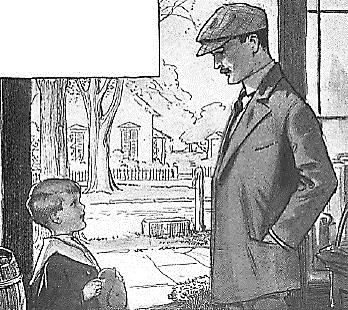
“Here we are, Peter,” said the blacksmith. “Have you your money? I shall come back for you in a little while. You wait for me.”

Peter went in. He said to one man, “I must have my hair cut. Will you cut it? Here is the money to pay you.”

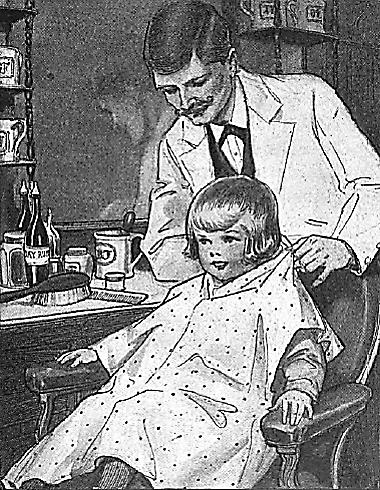
“Yes, I will,” said the barber. “Climb up into this chair. How will you have it cut — short or long?”

“It is long now,” said Peter. “So I will have it cut short.”

“Very well,” said the man. “Short it shall be.” And he began to snip, snip, snip with his shears.

At last the hair was cut. Peter jumped down from the chair. He put on his cap. It did not fit. It was too large. He felt of the back of his head.

His hair was stiff and short. He climbed up on the chair and looked in the mirror. “Oh, oh!” he cried. “My hair is short like father’s. I have always wished it to be like that.”

“You said to cut it short,” answered the barber. “Was that wrong? Won’t your father like it?”

“Maybe he will not care,” said Peter. “And anyway, I am glad. There is the blacksmith. I must go now. Goodbye.”

“See my hair,” said Peter to the blacksmith.

“I can’t see much, Peter. You must have left most of it behind you. Is that the way you were told to have it cut?”

“I wasn’t told,” said Peter. “Maybe my father will not care, and I like it.” Peter got out of the wagon at father’s store.

When father saw him, he said, “Well, I never! Now whose boy is this?”

“Oh father! Don’t you know me? It is Peter. It is your boy.”

“So it is,” said father. “But where is your hair? Your cap is too large.”

“My hair is at the barber’s. Do you care? I like it short.”

“No, Peter. I do not, much. But I think that mother may care. She likes it cut the other way. It is my fault, not yours. I forgot to tell you what to say to the barber. You wait for me here. I am going home to dinner in a minute.

“We will go together and tell mother about it. She will laugh. You do look funny. Your hair will grow before winter, so perhaps she will not mind.

Jack Frost’s Celebration

How the wind blows tonight!” said father after supper. “It whistles around the corners. It nearly whistled off my hat, when I came home.”

“I should think that you would wear a cap,” said mother.

“Fur caps will be needed soon,” father said. “The cold weather is here to stay. No more warm weather until next spring. Let’s celebrate, this evening.”

“I know what celebrate means,” said Polly. “It’s what we do on the Fourth of July and Thanksgiving and Christmas.”

“Birthdays, too,” said Peter. “I had a birthday party.”

“That is so,” Polly said. “But what shall we celebrate tonight?”

“Let us celebrate winter,” father said. “Let us give Jack Frost a party. Come now and begin.

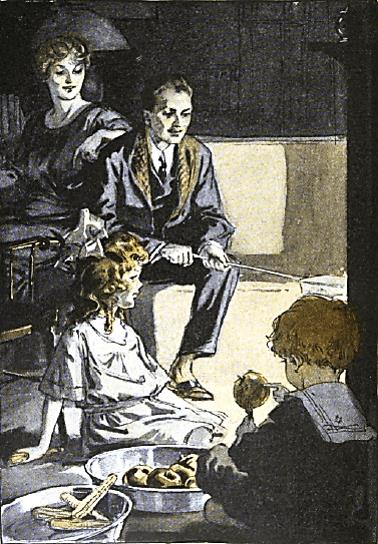
“First we will light the fire in the fireplace. Light your end, Polly. Light your end, Peter. We will see which end burns brighter.

“Mother will fix the chairs while I am down in the cellar. You two look out for sparks. That kindling wood is snapping.”

In a few minutes, father was back. Can you guess what he brought?

A pan full of apples. They came from a barrel in the cellar. They had grown out in the orchard.

Besides, he had a bag with ears of corn in it. And he had another pan, and a corn popper.

“Oh, oh, oh!” cried Peter and Polly. “How could you carry so many things?”

Father put down the pan of apples. “We will each roast one,” he said. “Pick yours out, children. Now we will put our apples on the bricks near the fire.

“Peter, you may watch them. After a while, you must turn them around. Do you know why?”

“What shall I do, father?” asked Polly.

“You may shell some corn into the popper. We cannot pop it jet. We must wait for the flames to die down a little.”

“Next week is Thanksgiving,” said mother. “Won’t it be fun to go down to grandmother’s for dinner? I wish that we might have a snowstorm before then.”

“I am thankful right now,” said Polly. “I am thankful for you and father and Peter and grandmother and this fire. I shall be thankful for popped corn, when I get some.”

“We will try it now,” said father. And he began to shake the popper over the coals.

Pop, pop, pop, pop went the corn. The white kernels hopped up and down. They seemed to be trying to get out.

“It is nearly done,” said Polly. “See! The popper is full.”

Just at that minute the corn caught fire.

“Oh, oh!” cried Polly. “It will all burn up! It will all burn up!”

It did not. Father quickly blew out the flames. Some of the kernels were black. He poured the others into the warm pan. Mother put in salt and melted butter.

Polly shelled more corn, and father popped it. Soon the pan was full. Did anything ever taste so good as that hot, buttered popped corn?

At last father said, “This celebration is almost over. I believe that it is long after bedtime.”

Polly said, “I am sure, now, that I am glad winter has come. I was not sure before. I have had a good time at our winter party.”

“So have I,” said Peter. “I am going to kiss everybody goodnight. I have had such a good time that I have lots of kisses in my face.”

“Pass them around then, my son,” said father. “Then run upstairs to bed. Jack Frost’s party is finished.”

The First Snowflakes

Mother, may I go to school to meet Polly?” asked Peter. “Tim has gone away. I have played with Wag-wag all the afternoon.”

“Why, yes,” said mother.

“Then may Polly and I take a walk? We will not go far.”

“Yes,” said mother again. “Be home before dark, please. It grows dark very early now. Next month will come the shortest days of the whole year.”

Peter went over to the schoolhouse. The children were just coming out.

One of the big boys said to him, “Hello, Peter. Did you think that you would come to school again? Have you grown big enough now? “

Peter only said, “I am waiting for Polly and there she is.”

“Polly, Polly,” he called, “come with me. Mother said that we might take a walk. I know where to go.”

“Where?” asked Polly.

“To the place where the brook runs under the road. Let us go under the road today. Will you?”

“All right, I will,” said Polly. “I always meant to. But I forgot about it. It will be fun. Isn’t it cold?”

“Yes,” said Peter. “My fingers are cold. But I do not care. Only I wish that I had on my new mittens.”

“Look at this,” said Polly. “Come out in the road. See how it is frozen into ruts. I am going to walk on the ridges.”

“That isn’t very much to look at,” said Peter. “It has been that way for a few days.”

“Yes, it has,” said Polly. “But look in the ruts. There is ice. It is thin. Let us step on it. Hear it crack.”

“There is a puddle,” said Peter. “It has ice on it, too. See me step on that.”

“Keep off the middle,” said Polly. “You do not know how deep that puddle is. If the ice lets you down, you may get your feet wet.”

“All right,” said Peter. “There is the blacksmith’s shop, Polly. Do you think that the blacksmith is inside?”

“Perhaps he is, Peter. See! He has closed his big door. That is because it is cold weather.

“He has it closed in winter. I like it to be summer better. Then I can see into the shop.”

“Here is the brook, Polly. Let us climb down the bank and look under the road.”

“There is ice on the edges of the brook, Peter. I think that the boiling spring is colder than ever now. Let’s break off pieces of this ice.”

“Can we walk through under the road?” asked Peter. “I told Tim about it. He said that we could not.”

“I think that we can,” said Polly. “Come on. We will try. Keep close to the wall. Do not step into the water.”

“It is quite dark,” said Peter. “I am glad that it is not far.”

“You must bend down now, Peter. I have to bend down. Do not push me. I shall slip in, if you do.”

“Oh, there is the end,” said Peter. “I can see the field. I do not like this place. It is hard walking on the stones. It is cold here, too.”

“I am out,” shouted Polly. “Come on, Peter. Oh Peter, Peter, Peter!”

“What, what?” called Peter. “Have you fallen in?”

“No, no!” shouted Polly. “But look at this! Don’t you know what it is?”

“A snowflake, a snowflake!” cried Peter. “And here is one on my sleeve, too.”

“There are more in the air, Peter. See them! See them! Do you suppose that it will be winter right away?”

“Of course it will, Polly. It is winter when the snow comes. Let us run home and get our sleds. You may take my new one part of the time.”

The children were at home before it was dark.

At supper time, when father came, Polly said, “Will you please get our sleds out for us tomorrow, father? How much has it snowed now?”

“Not much,” said father. “You see, that was just a little flurry of snow. We shall have many such before there is a good storm. You must wait a little longer for your sliding.”