Peter and Polly: The Circus
The Circus


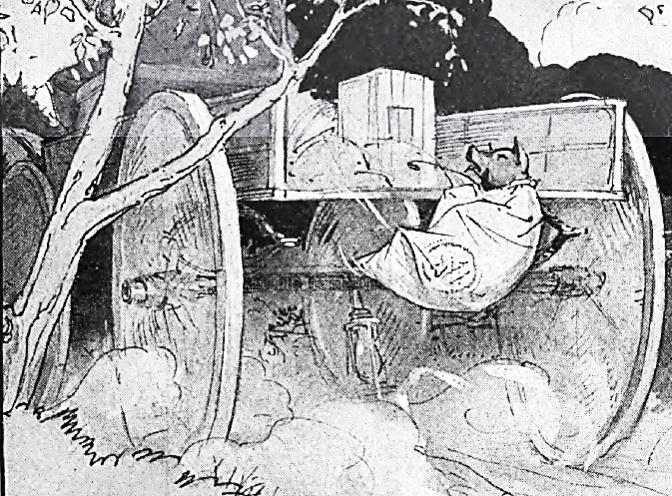
The blacksmith did not hear him fall. The iron in the wagon made too much noise for that. So he drove on to Large Village.
The little pig did not like the road. He did not like the bag. So he began to kick again.
Before you could think, he had rolled himself down the bank by the side of the road. There he lay.
That very same day Peter and Polly drove to Large Village. Their father took them.
Polly was driving. She was going very slowly. All at once she said, “What is that?”
“Stop and see,” said father.
“Grunt, grunt, grunt,” came from the side of the road.
“I can hear a pig,” said Peter. “But where is he?”
“I see him,” said father. And down he jumped. “Well, I never!” he said. “Somebody must have lost him out of a wagon. I call that a good joke.”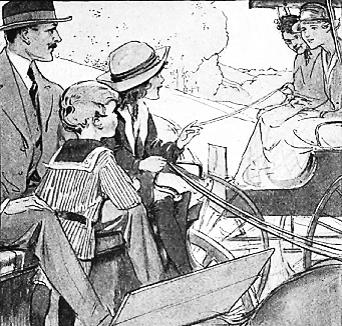
“I wonder whose pig he is,” said Polly.
“I don’t know,” said father. “But, if you like, you may ask the people we meet if they have lost him. Somebody may come back to look for him.”
So Polly asked the very next man they met.
“Lost a pig?” he said. “No, I haven’t. What do you mean?”
When they showed him the little pig he laughed. Then he drove on.
Next, they met two ladies. Polly was sure that they were driving back to look for the little pig.
So she called, “We have your pig.”
“Our pig?” said the ladies. “We have no pig.”
Then Mr. Howe told them about the pig. They smiled at Polly.
One of them said, “We have no little girl either. And I wish that we had.”
“Don’t you wish for a little boy, too?” asked Peter.
“We should very much like a little girl, a little boy, and a little black pig,” said the lady.
“Perhaps you may have the pig,” said Polly. “Perhaps we cannot find the owner.”
The ladies laughed. Then one said, “If we cannot have the girl and the boy, we will not have the pig.” And they drove on.
Soon Polly saw the blacksmith driving along. When he came near, she began to call, “We’ve found a pig! We’ve found a pig!”
At the same time the blacksmith began to call, “I’ve lost my little black pig! I’ve lost my little black pig!”
At that everybody laughed but the pig. He only said, “Grunt, grunt.”
The blacksmith took him and took Peter, too. Then they all drove to Large Village.
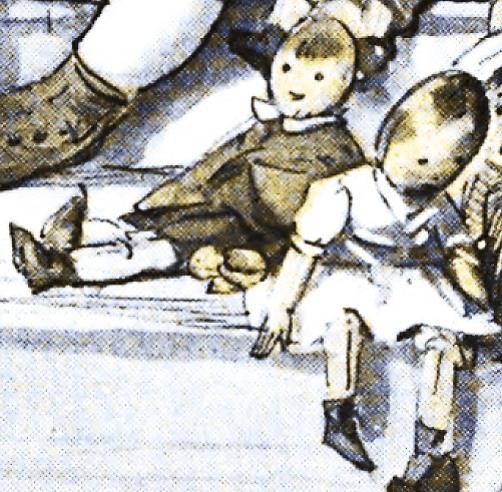
My dolls are sick and tired sometimes,
And I can’t stand their noise;
I put them quickly into bed,
And hide away their toys;
I shut the door and leave them
In the playroom all alone,
And scamper quickly down the stairs,
For fear I’ll hear them moan.
Last night I had the toothache hard;
My mother was so kind;
She held me closely in her arms,
And said to never mind.
She gently kissed the achy spot,
And soothed me with a song;
And, if you will believe my word,
The pain was quickly gone.
I like to have my mother care
When I am sick and blue;
I shouldn’t wonder if my dolls
Would like me gentle, too.
I think next time that one is sick,
I’ll sit and smooth her hair,
I’ll hold her hand and pat her cheek,
And let her know I care.
by Caroline M. Griswold.
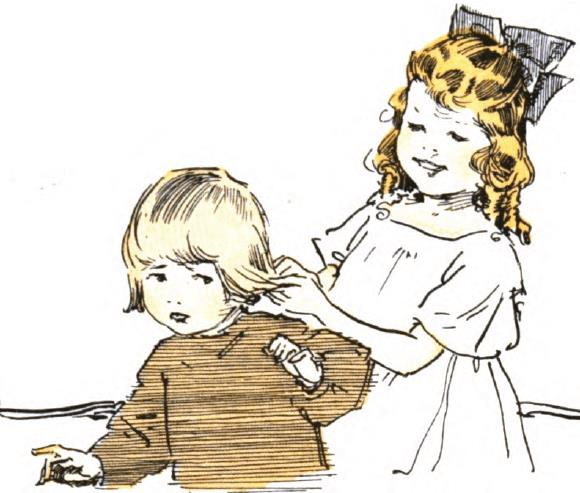
“That will hardly do, Polly. Boys do not have their hair braided. They have it cut.”
“I cannot take him to the barber’s today,” said father. “I cannot take him tomorrow. The next day is Sunday. And Monday is a holiday.”
“Oh, dear!” said Peter. “Can’t you ever take me?”
“That is only four days, Peter,” said Polly.
“I know it, Polly. But my hair will grow very long. I do not wish it braided. Oh, dear! Oh, dear!”
“I will not braid it, Peter. I was only teasing you.”
“Father,” Peter said, “let me go to the barber’s alone. I know where it is.”
There was no barber where Peter and Polly lived. When Peter had his hair cut, he went to the nearest village. Peter and Polly always called this “Large Village.”
“How can you get to Large Village, Peter?”
“I can walk,” said Peter.
“It is four miles,” said Polly. “I guess you can’t walk so far as that. I think you would stop when you came to Farmer Brown’s.”
“That is just halfway,” said Peter. “I think I should not stop, either. I could not get my hair cut there.”
“You wait a little while, Peter,” said father. “The blacksmith is going to Large Village today. Perhaps he will take you with him. I will go over to his shop to see him. Then I will telephone to you.”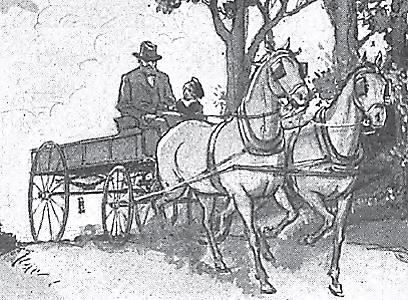
“Oh, goody, goody!” cried Peter. “I hope he will take me. I like to ride with him.”
In a few minutes the telephone rang.
“You may answer it, Peter,” said mother. “Perhaps it is father telephoning to you.”
“Hello,” said Peter. “Oh, will he take me? Yes, I will get ready now. Goodbye.”
“What did father say?” asked mother.
“He said that the blacksmith will take me. I must go to father’s store now.”
Peter ran to the store. Father was busy with some customers.
“Here is your money,” he said. “Keep it safe. Now go outside and watch for the blacksmith. He will soon be along.”
When the blacksmith came, Peter climbed up into his wagon. The seat was high. Peter liked that.
The blacksmith had two horses. Peter wished to drive them. So he took hold of the ends of the reins. He played that he was driving.
The blacksmith and Peter talked of many things. They talked about shoeing horses and mending wagons. They spoke of ponies. They spoke of boiling springs.
And then they talked about hair that was too long, and about going to the barber’s. At last they were in Large Village. They came to the barber’s shop.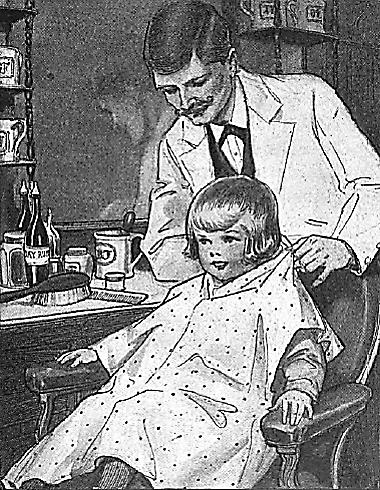
“Here we are, Peter,” said the blacksmith. “Have you your money? I shall come back for you in a little while. You wait for me.”
Peter went in. He said to one man, “I must have my hair cut. Will you cut it? Here is the money to pay you.”
“Yes, I will,” said the barber. “Climb up into this chair. How will you have it cut — short or long?”
“It is long now,” said Peter. “So I will have it cut short.”
“Very well,” said the man. “Short it shall be.” And he began to snip, snip, snip with his shears.
At last the hair was cut. Peter jumped down from the chair. He put on his cap. It did not fit. It was too large. He felt of the back of his head.
His hair was stiff and short. He climbed up on the chair and looked in the mirror. “Oh, oh!” he cried. “My hair is short like father’s. I have always wished it to be like that.”
“You said to cut it short,” answered the barber. “Was that wrong? Won’t your father like it?”
“Maybe he will not care,” said Peter. “And anyway, I am glad. There is the blacksmith. I must go now. Goodbye.”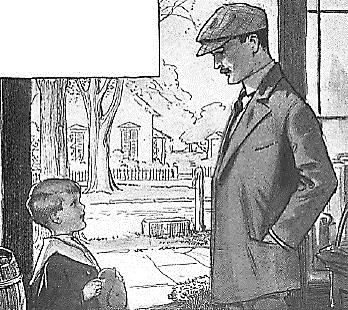
“See my hair,” said Peter to the blacksmith.
“I can’t see much, Peter. You must have left most of it behind you. Is that the way you were told to have it cut?”
“I wasn’t told,” said Peter. “Maybe my father will not care, and I like it.” Peter got out of the wagon at father’s store.
When father saw him, he said, “Well, I never! Now whose boy is this?”
“Oh father! Don’t you know me? It is Peter. It is your boy.”
“So it is,” said father. “But where is your hair? Your cap is too large.”
“My hair is at the barber’s. Do you care? I like it short.”
“No, Peter. I do not, much. But I think that mother may care. She likes it cut the other way. It is my fault, not yours. I forgot to tell you what to say to the barber. You wait for me here. I am going home to dinner in a minute.
“We will go together and tell mother about it. She will laugh. You do look funny. Your hair will grow before winter, so perhaps she will not mind.

“By and by we go back to our store. We put lots of things in our wagon. Then we drive around and give the things to our customers.”
“All right,” said Peter. “My father keeps a store. We will play that it is ours. But where is the book?”
“Here it is, Peter. My mother gave it to me yesterday. We played with it then.”
“Well, where is our wagon?”
“There is your father’s wagon, Peter. It is in front of the barn. I saw it. That is what made me think of the game.”
Tim and Peter climbed into the wagon.
“You drive,” said Tim. “I will take the orders. I know just how. See my pencil.”
“Get up,” said Peter to his play horse. And off they went.
“I wish that we truly had a horse,” he said. “Then we could take orders all over the village.”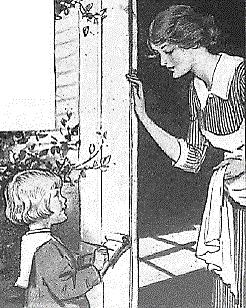
“I should rather have my goat,” said Tim. “I like him better than a horse.”
“Sometimes he will not go when you wish him to,” said Peter. “That is not very nice.”
“I do not care,” said Tim. “I like old Billy just the same. Here is the first house, Peter. Stop for me to get out.”
“Whoa,” said Peter. And the play horse stopped at once. Tim ran to Peter’s back door. He knocked. Mrs. Howe, Peter’s mother, was in the kitchen. She came to the door.
“Good morning, Tim,” she said.
“Good morning,” said Tim. “I am a store man. I am taking orders. Will you please order something of me?”
“Yes, I will. Let me see. Please bring me one pound of butter and one half pound of tea. Can you do that?”
“Oh, yes,” said Tim. “I can bring you more. We have a very big store.”
“Then I will order a dozen eggs and a quart of milk. Do not let Peter bring me a quart of eggs and a dozen of milk. That is the way he played store once.”
Peter heard what his mother said and he laughed. He had learned better than that.
“Goodbye,” said Tim.
“Goodbye,” said Mrs. Howe. “Oh Tim! Perhaps other families live in this house. Go to the side door and to the front door and see.”
Tim climbed back into the wagon.
“Get up,” said Peter to his horse. And the play horse started.
“Did you get many orders? How far is it to the next house?”
“I got four orders. Here is the next house. Please stop now.”
“Whoa,” said Peter. And the horse stopped at once.
Tim knocked at the side door. A lady, with a blue dress on, opened it. Tim played that it was not Mrs. Howe.
“Good morning,” he said.
“Good morning, Mr. Storekeeper,” said the lady. “Please bring me a box of salt, a pound of cheese, and a box of crackers.”
“Shall I bring you some bread?”
“I make my own bread, thank you. It is better than baker’s bread. But you may bring me a pound of coffee. Have you written all the things down? Goodbye.”
“Goodbye,” said Tim.
He climbed back into the wagon.
“Get up,” said Peter to his horse. And the play horse started. “How far is it to the next house?”
“Not very far,” said Tim. “It is just to your front door. Lots of families live in your house this morning. Here it is.”
“Whoa,” said Peter. And the horse stopped at once.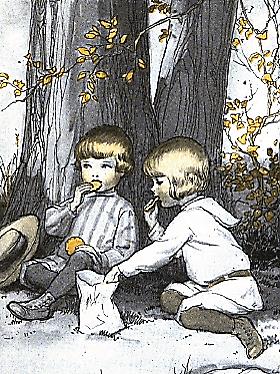
Knock, knock, knock went Tim’s hand on the front door. A lady, with a large white apron on, opened it.
“Good morning, Mr. Orderman,” she said. “I have been watching for you. I need a dozen pears and a dozen peaches. I need a box of strawberries, too.”
“You cannot have the strawberries,” said Tim. “They were all gone long ago. They come in the early summer. It is almost autumn now. My mother did not get enough to can.”
“That is too bad,” said the lady. “Then you cannot eat strawberries this winter, can you? Please bring me the pears and the peaches.
“You must get very hungry taking so many orders. Here is a bag of cookies for you and for the man who drives. You may eat them under the trees.”
“Oh, thank you,” said Tim. “I like this place best of all. We will bring your things some other time. Goodbye.”
The driver got down from his seat. He unharnessed the horse. Then the driver and the order man sat on the grass to eat their dinner. The horse had his dinner, too.
They had driven so far that they were tired and hungry.


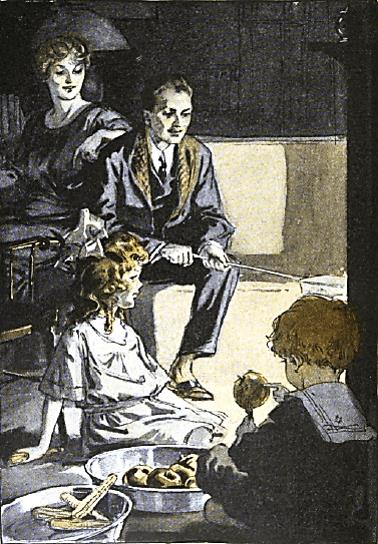


“Why, yes,” said mother.
“Then may Polly and I take a walk? We will not go far.”
“Yes,” said mother again. “Be home before dark, please. It grows dark very early now. Next month will come the shortest days of the whole year.”
Peter went over to the schoolhouse. The children were just coming out.
One of the big boys said to him, “Hello, Peter. Did you think that you would come to school again? Have you grown big enough now? “
Peter only said, “I am waiting for Polly and there she is.”
“Polly, Polly,” he called, “come with me. Mother said that we might take a walk. I know where to go.”
“Where?” asked Polly.
“To the place where the brook runs under the road. Let us go under the road today. Will you?”
“All right, I will,” said Polly. “I always meant to. But I forgot about it. It will be fun. Isn’t it cold?”
“Yes,” said Peter. “My fingers are cold. But I do not care. Only I wish that I had on my new mittens.”
“Look at this,” said Polly. “Come out in the road. See how it is frozen into ruts. I am going to walk on the ridges.”
“That isn’t very much to look at,” said Peter. “It has been that way for a few days.”
“Yes, it has,” said Polly. “But look in the ruts. There is ice. It is thin. Let us step on it. Hear it crack.”
“There is a puddle,” said Peter. “It has ice on it, too. See me step on that.”
“Keep off the middle,” said Polly. “You do not know how deep that puddle is. If the ice lets you down, you may get your feet wet.”
“All right,” said Peter. “There is the blacksmith’s shop, Polly. Do you think that the blacksmith is inside?”
“Perhaps he is, Peter. See! He has closed his big door. That is because it is cold weather.
“He has it closed in winter. I like it to be summer better. Then I can see into the shop.”
“Here is the brook, Polly. Let us climb down the bank and look under the road.”
“There is ice on the edges of the brook, Peter. I think that the boiling spring is colder than ever now. Let’s break off pieces of this ice.”
“Can we walk through under the road?” asked Peter. “I told Tim about it. He said that we could not.”
“I think that we can,” said Polly. “Come on. We will try. Keep close to the wall. Do not step into the water.”

“It is quite dark,” said Peter. “I am glad that it is not far.”
“You must bend down now, Peter. I have to bend down. Do not push me. I shall slip in, if you do.”
“Oh, there is the end,” said Peter. “I can see the field. I do not like this place. It is hard walking on the stones. It is cold here, too.”
“I am out,” shouted Polly. “Come on, Peter. Oh Peter, Peter, Peter!”
“What, what?” called Peter. “Have you fallen in?”
“No, no!” shouted Polly. “But look at this! Don’t you know what it is?”
“A snowflake, a snowflake!” cried Peter. “And here is one on my sleeve, too.”
“There are more in the air, Peter. See them! See them! Do you suppose that it will be winter right away?”
“Of course it will, Polly. It is winter when the snow comes. Let us run home and get our sleds. You may take my new one part of the time.”
The children were at home before it was dark.
At supper time, when father came, Polly said, “Will you please get our sleds out for us tomorrow, father? How much has it snowed now?”
“Not much,” said father. “You see, that was just a little flurry of snow. We shall have many such before there is a good storm. You must wait a little longer for your sliding.”
 articlesforchristians