A place to grow your relationship with God

Archive for the ‘Peter and Polly Series’ Category

Tim’s Football

Peter,” called Tim, “come out here.”

Tim was in Peter’s front yard. He was kicking something about.

“What are you doing?” asked Peter.

“I am playing football. Don’t you know that all the big boys play football in the autumn? My mother made me this football. It is a good one. See!”

Tim picked up his ball. He handed it to Peter. It was just a bag made of cloth. It was stuffed with rags.

“Yes, it is a good one,” said Peter. “One day I made a football out of burdock burrs. But it came to pieces, when I kicked it. Yours will not do that.”

“No,” said Tim, “it will not. My mother said that I may kick it to pieces, if I can. Then my father will bring me a real one from Large Village.”

“Let me take it a minute, Tim. Let me show it to my mother. She will make one for me.”

Mrs. Howe made Peter a football. It was just like Tim’s. It did not take her very long to do it. She made a strong bag on the sewing machine. She stuffed it with rags. Then she sewed up the end.

“There,” she said, “now you both have footballs. I think that they are very good ones. You may go to Tim’s and play with them. Tim has some leaves up at his house for you to jump in.”

Tim and Peter kicked their footballs all the way up the hill. Sometimes the balls did not go straight. Sometimes, when they tried, the boys did not kick them at all.

Once Peter kicked very hard. He did not touch his ball. He kicked so hard that he fell down.

“See all your leaves, Tim,” said Peter. “Your yard is fall of them. Let’s rake them up. Maybe we can have a bonfire.”

“We can rake them,” said Tim. “But we cannot burn them. I heard my father say that he should keep our leaves.”

“What for?” asked Peter.

“He is going to put them in a big pile,” said Tim. “He is going to cover them over.

“After he has left them in a pile for a long, long time, they will rot. Then they will be good for the garden.”

“I should rather have a bonfire,” said Peter.

“So should I,” said Tim. “But my father would not. He gets things to sell from his garden. So he has to make them grow fast.”

“My father does not,” said Peter. “He keeps a store. He has the post office, too. That is in his store. I have seen him put the letters into boxes.”

“So have I,” said Tim. “And I have had a letter, too. Let’s rake up a pile of leaves now. We can jump in them.”

“Where is my football?” asked Peter.

“I do not know, Peter. It must be somewhere in the leaves. We can find it when we rake them up. Oh, see mine!”

“There is a hole in it,” said Peter. “The insides are sticking out. Now you can have a real one, Tim. Your mother said so. Let us take it in to show her.”

When the boys came out of the house, Tim said, “Polly and I buried you in the sand the other day. Now you bury me in the leaves.”

He lay down and Peter piled leaves all over him. He even covered up his face. The leaves were very light. Tim liked the smell of them.

Soon he jumped up. He did not need anyone to dig him out. Then he covered Peter all over.

“Do not go to sleep,” he said. “If you do, we shall never get the leaves raked up. Now you have been buried long enough. Come out!”

Next, they tried to bury Collie and Wag-wag. But the dogs would not lie still. They thought that it was some kind of game. They wished to play, too.

At last the boys found Peter’s football.

“I must take this home, before I lose it again,” said Peter. “Goodbye, Tim. I have had a good time. Come and play with me this afternoon.”

Peter and Polly Series: The Four Horseshoes

The Four Horseshoes

The blacksmith and Polly and Peter went into the shop. It was fun inside. The children had often seen the blacksmith fit shoes on horses’ feet.

They liked to watch him hammer the white-hot iron. They liked to see the sparks that the hammer made. They liked to watch his fire.

“Why, there is Mary, our horse,” said Polly. “I did not know that she was over here.”

“I have been shoeing her. She is all ready to go to the store. I shall lead her. You may both ride on her back.”

“Oh, goody, goody!” cried Polly. “Sometimes father lets us do that.”

“Here are two presents for you, Polly. And here are two presents for you, Peter. Do you know what they are?”

“They look like horseshoes,” said Polly. “Thank you very much. But what odd little horseshoes! Did you make them for Mary? I guess that they did not fit her.”

“I did not make them for Mary. Can you guess what they are for?”

“They are just big enough for Tim’s goat,” said Peter.

“They are not for Billy,” said the blacksmith.” Guess again.”

“Are they for a little calf?”

“No,” said the blacksmith. “And I think that you had better look at Billy’s feet. Then I think that you had better look at a calf’s feet. You will see that round shoes would not fit them.”

“Then what are these for?” asked Polly. “I cannot guess.”

“I made them for a pony. If you were my children, maybe I should buy you a pony for your very own.”

“Oh, would you?” asked Peter. “I should like that. But I cannot be your boy, because I am my father’s.”

“Show him what I gave you. Tell him that you would like a pony to fit those four shoes. Well, Polly, what is the matter?”

“Nothing much,” said Polly. “I just dropped my horseshoes into my apron pocket. I forgot that my egg was there. It is all broken, now.”

“I should say it is, Polly. Come over here and clean up a little. Wipe out that pocket. Now are you ready? Then up you go on Mary. Peter first, Polly behind.”

“It is quite slippery up here,” said Peter. “Maybe I shall slide off.”

“That will not matter, unless you have eggs in your pocket, too. Have you, Peter?”

“No,” said Peter, “just horseshoes.”

“Then forward march,” said the blacksmith. And off they started.

Peter and Polly Series: At the Blacksmith’s Shop

Down the hill Peter and Polly trotted. They followed the little brook. By and by it ran into a larger one.

“This large brook runs into the river,” said Polly. “We cannot follow it much farther. We cannot follow it all the way to the river.”

“Why?” asked Peter.

“Because it goes under the road, Peter. Don’t you remember? Here is the place.”

“Oh, yes,” said Peter. “I remember. Well, let’s look under the road.”

“All right, Peter. But there is not much to see. It is dark.”

“I can see through to the other side,” said Peter.

“So can I, now,” said Polly. “And, Oh Peter! It is quite a big place. I am sure that we can walk through. Let’s go now.”

“All right,” said Peter. “I should like to walk under the road.”

“Dear me! I forgot this old egg,” said Polly. “I should be sure to break it. We must wait until some other day. Let us go to the blacksmith’s now.”

Soon they were at the shop.

“Well, Polly,” said the blacksmith, “did the water boil?”

“Here is my egg,” said Polly. “It did not cook. Maybe that is a boiling spring. But it is cold water.”

“It is really a bubbling spring,” said the blacksmith. “Much water comes out of the ground. It comes very fast.

“That makes the sand at the bottom of the spring move. It makes the top of the spring go up and down. The water looks as if it were boiling. But it is not.”

“It is a nice spring,” said Peter. “I took a drink of the water. It was very cold.”

“Yes,” said the blacksmith. “That water must come from deep down in the ground. It is the coldest spring I know.”

“I had a good time, anyway,” said Polly. “We saw goldenrod and Black-eyed Susans.”

“That is a sign that autumn is almost here,” said the blacksmith. “I can see another sign this very minute.”

“Where, where?” cried both children.

“Look on the telephone wires. The sign is there.”

“Oh, oh, see the swallows!” cried Polly. “I never before saw so many together. The wires are full.”

“Perhaps you saw the very same thing last fall,” the blacksmith said. “It happens every year. They are thinking about flying away. They go south for the winter, you know.”

“But it isn’t time,” said Polly. “It isn’t really autumn yet. It is only next to it. Oh, I do not wish them to go. I wish they would stay here.”

“They will not go yet. But they cannot stay here all winter. They could not get food,” said the blacksmith.

“Oh, oh!” called Peter. “They are going now! They are going now! They have just started! See them!”

The blacksmith laughed. “They are only flying about for fun, Peter. Come and see what I have in my shop.”

Peter and Polly in Winter

PETER AND POLLY IN WINTER

BY ROSE LUCIA

“Peter and Polly in Winter” by Rose Lucia is a children’s story written in the early 20th century. This book is part of a series that likely follows the adventures of Peter and his older sister Polly throughout the seasons. The narrative focuses on the joys of winter, highlighting the children’s imaginative play, their love for nature, and their interactions with animals and family. The opening of the story introduces Peter and Polly, who live in a picturesque white house in the country, surrounded by fields and woods. As winter approaches, Peter expresses his excitement about the coming snow and the magical snowflakes he lovingly refers to as “white butterflies.” With the Story Lady’s encouragement, he eagerly anticipates winter adventures, including watching birds migrate and seeing the first snowfall. The engaging dialogue between the siblings and their father sets the stage for a wholesome exploration of winter activities such as sledding and making snowmen, showcasing themes of family bonds, kindness to animals, and the beauty of the natural world.

Peter And Polly (In winter)
The Birds’ Game of Tag
The Stone-wall Post Office
Playing In the Leaves
How The Leaves Came Down
The Bonfire
The Hen That Helped Peter
The First Ice
The Three Guesses
The First Snowstorm
The Star Snowflake
How Peter Helped Grandmother
The Snow Man
Peter’s Dream
Cutting The Christmas Tree
The Give-away Box
Christmas Morning
The Snow House
The Fall Of The Igloo
Pulling Peter’s Tooth
Driving With Father
The Stag
Polly’s Bird Party
The New Sled
Brownie
Dish-pan Sleds
Cat And Copy-cat
Polly’s Snowshoes
The Woods In Winter
The Winter Picnic
The Sewing Lesson
Fishing Through The Ice
Making Molasses Candy
Grandmother’s Birthday Party
Around The Open Fire

The First Ice

THE FIRST ICE

“Water now has turned to stone,
Stone that I can walk upon.”

One morning mother said, “Polly, will you go to the store for me? I need a can of corn. We must have it for dinner.”

“May Peter go, too, mother?”

“Oh, yes, Peter may go, if he wishes. Run and find him.”

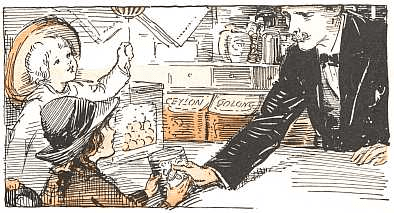
Now Polly and Peter liked to go to the store. It belonged to their father. Sometimes they helped him unpack goods. Sometimes they sat still and watched the customers.

Sometimes he let them play keeping store. Once Polly had really sold some candy to another little girl.

But to-day they could not stay to play. They must get the can of corn for mother, and come home.

They went down the hill. At the railroad tracks they stopped. They looked for a train. They saw none, so they ran across the tracks.

Then they came to the bridge. You can find it on the map in the front of this book.

They stopped to look over the rail at the water, far below.

“O Polly!” said Peter. “What is on the water?”

“Why, it is ice, Peter. The top of the water is frozen. See, the ice goes nearly across the river.”

“Ice, ice!” shouted Peter. “Now winter is almost here. The leaves have gone. The ice has come. Let’s run and tell father.”

The children ran to the store.

“Father, father,” called Peter, “we have seen ice!”

“So have I,” said father. “Where did you see it?”

“We saw it from the bridge. The river is frozen at the sides. It is not frozen in the middle.”

“Yes,” said father. “It freezes first at the edges, because the water flows more slowly there. In the middle it flows faster.

“Every cold night that ice will grow. It will soon cover the middle of the river, too. And at the same time it will grow thicker.”

“By and by it will be so thick that we can walk upon it. Then it is time to learn to skate. Perhaps you can learn this winter.”

“When the ice is thick enough, men cut it into blocks. What will they do with them?”

“Make houses of them,” said Peter.

“O Peter, we are not Eskimos,” said Polly. “I know, father. They will put the ice into big ice houses. They will keep it to use in the hot summer. I saw them doing it last winter.”

“Right, Polly. That is where our ice comes from in the summer.”

“Does all the water in the river freeze, father? Where do the fishes go? Are they in the ice?”

“The ice is lighter than the water, Peter. So it stays on top of the water. The bottom of our river does not freeze. The fishes are there. They do not mind the cold as we do.

“Did you come to the store just to tell me about the ice, chicks?”

“No, father,” said Polly. “We came for a can of corn. We saw the ice when we were on the bridge.”

“Then here is the corn. Take it to mother and tell her about the ice.”

Off went the children. When they came to the bridge, Peter dropped some small stones on the ice. But it did not break.

“It must be thick now, Polly,” said he. “I wish we could skate.”

“We weigh more than those stones do, Peter. I think the cold will have to make the ice grow more before father will let us. And, anyway, we have no skates.”

“Let’s tell mother about that, too, Polly. Perhaps she knows where there are some.”

So, Peter and Polly hurried up the hill to find their mother.

The Hen that Helped Peter

THE HEN THAT HELPED PETER

Peter is a nice little boy. But he can be very naughty. Mother and father know this. Grandmother Howe and Polly know it, too.

You see, Peter always wishes his own way. And you know this is not good for little boys and little girls.

Peter cannot have cake between his meals. He may always have milk to drink. Sometimes he may have bread and jelly, or bread and sugar.

He likes this very much. But he does not like the crusts of the bread. So he used to eat only the soft part. The crusts he threw away.

But at the table he could not throw them away.

Then he put them under the edge of his plate. You know how.

When mother took the plate, there would be a crust on the table. It did not look very well.

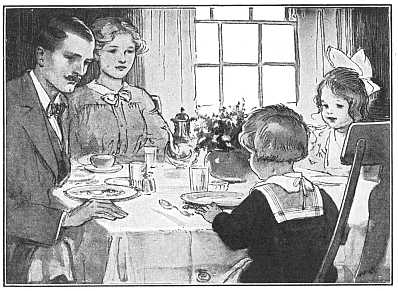
One day father said, “Peter, you are a big boy now. You are nearly five years old. You are old enough to eat your crusts.

“I will give you a week in which to learn how. After that, I shall not expect to see any more crusts on the table.”

Peter knew that, when his father spoke so, he meant what he said. But the little boy thought he would not eat his crusts until he had to do so.

He said to himself, “In a week I will begin to eat them all up. But now I will still put them under my plate.”

So, every day when his plate was taken away, there were the crusts. Peter did not see his father look at them. And his father said nothing more about them.

By and by Peter began to think that his father had forgotten.

So, when the week was over, he said to himself, “I am sure that my father has forgotten. I am going to keep on leaving my crusts.”

But his father had not forgotten. He was just waiting to see if Peter would obey.

That noon he saw that Peter had left a crust.

He said, “My son, you have not learned to eat your crusts. And you have not learned to obey. I must teach you.”

Then Peter was more naughty still. He said, “I do not like old crust. I will throw old crust away. Then I cannot eat it.”

He picked up the crust and jumped down from his chair.

His father called, “Peter!”

But Peter did not stop. He ran to the door and threw the crust out upon the grass.

His father went after him. “You may pick up your crust, Peter,” said he.

This time Peter started to obey. He knew that he had been very naughty. But, before he could get to the crust, an old hen ran up. She snatched it in her bill and off she went.

Peter looked at his father. He was not sure what his father would do. He almost wished the hen had not taken the crust.

Father only laughed. He said, “That old hen is a friend of yours, Peter. If it had not been for her, you would have eaten that crust.”

“I know it,” said Peter. “And, father, I am sorry. I do not like to be naughty. I will be good. I will eat my crusts now to please you.”

And after this he did.

The Bonfire

THE BONFIRE

The next day father said, “Peter and Polly, will you work for me? I wish to buy your leaves. I will give you a cent for three loads.”

“Oh, goody, goody!” said Polly.

“Oh, goody, goody!” said Peter.

“You must put the leaves in a pile in the garden. I will show you where.”

“What will you do with them, father?” asked Polly.

“You will see to-night, if you are good workmen.”

In the night the wind had blown the leaves about. So the children raked them up once more.

Then they filled the big basket full. They packed in the leaves as hard as they could.

“That is to give good measure,” said Polly. “Father always gives good measure at his store. So you and I must, too.”

Every time they took a basketful to the garden, Polly made a mark on a piece of paper.

At last the yard was raked clean. They had taken to the garden twenty-nine loads. They had worked nearly all day.

At supper father said, “You are good workmen, chicks. Our yard looks very clean. It is ready for winter.

“You piled the leaves carefully in the garden, too. Now, how much do I owe you?”

“We took twenty-nine loads, father,” said Polly. “I wish there had been one more to make thirty.”

“Why do you wish that, Polly?”

“Because three goes in thirty better than in twenty-nine.”

“Well,” said father, “we will call it thirty loads, Polly. I saw you packing the leaves into the basket very hard.

“You are honest workmen to give me such good measure. Now, Polly, three goes in thirty how many times?”

“Ten times, father. So you owe us ten cents. We shall each have five cents.”

“Very good, Polly. Here is your money. I have a surprise for you. Put on your coats and come to the garden. Mother will come, too.”

In the garden they found father beside the pile of leaves. He had thrown many things upon it.

He said, “I came home early and cleaned up the garden. Now, what shall we do with all this stuff?”

“Burn it, burn it!” shouted both children at once. “A bonfire, a bonfire!”

“Very well,” said father. “You may burn it. Here is a match for you, Polly. And here is one for you, Peter. Light your fire.”

Polly and Peter lighted the great heap. Soon the red flames were leaping up. They made the garden bright. Farther away from the fire it was very dark.

“Oh, see, see, mother!” cried Polly. “The flames are as pretty as the red and yellow leaves. Have they taken the color from the leaves? How hot they are!”

The children danced around the fire until it died down. Then mother took them into the house. It was bedtime.

How the Leaves Came Down

HOW THE LEAVES CAME DOWN

I’ll tell you how the leaves came down.
The great Tree to his children said,
“You’re getting sleepy, Yellow and Brown,
Yes, very sleepy, little Red;
It is quite time you went to bed.”

“Ah!” begged each silly, pouting leaf,
“Let us a little longer stay;
Dear Father Tree, behold our grief;
‘Tis such a very pleasant day
We do not want to go away.”

So, just for one more merry day
To the great Tree the leaflets clung,
Frolicked and danced and had their way,
Upon the autumn breezes swung,
Whispering all their sports among,—

“Perhaps the great Tree will forget,
And let us stay until the spring,
If we all beg and coax and fret.”
But the great Tree did no such thing;
He smiled to hear their whispering.

“Come, children, all to bed,” he cried;
And ere the leaves could urge their prayer
He shook his head, and far and wide,
Fluttering and rustling everywhere,
Down sped the leaflets through the air.

I saw them; on the ground they lay,
Golden and red, a huddled swarm,
Waiting till one from far away,
White bedclothes heaped upon her arm,
Should come to wrap them safe and warm.

The great bare Tree looked down and smiled,
“Good night, dear little leaves,” he said.
And from below, each sleepy child
Replied, “Good night,” and murmured,
“It is so nice to go to bed!”

—Susan Coolidge.

Copyright, 1889, by Roberts Brothers.

Playing in the Leaves

PLAYING IN THE LEAVES

One day Peter saw something that pleased him. It was a branch of red leaves on a maple tree.

He said to mother, “It will be winter soon.”

“Why do you think so, Peter?”

“I have seen red leaves,” said Peter.

“But, Peter, a few red leaves do not count. There are red leaves in the summer. You must watch until you see many red, yellow, and brown leaves.”

“What makes the leaves red and yellow, mother? Is it magic?” asked Peter. “Can you do it?”

“Perhaps it is a kind of magic, Peter. It is like the clouds turning into snow. I cannot do that.”

Then Peter watched for all the trees to turn. At last they were bright with colors.

The maples were red and yellow; the oaks a deep red. The beeches were a bright yellow.

Even the elm trees in front of the house were yellow. Now Polly liked more than ever to swing. The swing took her way up among the yellow leaves.

Then, one day, the leaves began to fall. Down they came, a few at a time. The next day more fell, and the next and the next.

Polly said, “They are prettier than the snowflakes. The snow is white. These have lovely colors. See them flying through the air.”

At last most of the trees were bare. The leaves lay on the ground.

Then Peter said, “Oh, the poor trees! They haven’t any clothes on. I am so sorry.”

Polly said, “The leaves are not clothes. They are children. Now they have gone to bed. The snow is their blanket. When it comes, it will keep them warm. If we leave them alone, they will sleep all winter. I learned it in a poem.”

“They cannot go to sleep yet,” said Peter. “I shall not let them. I shall wake them up.”

“How will you do that?” asked Polly.

“I shall run in them. That will keep them awake. I shall do it now. Come on! See if you can make as much noise as I can.”

After a while the children raked the leaves into large heaps. Then they jumped in the heaps. This scattered the leaves. But the children did not care. They raked them up again.

Once Peter jumped where the leaves were not very deep. He came to the ground with a bang. He was surprised. But he was not much hurt.

He said to mother, “My teeth shut with a noise when I went down.”

Mother said, “It is lucky that your tongue was not in the way. You would have bitten it badly.”

“Come in now, both of you. You must wash your hands and faces. Father will be home soon. You may play in the leaves to-morrow.”

The Birds’ Game of Tag

THE BIRDS’ GAME OF TAG

It is fall. Summer is really over. But it is still warm. Jack Frost has not yet begun his work.

Peter and Polly have been watching the birds. For days they have seen great flocks of them. In the summer there were not so many together.

One day they saw several robins. These were flying from tree to tree.

Peter said, “I know they are having a party. They are playing tag.”

“Perhaps they are,” said his father. “Perhaps each bird is telling something to the bird he tags.”

“What is he telling?” asked Peter.

“I think he is saying, ‘Brother bird, don’t you know that winter is coming? Soon the snow will be here. What shall we do then?

“‘We cannot get food. We shall freeze. Come, let us fly away to the South. It is warm there.'”

“What does brother bird say?” asked Peter.

“I think brother bird says, ‘It is a long way to the South. It will take many days and nights to fly there.

“‘Are our children’s wings yet strong enough? I do not like to go. But I know that we must.'”

“Doesn’t he like to go, truly?” asked Peter.

“We do not know, Peter. The robins make their nests here. They lay their blue eggs here. They hatch their little birds here. They never do this in the South.

“Besides, they sing their beautiful songs here. They never sing them in the South. We like to think that they love the North better. But, of course, we do not know.”

“How can they find their way back?” asked Polly.

“We do not know that, either, Polly. Many birds fly in the nighttime. Then they rest a part of the day.”

“I couldn’t find my way in the dark,” said Polly.

“But the birds can,” said father. “We do not know how. The winter home of some of our birds is thousands of miles from here.”

“I like to watch the swallows,” said Polly. “They sit in a line on a telephone wire. Then one flies to another wire. In a minute they all fly, too.

“I think that they are talking about going away soon. I hope they will not get lost.”

“Yes,” said father. “They will soon be gone. But perhaps some of these very birds will come back here next summer.”

“I wish we could know them,” said Polly.

“We shall have a few birds left this winter,” said father. “You know some of them. You know the chick-a-dees and the woodpeckers. And this winter I shall show you others.”

“May we hunt for nests and eggs, father?” asked Peter.

“We may hunt, Peter, but we won’t find any eggs in winter. We shall find other things. Perhaps we shall find the white-footed mouse. He sometimes makes his home in an old bird’s nest.”

“Can a mouse climb trees, father? If he lives in a bird’s nest, does he lay bird’s eggs?”

“He can climb trees, Peter. But he cannot lay eggs. We will see if we can find Mr. White-foot some day.

“But first we will watch the birds fly away and the snow come.”